• Home
  • Latest
  • Fortune 500
  • Finance
  • Tech
  • Leadership
  • Lifestyle
  • Rankings
  • Multimedia

Trendingnow

1

26 Meta employees accuse Mark Zuckerberg of using AI to target 8,000 layoffs against workers on medical, parental or family leave

2

MacKenzie Scott, Melinda French Gates, and Lauren Sánchez Bezos are rewriting the rules of billionaire giving—one quietly, one strategically, one very publicly

3

After donating $48 billion to the Gates Foundation, Warren Buffett is quietly ending one of the biggest philanthropic relationships in history

1

26 Meta employees accuse Mark Zuckerberg of using AI to target 8,000 layoffs against workers on medical, parental or family leave

2

MacKenzie Scott, Melinda French Gates, and Lauren Sánchez Bezos are rewriting the rules of billionaire giving—one quietly, one strategically, one very publicly

3

After donating $48 billion to the Gates Foundation, Warren Buffett is quietly ending one of the biggest philanthropic relationships in history
Commentary

Commentary: This Design Change Could Transform the iPhone as We Know It

By
Mohanbir Sawhney
Mohanbir Sawhney
and
Bethany Cianciolo
Bethany Cianciolo
Down Arrow Button Icon
By
Mohanbir Sawhney
Mohanbir Sawhney
and
Bethany Cianciolo
Bethany Cianciolo
Down Arrow Button Icon
December 5, 2017, 11:26 AM ET
Apple launches iPhone 8 and iPhone 8 Plus in Russia
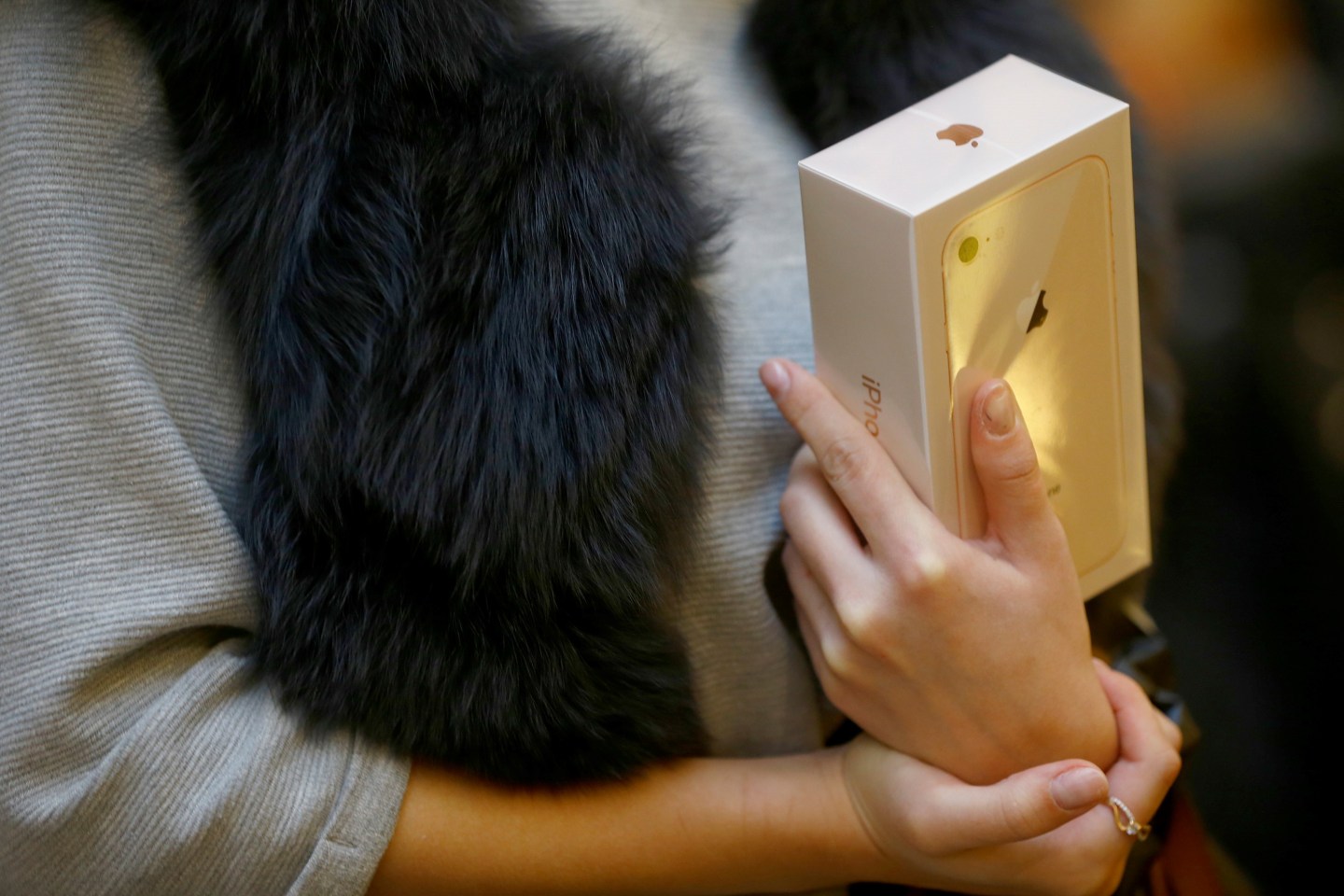
MOSCOW, RUSSIA - SEPTEMBER 29: A woman holds a box of Apple phone in her hand after Apple launched iPhone 8 and 8 plus at the GUM department store in Moscow, Russia on September 29, 2017. (Photo by Sefa Karacan/Anadolu Agency/Getty Images)Anadolu Agency Getty Images
Add Fortune on Google for similar content.

There’s another evolution brewing in the tech world. We know display technology as what we experience with our smartphones: flat and static—not three-dimensional. But imagine an iPhone that better represents everyday objects and more closely links form of the display to the function of the device. It could create intriguing possibilities.

Apple seems to agree. Its patent for a flexible folding display has garnered a lot of attention and speculation, as it could bring together form and function for next-generation iPhones, iPads, and Apple watches, as well as for nontraditional devices like appliances, cars, and medical devices. Such a device would address a common complaint about smartphones becoming too big. Imagine a smartphone that can fit easily in a coat pocket, but can then be expanded with a foldout display. A gaming device with a screen that hinges could allow two players to each have their dedicated screen without being able to see their competitor’s display. A smartwatch could have a display that wraps around your wrist like a cuff.

As with technology in general, flexible display technology is a means to an end, not an end in itself. History is replete with innovations that were technical marvels, but failed to find compelling applications that customers would pay for. Consider, for instance, the amazing 3D display technology that Amazon (AMZN) pioneered in its ill-fated Fire Phone, only to find that customers did not really find this feature useful or relevant. Flexible displays will only find market acceptance if they allow users to do things that they could not do before.

To make the flexible display technology useful, Apple (AAPL) must consider what people might want to do with a display, but are not able to do yet—or aren’t even asking for today. When Apple created “pinch and expand” and “swipe” features, users were surprised and delighted. Now, how might displays that adapt and morph address the unspoken problems and unarticulated needs of users as they engage activities such as watching a movie with friends, reading a newspaper online, reading the display like a roadmap in a car, or accessing fitness features while exercising?

Samsung is ahead of the pack with its Galaxy S6 edge, the first smartphone to feature a curved display as early as March 2015, which has been a success, mostly for aesthetic reasons, as the edges of the screen also provide an additional place to show information without interfering with the main display. In fact, it would not be surprising if Samsung came out with the first foldable or bendable display on a smartphone, while Apple will watch, wait, and learn from the pioneers. Apple may even buy its flexible screens from Samsung as it does today for the displays of its iPhoneX. I also predict that we will see flexible displays by 2019 from other Asian companies like LG and Xiaomi, which are closer to the manufacturers in Korea and China.


Flexible displays will be an advancement from a technical standpoint. Whether it will be a “killer feature” in future phones and Internet-connected devices remains to be seen. Although I see a lot of opportunity for non-flat displays, my expectation is that some of the killer apps will be for devices that aren’t phones. We are heading into a future where every object can be connected to a network. Flexible displays will allow users to interact with these smart objects. Displays can be embedded into architectural elements like windows and walls. They can be integrated into automotive dashboards and windshields for enhanced views and increased safety. They can allow wearable medical devices to expand with bigger displays of data. They can even be embedded into workout clothes to give you information on how your workout is affecting specific muscle groups. Greater contextual adaptability could be very useful for the “Internet of Things,” the vast interconnected web of smart devices for consumer as well as industrial applications.

It is exciting to think about all the possibilities of flexible displays, but technology needs to be more than a solution looking for a problem. Here are the critical questions for Apple, Samsung, and all the rest to ask themselves: What customer problems are flexible displays going to solve? Who will use them? What will be the most valuable use cases? How much will people pay for the added functionality? A lot of experimentation will be needed to discover the “killer applications” for flexible displays.

Mohanbir Sawhney is the McCormick Foundation professor of technology at the Kellogg School of Management at Northwestern University.


About the Authors
By Mohanbir Sawhney
See full bioRight Arrow Button Icon
By Bethany Cianciolo
See full bioRight Arrow Button Icon
Add Fortune on Google for similar content.

Latest in Commentary

Finance
Lorem ipsum dolor sit amet, consectetur adipiscing elit, sed do eiusmod tempor incididunt ut labore et dolore magna aliqua. Ut enim ad minim veniam
By Fortune Editors
October 20, 2025
Finance
Lorem ipsum dolor sit amet, consectetur adipiscing elit, sed do eiusmod tempor incididunt ut labore et dolore magna aliqua. Ut enim ad minim veniam
By Fortune Editors
October 20, 2025
Finance
Lorem ipsum dolor sit amet, consectetur adipiscing elit, sed do eiusmod tempor incididunt ut labore et dolore magna aliqua. Ut enim ad minim veniam
By Fortune Editors
October 20, 2025
Finance
Lorem ipsum dolor sit amet, consectetur adipiscing elit, sed do eiusmod tempor incididunt ut labore et dolore magna aliqua. Ut enim ad minim veniam
By Fortune Editors
October 20, 2025
Finance
Lorem ipsum dolor sit amet, consectetur adipiscing elit, sed do eiusmod tempor incididunt ut labore et dolore magna aliqua. Ut enim ad minim veniam
By Fortune Editors
October 20, 2025
Finance
Lorem ipsum dolor sit amet, consectetur adipiscing elit, sed do eiusmod tempor incididunt ut labore et dolore magna aliqua. Ut enim ad minim veniam
By Fortune Editors
October 20, 2025

Most Popular

Finance
Lorem ipsum dolor sit amet, consectetur adipiscing elit, sed do eiusmod tempor incididunt ut labore et dolore magna aliqua. Ut enim ad minim veniam
By Fortune Editors
October 20, 2025
Finance
Lorem ipsum dolor sit amet, consectetur adipiscing elit, sed do eiusmod tempor incididunt ut labore et dolore magna aliqua. Ut enim ad minim veniam
By Fortune Editors
October 20, 2025
Finance
Lorem ipsum dolor sit amet, consectetur adipiscing elit, sed do eiusmod tempor incididunt ut labore et dolore magna aliqua. Ut enim ad minim veniam
By Fortune Editors
October 20, 2025
Finance
Lorem ipsum dolor sit amet, consectetur adipiscing elit, sed do eiusmod tempor incididunt ut labore et dolore magna aliqua. Ut enim ad minim veniam
By Fortune Editors
October 20, 2025
Finance
Lorem ipsum dolor sit amet, consectetur adipiscing elit, sed do eiusmod tempor incididunt ut labore et dolore magna aliqua. Ut enim ad minim veniam
By Fortune Editors
October 20, 2025
Finance
Lorem ipsum dolor sit amet, consectetur adipiscing elit, sed do eiusmod tempor incididunt ut labore et dolore magna aliqua. Ut enim ad minim veniam
By Fortune Editors
October 20, 2025
Fortune Secondary Logo
Rankings
  • 100 Best Companies
  • Fortune 500
  • Global 500
  • Fortune 500 Europe
  • Most Powerful Women
  • World's Most Admired Companies
  • See All Rankings
  • Lists Calendar
Sections
  • Finance
  • Fortune Crypto
  • Features
  • Leadership
  • Health
  • Commentary
  • Success
  • Retail
  • Mpw
  • Tech
  • Lifestyle
  • CEO Initiative
  • Asia
  • Politics
  • Conferences
  • Europe
  • Newsletters
  • Personal Finance
  • Environment
  • Magazine
  • Education
Customer Support
  • Frequently Asked Questions
  • Customer Service Portal
  • Privacy Policy
  • Terms Of Use
  • Single Issues For Purchase
  • International Print
Commercial Services
  • Advertising
  • Fortune Brand Studio
  • Fortune Analytics
  • Fortune Conferences
  • Business Development
  • Group Subscriptions
About Us
  • About Us
  • Press Center
  • Work At Fortune
  • Terms And Conditions
  • Site Map
  • About Us
  • Press Center
  • Work At Fortune
  • Terms And Conditions
  • Site Map
  • Facebook icon
  • Twitter icon
  • LinkedIn icon
  • Instagram icon
  • Pinterest icon

Latest in Commentary

sb
Commentarynational debt
The national debt is over 100% of GDP and most of Congress is ignoring wishes to rein it in. It’s time to amend the Constitution
By Steve H. Hanke and David M. WalkerJuly 15, 2026
13 hours ago
Is your AI really working? Why productivity isn’t the same as progress
Future of WorkBrainstorm Tech
Is your AI really working? Why productivity isn’t the same as progress
By Jamie GarverickJuly 15, 2026
15 hours ago
r
CommentaryFDA
Trust in the FDA is collapsing. It’s time to get really transparent about our food and our drugs
By Jeffrey Sonnenfeld, Megan Ranney, Sten Vermund, Patricia Greenstein and Steven TianJuly 14, 2026
1 day ago
mm
Commentaryregulation
Exclusive: Delaware proposes testing the AIC, a new legal entity for agents in a regulatory sandbox
By John Nay and Charuni Patibanda-SanchezJuly 14, 2026
2 days ago
jobs
CommentaryLabor
Black women’s unemployment rate fell. That’s not the good news you think it is
By Katica RoyJuly 14, 2026
2 days ago
b
CommentaryWorld Cup
Columbia Business School professors: What the Balogun red card can teach us about AI and judgment
By Oded Netzer, Christopher Frank and Paul MagnoneJuly 13, 2026
3 days ago

Most Popular

26 Meta employees accuse Mark Zuckerberg of using AI to target 8,000 layoffs against workers on medical, parental or family leave
Law
26 Meta employees accuse Mark Zuckerberg of using AI to target 8,000 layoffs against workers on medical, parental or family leave
By Barbara Ortutay, Alexandra Olson and The Associated PressJuly 15, 2026
15 hours ago
MacKenzie Scott, Melinda French Gates, and Lauren Sánchez Bezos are rewriting the rules of billionaire giving—one quietly, one strategically, one very publicly
Newsletters
MacKenzie Scott, Melinda French Gates, and Lauren Sánchez Bezos are rewriting the rules of billionaire giving—one quietly, one strategically, one very publicly
By Sydney LakeJuly 14, 2026
1 day ago
After donating $48 billion to the Gates Foundation, Warren Buffett is quietly ending one of the biggest philanthropic relationships in history
North America
After donating $48 billion to the Gates Foundation, Warren Buffett is quietly ending one of the biggest philanthropic relationships in history
By Marco Quiroz-GutierrezJuly 14, 2026
1 day ago
Jamie Dimon understands why people are anti-rich: 'We have, in fact, left the lower-income folks behind' and 'that's kind of annoying'
Economy
Jamie Dimon understands why people are anti-rich: 'We have, in fact, left the lower-income folks behind' and 'that's kind of annoying'
By Eleanor PringleJuly 15, 2026
17 hours ago
He sold his last company to Palantir. Now he's betting $32 million that robots can fix construction's labor crisis
Innovation
He sold his last company to Palantir. Now he's betting $32 million that robots can fix construction's labor crisis
By Lily Mae LazarusJuly 15, 2026
16 hours ago
FedEx CEO says we are in the middle of the biggest supply chain shift he’s seen in 35 years: ‘We are the referendum’
C-Suite
FedEx CEO says we are in the middle of the biggest supply chain shift he’s seen in 35 years: ‘We are the referendum’
By Fortune EditorsJuly 15, 2026
13 hours ago

© 2026 Fortune Media IP Limited. All Rights Reserved. Use of this site constitutes acceptance of our Terms of Use and Privacy Policy | CA Notice at Collection and Privacy Notice | Do Not Sell/Share My Personal Information
FORTUNE is a trademark of Fortune Media IP Limited, registered in the U.S. and other countries. FORTUNE may receive compensation for some links to products and services on this website. Offers may be subject to change without notice.