• Home
  • Latest
  • Fortune 500
  • Finance
  • Tech
  • Leadership
  • Lifestyle
  • Rankings
  • Multimedia
Russia

Russia Develops a Taste for Alcohol-Free Beer as Government Fights Drinking

By
Reuters
Reuters
Down Arrow Button Icon
By
Reuters
Reuters
Down Arrow Button Icon
March 31, 2017, 2:34 AM ET
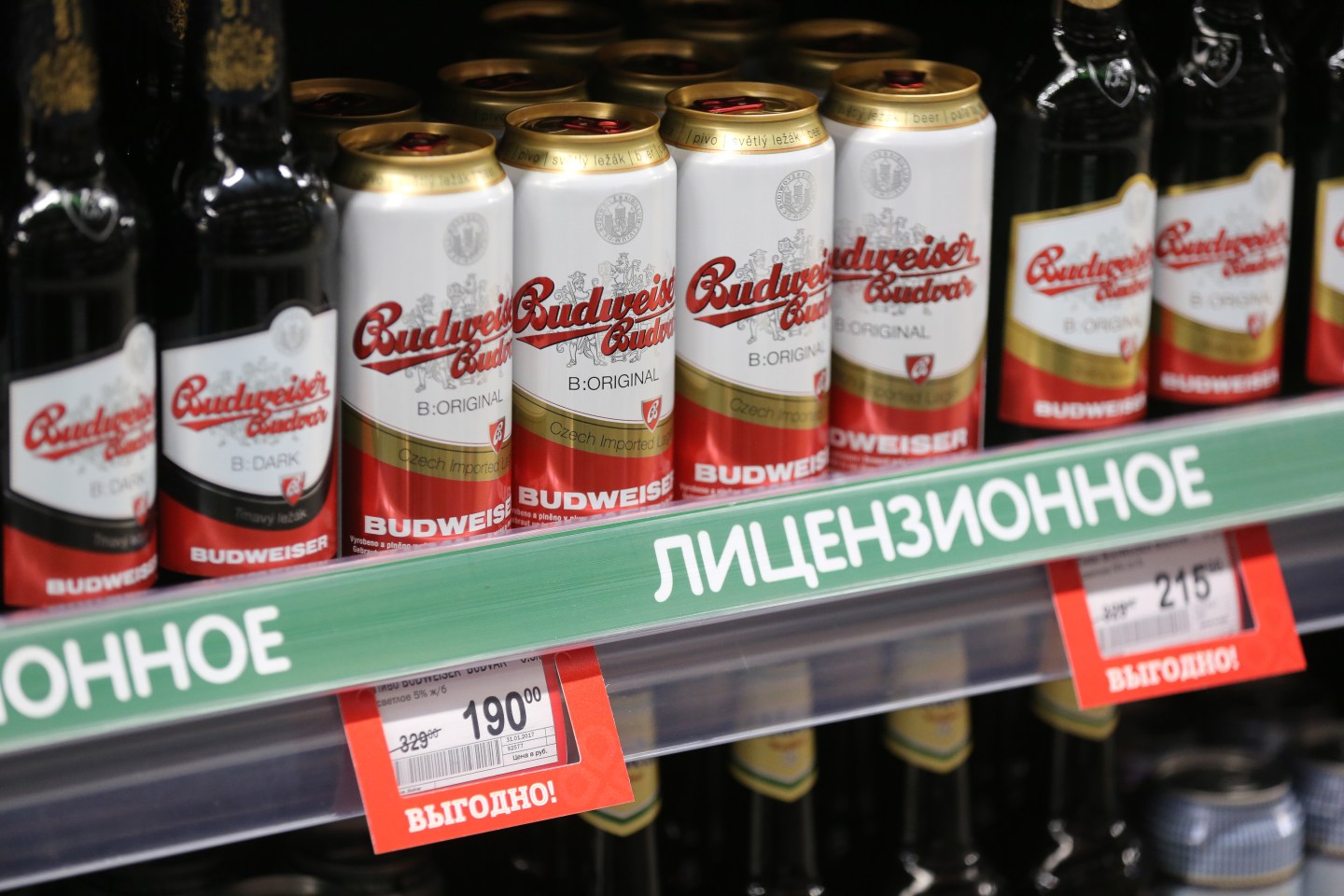
Retail Economy Inside An X5 Retail Group NV Supermarket As Russia Nears End Of Recession
Cans and bottles of Budweiser Budvar branded beer Czech beer sit on a shelf inside a Perekrestok supermarket, operated by X5 Retail Group NV in Moscow, Russia, on Wednesday, Feb. 8, 2017. X5 says its interested in technologies for online payments in stores, personalized promotions based on big data and using robots in logistics. Photographer: Andrey Rudakov/Bloomberg via Getty ImagesAndrey Rudakov—Bloomberg/Getty Images

Russians are among the biggest drinkers of alcohol in the world, yet are developing a new taste for alcohol-free beer, which could help save a brewing industry that has stalled under government initiatives to discourage drinking.

Sales of zero-alcohol beer jumped 12% last year even as the broader Russian market shrank by 2%, according to research firm Nielsen, extending a 40% slide in beer sales since the government tightened regulations in 2008.

Anheuser Busch InBev (BUD) plans to promote the alcohol-free version of its Bud brand as a sponsor of soccer’s FIFA World Cup when Russia hosts it next year. Carlsberg’s (CABJF) Russian unit Baltika, which has the largest share of Russia’s alcohol-free beer market, said this month it was making new investments in zero-strength beer.

The trend, say people in the industry, is being driven by a move towards healthier lifestyles among Russian consumers, nudged by government measures that include restrictions on alcohol sales and tougher penalties for drunk-driving.

“This market is absolutely undeveloped in Russia. We plan to expand our range, we want more,” said Dmitry Shpakov, head of AB InBev’s Russian business, which markets alcohol-free versions of its international Bud, Stella Artois and Hoegaarden brands as well of some of its Russian brands.

Last year AB InBev saw double-digit growth in Russian sales of its alcohol-free beers, and it expects to achieve a similar pace this year.

The segment is growing from a low base. Alcohol-free beer accounts for around 1.2% of Russia’s beer market, according to Nielsen. That, said Shpakov, compares to 5% of the German beer market and 13% in Spain.

For more on beer, watch Fortune’s video:

AB InBev has a global aim for weak and alcohol-free beer to account for 20% of its total sales by 2025.

“I’m not saying it can’t be 20% in Russia. It certainly can. We are thinking about a number of very strong initiatives, which can drive this process,” Shpakov told Reuters in an interview. “It’s a very important focus.”

Philip Gorham, analyst at Morningstar, said the Russian government’s push to curb drinking would help the segment: “Per capita (alcohol) consumption has been declining. If that continues, I do think there is room for non- and low-alcohol alternatives to act as a substitute.”

Brewers pioneered non-alcoholic beer in the 1980s and 1990s, but with only limited success, partly because consumers did not like the taste. Since then, changes to the production process have made it taste more like regular beer.

“I think the stigma attached to drinking non-alcoholic beer is less today than it used to be. Ten years ago, non-alcoholic beer was rare whereas today there is greater consumer acceptance, partly helped by the much-improved taste profile,” said Ed Mundy, analyst at Jefferies.

“Do I think that the 1% beer share of Russian beer can that grow? Yes I think so. As consumers come to accept that the product offering is much improved.”

CUTTING BACK

Alcohol-free beer is a rare bright spot for a Russian brewing industry which Euromonitor estimates was worth an estimated $15 billion in 2016, but which shrank as the government has sought to reduce drinking.

The average Russian over the age of 15 consumed the equivalent of 15.1 litres of pure alcohol per year in 2008-2010, according to the most recent figures from the World Health Organisation. That was a liter less than five years earlier, but still among the highest in the world: only the citizens of two other ex-Soviet republics, Belarus and Lithuania, consumed more.

While spirits still account for 51% of the alcohol consumed in the birthplace of vodka, beer’s share rose rapidly after 2000 as international brewers invested heavily.

But beer sales tumbled after 2008 when Russia started to increase the excise tax on it, tightened rules on its advertising and banned its sale in street kiosks. Brewers have since shut 12 plants.

AB InBev has closed five plants, and Shpakov said the firm’s remaining five were running at between 40 and 90% of capacity last year depending on season and regions they serve.

The industry had hoped to halt the slide this year, but a new ban on beer in popular plastic bottles larger than 1.5 liters has again hurt sales. Shpakov said he expects the market to fall a further 5% in 2017.

None of the new regulations affect beer without alcohol, and increasingly Russians see it as a safer way to enjoy their traditional drinking culture. Alexander Bumagin, a 40-year-old self employed Muscovite, said he has not drunk alcohol for more than 10 years, but likes an alcohol-free beer to wash down prawns, a typical Russian “zakuska”, or drinking snack.

He drinks it “for the sake of the process,” he said.
About the Author
By Reuters
See full bioRight Arrow Button Icon
0

Most Popular

Finance
Lorem ipsum dolor sit amet, consectetur adipiscing elit, sed do eiusmod tempor incididunt ut labore et dolore magna aliqua. Ut enim ad minim veniam
By Fortune Editors
October 20, 2025
Finance
Lorem ipsum dolor sit amet, consectetur adipiscing elit, sed do eiusmod tempor incididunt ut labore et dolore magna aliqua. Ut enim ad minim veniam
By Fortune Editors
October 20, 2025
Finance
Lorem ipsum dolor sit amet, consectetur adipiscing elit, sed do eiusmod tempor incididunt ut labore et dolore magna aliqua. Ut enim ad minim veniam
By Fortune Editors
October 20, 2025
Finance
Lorem ipsum dolor sit amet, consectetur adipiscing elit, sed do eiusmod tempor incididunt ut labore et dolore magna aliqua. Ut enim ad minim veniam
By Fortune Editors
October 20, 2025
Finance
Lorem ipsum dolor sit amet, consectetur adipiscing elit, sed do eiusmod tempor incididunt ut labore et dolore magna aliqua. Ut enim ad minim veniam
By Fortune Editors
October 20, 2025
Finance
Lorem ipsum dolor sit amet, consectetur adipiscing elit, sed do eiusmod tempor incididunt ut labore et dolore magna aliqua. Ut enim ad minim veniam
By Fortune Editors
October 20, 2025
Fortune Secondary Logo
Rankings
  • 100 Best Companies
  • Fortune 500
  • Global 500
  • Fortune 500 Europe
  • Most Powerful Women
  • Future 50
  • World’s Most Admired Companies
  • See All Rankings
Sections
  • Finance
  • Fortune Crypto
  • Features
  • Leadership
  • Health
  • Commentary
  • Success
  • Retail
  • Mpw
  • Tech
  • Lifestyle
  • CEO Initiative
  • Asia
  • Politics
  • Conferences
  • Europe
  • Newsletters
  • Personal Finance
  • Environment
  • Magazine
  • Education
Customer Support
  • Frequently Asked Questions
  • Customer Service Portal
  • Privacy Policy
  • Terms Of Use
  • Single Issues For Purchase
  • International Print
Commercial Services
  • Advertising
  • Fortune Brand Studio
  • Fortune Analytics
  • Fortune Conferences
  • Business Development
  • Group Subscriptions
About Us
  • About Us
  • Editorial Calendar
  • Press Center
  • Work At Fortune
  • Diversity And Inclusion
  • Terms And Conditions
  • Site Map
Fortune Secondary Logo
  • About Us
  • Editorial Calendar
  • Press Center
  • Work At Fortune
  • Diversity And Inclusion
  • Terms And Conditions
  • Site Map
  • Facebook icon
  • Twitter icon
  • LinkedIn icon
  • Instagram icon
  • Pinterest icon

Most Popular

placeholder alt text
Economy
The Treasury may need to borrow an extra $1.6 trillion to cover the hole left by tariff ruling and pay a further $400 billion in debt interest
By Eleanor PringleMarch 6, 2026
16 hours ago
placeholder alt text
Success
Chinese billionaire who has fathered more than 100 children hopes to have dozens of U.S.-born boys to one day take over his business
By Emma BurleighMarch 5, 2026
2 days ago
placeholder alt text
Politics
Iran is turning out to be a more effective enemy than many thought, and U.S. allies are losing their patience with the war
By Jim EdwardsMarch 6, 2026
16 hours ago
placeholder alt text
AI
Anthropic just mapped out which jobs AI could potentially replace. A 'Great Recession for white-collar workers' is absolutely possible
By Jake AngeloMarch 6, 2026
11 hours ago
placeholder alt text
Middle East
The Iran conflict will be the ’straw that breaks the camel’s back’ for the U.S. economy if it goes on much longer, Nobel laureate Paul Krugman warns
By Tristan BoveMarch 6, 2026
20 hours ago
placeholder alt text
AI
OpenAI investor Vinod Khosla predicts today’s 5-year-olds won’t ever need to get jobs thanks to AI
By Sasha RogelbergMarch 4, 2026
3 days ago

© 2026 Fortune Media IP Limited. All Rights Reserved. Use of this site constitutes acceptance of our Terms of Use and Privacy Policy | CA Notice at Collection and Privacy Notice | Do Not Sell/Share My Personal Information
FORTUNE is a trademark of Fortune Media IP Limited, registered in the U.S. and other countries. FORTUNE may receive compensation for some links to products and services on this website. Offers may be subject to change without notice.