• Home
  • Latest
  • Fortune 500
  • Finance
  • Tech
  • Leadership
  • Lifestyle
  • Rankings
  • Multimedia
TechPointCloud

Why Intel Is Finally Shifting to Favor Servers Over PCs

By
Aaron Pressman
Aaron Pressman
Down Arrow Button Icon
By
Aaron Pressman
Aaron Pressman
Down Arrow Button Icon
February 9, 2017, 4:46 PM ET
Inside The 2017 Consumer Electronics Show
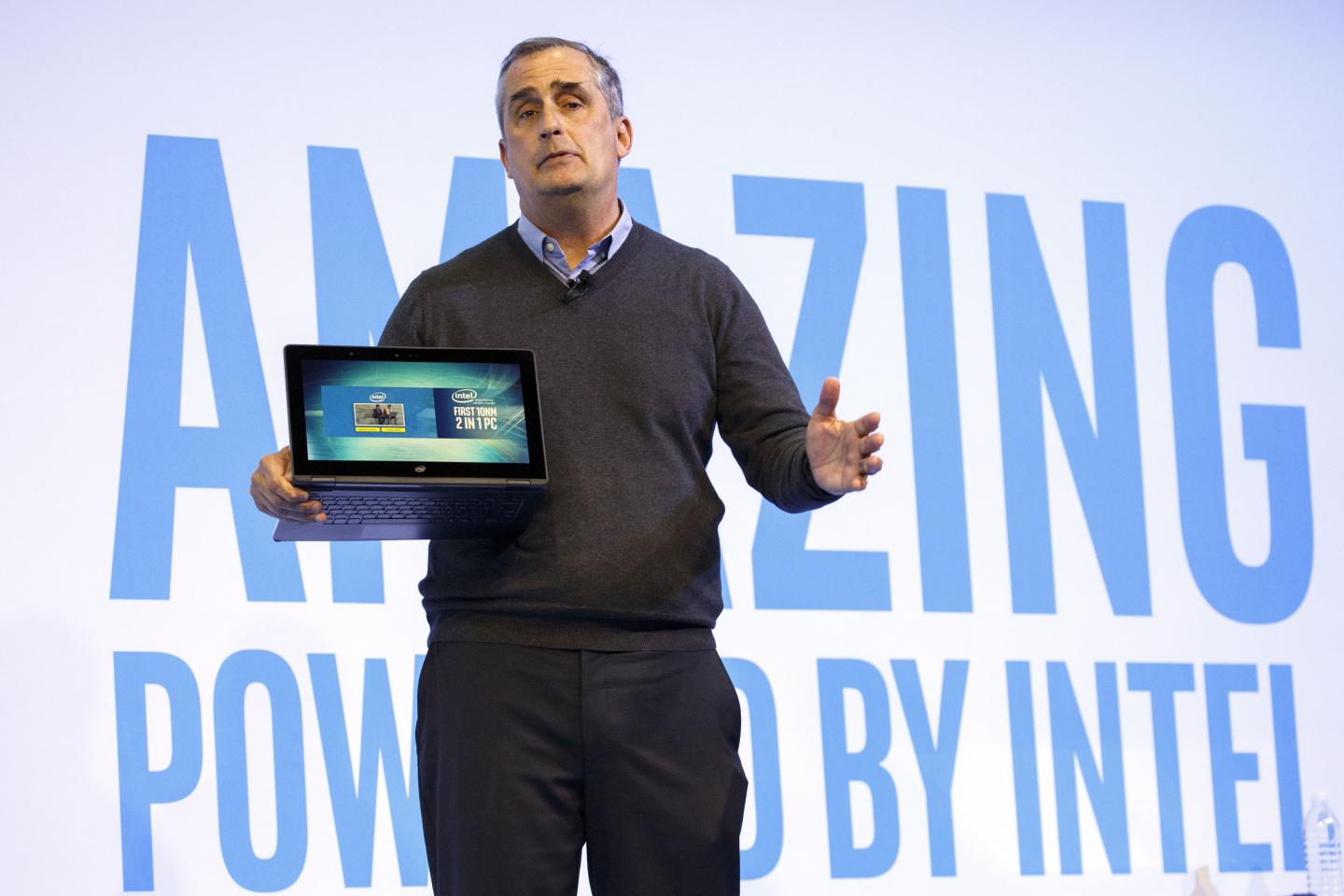
Brian Krzanich, chief executive officer of Intel Corp., speaks during the company's press event at the 2017 Consumer Electronics Show (CES) in Las Vegas, Nevada, U.S., on Wednesday, Jan. 4, 2017. Intel, trying to convert its dominance of computers into a stake in the growing market for chips used in cars, is offering automakers new products aimed at making its technology crucial to the effort to develop self-driving vehicles. Photographer: Patrick T. Fallon/Bloomberg via Getty Images Photo credit: Bloomberg via Getty Images

Progress often moves achingly slowly in semiconductors, where a new line of business can take a decade to reach the market and a new factory costs $7 billion.

For Intel, despite the best effort of CEO Brian Krzanich, the big strategic shifts needed to match the shifting demands of the market are taking a long time, too.

On Thursday, Krzanich and his team let slip a huge shift in strategy, although it was almost completely ignored by the attending audience of Wall Street analysts, who are so focused on their next few quarters of financial projections.

Get Data Sheet, Fortune’s technology newsletter.

Intel, like the entire computing industry, was first about personal computers and later about more capable server computers. And so it has always rolled out new generations of ground-breaking technologies in its PC chips and only years later bringing them to the server side. There may have been a logic to this at one time because consumers used to upgrade their PCs much more quickly than big businesses replaced servers.

But with smartphones crushing the PC replacement cycle, the justification has disappeared. And the massive growth in cloud computing and machine learning tasks has made the server market even more important, trends being targeted by Intel competitors Advanced Micro Devices (AMD) and Nvidia (NVDA).

So going forward, Intel’s head of server chips, Diane Bryant announced on Thursday, the company will use its newest technologies first in server chips and then later in PC chips.

Sounds great, overdue even. The problem is that it takes so long to develop each new generation and build the proper facilities to fabricate the new chips that the impact of the strategic shift won’t be felt for probably three or four years.

Intel (INTC) last made a major improvement, reducing the scale of its chips from 22 nanometers to 14, in 2014 with its Broadwell line. Since then, its been stuck at 14 nm, though 2015’s Skylake and last year’s Kaby Lake offered modest improvements. Finally, 10 nm chips will hit the market towards the end of this year, Intel says, in its Cannonlake line.

But that will be for PC chips. Server versions lag far behind; Intel still sells Broadwell-generation server chips.

So it’s far too late to put server chips first for Cannonlake or even for 2018’s scheduled Ice Lake improvement. Servers should finally get first dibs for the third 10 nm iteration, called Tiger Lake, expected in 2019, according to Bryant. And then the all-new 7 nm chip process, which still has no solid arrival date, will be server-first all the way.

The analysts, meanwhile, were caught up in a short-term consequence of the big strategy shift. With new tech going first to servers, Krzanich decided to allocate more of the company’s total overhead costs to the server unit. Companywide, the move is completely neutral, as the higher overhead in servers will mean lower overhead in the slower growing PC chip unit.

“The cost base that we have is the cost base that we have,” CFO Bob Swan tried to explain during a Q&A session later in the day. “At the Intel level, it is what it is in terms of our overall costs. I wouldn’t be too concerned about how costs get allocated.”

But the analyst and investor community is already concerned about a slowing sales growth forecast from Intel for its server business. On Thursday, Bryant announced Intel was formally abandoning its rarely reached, long-term revenue growth target of 15% for the unit. Instead, growth over the next five years should average in the low double digit percentage points, she said.

That revelation had been hinted at enough that it was largely expected. What was not was Bryant’s further disclosure that the operating margin in the server chip business would slip to 40% to 45% from its current range of about 45% to 50%. Shares of Intel, which had been nearly unchanged for most of the day, slid over 2% after Bryant’s margin comment.

But in the greater scheme of things, the change won’t matter much. If Intel can speed up growth in server chip sales by adding new technology sooner, it could more than offset the slightly lower margins.

By the end of the four hours of presentations, there was a more existential question from one analyst.

Chip competitor Texas Instruments (TXN) has abandon a growth strategy and instead seeks to pay back as much cash to shareholders as possible via dividends and stock buybacks. Last year, TI returned $3.8 billion to shareholders, while spending only $1.4 billion on research and development, on revenue of $13.4 billion. With over four times the revenue, Intel spent only twice as much as TI on buybacks and dividends but nine times more on R&D. And over the past five years, TI’s share price has risen 126% to Intel’s 33% gain.

Couldn’t spending be slowed and “give all the cash back to the investors, does that ever come up,” the analyst asked.

For more on Krzanich’s view of the future, watch:

Krzanich wasn’t biting. “We need to have this growth in order to fuel our factories,” the CEO said. “The minute you stop growing, you’re basically saying over time the likelihood is you’ll run out of the ability to afford those factories.”

Fueling the factories also requires the right strategy to anticipate future market needs. The bigger question for Krzanich–and Intel investors–may be whether he’s anticipated those needs quickly enough.

About the Author
By Aaron Pressman
See full bioRight Arrow Button Icon

Latest in Tech

Finance
Lorem ipsum dolor sit amet, consectetur adipiscing elit, sed do eiusmod tempor incididunt ut labore et dolore magna aliqua. Ut enim ad minim veniam
By Fortune Editors
October 20, 2025
Finance
Lorem ipsum dolor sit amet, consectetur adipiscing elit, sed do eiusmod tempor incididunt ut labore et dolore magna aliqua. Ut enim ad minim veniam
By Fortune Editors
October 20, 2025
Finance
Lorem ipsum dolor sit amet, consectetur adipiscing elit, sed do eiusmod tempor incididunt ut labore et dolore magna aliqua. Ut enim ad minim veniam
By Fortune Editors
October 20, 2025
Finance
Lorem ipsum dolor sit amet, consectetur adipiscing elit, sed do eiusmod tempor incididunt ut labore et dolore magna aliqua. Ut enim ad minim veniam
By Fortune Editors
October 20, 2025
Finance
Lorem ipsum dolor sit amet, consectetur adipiscing elit, sed do eiusmod tempor incididunt ut labore et dolore magna aliqua. Ut enim ad minim veniam
By Fortune Editors
October 20, 2025
Finance
Lorem ipsum dolor sit amet, consectetur adipiscing elit, sed do eiusmod tempor incididunt ut labore et dolore magna aliqua. Ut enim ad minim veniam
By Fortune Editors
October 20, 2025

Most Popular

Finance
Lorem ipsum dolor sit amet, consectetur adipiscing elit, sed do eiusmod tempor incididunt ut labore et dolore magna aliqua. Ut enim ad minim veniam
By Fortune Editors
October 20, 2025
Finance
Lorem ipsum dolor sit amet, consectetur adipiscing elit, sed do eiusmod tempor incididunt ut labore et dolore magna aliqua. Ut enim ad minim veniam
By Fortune Editors
October 20, 2025
Finance
Lorem ipsum dolor sit amet, consectetur adipiscing elit, sed do eiusmod tempor incididunt ut labore et dolore magna aliqua. Ut enim ad minim veniam
By Fortune Editors
October 20, 2025
Finance
Lorem ipsum dolor sit amet, consectetur adipiscing elit, sed do eiusmod tempor incididunt ut labore et dolore magna aliqua. Ut enim ad minim veniam
By Fortune Editors
October 20, 2025
Finance
Lorem ipsum dolor sit amet, consectetur adipiscing elit, sed do eiusmod tempor incididunt ut labore et dolore magna aliqua. Ut enim ad minim veniam
By Fortune Editors
October 20, 2025
Finance
Lorem ipsum dolor sit amet, consectetur adipiscing elit, sed do eiusmod tempor incididunt ut labore et dolore magna aliqua. Ut enim ad minim veniam
By Fortune Editors
October 20, 2025
Fortune Secondary Logo
Rankings
  • 100 Best Companies
  • Fortune 500
  • Global 500
  • Fortune 500 Europe
  • Most Powerful Women
  • World's Most Admired Companies
  • See All Rankings
  • Lists Calendar
Sections
  • Finance
  • Fortune Crypto
  • Features
  • Leadership
  • Health
  • Commentary
  • Success
  • Retail
  • Mpw
  • Tech
  • Lifestyle
  • CEO Initiative
  • Asia
  • Politics
  • Conferences
  • Europe
  • Newsletters
  • Personal Finance
  • Environment
  • Magazine
  • Education
Customer Support
  • Frequently Asked Questions
  • Customer Service Portal
  • Privacy Policy
  • Terms Of Use
  • Single Issues For Purchase
  • International Print
Commercial Services
  • Advertising
  • Fortune Brand Studio
  • Fortune Analytics
  • Fortune Conferences
  • Business Development
  • Group Subscriptions
About Us
  • About Us
  • Press Center
  • Work At Fortune
  • Terms And Conditions
  • Site Map
  • About Us
  • Press Center
  • Work At Fortune
  • Terms And Conditions
  • Site Map
  • Facebook icon
  • Twitter icon
  • LinkedIn icon
  • Instagram icon
  • Pinterest icon

Latest in Tech

Meta's Hyperion data-center site in Northeastern Louisiana.
NewslettersEye on AI
Big Tech will spend nearly $700 billion on AI this year. No one knows where the buildout ends
By Sharon GoldmanApril 30, 2026
2 hours ago
Financial analyst working at a computer
Personal FinancePersonal Finance Evergreen
AI’s entry-level hiring nightmare is another gift to boomers’ retirement plans
By Catherina GioinoApril 30, 2026
3 hours ago
TOPSHOT - Alphabet Inc. and Google CEO Sundar Pichai speaks during the inauguration of a Google Artificial Intelligence (AI) hub in Paris on February 15, 2024. (Photo by ALAIN JOCARD / AFP via Getty Images)
AIGoogle
Google and Amazon’s biggest profit driver last quarter was their Anthropic stakes—which they haven’t sold
By Eva RoytburgApril 30, 2026
4 hours ago
Elon Musk arrives at the courthouse during his trial against OpenAI
CryptoElon Musk
Elon Musk likes Bitcoin—but he just told a jury most crypto coins are scams
By Jack KubinecApril 30, 2026
5 hours ago
Jamie Dimon, chief executive officer of JPMorgan Chase & Co., at the Norges Bank Investment Management annual investment conference in Oslo, Norway, on Tuesday, April 28, 2026.
EconomyJamie Dimon
For years, the risk Jamie Dimon was most concerned about was geopolitics. His answer has shifted
By Eleanor PringleApril 30, 2026
6 hours ago
google
InvestingMarkets
Google shares hit all-time high on blowout earnings, market cap doubles to $4.4 trillion in just a year
By Michael Liedtke and The Associated PressApril 30, 2026
6 hours ago

Most Popular

Apple cofounder Ronald Wayne—whose stake would be worth up to $400 billion had he not sold it in 1976—says that at 91, he has no regrets
Success
Apple cofounder Ronald Wayne—whose stake would be worth up to $400 billion had he not sold it in 1976—says that at 91, he has no regrets
By Preston ForeApril 27, 2026
3 days ago
‘They left me no choice’: Powell isn’t going anywhere—blocking Trump from another Fed appointee
Banking
‘They left me no choice’: Powell isn’t going anywhere—blocking Trump from another Fed appointee
By Eva RoytburgApril 29, 2026
1 day ago
Google Cloud revenue is now 18% of Alphabet's business. Is this the beginning of the end of Google's search identity?
Big Tech
Google Cloud revenue is now 18% of Alphabet's business. Is this the beginning of the end of Google's search identity?
By Alexei OreskovicApril 29, 2026
19 hours ago
Jamie Dimon gets candid about national debt: ‘There will be a bond crisis, and then we’ll have to deal with it’
Economy
Jamie Dimon gets candid about national debt: ‘There will be a bond crisis, and then we’ll have to deal with it’
By Eleanor PringleApril 29, 2026
1 day ago
‘The cost of compute is far beyond the costs of the employees’: Nvidia executive says right now AI is more expensive than paying human workers
AI
‘The cost of compute is far beyond the costs of the employees’: Nvidia executive says right now AI is more expensive than paying human workers
By Sasha RogelbergApril 28, 2026
3 days ago
Elon Musk says saving for retirement is irrelevant because AI is going to create a world of abundance: 'It won't matter'
Future of Work
Elon Musk says saving for retirement is irrelevant because AI is going to create a world of abundance: 'It won't matter'
By Marco Quiroz-GutierrezApril 26, 2026
4 days ago

© 2026 Fortune Media IP Limited. All Rights Reserved. Use of this site constitutes acceptance of our Terms of Use and Privacy Policy | CA Notice at Collection and Privacy Notice | Do Not Sell/Share My Personal Information
FORTUNE is a trademark of Fortune Media IP Limited, registered in the U.S. and other countries. FORTUNE may receive compensation for some links to products and services on this website. Offers may be subject to change without notice.