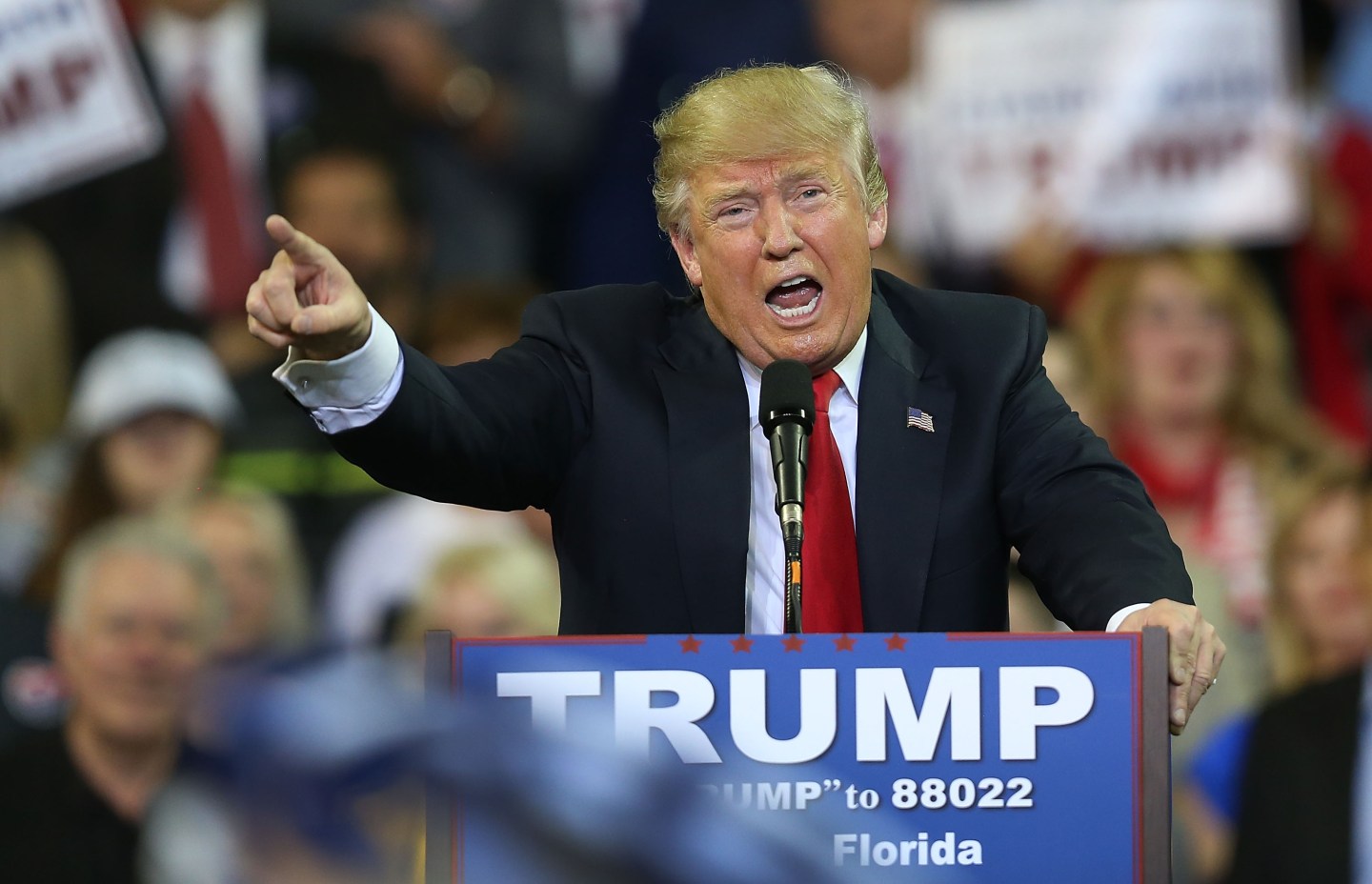
As expected, Donald Trump’s often blatant disregard for accuracy has not moderated itself any now that he has become the 45th President of the United States. In just the last few days, he has made multiple statements that are clearly false, including comments about the size of the crowd at his inauguration and—more importantly—whether millions of people illegally voted in the election.
This behavior has sparked a kind of existential debate within the U.S. news media: How should a news organization respond when the President makes false statements or repeats unsupported claims? Is it ever appropriate to use the word “lie” in such circumstances?
It would be nice if there was general agreement on this question, but there isn’t. Some media companies clearly believe that lies should be called what they are. CNN used the word more than once in its reports on Trump, and even the normally cautious New York Times has shown what appears to be an increasing willingness to call a lie exactly that.
Others believe just as strongly that using the word “lie” is not appropriate unless we know the speaker’s intent. In other words, they argue that you can only call a statement a lie if you know for a fact that the person who said it knew it was false—and that they did so in a deliberate attempt to deceive or mislead their audience.
Here's my question: When can the repeated assertion of falsehoods despite being confronted by factual evidence be considered "lying"? https://t.co/n9Vsm4ZfkE
— Gabe Rosenberg (@GabrielJR) January 25, 2017
National Public Radio, for example, said this week that it has chosen not to use the word “lie” in reference to the false or inaccurate statements that President Trump makes because the intent behind those statements cannot be known. (This is also the view of Time Inc., which owns Fortune.)
The dictionary definition of a lie, NPR’s Mary Kelly said, is “a false statement made with intent to deceive. Intent being the key word there. Without the ability to peer into Donald Trump’s head, I can’t tell you what his intent was.”
Get Data Sheet, Fortune’s technology newsletter.
NPR’s senior vice president for news, Michael Oreskes, said the job of journalists is “to report, to find facts, and establish their authenticity and share them with everybody. It’s really important that people understand that these aren’t our opinions. I think the minute you start branding things with a word like ‘lie,’ you push people away from you.”
This is pathetically mealy-mouthed. Lies apparently aren't lies if the liar has deluded himself into believing them. https://t.co/kjTP4dwqLr
— Andrew Hunter Murray (@andrewhunterm) January 25, 2017
Earlier this year, Wall Street Journal editor Gerard Baker made a similar argument, saying the word lie “implies much more than just saying something that’s false. It implies a deliberate intent to mislead. If you start ascribing a moral intent, as it were, to someone by saying that they’ve lied, I think you run the risk that you look like you’re not being objective.”
Both Oreskes and Baker seem concerned in part that calling Trump statements lies will alienate readers and listeners from the mainstream media even more than they already are, and that the only refuge is to stress objectivity as much as possible. (Baker later expanded on his comments in a full-length essay in the Journal.)
This argument assumes that people will believe an organization is objective and unbiased so long as it uses words like “false” or “inaccurate” or “unsupported,” rather than the word “lie.” Is there any reason to think that this is the case? Not really. Those who believe the Times is anti-Trump and the Journal is pro-Trump will likely continue to do so regardless of which euphemism or adjective is used.
It’s a tough spot to be in. Media organizations that choose not to call Trump’s false statements “lies” run the risk of being seen as either trying to curry favor with the administration or just lacking the courage to call a spade a spade. If a news outlet wants to be seen as a vehicle for the truth, then how can it not call a lie a lie? If anything could cause a further erosion of trust in the media, surely it’s that. Right?
Journalists are running out of euphemisms to say "Trump lied." These are not mistakes he's making. He's lying on purposes. Repeatedly. https://t.co/LMBdZ5PTNp
— Keith Boykin (@keithboykin) January 24, 2017
What, then, of the argument that we shouldn’t use the word lie unless we know the intent of the speaker? This is a good test—but all it means is that we have to infer intent based on what is known or what a person can reasonably be expected to know. In that sense, it’s not unlike the legal test for a false statement, which requires a “willful disregard” for the truth.
In a nutshell, a statement can fairly be called a lie if there is abundant evidence to the contrary that a speaker should have known about. For example, you can argue that saying the inauguration drew record crowds deserves to be called a lie because there are multiple credible news reports that have proven this to be untrue. At the time of the inauguration, saying so might merely have been a misunderstanding. But one week later, that stance has hardened into something that could be called a lie.
The President’s comments about voter fraud are in a similar position. In response to reporters’ questions, White House press secretary Sean Spicer said Tuesday that Trump “believes what he believes” despite all available evidence showing that there was no fraud. Using the “willful disregard” benchmark, Trump’s statement should qualify as a lie.
And then there are statements that can’t be proven to be true but don’t deserve to be called lies. If President Trump says that the New York Mets are the best team that ever played baseball, that falls under the category of opinion. Same goes if he said Snickers is a terrific candy bar or Mariah Carey is a tremendous singer. Calling those statements lies serves no larger purpose.
So what’s the moral of this story? There is no question that the word “lie” shouldn’t be thrown around willy-nilly—otherwise it will lose its effectiveness. If the press chooses to use it, it should be prepared to defend its use for specific reasons, such as those outlined above. Does that approach risk alienating some of its audience? Of course it does—as do many of the other things that journalists routinely do. But exposing the cold, hard truth is what journalism is all about. And that’s no lie.