• Home
  • Latest
  • Fortune 500
  • Finance
  • Tech
  • Leadership
  • Lifestyle
  • Rankings
  • Multimedia
CommentaryArgentina

Why Argentina’s Macri Could Have a Rockier Year in 2017

By
Shannon K. O'Neil
Down Arrow Button Icon
By
Shannon K. O'Neil
Down Arrow Button Icon
January 22, 2017, 12:00 PM ET
ARGENTINA-POLITICS-MACRI
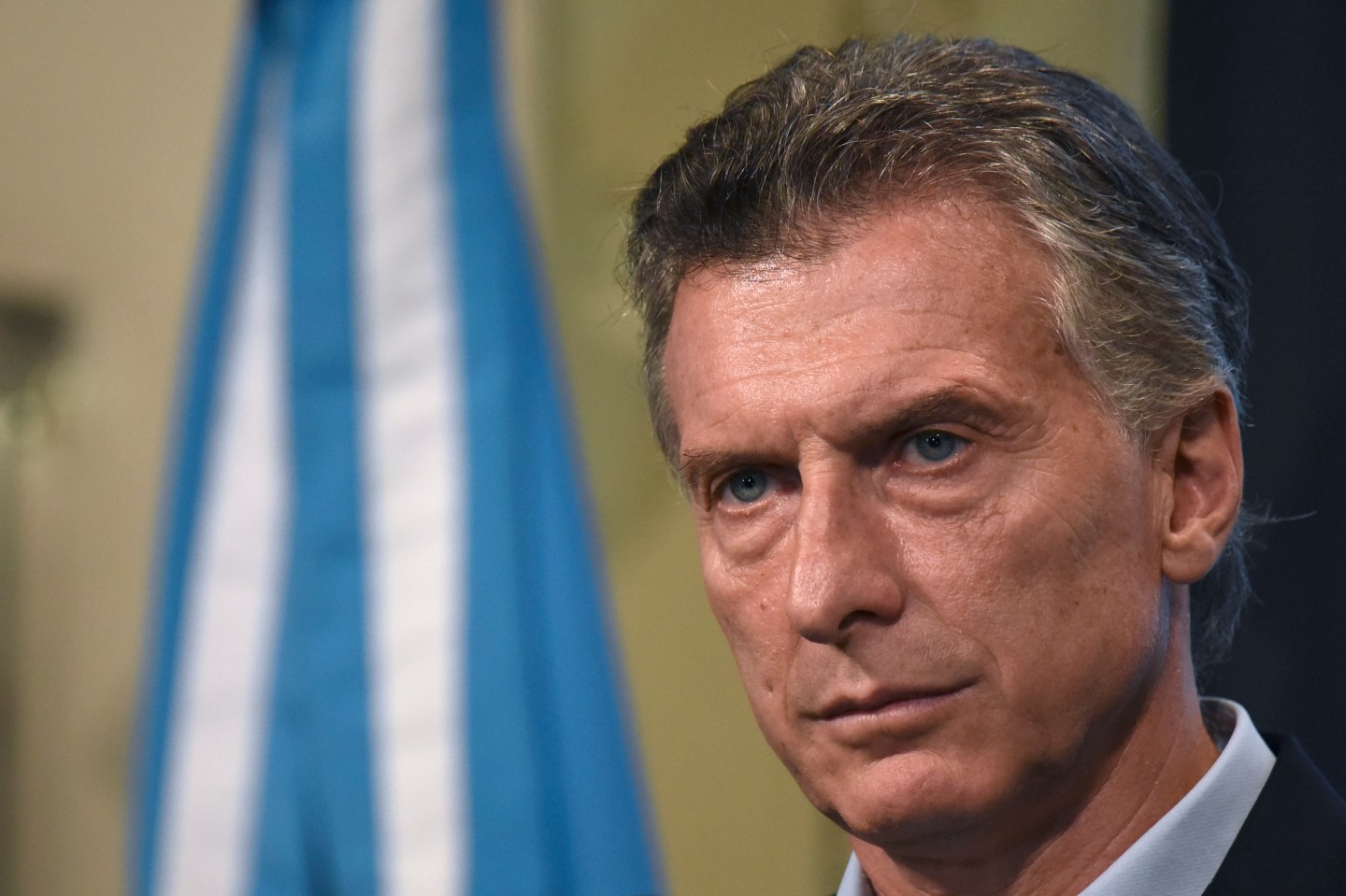
Argentine President Mauricio Macri offers a press conference at the Casa Rosada presidential palace in Buenos Aires on January 17, 2017. While the IMF lowered its growth expectations for Argentina, President Mauricio Macri reiterated that he expects the third largest economy in Latin America to grow by 3% in 2017. / AFP / Eitan ABRAMOVICH (Photo credit should read EITAN ABRAMOVICH/AFP/Getty Images)Photograph by Eitan Abramovich—AFP/Getty Images

Argentine President Mauricio Macri and his team can take a bow for their first year in office. Despite Macri’s outsider status and his party’s limited influence in the Congress, he in short order took on the country’s biggest economic distortions—unifying the exchange rate, resolving the fight with international creditors, cutting energy subsidies, reestablishing credible statistics, and eliminating a whole host of tariffs, quotas, and export licenses.

Now comes the harder part. Macri needs to capitalize on continuing international investor and domestic Argentine support to push through more fundamental changes, restructuring the state and the economy to enable longer-term sustainable growth. In order to accomplish these weighty goals, Macri must not only stay the economic course set during his first year, but also double down and take on Argentina’s outsized reliance on public spending.

The rewards from Macri’s exertions are just beginning, as at least some economic indicators are finally turning in Argentina’s favor. Inflation is falling, recession is slowing, and some sectors—agriculture, real estate, and construction in the capital city—are on the rebound. These beginnings of a turnaround will make it easier for Macri to continue taking measures to open up the economy.

The disarray within the opposition Justicialist Party (PJ)—better known as the Peronists —eases the way as well. Though the PJ was the dominant political force for decades, continuing recriminations over last year’s electoral losses, corruption investigations into former President Cristina Kirchner and her aides, and differing views on how to respond to Macri’s strategic carrot and stick offerings have kept party leaders divided. Some factions were even disinvited to October’s Day of Peronist Loyalty, as political rivals were unwilling to stand side by side for the annual photo opportunity. This has enabled the Macri administration to push through legislative reforms despite its minority position in both houses.

Most surprisingly, Argentines are being uncharacteristically patient. Despite high inflation, unemployment, and stagnant growth, recent polls show the majority of the population is still giving the president the benefit of the doubt, believing that this year will be better.

All of this suggests that if the government can boost growth, it may do well in next October’s midterms, gaining seats in Congress and the symbolic mandate to continue on a market-friendly path.

Yet at the same time, the challenges to Macri’s success are growing.

Macri’s Goldilocks gradualism of reform without austerity—evoking the “not too hot, not too cold” approach of the storybook character—all depends on international capital to support a bloated state as well as to ply provincial governors in return for their support on key votes. Investors, desperate for better returns and buying Argentina’s prodigal son story, have happily obliged to the tune of nearly $50 billion dollars.

Argentina will likely need another estimated $28 billion dollars in 2017. For those with any familiarity with Latin America, these outsized deficits bring a sense of deja vu—though Macri’s rhetoric differs, piling on public debt to fund current expenditures looks an awful lot like the populist economic policies practiced by his predecessor. With most expecting the American dollar to strengthen and U.S. interest rates to jump under the new Trump administration, financing large emerging market deficits will get harder and harder. The Chinese may jump in, especially if their money goes to building infrastructure that ensures that Argentine soy gets to boats headed west. But regardless, the financing limits are real.

The only way to balance the budget is to fire government employees and cut pensions. Nearly one in three Argentines works for the government, making wages the number one cost for the public sector. This is followed closely by pensions, which make up over a third of the federal budget. Yet this is politically untenable, as disgruntled workers and pensioners would go straight to the picket line, threatening to upend the whole economic project.

Finally, voters may galvanize the Peronist opposition in ways that their leaders have not. Whoever comes out on top in the Buenos Aires provincial elections this year will be the heir apparent to the vast party machine, one still easily able to halt the government’s agenda when united and if so inclined.

Argentines will ultimately decide if this time is different. The Macri government has tried to entice the estimated $400 billion dollars in offshore funds back to the country through a tax amnesty program, allowing Argentines who declare their funds to pay a fine, and giving incentives for those that invest in infrastructure related bonds. So far it has been a success, uncovering over $30 billion dollars in the first two months, with expectations of much more before the end of March when the window closes. But while the program has been successful in identifying funds, little of this money has come back to Argentina to stay. Argentines are waiting to see if the changes are real. International investors are following their lead. And if all decide to wait and see, then Macri’s path will be much more difficult.

The recent cabinet shuffle, replacing former Finance Minister Alfonso Prat-Gay with Nicolás Dujovne, reflects this quandary. And it signals that Macri may be ready to take a harder line as he enters his sophomore year. Known for his fiscal conservatism, the new finance minister has already promised to lower the official government deficit projection of 4.2% for 2017. The potential cuts to jobs, social programs, and provincial slush funds will undoubtedly bring political costs. But the current financial path carries its own risks in the face of the global economic volatility likely to come.

And politically, to convince Argentines that this time is in fact different, market-based means may matter just as much as the hoped-for economic ends.

Shannon K. O’Neil is the Nelson and David Rockefeller senior fellow for Latin America studies and director of the civil society, markets and democracy program at the
 Council on Foreign Relations.

About the Author
By Shannon K. O'Neil
See full bioRight Arrow Button Icon

Latest in Commentary

Finance
Lorem ipsum dolor sit amet, consectetur adipiscing elit, sed do eiusmod tempor incididunt ut labore et dolore magna aliqua. Ut enim ad minim veniam
By Fortune Editors
October 20, 2025
Finance
Lorem ipsum dolor sit amet, consectetur adipiscing elit, sed do eiusmod tempor incididunt ut labore et dolore magna aliqua. Ut enim ad minim veniam
By Fortune Editors
October 20, 2025
Finance
Lorem ipsum dolor sit amet, consectetur adipiscing elit, sed do eiusmod tempor incididunt ut labore et dolore magna aliqua. Ut enim ad minim veniam
By Fortune Editors
October 20, 2025
Finance
Lorem ipsum dolor sit amet, consectetur adipiscing elit, sed do eiusmod tempor incididunt ut labore et dolore magna aliqua. Ut enim ad minim veniam
By Fortune Editors
October 20, 2025
Finance
Lorem ipsum dolor sit amet, consectetur adipiscing elit, sed do eiusmod tempor incididunt ut labore et dolore magna aliqua. Ut enim ad minim veniam
By Fortune Editors
October 20, 2025
Finance
Lorem ipsum dolor sit amet, consectetur adipiscing elit, sed do eiusmod tempor incididunt ut labore et dolore magna aliqua. Ut enim ad minim veniam
By Fortune Editors
October 20, 2025

Most Popular

Finance
Lorem ipsum dolor sit amet, consectetur adipiscing elit, sed do eiusmod tempor incididunt ut labore et dolore magna aliqua. Ut enim ad minim veniam
By Fortune Editors
October 20, 2025
Finance
Lorem ipsum dolor sit amet, consectetur adipiscing elit, sed do eiusmod tempor incididunt ut labore et dolore magna aliqua. Ut enim ad minim veniam
By Fortune Editors
October 20, 2025
Finance
Lorem ipsum dolor sit amet, consectetur adipiscing elit, sed do eiusmod tempor incididunt ut labore et dolore magna aliqua. Ut enim ad minim veniam
By Fortune Editors
October 20, 2025
Finance
Lorem ipsum dolor sit amet, consectetur adipiscing elit, sed do eiusmod tempor incididunt ut labore et dolore magna aliqua. Ut enim ad minim veniam
By Fortune Editors
October 20, 2025
Finance
Lorem ipsum dolor sit amet, consectetur adipiscing elit, sed do eiusmod tempor incididunt ut labore et dolore magna aliqua. Ut enim ad minim veniam
By Fortune Editors
October 20, 2025
Finance
Lorem ipsum dolor sit amet, consectetur adipiscing elit, sed do eiusmod tempor incididunt ut labore et dolore magna aliqua. Ut enim ad minim veniam
By Fortune Editors
October 20, 2025
Rankings
  • 100 Best Companies
  • Fortune 500
  • Global 500
  • Fortune 500 Europe
  • Most Powerful Women
  • Future 50
  • World’s Most Admired Companies
  • See All Rankings
Sections
  • Finance
  • Leadership
  • Success
  • Tech
  • Asia
  • Europe
  • Environment
  • Fortune Crypto
  • Health
  • Retail
  • Lifestyle
  • Politics
  • Newsletters
  • Magazine
  • Features
  • Commentary
  • Mpw
  • CEO Initiative
  • Conferences
  • Personal Finance
  • Education
Customer Support
  • Frequently Asked Questions
  • Customer Service Portal
  • Privacy Policy
  • Terms Of Use
  • Single Issues For Purchase
  • International Print
Commercial Services
  • Advertising
  • Fortune Brand Studio
  • Fortune Analytics
  • Fortune Conferences
  • Business Development
About Us
  • About Us
  • Editorial Calendar
  • Press Center
  • Work At Fortune
  • Diversity And Inclusion
  • Terms And Conditions
  • Site Map

© 2025 Fortune Media IP Limited. All Rights Reserved. Use of this site constitutes acceptance of our Terms of Use and Privacy Policy | CA Notice at Collection and Privacy Notice | Do Not Sell/Share My Personal Information
FORTUNE is a trademark of Fortune Media IP Limited, registered in the U.S. and other countries. FORTUNE may receive compensation for some links to products and services on this website. Offers may be subject to change without notice.


Most Popular

placeholder alt text
Success
'I had to take 60 meetings': Jeff Bezos says 'the hardest thing I've ever done' was raising the first million dollars of seed capital for Amazon
By Dave SmithDecember 15, 2025
4 hours ago
placeholder alt text
Success
Sorry, six-figure earners: Elon Musk says that money will 'disappear' in the future as AI makes work (and salaries) irrelevant
By Orianna Rosa RoyleDecember 15, 2025
8 hours ago
placeholder alt text
Uncategorized
Transforming customer support through intelligent AI operations
By Lauren ChomiukNovember 26, 2025
19 days ago
placeholder alt text
Success
Meetings are not work, says Southwest Airlines CEO—and he’s taking action, by blocking his calendar every afternoon from Wednesday to Friday 
By Preston ForeDecember 15, 2025
6 hours ago
placeholder alt text
AI
Deloitte's CTO on a stunning AI transformation stat: Companies are spending 93% on tech and only 7% on people
By Nick LichtenbergDecember 15, 2025
11 hours ago
placeholder alt text
Success
Apple cofounder Ronald Wayne sold his 10% stake for $800 in 1976—today it’d be worth up to $400 billion
By Preston ForeDecember 12, 2025
3 days ago

Latest in Commentary

Charles Lamanna
CommentaryMicrosoft
I lead Microsoft’s enterprise AI agent strategy. Here’s what every company should know about how agents will rewrite work
By Charles LamannaDecember 15, 2025
8 hours ago
Julian Braithwaite is the Director General of the International Alliance for Responsible Drinking
CommentaryProductivity
Gen Z is drinking 20% less than Millennials. Productivity is rising. Coincidence? Not quite
By Julian BraithwaiteDecember 13, 2025
2 days ago
carbon
Commentaryclimate change
Banking on carbon markets 2.0: why financial institutions should engage with carbon credits
By Usha Rao-MonariDecember 13, 2025
2 days ago
Dr. Javier Cárdenas is the director of the Rockefeller Neuroscience Institute NeuroPerformance Innovation Center.
Commentaryconcussions
Fists, not football: There is no concussion protocol for domestic violence survivors
By Javier CárdenasDecember 12, 2025
3 days ago
Gary Locke is the former U.S. ambassador to China, U.S. secretary of commerce, and governor of Washington.
CommentaryChina
China is winning the biotech race. Patent reform is how we catch up
By Gary LockeDecember 12, 2025
3 days ago
millennial
CommentaryConsumer Spending
Meet the 2025 holiday white whale: the millennial dad spending $500+ per kid
By Phillip GoerickeDecember 12, 2025
3 days ago