A decade is a long time—even in the real world. On the Internet, it is more like a century, especially in the life of a startup. But that’s how long it has been since Facebook launched the real-time news feed that has become the core of the service for more than 1.5 billion people.
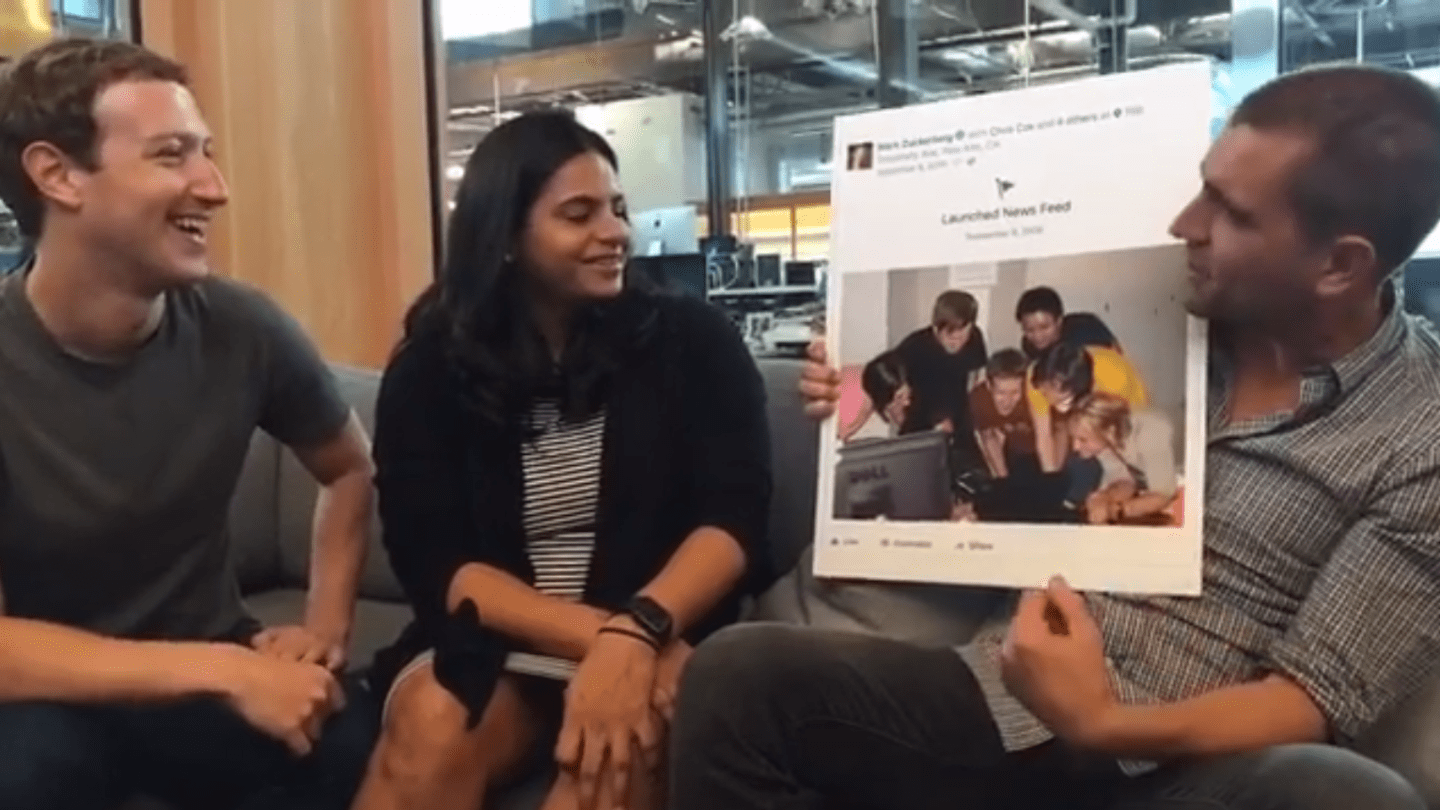
It’s hard to even imagine the social network now without this essential feature, as early Facebook staffer Andrew “Boz” Bosworth recalled during a discussion with CEO Mark Zuckerberg and three other members of the original news feed team on Tuesday (hosted via Facebook’s live-streaming video service, of course).
At that time, the site “was just a page with a big finger pointing at the number of new posts you had,” Boz said. Users had to click on the profiles of each of the people they were friends with, and then try to remember what their last post was and if anything had changed.
“It’s hard to remember back that far, but you had to just browse around and check people’s profiles, to see who wrote on someone’s wall or what they had posted,” Zuckerberg recalled. “There was no guarantee if you put something on your profile that someone was even going to see it. Now we kind of take it for granted…But at the time, there was really nothing like it in the world.”
After about nine months of work by the three members of the original team, which included Chris Cox—now in charge of product development for the news feed—and Ruchi Sanghvi, the new feature was rolled out late at night on September 5th, 2006.
And then all hell broke loose.
Get Data Sheet, Fortune’s technology newsletter.
Boz left on vacation just before the launch, he recalled during the Live broadcast. So Sanghvi, Cox, and engineer Kang-Xing Jin had to watch the initial reaction while gathered around Zuckerberg’s PC. At that time, Facebook (FB) only had about 10 million users, and a huge number of them seemed to think the news feed was the worst thing that had ever happened to the service.
“We all loved it internally, and it seemed pretty clear it would be a good thing, so when we launched it we expected people to be really excited, and we were waiting for the first feedback to come in,” Zuckerberg said during the Live broadcast. “But it was not good news.”
Cox recalled the team woke up to a new group with more than a million members called, “I Hate the News Feed, Turn It Off.”
As the headlines from that time reflect, many people hated the news feed because it changed the way the site worked in a fairly radical way. They also disliked it because it revealed their behavior—likes, shares, and comments, etc.—in a more obvious way.
Many users seemed to see this is an invasion of privacy, something that has become a running theme with almost every new feature that Facebook rolls out. Sanghvi cited approximately 10% of the existing user base threatened to delete their accounts or boycott the service.
Zuckerberg was forced to write an apology for the way the transition was handled. “Calm down. Breathe. We hear you,” he wrote, in what many said at the time was a classically tone-deaf manner.
Does Facebook need humans to decide what’s trending? Watch:
The enthusiasm that the Facebook co-founder and the original team had for the idea of the news feed comes across loud and clear in the Live stream. Sanghvi said that the idea came from watching people clicking around from profile to profile, and trying to think of ways to make that easier for users.
But it was clear at the time that there was a huge disconnect between that desire and how it was perceived.
That disconnect arguably continues today in a variety of ways. The news feed is now used by more than 1.5 billion people every day, and as such, it has a huge influence on the information that people see about the world, whether it’s baby photos or news about a bombing or a police shooting.
That influence in turn helps control (whether Facebook wants to admit it or not) the fate of large media entities, who now rely on the social network to send users to their content, or to cut advertising deals with them in return for hosting their content, or to pay them to create Live video. And every time Facebook tweaks its algorithm, those media outlets tremble.
The feed also shapes the way that people see the world in some fairly significant ways, as sociologist Zeynep Tufekci and others have pointed out. What it chooses to include and exclude can have a huge impact.
Cox, who joined Facebook a year before the news feed was rolled out, recalled talking with Facebook co-founder Dustin Moskovitz and early staffer Adam D’Angelo about how the news feed should be a “newspaper” for the digital world around its users—a metaphor he and Zuckerberg have continued to use.
That newspaper has become the most popular news source in the history of humanity, and it has also powered the transformation of Facebook from a tiny startup into a globe-spanning behemoth with a market value of more than $375 billion.
As a product, it is clearly a massive success. But as a social phenomenon, its full implications are only just starting to become obvious.