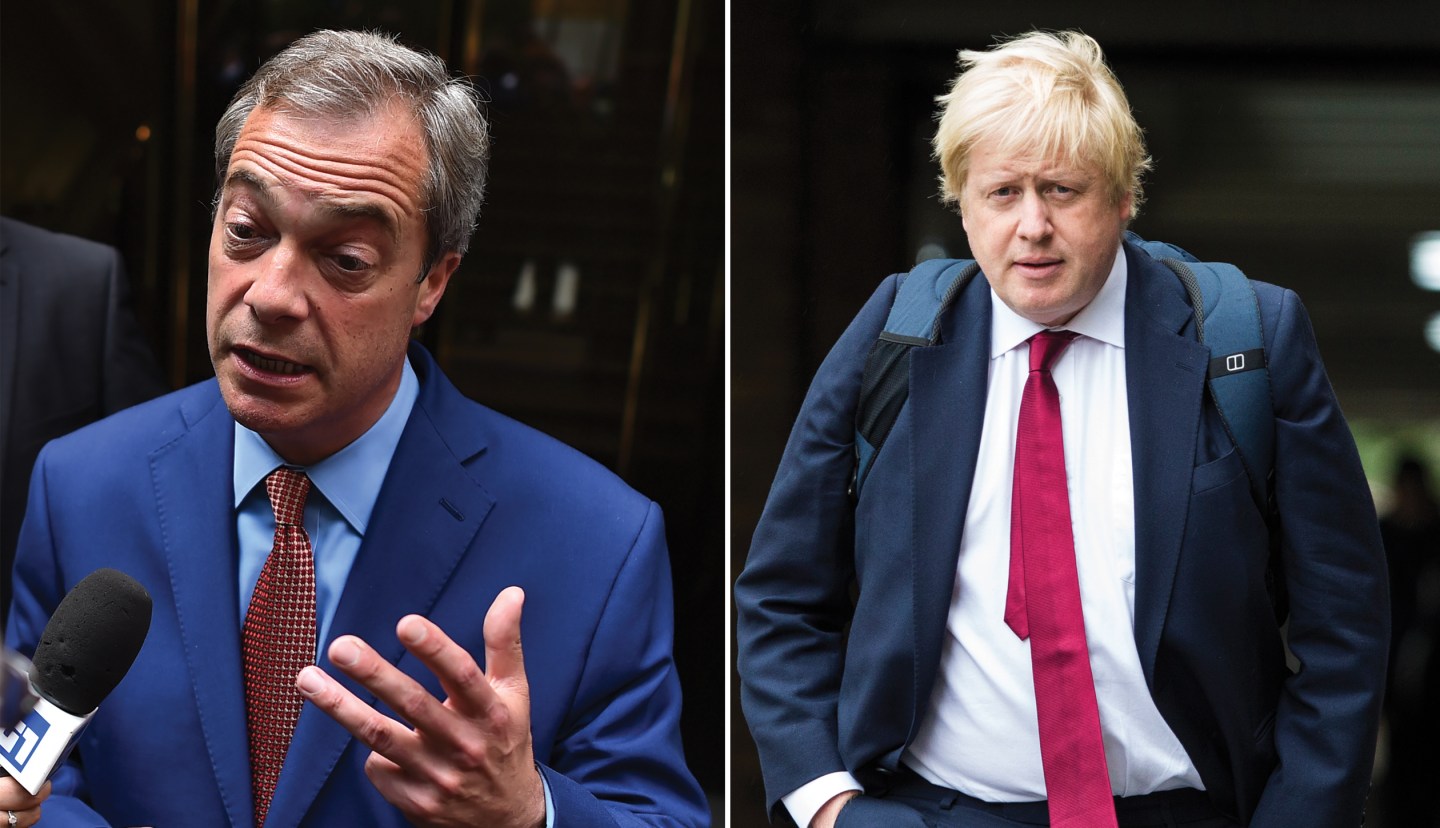
Boris Johnson, the flamboyant ex-mayor of London and most prominent Tory “leave” proponent, and Nigel Farage, the eccentric Eurosceptic member of European Parliament who relentlessly campaigned for Brexit since he first took over the U.K. Independence Party (UKIP) leadership some 10 years ago, both left their leadership positions at the pinnacle of the “leave” campaign’s stunning success. My favorite comment on Twitter about these shocking departures stated, not without a dose of bitter irony: “More Brits would have supported Leave if they knew Johnson & Farage meant it literally.” Indeed, commentators consolidated around the idea that the departure of the two underpins the simple fact that the “leave” camp did not anticipate to succeed, has no plan on how to deal with the Brexit, and is in total disarray.
Earlier this week, European Commission President Jean-Claude Juncker lashed out at Johnson and Farage, calling them “retro-nationalists” and “sad Brexit heroes,” while the leader of the center-right Alliance of Liberals and Democrats for Europe group in the European Parliament, Guy Verhofstadt, even crudely compared them to “rats fleeing a sinking ship.” It seems as though, just like all revolutions, the “leave” one, too, is on the course of slowly devouring its children. The comparison is tempting, and the conclusion seems logical. But I beg to differ. The departures are a sign for the Brexiteers’ determination to carry on with the “leave” agenda—not to give up.
Both Johnson’s and Farage’s decisions to step down are underpinned by a solid, strategic logic, and by no means are expressions of emotional outbursts, fear, or panic. Johnson’s decision was certainly provoked by the backstabbing move of his Oxford comrade and “leave” Tory co-leader, Michael Gove, who surprisingly considered Johnson unfit for the job to become the next British prime minister. With a tarnished reputation like this, it was unrealistic to expect Johnson to unite the Tory’s bitterly split “leave” and “remain” campaigns, and lead the U.K. through the tenuous Brexit process that lies ahead.
But there is even more subtle reason for his departure: a strategic calculation that whoever leads the Tories in these tumultuous times and becomes the next U.K. prime minister will have to make highly unpopular decisions, strike blood-stained compromises, and lead to a kind of Brexit that will inevitably retain some of the most controversial features of the single market that so emancipated the “leave” vote in the first place. In short, there will be no way for the next prime minister—either the Home Secretary and “remain” Tory campaigner Theresa May, or the junior secretary of energy and climate change and prominent “leave” proponent, Andrea Leadsom—to get out of the water dry. In all probability, either will end up making both Brexiteers and Bremainers extremely unhappy. This is a function of the structural particularities of the Brexit negotiations that lie ahead, rather than of the personal characteristics of the two contenders. There is simply no good Brexit option that would satisfy a majority of “leave” or “remain” supporters. The Brexit British people will get is going to be neither the Brexit many voted for, nor the Bremain many hope to achieve.
Johnson, just like Farage, officially backed Leadsom for the leadership position. This will not stop him, however, in two and a half years from now—about the time Brexit negotiations must be just completed, and the next prime minister’s unpopularity to hit hard bottom—to attack her for failing to implement the promised Brexit deal to the “leave” supporters. Strategically, it will be even better for Johnson if Leadsom, and not May, becomes the prime minister because she will fail, despite her commitment to “leave,” and her credibility will be totally tarnished, while his is strengthened by the sense of lost, untimely opportunity because of Gove’s treachery. That is how Johnson could turn his backstabbing into an asset. But, regardless of who becomes the next Tory leader and British prime minister, Johnson’s best strategy is to step aside and let someone else pick up the negatives, and then, when the time is right, to come back as a white knight and a savior. In the meantime, he can sit in the sidelines and direct his ire at any deal that falls short of the promised Brexit benchmark to the “leave” constituents. Plus, he already got his revenge at Gove. Johnson’s game, in other words, is of waiting and poaching.
The story with Farage’s resignation is notably different. Although being behind UKIP’s recent rise to prominence, he is a very controversial politician. Never shying away from scandal, he likes to brag about his drinking habits and provoke opponents with outrageous comments. He sneers at the EU officials and mocks fellow political leaders. Judging from the members of European Parliament’s rath against him during his most recent appearance in European Parliament, where he is a member, Farage certainly ranks among the most hated persons among the European political circles.
Farage may act like a political buffoon, but he is neither blind nor stupid. Just like Johnson, he too, has a long-term strategy. He fully understands that UKIP is at a make-it-or-break-it point, and his presence at the top leadership may risk the future of the party. During the last few rounds of general, local, and European elections, he successfully planted the seeds of split within the camp of the Conservatives, as the Brexit referendum was a result of the pressure he exerted over David Cameron to calm down the Eurosceptic Tory backbenchers. Farage, however, failed to secure more than one MP seat in the last general elections in 2015, mainly because his personality loomed large over the party and clouded its success. Now UKIP aims to split the Labour Party, similar to the way it did with the Tories, and expects to make strides in the upcoming general elections. It may not be too far-fetched to contemplate a coalitional role for UKIP in a future Tory-led government, with an assigned role of a buffer in what’s promised to be extremely loaded negotiations with the EU. UKIP’s success and role for any of this would be almost impossible, however, if Farage remained at the helm of the party.
His decision to resign is also significant in another way. Small, populist, Eurosceptic parties across the EU now show a very different political style of organization and behavior compared to the old-type populist parties. The old ones were centered and functioned around a charismatic leader at its core. Examples include the Danish Progress Party of the eccentric Morgens Glistrup, the French Front National under its fiery leader Jean-Marie Le Pen, and the Italian Lega Nord under Umberto Bossi. These were also somewhat idealistic parties, in the rather cynical sense of the word. The blatant, uncompromising and unabated illiberalism they use to radiate, rendered them pariahs in their respective political systems, so they had no chance to come anywhere near the political power center, with perhaps the possible exception of Bossi’s 1990s collaboration with another personality party, Berlusconi’s Forza Italia.
The new populist Eurosceptic parties are much more pragmatic and strategically oriented in both their organization and their behavior. They change leadership whenever necessary, and center around less divisive, but more practical policy issues. As a result, many of them managed to crawl out of their pariah status and enter the mainstream politics.
Farage certainly will not just retire to some exotic island. If anything, he seems determined to remain hidden behind the scenes to give direction. Both he and Johnson, though, each in his own way, are getting ready to play an important role in post-Brexit Britain. They seem to have just as much chance to succeed as the EU does to disintegrate under its own weight of deepening dysfunctional politics and emerging faulty lines.