• Home
  • Latest
  • Fortune 500
  • Finance
  • Tech
  • Leadership
  • Lifestyle
  • Rankings
  • Multimedia

Trendingnow

1

Jeff Bezos wants the bottom half of earners to pay zero income tax—he says nurses making just $75K should save $12K a year

2

Despite a $500 million net worth, Shaq just finished his fourth degree. He warns graduates: 'Your character will take you further than your resume'

3

Bolt CEO says he let go of his entire HR team for creating problems that didn’t exist: ‘Those problems disappeared when I let them go’ 

1

Jeff Bezos wants the bottom half of earners to pay zero income tax—he says nurses making just $75K should save $12K a year

2

Despite a $500 million net worth, Shaq just finished his fourth degree. He warns graduates: 'Your character will take you further than your resume'

3

Bolt CEO says he let go of his entire HR team for creating problems that didn’t exist: ‘Those problems disappeared when I let them go’ 
TechMilitary

How to Defend Against Russia and China: Missiles, Missiles, and More Missiles

By
Clay Dillow
Clay Dillow
Down Arrow Button Icon
By
Clay Dillow
Clay Dillow
Down Arrow Button Icon
April 27, 2016, 4:44 PM ET
U.S. Navy

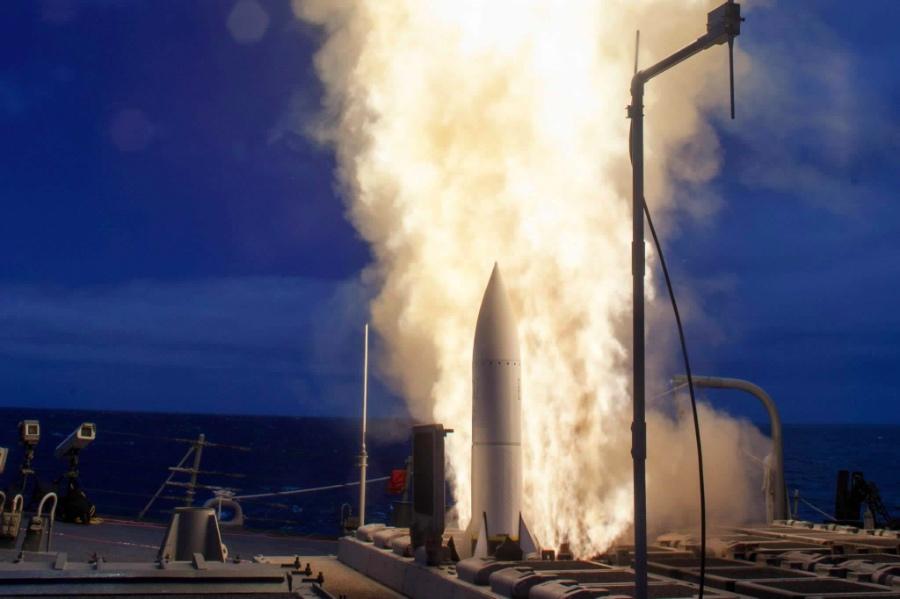
As the House Armed Services Committee (HASC) works its way through a marathon markup of the 2017 defense budget today, a certain theme is emerging. If the House gets its way, the Pentagon will receive millions of extra dollars to develop and deploy a range of new long-range missile (and anti-missile) technologies on land and at sea, aiming to counter what HASC clearly sees as a growing threat to U.S. military superiority.

Included in the HASC chairman’s markup of the defense budget: funding to explore new offensive missiles for the Navy’s amphibious ships (which currently have none), land-based anti-ship missiles and longer-reaching land-attack batteries for the Army, and futuristic electromagnetic railguns that can knock incoming missiles out of the sky.

The missile threat, for its part, is real. When security experts talk about U.S. military power, they often talk about fighter jet superiority, aircraft carriers that project power across the globe, and a range of air and space-based reconnaissance capabilities that make U.S. forces smarter and better-informed than their adversaries. When they talk about potential future adversaries that could limit the ability of U.S. forces to operate freely abroad—a concept known in military circles as Anti-Access/Area Denial, or A2/AD—they talk about missiles.

Where China is concerned, it’s a range of ballistic missiles, perhaps most notably the DF-21D anti-ship ballistic missiles known unambiguously as the “carrier killer.” Security experts and officials routinely wring their hands over the advanced state of Russian missile technology as well as its proliferation. (Authorities believe a Russian surface-to-air missile shot down Malaysia Airlines Flight 17 over Ukraine in 2014, and Russia’s recent sale of its advanced S-300 surface-to-air missile systems to Iran has rankled Western security officials as well.)

Get Data Sheet, Fortune’s technology newsletter.

Iran’s own homegrown ballistic missile program further worries the Islamic Republic’s Middle Eastern neighbors—as well as the Pentagon—as its long-range missiles could be used to strike at Israel or other U.S. allies in the region. North Korea has captured several news cycles in recent weeks by testing various missiles, the means by which it could turn its small nuclear arsenal into a massive global threat.

It’s little wonder then that HASC is taking the missile threat so seriously in its defense budget markup. Congress would like to see the Pentagon close the gap between countries with lots of long-range offensive missiles and the U.S. military, which has lately focused more on defensive missiles than offensive ones.

The first way HASC wants to turn that around is by ordering the Navy to look into installing missile tubes on the Navy’s amphibious ships—transports that currently have no missile power and are used to ferry Marines. The Navy’s Vertical Launch System missile tube can accommodate a range of both offensive and defensive missiles, so adding them to its fleet of assault ships could create two dozen new missile-launching platforms over the next several years.

The committee also wants to add $5 million to the Army’s budget for “examination of Army land-attack and anti-ship capability.” The Army already has land-based missiles designed to attack land-targets, but its missiles are out-ranged by some adversary systems. The longest-range Army projectile can travel just under 200 miles. Part of that $5 million would go toward exploring a new missile that will top 300 miles in range.

The rest would go toward taking a page out of China’s playbook. China (as well as Iran) relies heavily on its arsenal of land-based, anti-ship cruise missiles designed to ensure that it can threaten potentially hostile (read: American) warships operating near its shores. The U.S. Army doesn’t even have a land-based, anti-ship missile in its arsenal. The HASC version of the defense budget would throw some money at developing a similar land-based weapon to help defend U.S. allies in the Pacific and elsewhere from potentially hostile (read: Chinese) naval vessels.

For more about missiles, watch:

The HASC markup also adds $10 million to the $15.4 million already earmarked for research and development of an electromagnetic railgun for the Navy. Railguns use electromagnets (rather than controlled explosions) to accelerate massive metal projectiles to extremely high speeds. The high speed and low cost of these projectiles make them attractive as both offensive artillery pieces and means of shooting incoming missiles out of the sky. Both BAE Systems (BAESY) and General Dynamics (GD) have demonstrated railgun technology for the Navy and Army, respectively.

HASC isn’t just concerned with the U.S. military’s ability to win a high-tech missile fight. The committee’s defense bill markup would add $200 million in additional funds to help produce various Israeli missile defense systems, including the so-called Iron Dome missile interceptor system and David’s Sling, a medium- and long-range air defense system. Both are co-produced by Israel’s Rafael Advanced Systems and U.S.-based Raytheon (RTN).

About the Author
By Clay Dillow
See full bioRight Arrow Button Icon

Latest in Tech

Finance
Lorem ipsum dolor sit amet, consectetur adipiscing elit, sed do eiusmod tempor incididunt ut labore et dolore magna aliqua. Ut enim ad minim veniam
By Fortune Editors
October 20, 2025
Finance
Lorem ipsum dolor sit amet, consectetur adipiscing elit, sed do eiusmod tempor incididunt ut labore et dolore magna aliqua. Ut enim ad minim veniam
By Fortune Editors
October 20, 2025
Finance
Lorem ipsum dolor sit amet, consectetur adipiscing elit, sed do eiusmod tempor incididunt ut labore et dolore magna aliqua. Ut enim ad minim veniam
By Fortune Editors
October 20, 2025
Finance
Lorem ipsum dolor sit amet, consectetur adipiscing elit, sed do eiusmod tempor incididunt ut labore et dolore magna aliqua. Ut enim ad minim veniam
By Fortune Editors
October 20, 2025
Finance
Lorem ipsum dolor sit amet, consectetur adipiscing elit, sed do eiusmod tempor incididunt ut labore et dolore magna aliqua. Ut enim ad minim veniam
By Fortune Editors
October 20, 2025
Finance
Lorem ipsum dolor sit amet, consectetur adipiscing elit, sed do eiusmod tempor incididunt ut labore et dolore magna aliqua. Ut enim ad minim veniam
By Fortune Editors
October 20, 2025

Most Popular

Finance
Lorem ipsum dolor sit amet, consectetur adipiscing elit, sed do eiusmod tempor incididunt ut labore et dolore magna aliqua. Ut enim ad minim veniam
By Fortune Editors
October 20, 2025
Finance
Lorem ipsum dolor sit amet, consectetur adipiscing elit, sed do eiusmod tempor incididunt ut labore et dolore magna aliqua. Ut enim ad minim veniam
By Fortune Editors
October 20, 2025
Finance
Lorem ipsum dolor sit amet, consectetur adipiscing elit, sed do eiusmod tempor incididunt ut labore et dolore magna aliqua. Ut enim ad minim veniam
By Fortune Editors
October 20, 2025
Finance
Lorem ipsum dolor sit amet, consectetur adipiscing elit, sed do eiusmod tempor incididunt ut labore et dolore magna aliqua. Ut enim ad minim veniam
By Fortune Editors
October 20, 2025
Finance
Lorem ipsum dolor sit amet, consectetur adipiscing elit, sed do eiusmod tempor incididunt ut labore et dolore magna aliqua. Ut enim ad minim veniam
By Fortune Editors
October 20, 2025
Finance
Lorem ipsum dolor sit amet, consectetur adipiscing elit, sed do eiusmod tempor incididunt ut labore et dolore magna aliqua. Ut enim ad minim veniam
By Fortune Editors
October 20, 2025
Fortune Secondary Logo
Rankings
  • 100 Best Companies
  • Fortune 500
  • Global 500
  • Fortune 500 Europe
  • Most Powerful Women
  • World's Most Admired Companies
  • See All Rankings
  • Lists Calendar
Sections
  • Finance
  • Fortune Crypto
  • Features
  • Leadership
  • Health
  • Commentary
  • Success
  • Retail
  • Mpw
  • Tech
  • Lifestyle
  • CEO Initiative
  • Asia
  • Politics
  • Conferences
  • Europe
  • Newsletters
  • Personal Finance
  • Environment
  • Magazine
  • Education
Customer Support
  • Frequently Asked Questions
  • Customer Service Portal
  • Privacy Policy
  • Terms Of Use
  • Single Issues For Purchase
  • International Print
Commercial Services
  • Advertising
  • Fortune Brand Studio
  • Fortune Analytics
  • Fortune Conferences
  • Business Development
  • Group Subscriptions
About Us
  • About Us
  • Press Center
  • Work At Fortune
  • Terms And Conditions
  • Site Map
  • About Us
  • Press Center
  • Work At Fortune
  • Terms And Conditions
  • Site Map
  • Facebook icon
  • Twitter icon
  • LinkedIn icon
  • Instagram icon
  • Pinterest icon

Latest in Tech

Jon McNeill
SuccessCareers
Former Tesla president shares the secret to success he learned from his former boss, Elon Musk: ‘He demands to only work with world-class talent’
By Preston ForeMay 23, 2026
1 hour ago
clay
CommentaryLoneliness
I’ve spent 25 years studying loneliness. AI is about to make it much worse
By Clay RoutledgeMay 23, 2026
2 hours ago
ambrose
CommentaryRobotics
Former NASA Robotics Chief: America is building the wrong kind of robots — and China knows it
By Robert AmbroseMay 23, 2026
2 hours ago
Elon Musk’s SpaceX IPO filing just told us what business he’s betting on for the future—and it’s not rockets
InvestingFinance
Elon Musk’s SpaceX IPO filing just told us what business he’s betting on for the future—and it’s not rockets
By Shawn TullyMay 23, 2026
3 hours ago
morris
CommentaryEntrepreneurship
My startup hit $200 million ARR. But first I walked away from 2.5 million YouTube subscribers and nearly went bankrupt
By Joel MorrisMay 23, 2026
4 hours ago
How Grab’s CTO sees the superapp’s push into physical AI and automated driving—and why he uses his competitors’ robots in the office
AITransportation
How Grab’s CTO sees the superapp’s push into physical AI and automated driving—and why he uses his competitors’ robots in the office
By Angelica AngMay 22, 2026
14 hours ago

Most Popular

Jeff Bezos wants the bottom half of earners to pay zero income tax—he says nurses making just $75K should save $12K a year
Success
Jeff Bezos wants the bottom half of earners to pay zero income tax—he says nurses making just $75K should save $12K a year
By Preston ForeMay 21, 2026
2 days ago
Despite a $500 million net worth, Shaq just finished his fourth degree. He warns graduates: 'Your character will take you further than your resume'
Success
Despite a $500 million net worth, Shaq just finished his fourth degree. He warns graduates: 'Your character will take you further than your resume'
By Preston ForeMay 20, 2026
3 days ago
Bolt CEO says he let go of his entire HR team for creating problems that didn’t exist: ‘Those problems disappeared when I let them go’ 
Workplace Culture
Bolt CEO says he let go of his entire HR team for creating problems that didn’t exist: ‘Those problems disappeared when I let them go’ 
By Preston ForeMay 19, 2026
4 days ago
Indeed chief economist says we’re entering an era of ‘great mismatch’ thanks to a generational imbalance of workers
Success
Indeed chief economist says we’re entering an era of ‘great mismatch’ thanks to a generational imbalance of workers
By Emma BurleighMay 22, 2026
19 hours ago
Microsoft reports are exposing AI's real cost problem: Using the tech is more expensive than paying human employees
AI
Microsoft reports are exposing AI's real cost problem: Using the tech is more expensive than paying human employees
By Jake AngeloMay 22, 2026
18 hours ago
Pay transparency is exposing a bigger problem: Most companies can't explain why they pay what they pay
Workplace Culture
Pay transparency is exposing a bigger problem: Most companies can't explain why they pay what they pay
By Sydney LakeMay 20, 2026
3 days ago

© 2026 Fortune Media IP Limited. All Rights Reserved. Use of this site constitutes acceptance of our Terms of Use and Privacy Policy | CA Notice at Collection and Privacy Notice | Do Not Sell/Share My Personal Information
FORTUNE is a trademark of Fortune Media IP Limited, registered in the U.S. and other countries. FORTUNE may receive compensation for some links to products and services on this website. Offers may be subject to change without notice.