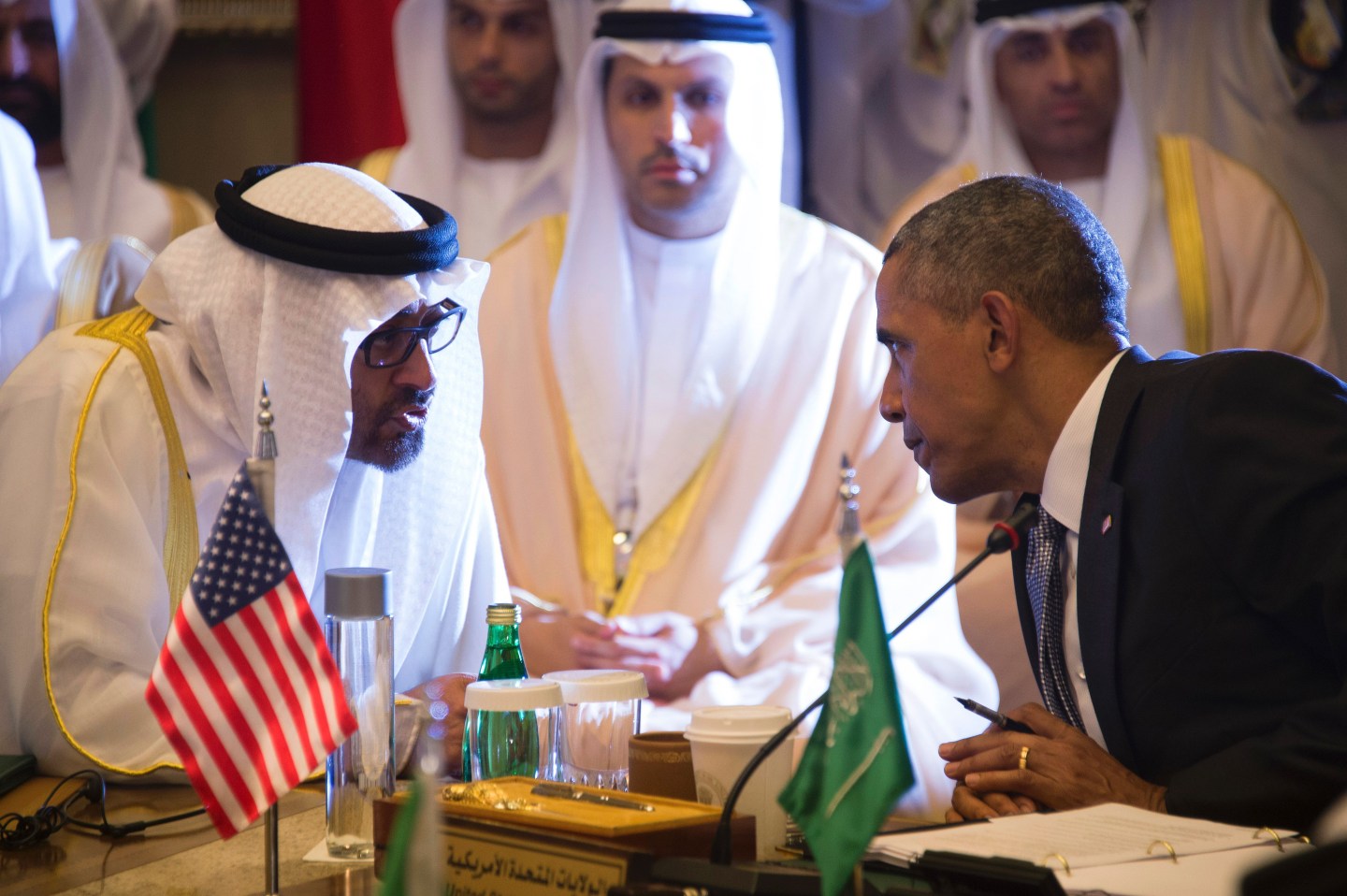
Last week, President Obama visited Riyadh with the Sunni Arab Gulf leaders, and the usual façade of amity of the Middle East monarchies prevailed. Washington says it supports Gulf security, in particular with massive arms sales and a U.S. military presence that absorbs 15% or so of the Pentagon’s budget. The Gulf countries say they oppose the Islamic State, in particular in Syria and Iraq. But underneath the façade, tectonic plates are moving apart. Both Washington and the Sunni Arab monarchies know it.
America is far less vulnerable to a cutoff of Middle East oil supplies than it once was. It is producing more and importing less. Its economy is less dependent on energy than 20 years ago, it has a Strategic Petroleum Reserve of more than 90 days of imports, and has eliminated price controls that aggravated past shortages. A cutoff of supplies coming from the Gulf would still bump up world oil prices, causing worldwide economic damage, but China and India are the big and growing consumers of Middle Eastern oil, not the U.S.
Terrorism remains a major American concern, but 15 years of whack-a-mole with its various protagonists—Al Qaeda, Al Qaeda in Iraq, Al Qaeda in the Arabian Peninsula, and the Islamic State in Syria, Iraq, Libya, Afghanistan, and Yemen—have done nothing to make extremism shrink, and may even have helped it recruit and grow. The Americans think extremists will thrive until Middle Eastern countries learn to govern in more orderly, inclusive, and open ways.
None of the Gulf countries is much inclined in that direction. Saudi Arabia has incubated the Wahabi ideology that Islamist extremists now espouse. The Kingdom’s experiments with women voting and local elections have been minimalist. With the modest exception of Kuwait, which owes its restoration to Washington, the Gulf monarchies are at best uninterested in American support for inclusive and open societies. Some actively oppose it.
The split is even more dramatic on Iran. The United States has prioritized blocking the Iranian nuclear program, which looked likely to produce nuclear weapons in less than five years. The nuclear deal postpones that possibility for as many as 15 years. But the Gulf monarchies are far more worried about Iran’s subversion of Arab states in the region: Lebanon, Yemen, Iraq, and Syria. The U.S. doesn’t like that either, but at least some in the U.S. administration hope Iran will at least make common cause against Sunni extremism.
Notably muted among Arab Gulf concerns is the Palestinian cause, which in the past was a major source of friction with the U.S. President Obama has continued to provide unconditional security support to Israel. But now the Arab Gulf states and Israel share a preoccupation with Iran that overshadows Israel’s wars against Iran-supported Hamas in Gaza and expanding settlements on the West Bank.
Tectonic plates move slowly. It may still be a long time before there is a major change in America’s relations with the Arab Gulf states. The Administration and Congress still seem determined to keep any Saudi role in the 9/11 attacks secret and to block legislation that would allow lawsuits against the Kingdom for the 9/11 attacks. Washington is not pressing the Gulf monarchies hard on human rights issues and has given up conditioning aid to Egypt on its human rights performance, largely because of pressure from the Gulf. There is no sign of American reluctance to sell arms in the Gulf or to support Israel’s security with high-technology weapons and funding.
But the Americans are already trying hard to shift burdens to others and reduce their own. President Obama believes the Sunni Arab countries are free riders on the large American security presence in the Gulf. He wants them not only arming themselves but also trying to reach an accommodation with Iran on regional security issues. The Administration thinks both the Arab and Persian sides of the Gulf would benefit from some sort of regional security architecture that reduces sectarian frictions and avoids proxy wars.
That would in turn allow the U.S. to withdraw more from the Middle East, without leaving a vacuum that extremists would be glad to fill. Tectonic plates move slowly, but they move and cause earthquakes. More big shifts in America’s Middle East policy are still to come.
Daniel Serwer is professor and director of conflict management at the Johns Hopkins School of Advanced International Studies and a scholar at the Middle East Institute. He tweets @DanielSerwer.