• Home
  • Latest
  • Fortune 500
  • Finance
  • Tech
  • Leadership
  • Lifestyle
  • Rankings
  • Multimedia
Commentary

What a Contested Convention Would Mean for Bernie Sanders

By
Ben Railton
Down Arrow Button Icon
By
Ben Railton
Down Arrow Button Icon
April 25, 2016, 8:00 PM ET
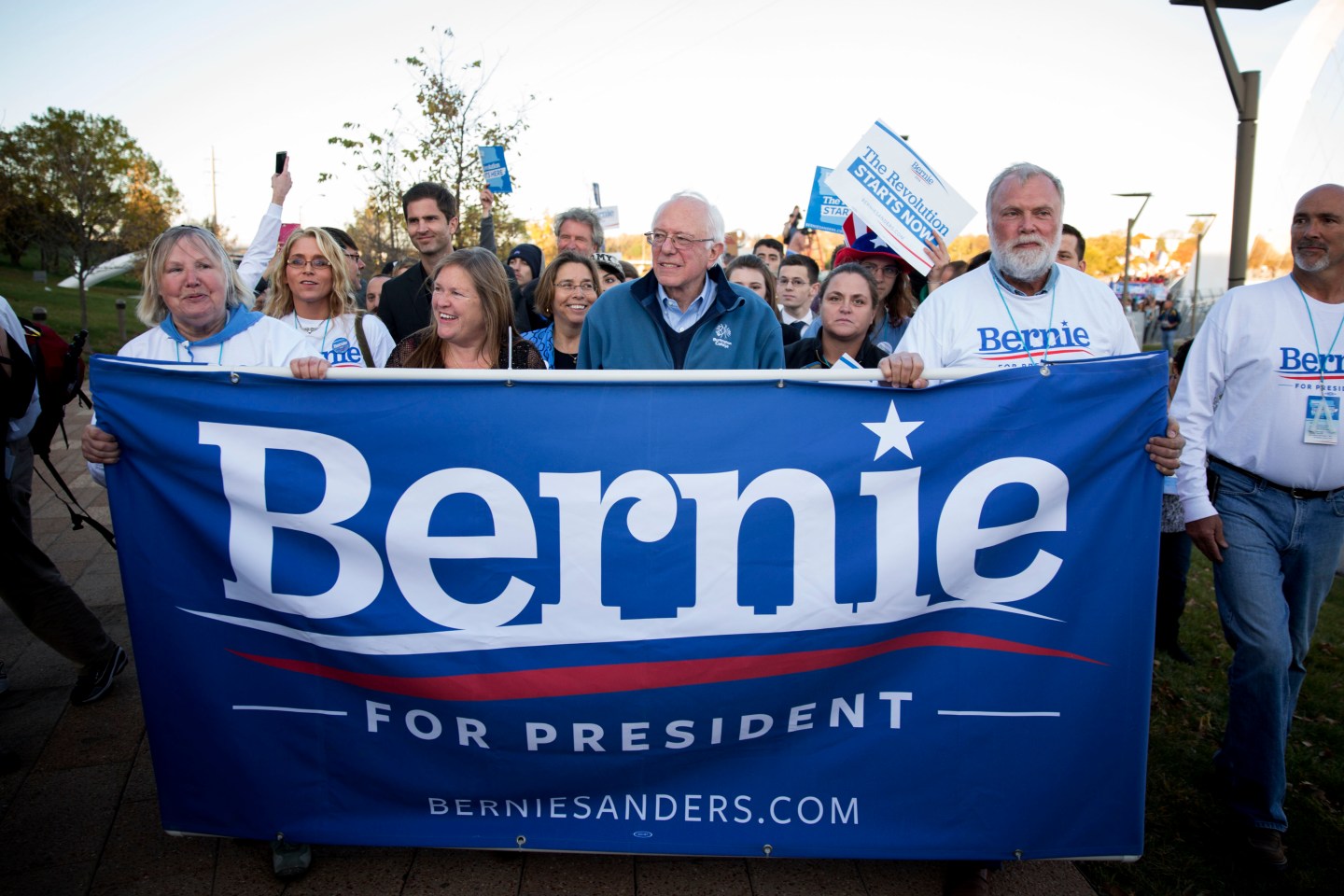
Presidential Candidates Speak At Iowa Democratic Party Jefferson-Jackson Dinner
Senator Bernie Sanders, an independent from Vermont and 2016 Democratic presidential candidate, leads a group of supporters across a bridge ahead of the Jefferson-Jackson Dinner in Des Moines, Iowa, U.S., on Saturday, Oct. 24, 2015. With Vice President Joe Biden officially out of the presidential race, the nation's first nominating contest between front-runner Hillary Clinton and Sanders is gaining steam, according to a new Bloomberg Politics/Des Moines Register Iowa Poll. Photographer: Daniel Acker/Bloomberg via Getty ImagesPhotograph by Daniel Acker — Bloomberg via Getty Images

Given Tuesday’s slate of primaries, there’s a good chance that it will no longer be mathematically possible for Bernie Sanders to secure sufficient delegates and superdelegates to win the Democratic presidential nomination. Yet even if that scenario occurs, whether Tuesday or at any other moment, Sanders has pledged to continue his campaign through the late July Democratic National Convention in Philadelphia, raising the strong possibility of a contested convention.

The question, however, is not whether there’ll be a contested convention, but rather what kind of contested convention Sanders and his supporters might produce. If we examine the history of contested conventions in prior presidential campaigns (there have been 18 total since 1868), two clear, distinct trends emerge: destructive contests that resulted in divisions between political parties; and those that contributed instead to constructive conversations and significant political and social progress.

For the worst case on the Democratic side, two 20th century contested conventions reflected and extended the party’s ideological splintering on issues of race and culture. In 1924, Ku Klux Klan members and other white supremacists attacked the Catholic Democratic front-runner, Governor Alfred Smith of New York, leading to a convention that went through more than 103 ballots before settling on a compromise candidate, West Virginia Congressman John W. Davis. And in 1948, the entire delegations from Mississippi and Alabama (among other Southern delegates) walked out of the convention to protest the party’s addition of a civil rights plank to its platform; these delegates would help create the new Dixiecrat Party, which nominated Strom Thurmond in opposition to Democratic nominee Harry Truman.

See also: Why 2016 Political Conventions Can’t Attract Corporate Sponsors

Both the 1924 and 1948 contested convention signaled deep ideological and social divisions, but led to debates and policies that furthered — and worsened — those divisions. If Sanders and his supporters emulate these prior conventions, whether by opposing the nomination of Hillary Clinton at all costs, walking out to form a third party, or seeking to nominate their own candidate by capitalizing on party and national divisions, these historical examples — moments of infighting and ideological extremism that pulled both party and nation apart — bode poorly for the results.

Yet a contested 2016 Democratic convention doesn’t have to follow those models, and the more constructive historical examples suggest vital alternatives. Two of the most influential 20th century Democratic presidents, Woodrow Wilson and Franklin Delano Roosevelt, were nominated in their initial presidential campaigns at contested conventions. In 1912 the Progressive Wilson needed 46 ballots to secure the nomination against a far more conservative front-runner, Missouri Congressman Champ Clark; while in 1932 Roosevelt needed four ballots to secure it over Speaker of the House John Nance Garner and KKK favorite William Gibbs McAdoo.

In both cases, the contested conventions and the debates they produced continued in meaningful ways into the men’s presidencies: Wilson’s opposition to Tammany Hall, the conservative political machine that had endorsed Clark, helped him refine and articulate his own Progressive platform; while Roosevelt chose Garner as his VP running mate and in his convention acceptance speech promised to provide “a new deal for the American people” (the first such framing of his overarching plan to battle the Depression).

Offering even more overt models for candidates exerting influence despite suffering defeat at a contested convention are the examples of Richard Bland and Robert Pattison at the 1896 Democratic convention. Although it was the populist Senator William Jennings Bryan who was nominated on the convention’s fifth ballot, the anti-imperialist Bland and the anti-corporate Pattison both helped pull the Democratic party and its platform in significant new directions, ones that would influence the party’s opposition to President William McKinley’s imperial ventures and contribute to the rise of the Progressive movement.

It’s a separate question, of course, whether these contested conventions helped or hindered their party’s electoral chances. In truth, the results seem mixed: Truman, Hayes, Wilson, and Roosevelt won their respective elections, while Davis and Bryan lost theirs; overall, only seven of the 18 eighteen candidates nominated at contested conventions went on to win the presidency. Yet Sanders would be the first to note that the goal isn’t simply or even principally winning the 2016 election; it’s influencing both a party and a national conversation for many years to come. To achieve that end, he and his supporters can’t just angle for a contested convention—they (along with Clinton and her supporters, to be sure) have to work to make it a constructive rather than destructive conversation, one that contributes to policy debates and social progress rather than reflecting and furthering party divisions.

Ben Railton is a professor of english studies at Fitchburg State University.

About the Author
By Ben Railton
See full bioRight Arrow Button Icon

Latest in Commentary

Finance
Lorem ipsum dolor sit amet, consectetur adipiscing elit, sed do eiusmod tempor incididunt ut labore et dolore magna aliqua. Ut enim ad minim veniam
By Fortune Editors
October 20, 2025
Finance
Lorem ipsum dolor sit amet, consectetur adipiscing elit, sed do eiusmod tempor incididunt ut labore et dolore magna aliqua. Ut enim ad minim veniam
By Fortune Editors
October 20, 2025
Finance
Lorem ipsum dolor sit amet, consectetur adipiscing elit, sed do eiusmod tempor incididunt ut labore et dolore magna aliqua. Ut enim ad minim veniam
By Fortune Editors
October 20, 2025
Finance
Lorem ipsum dolor sit amet, consectetur adipiscing elit, sed do eiusmod tempor incididunt ut labore et dolore magna aliqua. Ut enim ad minim veniam
By Fortune Editors
October 20, 2025
Finance
Lorem ipsum dolor sit amet, consectetur adipiscing elit, sed do eiusmod tempor incididunt ut labore et dolore magna aliqua. Ut enim ad minim veniam
By Fortune Editors
October 20, 2025
Finance
Lorem ipsum dolor sit amet, consectetur adipiscing elit, sed do eiusmod tempor incididunt ut labore et dolore magna aliqua. Ut enim ad minim veniam
By Fortune Editors
October 20, 2025

Most Popular

Finance
Lorem ipsum dolor sit amet, consectetur adipiscing elit, sed do eiusmod tempor incididunt ut labore et dolore magna aliqua. Ut enim ad minim veniam
By Fortune Editors
October 20, 2025
Finance
Lorem ipsum dolor sit amet, consectetur adipiscing elit, sed do eiusmod tempor incididunt ut labore et dolore magna aliqua. Ut enim ad minim veniam
By Fortune Editors
October 20, 2025
Finance
Lorem ipsum dolor sit amet, consectetur adipiscing elit, sed do eiusmod tempor incididunt ut labore et dolore magna aliqua. Ut enim ad minim veniam
By Fortune Editors
October 20, 2025
Finance
Lorem ipsum dolor sit amet, consectetur adipiscing elit, sed do eiusmod tempor incididunt ut labore et dolore magna aliqua. Ut enim ad minim veniam
By Fortune Editors
October 20, 2025
Finance
Lorem ipsum dolor sit amet, consectetur adipiscing elit, sed do eiusmod tempor incididunt ut labore et dolore magna aliqua. Ut enim ad minim veniam
By Fortune Editors
October 20, 2025
Finance
Lorem ipsum dolor sit amet, consectetur adipiscing elit, sed do eiusmod tempor incididunt ut labore et dolore magna aliqua. Ut enim ad minim veniam
By Fortune Editors
October 20, 2025
Rankings
  • 100 Best Companies
  • Fortune 500
  • Global 500
  • Fortune 500 Europe
  • Most Powerful Women
  • Future 50
  • World’s Most Admired Companies
  • See All Rankings
Sections
  • Finance
  • Leadership
  • Success
  • Tech
  • Asia
  • Europe
  • Environment
  • Fortune Crypto
  • Health
  • Retail
  • Lifestyle
  • Politics
  • Newsletters
  • Magazine
  • Features
  • Commentary
  • Mpw
  • CEO Initiative
  • Conferences
  • Personal Finance
  • Education
Customer Support
  • Frequently Asked Questions
  • Customer Service Portal
  • Privacy Policy
  • Terms Of Use
  • Single Issues For Purchase
  • International Print
Commercial Services
  • Advertising
  • Fortune Brand Studio
  • Fortune Analytics
  • Fortune Conferences
  • Business Development
About Us
  • About Us
  • Editorial Calendar
  • Press Center
  • Work At Fortune
  • Diversity And Inclusion
  • Terms And Conditions
  • Site Map

© 2025 Fortune Media IP Limited. All Rights Reserved. Use of this site constitutes acceptance of our Terms of Use and Privacy Policy | CA Notice at Collection and Privacy Notice | Do Not Sell/Share My Personal Information
FORTUNE is a trademark of Fortune Media IP Limited, registered in the U.S. and other countries. FORTUNE may receive compensation for some links to products and services on this website. Offers may be subject to change without notice.


Most Popular

placeholder alt text
Economy
The $38 trillion national debt is to blame for over $1 trillion in annual interest payments from here on out, CRFB says
By Nick LichtenbergDecember 17, 2025
1 day ago
placeholder alt text
AI
'Robots are going to be amongst us': Qualcomm exec says buckle up for the next 5 years. Your car is going to be the first shoe to drop
By Nino PaoliDecember 17, 2025
2 days ago
placeholder alt text
C-Suite
Red Lobster CEO Damola Adamolekun says the key to being a better leader is being a better person: ‘Leadership is self-improvement’
By Sydney LakeDecember 17, 2025
1 day ago
placeholder alt text
Success
As millions of Gen Zers face unemployment, McDonald's CEO dishes out some tough love career advice for navigating the market: ‘You've got to make things happen for yourself’
By Preston ForeDecember 16, 2025
2 days ago
placeholder alt text
Success
Britain’s defense chief calls on Gen Z grads leaving university to skip corporate jobs and join the military as war with Russia becomes a growing risk
By Emma BurleighDecember 17, 2025
1 day ago
placeholder alt text
AI
Amazon CEO Andy Jassy announces departure of AI exec Rohit Prasad in leadership shake-up
By Sharon GoldmanDecember 17, 2025
1 day ago

Latest in Commentary

unemployed
CommentaryLayoffs
The AI efficiency illusion: why cutting 1.1 million jobs will stifle, not scale, your strategy
By Katica RoyDecember 18, 2025
8 hours ago
Muddu
CommentaryIT
IT service is reaching its breaking point. At Salesforce, we see 3 tipping points
By Muddu SudhakarDecember 18, 2025
12 hours ago
small business
CommentaryLayoffs
Our data shows that companies of 500 and fewer workers mostly avoided the AI layoffs. They’re making AI work for them
By Gabby BurlacuDecember 18, 2025
12 hours ago
Sophia Romee is the General Manager of the GenAI Studio at the College Board
CommentaryEducation
Gen Z is on the fence about AI in the classroom. That’s a good thing
By Sophia RomeeDecember 18, 2025
12 hours ago
Tim Parker
CommentaryAutos
How Bentley’s brand is creating business advantage in disruptive times 
By Tim ParkerDecember 18, 2025
16 hours ago
layoffs
CommentaryLayoffs
The AI layoff wave is just beginning — and it’s by design
By Kevin OakesDecember 17, 2025
2 days ago










