• Home
  • Latest
  • Fortune 500
  • Finance
  • Tech
  • Leadership
  • Lifestyle
  • Rankings
  • Multimedia
CommentaryChina

Here’s How China Is Building the Car of the Future

By
Sebastian Heilmann
Sebastian Heilmann
Down Arrow Button Icon
By
Sebastian Heilmann
Sebastian Heilmann
Down Arrow Button Icon
April 24, 2016, 8:00 PM ET
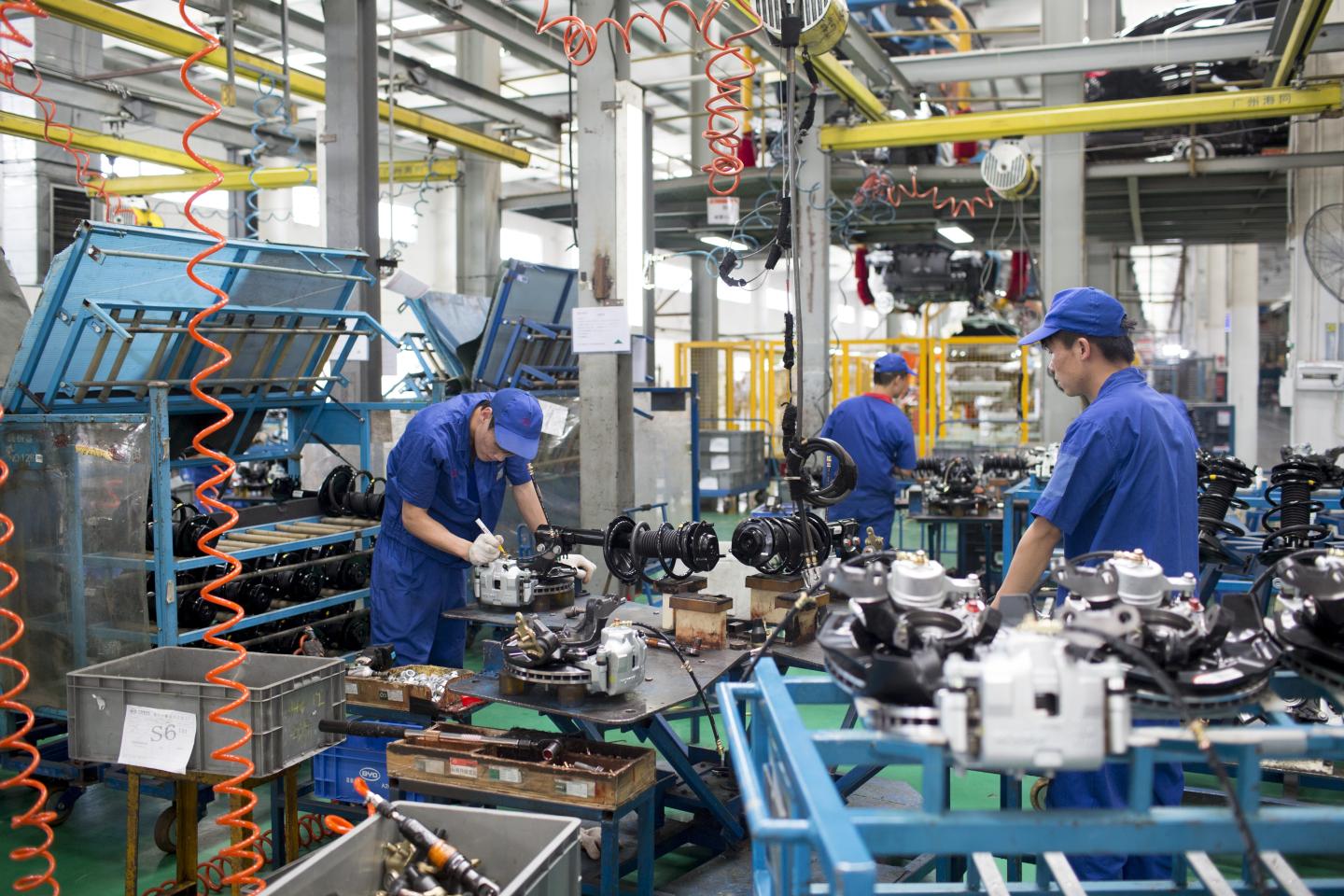
Inside BYD Co.'s Vehicle Assembly Plant and Headquarters
Employees assemble brake pads for BYD Co. S6 sport-utility vehicles (SUV) at the company's assembly plant in the Pingshan district of Shenzhen, China, on Tuesday, Aug. 5, 2014. Photographer: Brent Lewin/Bloomberg via Getty ImagesPhotograph by Brent Lewin — Bloomberg via Getty Images

The Detroit Auto Show has long set the tone for the global car industry, but a new player on the other side of the world could prove to be a bigger player. As the Beijing Motor Show begins on Monday, it’s worth taking a closer look at China’s auto industry.

True, China has a long way to go. The world’s second largest economy still doesn’t have any top-notch car manufacturers. Western companies look at the Chinese market as important for their sales, but not with regard to technological innovations.

Just how could China get the upper hand? The key race in the global automotive industry is all about the connected car – what China’s automotive industry leaders dubs the “Internet of Vehicles.” It is important to realize that China has a number of natural advantages in this arena – as well as less “natural” ones.

China’s first advantage is that it does not have to contend with the rather small, “balkanized” markets found in Western countries. That makes the required scaling up much easier in China than elsewhere.

The second is the ease of industrial and regulatory integration. Consider all the industries and sectors that have to align their interests and technologies in order to make the connected car a reality. These include smartphone makers, telecom firms, Internet companies, satellite navigation and traffic management firms, insurance firms, as well as car manufacturers themselves.

In Western countries, there are many established players, each with their own particular agendas and conflicting goals. These incumbents exercise a lot of power, both politically and in the marketplace itself. All too often, their primary objective is to jealously protect their own turf against any other company, sector or industry in the connectivity field – even if the net result is mutual paralysis.

Contrast that with China. There, industry operates in a more top-down way. Industrial policy, actively shaped by the government, is embraced, not resisted. There also is discernably more readiness to cooperate at the behest of the government. In addition, China’s domestic market is so large that most players have a sense that they should be able to get a viable share of the pie.

The sense of excitement and national pride also includes a clear ambition to leapfrog Western competitors. While Chinese car companies are still playing catch-up on manufacturing quality, the cards are distributed anew now that the connectivity issue ranks above all.

The shift to e-mobility helps the Chinese as well. Electric cars are far less “engineering intense” than traditional combustion engines. This great leveler of the playing field helps explain why Chinese Internet companies are so determined to develop their own electric cars. They can also count on the Chinese government to subsidize the sales of those vehicles on a large-scale basis.

Finally, customer expectations as to vehicle quality are less demanding than in other major countries. Combined, these factors allow China to make the grand vision of twinning e-mobility and the Internet of Vehicles a reality there first.

Meanwhile, in Western countries, doubts about China’s ability to innovate prevail, leading to a great deal of complacency. The sentiment often expressed is that Chinese firms are good at copycatting and perhaps at cyber espionage, but that there is precious little domestically generated innovation.

Whatever the ultimate truth, and it will take a long time to come up with a definitive answer, it simply does not behoove Western firms to assume that China is deficient in that regard. What if that assumption proves to be untrue? The West cannot base its future competitiveness on culturally induced notions of superiority.

So much for what could be considered China’s natural advantages. What about the more “unnatural” ones? Just consider the case of Google (GOOGL). The Chinese authorities’ long-standing efforts to keep Google from gaining a solid foothold in China were long seen in the West as a matter of impeding the free flow of information. In the connected car context, however, cutting big U.S. data gatherers out of the Chinese market means that they can’t be players in the connected car market, as well as in many other dimensions of the Industrial Internet.

There are other geostrategic considerations that enter into the equation. Take the effort by Chinese defense companies to use their proprietary Beidou navigation technology as the backbone of the connected car system in China. This effort is about head-to-head competition with the United States.

The ultimate goal is not just to push the U.S.’s GPS out of the Chinese market. Chinese firms also realize that there is a global race underway – not least over who will dominate connected car systems in Asia’s and Africa’s traffic-congested metro areas. In line with the Chinese government’s goal of moving more toward services and up the value-added curve, the country’s clear ambition is to become the preferred provider in those markets as well.

It remains to be seen whether China can realize its manifold ambitions surrounding the Internet of Vehicles. However, Western firms who are inclined to belittle, or disregard, the rather enormous competition that may be heading their way do so at their own peril. China has a handful of potent advantages that, in the specific context of the Internet of Vehicles, give it a fair shot at playing a leading role globally.

Sebastian Heilmann is president of the Mercator Institute for China Studies (MERICS), a Berlin, Germany-based think tank on China.

About the Author
By Sebastian Heilmann
See full bioRight Arrow Button Icon

Latest in Commentary

Finance
Lorem ipsum dolor sit amet, consectetur adipiscing elit, sed do eiusmod tempor incididunt ut labore et dolore magna aliqua. Ut enim ad minim veniam
By Fortune Editors
October 20, 2025
Finance
Lorem ipsum dolor sit amet, consectetur adipiscing elit, sed do eiusmod tempor incididunt ut labore et dolore magna aliqua. Ut enim ad minim veniam
By Fortune Editors
October 20, 2025
Finance
Lorem ipsum dolor sit amet, consectetur adipiscing elit, sed do eiusmod tempor incididunt ut labore et dolore magna aliqua. Ut enim ad minim veniam
By Fortune Editors
October 20, 2025
Finance
Lorem ipsum dolor sit amet, consectetur adipiscing elit, sed do eiusmod tempor incididunt ut labore et dolore magna aliqua. Ut enim ad minim veniam
By Fortune Editors
October 20, 2025
Finance
Lorem ipsum dolor sit amet, consectetur adipiscing elit, sed do eiusmod tempor incididunt ut labore et dolore magna aliqua. Ut enim ad minim veniam
By Fortune Editors
October 20, 2025
Finance
Lorem ipsum dolor sit amet, consectetur adipiscing elit, sed do eiusmod tempor incididunt ut labore et dolore magna aliqua. Ut enim ad minim veniam
By Fortune Editors
October 20, 2025

Most Popular

Finance
Lorem ipsum dolor sit amet, consectetur adipiscing elit, sed do eiusmod tempor incididunt ut labore et dolore magna aliqua. Ut enim ad minim veniam
By Fortune Editors
October 20, 2025
Finance
Lorem ipsum dolor sit amet, consectetur adipiscing elit, sed do eiusmod tempor incididunt ut labore et dolore magna aliqua. Ut enim ad minim veniam
By Fortune Editors
October 20, 2025
Finance
Lorem ipsum dolor sit amet, consectetur adipiscing elit, sed do eiusmod tempor incididunt ut labore et dolore magna aliqua. Ut enim ad minim veniam
By Fortune Editors
October 20, 2025
Finance
Lorem ipsum dolor sit amet, consectetur adipiscing elit, sed do eiusmod tempor incididunt ut labore et dolore magna aliqua. Ut enim ad minim veniam
By Fortune Editors
October 20, 2025
Finance
Lorem ipsum dolor sit amet, consectetur adipiscing elit, sed do eiusmod tempor incididunt ut labore et dolore magna aliqua. Ut enim ad minim veniam
By Fortune Editors
October 20, 2025
Finance
Lorem ipsum dolor sit amet, consectetur adipiscing elit, sed do eiusmod tempor incididunt ut labore et dolore magna aliqua. Ut enim ad minim veniam
By Fortune Editors
October 20, 2025
Fortune Secondary Logo
Rankings
  • 100 Best Companies
  • Fortune 500
  • Global 500
  • Fortune 500 Europe
  • Most Powerful Women
  • Future 50
  • World’s Most Admired Companies
  • See All Rankings
Sections
  • Finance
  • Fortune Crypto
  • Features
  • Leadership
  • Health
  • Commentary
  • Success
  • Retail
  • Mpw
  • Tech
  • Lifestyle
  • CEO Initiative
  • Asia
  • Politics
  • Conferences
  • Europe
  • Newsletters
  • Personal Finance
  • Environment
  • Magazine
  • Education
Customer Support
  • Frequently Asked Questions
  • Customer Service Portal
  • Privacy Policy
  • Terms Of Use
  • Single Issues For Purchase
  • International Print
Commercial Services
  • Advertising
  • Fortune Brand Studio
  • Fortune Analytics
  • Fortune Conferences
  • Business Development
  • Group Subscriptions
About Us
  • About Us
  • Editorial Calendar
  • Press Center
  • Work At Fortune
  • Diversity And Inclusion
  • Terms And Conditions
  • Site Map
  • About Us
  • Editorial Calendar
  • Press Center
  • Work At Fortune
  • Diversity And Inclusion
  • Terms And Conditions
  • Site Map
  • Facebook icon
  • Twitter icon
  • LinkedIn icon
  • Instagram icon
  • Pinterest icon

Latest in Commentary

hormuz
CommentaryIran
With Hormuz under strain, a trade corridor built for resilience faces a real-world test
By Angela Chitkara and Samantha SuttonApril 17, 2026
3 hours ago
broker
CommentarySoftware
The 3 forces quietly dismantling the business model that made enterprise software fabulously profitable
By Michael Jacobides and Stefano PuntoniApril 17, 2026
4 hours ago
welti
CommentaryIran
Switzerland’s former ambassador to Iran: here’s how to end this war — and why Pakistan isn’t enough
By Philippe WeltiApril 17, 2026
10 hours ago
Anita Beveridge-Raffo is Head of Retail and Consumer Goods at Palantir Technologies
CommentaryAI agents
Palantir exec: the biggest mistake retailers are making with AI? Trying to do it all with one agent
By Anita Beveridge-RaffoApril 16, 2026
1 day ago
wyle
CommentaryHealth
‘The Pitt’ reveals why healthcare desperately needs a new front door
By Jeremy MorganApril 16, 2026
1 day ago
health
CommentaryHealth Care Service
Two physicians on ending the waiting-room era: bring care home
By Benjamin Kornitzer and Bill FristApril 16, 2026
1 day ago

Most Popular

A world going broke: IMF says America's $39 trillion national debt is actually a global problem—and AI may be the only rescue
Economy
A world going broke: IMF says America's $39 trillion national debt is actually a global problem—and AI may be the only rescue
By Nick LichtenbergApril 16, 2026
21 hours ago
Jeff Bezos pledged $10 billion for climate change. With the 2030 clock ticking, his wife, Lauren Sánchez Bezos, is leading the charge to spend it
Environment
Jeff Bezos pledged $10 billion for climate change. With the 2030 clock ticking, his wife, Lauren Sánchez Bezos, is leading the charge to spend it
By Sydney LakeApril 15, 2026
2 days ago
Pope Leo warned the world is in ‘big trouble’ if Elon Musk becomes the first trillionaire
Success
Pope Leo warned the world is in ‘big trouble’ if Elon Musk becomes the first trillionaire
By Preston ForeApril 17, 2026
7 hours ago
Germany already told its workers to ditch four-day weeks and work-life balance. Now the government wants to cut their pay for calling in sick, too
Success
Germany already told its workers to ditch four-day weeks and work-life balance. Now the government wants to cut their pay for calling in sick, too
By Orianna Rosa RoyleApril 16, 2026
1 day ago
MacKenzie Scott is bypassing the Ivy League and rewriting the $79 billion higher ed playbook by giving to HBCUs and community colleges
Politics
MacKenzie Scott is bypassing the Ivy League and rewriting the $79 billion higher ed playbook by giving to HBCUs and community colleges
By Sydney LakeApril 16, 2026
1 day ago
Current price of oil as of April 16, 2026
Personal Finance
Current price of oil as of April 16, 2026
By Joseph HostetlerApril 16, 2026
1 day ago

© 2026 Fortune Media IP Limited. All Rights Reserved. Use of this site constitutes acceptance of our Terms of Use and Privacy Policy | CA Notice at Collection and Privacy Notice | Do Not Sell/Share My Personal Information
FORTUNE is a trademark of Fortune Media IP Limited, registered in the U.S. and other countries. FORTUNE may receive compensation for some links to products and services on this website. Offers may be subject to change without notice.