• Home
  • Latest
  • Fortune 500
  • Finance
  • Tech
  • Leadership
  • Lifestyle
  • Rankings
  • Multimedia
CommentaryDonald Trump

How Occupy Wall Street Led to the Rise of Donald Trump

By
Euel Elliott
Euel Elliott
and
Bethany Cianciolo
Bethany Cianciolo
Down Arrow Button Icon
By
Euel Elliott
Euel Elliott
and
Bethany Cianciolo
Bethany Cianciolo
Down Arrow Button Icon
March 23, 2016, 5:00 AM ET
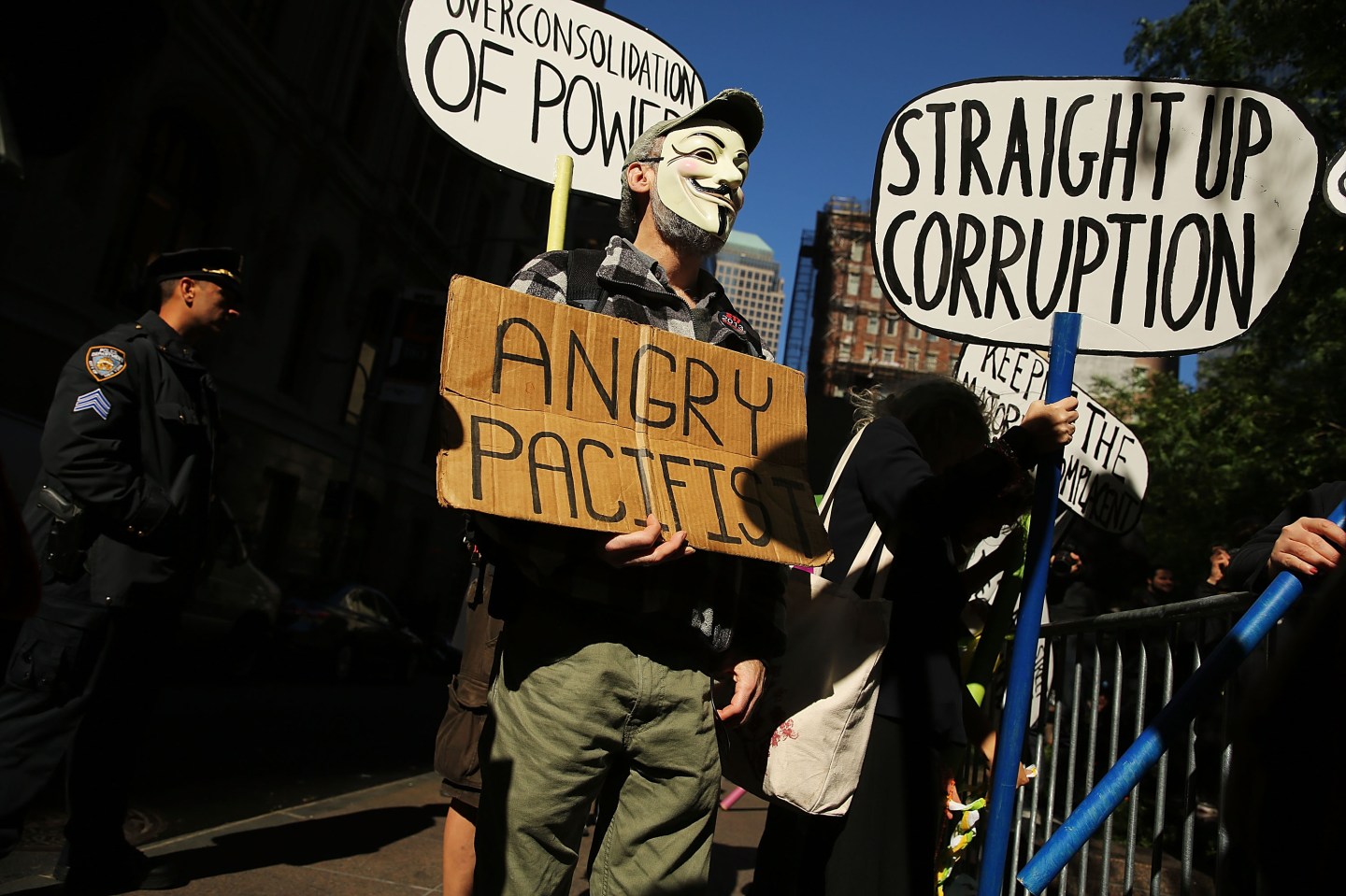
Occupy Wall Street Activists Mark 2 Year Anniversary Of Movement
NEW YORK, NY - SEPTEMBER 17: Protesters affiliated with Occupy Wall Street demonstrate for a variety of causes at Zuccotti Park near the New York Stock Exchange on the second anniversary of the movement on September 17, 2013 in New York City. Numerous rallies and events across the city were planned for the movement which takes aim at inequality and financial greed and which has influenced activist moments around the world. While police presence was high in New York, with a helicopter flying above the park, no incidents had been reported by the afternoon. (Photo by Spencer Platt/Getty Images)Photograph by Spencer Platt via Getty Images

Seven years ago, the Tea Party movement came into being, and since then has been an almost continuous thorn in the side of the Republican Party establishment. Just two years later, Occupy Wall Street burst onto the scene, using Zuccotti Park as a staging ground in New York City, spawning marches, demonstrations, and other protests in numerous cities in the months ahead. And despite their differences, the populist, anti-elite, and anti-establishment forces at work in both movements have manifested themselves in bold relief within the presidential campaigns of Donald Trump, Ted Cruz, and Bernie Sanders.

To be sure, the Tea Party and Occupy Wall Street-ers were in many respects, to pardon the pun, radically different. Tea Partiers tend to be heavily white (although not necessarily exclusively), conservative, and Republican Party identifiers or Republican-leaning independents. Their agenda was a fairly standard conservative emphasis on balanced budgets, debt reduction, Second Amendment rights, and more restrictive immigration policy, viewing illegal immigration through the lens of the rule of law or “not playing by the rules.” Tea partiers identify as strict constitutionalists (as defined by conservatives), with a fairly large measure of religious beliefs and unashamed traditional patriotism.

Most in the Tea Party movement would likely not be impressed by, or identify with, the more counter-culture-like denizens of Zuccotti Park (and elsewhere). Nor would those who participated in the activities surrounding Occupy Wall Street be swayed by the rural and suburban all-American types who make up the Tea Party.

But while different in many respects, both groups shared one common characteristic: a deep and abiding disdain—and even hostility—for the political elites and political establishment they believe betrayed them, betrayed the nation, and left them to fend for themselves. Yes, Tea Partiers are particularly bitter at what they see as an out-of-touch Republican establishment and an utterly arrogant federal bureaucracy, while Occupy Wall Street-ers have vented their frustration at what they see as the financial elites of Wall Street and multinational corporations, but the broader critique of American politics is not drastically different. For both groups, the founding principles of Republican government and representative democracy no longer work. The system, in their view, is broken.

And now, both the Tea Party and Occupy Wall Street have fallen on hard times. Occupy Wall Street no longer exists, though it has surely helped to spawn offshoots, including Black Lives Matter. The Tea Party is still around, but has seemingly faded in visibility, though it’s still more than capable of discouraging Republicans from negotiating compromises with Democrats on anything that touches on the bedrock principles of the movement.


Within the Republican Party, Trump and Cruz, to the horror of the party wise men, have accumulated more than 75% of the delegates to date, and won the vast majority of votes in the Republican primaries. The two leading voices of anti-establishment politics in the Republican Party have routed the party traditionalists, and one of them almost certainly will be the Republican nominee, as the “stop-Trump” movement seems to be running out of gas. On the Democratic side, it is Bernie Sanders, a 74-year-old, self-declared socialist who has taken on Hillary Clinton and the Democratic Party establishment. While having no chance to win, Sanders has unleashed forces that are unlikely to simply disappear after the election.

But it is Donald Trump who appears to have best captured the complex populist currents that are abroad in the land today. It is no surprise that Trump’s support defies easy ideological pigeonholing, and it is that in large part that makes the prospect of his nomination anathema to the Republican establishment and to the cultural and media elites who look down upon the kind of people who are most attracted to Trump’s candidacy: mostly white, not necessarily well-educated, and working class or struggling middle-class types who have tried to play by the rules and find themselves being given short shrift by those for whom they have voted, of both parties. They’re concerned about jobs and wages, and view their children’s future as grim. So when someone like Trump comes along and articulates a message that tells them essentially what they already know, why should anyone be shocked that he has emerged as a threat to the Republican establishment, and the political and cultural elites on the coasts? There was a hunger for someone to provide a message like what Trump is offering—that the cozy Wall Street-Washington nexus cares nothing about them and it is time to take matters into their own hands and reject the blandishments of those who have put them in the state they are in. It was Trump’s genius to be able to understand and articulate that message, and to articulate a message that obliterates the traditional liberal-conservative ideological cleavages.

This is why the 2016 election is so unpredictable. The Republican Party needs to face the simple fact that the kind of message it has been articulating leaves out vast swathes of the electorate for whom the standard fare they have offered election after election is no longer relevant, or at a minimum, is not enough.

While it may well be the case that Trump’s idiosyncrasies and limitations as a candidate will ultimately prove to be his undoing, and while all the smart money—contributions by elites, corporations, and banks—is on Clinton in the November election, the next several months may well be among the most earthshaking in our electoral history. Who would have thought a year ago that a loud-mouthed real estate tycoon and erstwhile reality television show star from New York would be able to articulate a message that may reshape the contours of American politics? It has happened before: Andrew Jackson was despised by the elites of the day, and so was William Jennings Bryan. Both found themselves at the head of movements larger than themselves, which ultimately helped reshape American politics. To dismiss Trump as simply a joke, or worse, some bigoted authoritarian, would be to make an enormous blunder. Whatever happens at the Republican convention, or in the general election, we ignore the voters (and Donald Trump’s message) at our own peril.

Dr. Euel Elliott is a professor of public policy and political economy and the senior associate dean in the School of Economic, Political and Policy Sciences at the University of Texas at Dallas.


About the Authors
By Euel Elliott
See full bioRight Arrow Button Icon
By Bethany Cianciolo
See full bioRight Arrow Button Icon

Latest in Commentary

Finance
Lorem ipsum dolor sit amet, consectetur adipiscing elit, sed do eiusmod tempor incididunt ut labore et dolore magna aliqua. Ut enim ad minim veniam
By Fortune Editors
October 20, 2025
Finance
Lorem ipsum dolor sit amet, consectetur adipiscing elit, sed do eiusmod tempor incididunt ut labore et dolore magna aliqua. Ut enim ad minim veniam
By Fortune Editors
October 20, 2025
Finance
Lorem ipsum dolor sit amet, consectetur adipiscing elit, sed do eiusmod tempor incididunt ut labore et dolore magna aliqua. Ut enim ad minim veniam
By Fortune Editors
October 20, 2025
Finance
Lorem ipsum dolor sit amet, consectetur adipiscing elit, sed do eiusmod tempor incididunt ut labore et dolore magna aliqua. Ut enim ad minim veniam
By Fortune Editors
October 20, 2025
Finance
Lorem ipsum dolor sit amet, consectetur adipiscing elit, sed do eiusmod tempor incididunt ut labore et dolore magna aliqua. Ut enim ad minim veniam
By Fortune Editors
October 20, 2025
Finance
Lorem ipsum dolor sit amet, consectetur adipiscing elit, sed do eiusmod tempor incididunt ut labore et dolore magna aliqua. Ut enim ad minim veniam
By Fortune Editors
October 20, 2025

Most Popular

Finance
Lorem ipsum dolor sit amet, consectetur adipiscing elit, sed do eiusmod tempor incididunt ut labore et dolore magna aliqua. Ut enim ad minim veniam
By Fortune Editors
October 20, 2025
Finance
Lorem ipsum dolor sit amet, consectetur adipiscing elit, sed do eiusmod tempor incididunt ut labore et dolore magna aliqua. Ut enim ad minim veniam
By Fortune Editors
October 20, 2025
Finance
Lorem ipsum dolor sit amet, consectetur adipiscing elit, sed do eiusmod tempor incididunt ut labore et dolore magna aliqua. Ut enim ad minim veniam
By Fortune Editors
October 20, 2025
Finance
Lorem ipsum dolor sit amet, consectetur adipiscing elit, sed do eiusmod tempor incididunt ut labore et dolore magna aliqua. Ut enim ad minim veniam
By Fortune Editors
October 20, 2025
Finance
Lorem ipsum dolor sit amet, consectetur adipiscing elit, sed do eiusmod tempor incididunt ut labore et dolore magna aliqua. Ut enim ad minim veniam
By Fortune Editors
October 20, 2025
Finance
Lorem ipsum dolor sit amet, consectetur adipiscing elit, sed do eiusmod tempor incididunt ut labore et dolore magna aliqua. Ut enim ad minim veniam
By Fortune Editors
October 20, 2025
Fortune Secondary Logo
Rankings
  • 100 Best Companies
  • Fortune 500
  • Global 500
  • Fortune 500 Europe
  • Most Powerful Women
  • Future 50
  • World’s Most Admired Companies
  • See All Rankings
Sections
  • Finance
  • Fortune Crypto
  • Features
  • Leadership
  • Health
  • Commentary
  • Success
  • Retail
  • Mpw
  • Tech
  • Lifestyle
  • CEO Initiative
  • Asia
  • Politics
  • Conferences
  • Europe
  • Newsletters
  • Personal Finance
  • Environment
  • Magazine
  • Education
Customer Support
  • Frequently Asked Questions
  • Customer Service Portal
  • Privacy Policy
  • Terms Of Use
  • Single Issues For Purchase
  • International Print
Commercial Services
  • Advertising
  • Fortune Brand Studio
  • Fortune Analytics
  • Fortune Conferences
  • Business Development
  • Group Subscriptions
About Us
  • About Us
  • Editorial Calendar
  • Press Center
  • Work At Fortune
  • Diversity And Inclusion
  • Terms And Conditions
  • Site Map
  • About Us
  • Editorial Calendar
  • Press Center
  • Work At Fortune
  • Diversity And Inclusion
  • Terms And Conditions
  • Site Map
  • Facebook icon
  • Twitter icon
  • LinkedIn icon
  • Instagram icon
  • Pinterest icon

Latest in Commentary

assis
CommentaryIBM
The digital sovereignty dilemma is a false choice — here’s how enterprises can have both
By Ana Paula AssisApril 9, 2026
1 day ago
housing
CommentaryHousing
The housing market has been frozen for 3 years. Here’s why this spring could finally change that
By Jessica LautzApril 8, 2026
2 days ago
curtin
CommentaryInfrastructure
TE Connectivity CEO: the real promise of AI is long-term transformation, not short-term efficiency gains
By Terrence CurtinApril 7, 2026
3 days ago
philip
CommentaryEducation
I just became CEO of one of education’s Big 3. Here’s why AI will never replace a great teacher
By Philip MoyerApril 7, 2026
3 days ago
omar
Commentarydisruption
Pearson CEO: the AI job apocalypse is a Silicon Valley story. The data tells a different one
By Omar AbboshApril 6, 2026
4 days ago
no kings
CommentaryLeadership
America’s CEOs have become reluctant guardians of democracy
By Jeffrey Sonnenfeld and Stephen HenriquesApril 6, 2026
4 days ago

Most Popular

The U.S. government is spending $88 billion a month in interest on national debt—equal to spending on defense and education combined
Economy
The U.S. government is spending $88 billion a month in interest on national debt—equal to spending on defense and education combined
By Fortune EditorsApril 9, 2026
1 day ago
A Meta employee created a dashboard so coworkers can compete to be the company's No. 1 AI token user—and Zuckerberg doesn't even rank in the top 250
AI
A Meta employee created a dashboard so coworkers can compete to be the company's No. 1 AI token user—and Zuckerberg doesn't even rank in the top 250
By Fortune EditorsApril 9, 2026
1 day ago
Mark Cuban admits he made a mistake letting go of the Mavericks: 'I don't regret selling. I regret who I sold to'
Investing
Mark Cuban admits he made a mistake letting go of the Mavericks: 'I don't regret selling. I regret who I sold to'
By Fortune EditorsApril 9, 2026
1 day ago
Gen Z doesn't want your full-time job. They want several part-time roles, and it's reshaping the entire workforce
Success
Gen Z doesn't want your full-time job. They want several part-time roles, and it's reshaping the entire workforce
By Fortune EditorsApril 9, 2026
1 day ago
'I hate working 5 days': Zoom CEO says traditional work schedules are becoming obsolete—and predicts a 3-day workweek by 2031
Success
'I hate working 5 days': Zoom CEO says traditional work schedules are becoming obsolete—and predicts a 3-day workweek by 2031
By Fortune EditorsApril 9, 2026
1 day ago
Current price of oil as of April 9, 2026
Personal Finance
Current price of oil as of April 9, 2026
By Fortune EditorsApril 9, 2026
1 day ago

© 2026 Fortune Media IP Limited. All Rights Reserved. Use of this site constitutes acceptance of our Terms of Use and Privacy Policy | CA Notice at Collection and Privacy Notice | Do Not Sell/Share My Personal Information
FORTUNE is a trademark of Fortune Media IP Limited, registered in the U.S. and other countries. FORTUNE may receive compensation for some links to products and services on this website. Offers may be subject to change without notice.