
• Home
  • Latest
  • Fortune 500
  • Finance
  • Tech
  • Leadership
  • Lifestyle
  • Rankings
  • Multimedia

Trendingnow

1

Egg companies made $1.22 billion in profit off a $6 carton — now they’re buying their way out of a price-fixing case with 53 million donated eggs

2

Even as Elon Musk calls philanthropy ‘very hard,’ everyday Americans gave a record $617 billion—despite feeling the squeeze over the cost of living

3

Meet the Zillennials: The luckiest micro-generation in the workforce, born between 1993 and 1998

1

Egg companies made $1.22 billion in profit off a $6 carton — now they’re buying their way out of a price-fixing case with 53 million donated eggs

2

Even as Elon Musk calls philanthropy ‘very hard,’ everyday Americans gave a record $617 billion—despite feeling the squeeze over the cost of living

3

Meet the Zillennials: The luckiest micro-generation in the workforce, born between 1993 and 1998
TechMedia

Mic Wants to Go Beyond Clicks, Measure Actual Impact

By
Mathew Ingram
Mathew Ingram
Down Arrow Button Icon
By
Mathew Ingram
Mathew Ingram
Down Arrow Button Icon
March 4, 2016, 4:26 PM ET
photos of Chris Altchek and the Mic.com offices for The Atlantic
Courtesy of Jake Fromm and Mic
Add Fortune on Google for similar content.

One of the paradoxical things about the online media business is that it’s never been easier to measure what people are doing online—what they are clicking on, how long they spend, where they come from, and so on. But at the same time, it has never been harder to figure out how (or even if) any of that actually translates into things that matter to media companies.

Mic is trying to help answer those questions. Founded in 2011 by Chris Altchek and Jake Horowitz under the former moniker PolicyMic, the site is one of a number of rapidly growing, online-only media startups. Its market value has been estimated at more than $100 million.

The New York-based business is hard at work on a new reader engagement metric that it calls, “Impact.” In a nutshell, Mic is trying to connect the dots between reader behavior and the actual fundamental value it is providing to its audience.

At the moment, the online media industry is trapped somewhere between the past and the future when it comes to measurement. Many sites continue to focus on metrics such as page views, clicks, and unique visitors. They do so in part because they are relatively easy to track and many advertisers still think about success and reach in terms of those figures.

Cory Haik, who recently joined Mic as chief strategy officer after working in a similar capacity at the Washington Post, says a big part of what she and Mic’s director of growth and editorial products, Marcus Moretti, are working on is an attempt to marry traditional measurements of reader activity with newer ways of determining if readers are getting long-term value from what the site is providing. Impact consists of the combination of those two things as a new kind of all-in-one metric.

“Numbers matter to everybody in the media industry, but the question is what do those numbers ultimately mean,” Haik says. “You can look at unique visitors and page views and other things that are a mile wide and an inch deep, as Evan Williams put it in a post on Medium a while back. Those are the things the industry typically looks at. But what does that mean at the end of the day?”

Watch: “We want to make media for the way the world is today.”

Mic looks at its business as a combination of reach and trust, Haik says. There are a number of ways of measuring reach, whether it’s clicks or shares. But how does one measure trust?

For a company like Mic that is trying to build a new media brand in a hyper-competitive market, that’s an important question to answer, Haik admits.

One way to measure trust is relatively old fashioned: a reader survey. So Mic is rolling out reader-response surveys on some of its stories, which give users a sliding scale of worthiness they can choose from to express whether a post was deemed time-worthy or not.

The next piece of the puzzle, Haik explains, is to track and see if the actual quantitative behavior of readers—clicking, sharing, time spent, and other metrics—match up with the surveys.
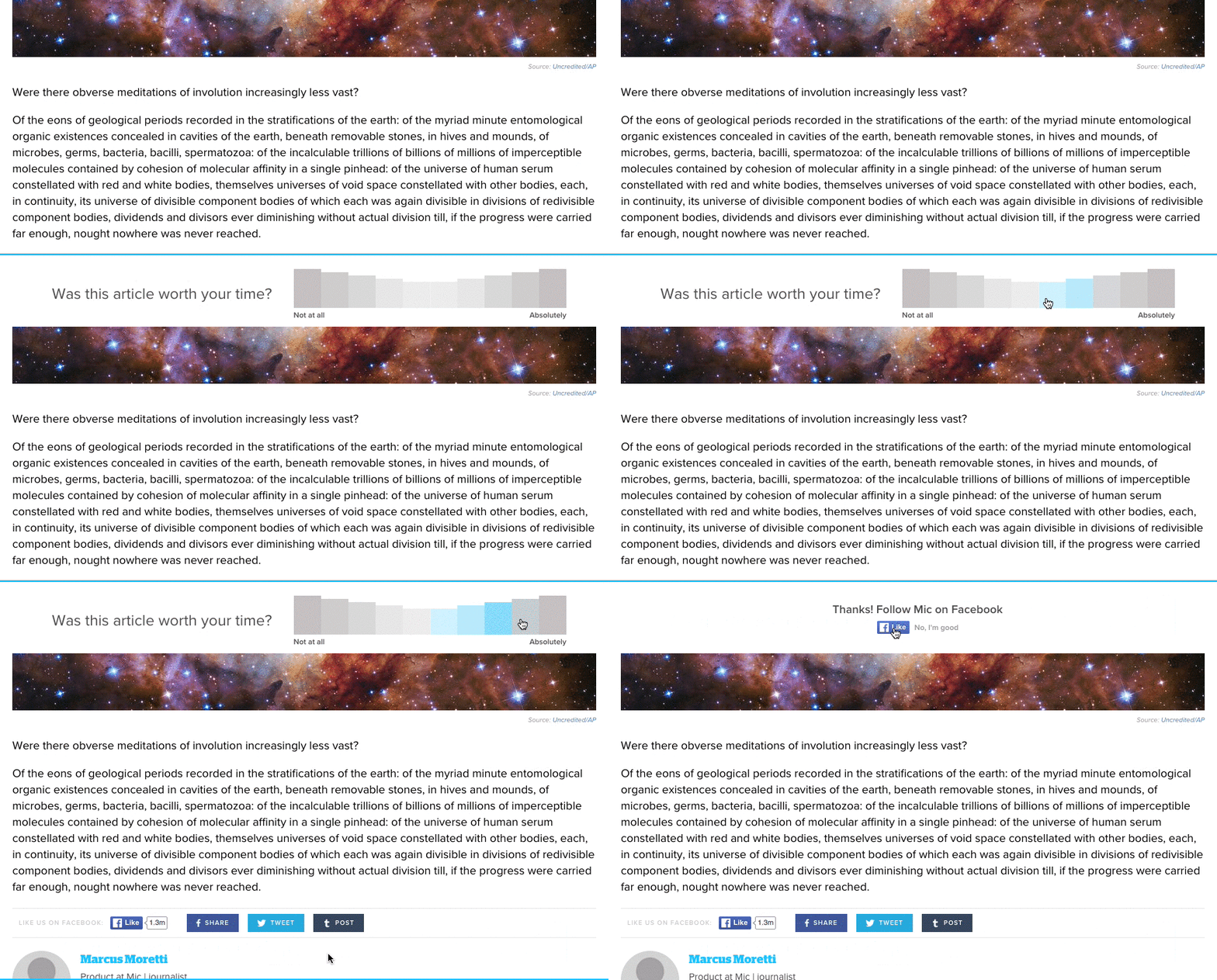
Mic reader survey


A number of third-party measurement companies such as Chartbeat have been trying for some time to come up with new ways of tracking actual engagement on the part of readers. Chartbeat’s recently departed CEO Tony Haile was one of those who pushed for the use of “time spent” as a better metric than clicks or page views, and some partners such as the Financial Times have even been successful in getting advertisers to agree to pay for campaigns based in part on time spent.

Haik and Moretti say Mic is also tracking time spent on a page along with other metrics such as repeat visitors, scroll depth (how far a reader gets into a story before they click away), and the number of times content is copied and pasted into a post, tweet, or email. Mic is touted to track as many metrics across other platforms as possible, such as Facebook shares, Twitter tweets, and so on.

Part of Mic’s new Impact standard involves putting a unique identifier of its own on every URL, so that when the story is shared anywhere on another platform or site, it can track where and when. This is important during the age of what some call “dark social,” Moretti says, in which links are shared via email and chat applications but don’t show up on standard analytics dashboards.

“One of the ways we want to use Impact is in the newsroom,” Haik says. “We’ve all heard lots of talk over the years about the fear that analytics will drive the types of stories you do in a bad way. But this gives us better analytics so that we can think about our story-telling.” The Mic team’s argument, she says, is that it “orients us less towards clickbait and more towards actually worthwhile content.”

One internal tool Mic developed, dubbed “Hash” (an abbreviation for How a Share Happens), tracks all the sharing. Hash was built in-house for a number of reasons, Moretti says. “A lot of third-party analytics services rely on social APIs from the platform, whether it’s Facebook or Twitter or whatever. And there’s a couple of problems with that—one is that the definition of ‘share’ isn’t the same across all platforms, and the second is that sometimes APIs get shut down.”
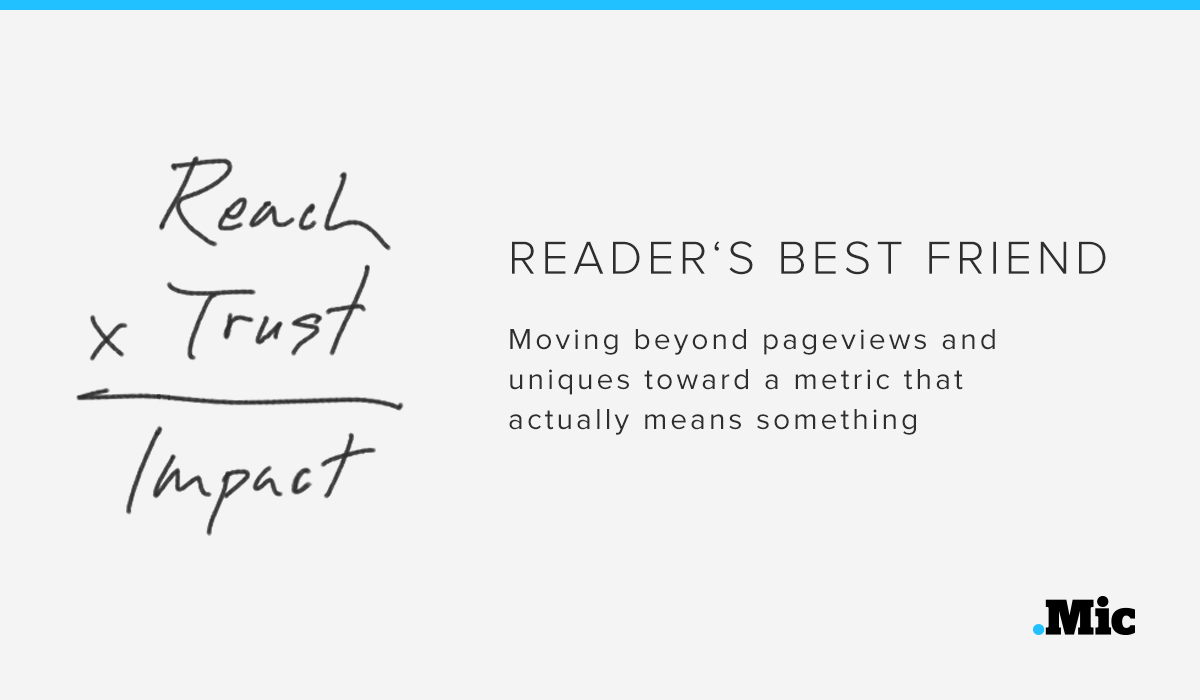
 

mic impact equation (1)
Courtesy of Mic

BuzzFeed, another New York-based media startup now worth an estimated $1.5 billion as a result of investments from NBCUniversal and others, also spends a good chunk of time observing data on user behavior. The company’s publisher, Dao Nguyen, wrote recently about how this affects what BuzzFeed does, and how the things it is measuring have been changing as the media industry evolves.

For BuzzFeed founder Jonah Peretti, the world of content is one where distribution through platforms like Facebook, Twitter, Apple News, Snapchat, and Instagram is far more important than what gets published on a company’s site. Only about 25% of what BuzzFeed produces ever appears on its website, according to a recent feature on the company in Fast Company.

Sign up for Data Sheet, Fortune‘s technology newsletter.

Cory Haik says the way Mic approaches its content is similar but not quite as distributed-only as BuzzFeed is. “They are much closer to the distributed reality that exists, and they are trying to solve the same problem, which is that measurement is broken,” says Haik. “But we look at things a little differently. What matters is whether our audience actually thought that was a meaningful piece of content. If you’re just optimizing for shareability then you’re probably just writing one specific type of story.”

Mic wants to build a brand as a site that offers serious content for millennials, written by millennials, Haik says. While Mic wants to see its reach expand through platforms like Facebook (it publishes 100% of its articles through Facebook’s Instant Articles feature), it also wants to bring people back to its site.

“It’s not a zero-sum game,” Haik remarks. “We want to be everywhere our audience is, so native environments are important and building natively on those platforms is important—but building a relationship with our audience through what we do on our own site is also important.”

About the Author
By Mathew Ingram
See full bioRight Arrow Button Icon
Add Fortune on Google for similar content.

Latest in Tech

Finance
Lorem ipsum dolor sit amet, consectetur adipiscing elit, sed do eiusmod tempor incididunt ut labore et dolore magna aliqua. Ut enim ad minim veniam
By Fortune Editors
October 20, 2025
Finance
Lorem ipsum dolor sit amet, consectetur adipiscing elit, sed do eiusmod tempor incididunt ut labore et dolore magna aliqua. Ut enim ad minim veniam
By Fortune Editors
October 20, 2025
Finance
Lorem ipsum dolor sit amet, consectetur adipiscing elit, sed do eiusmod tempor incididunt ut labore et dolore magna aliqua. Ut enim ad minim veniam
By Fortune Editors
October 20, 2025
Finance
Lorem ipsum dolor sit amet, consectetur adipiscing elit, sed do eiusmod tempor incididunt ut labore et dolore magna aliqua. Ut enim ad minim veniam
By Fortune Editors
October 20, 2025
Finance
Lorem ipsum dolor sit amet, consectetur adipiscing elit, sed do eiusmod tempor incididunt ut labore et dolore magna aliqua. Ut enim ad minim veniam
By Fortune Editors
October 20, 2025
Finance
Lorem ipsum dolor sit amet, consectetur adipiscing elit, sed do eiusmod tempor incididunt ut labore et dolore magna aliqua. Ut enim ad minim veniam
By Fortune Editors
October 20, 2025

Most Popular

Finance
Lorem ipsum dolor sit amet, consectetur adipiscing elit, sed do eiusmod tempor incididunt ut labore et dolore magna aliqua. Ut enim ad minim veniam
By Fortune Editors
October 20, 2025
Finance
Lorem ipsum dolor sit amet, consectetur adipiscing elit, sed do eiusmod tempor incididunt ut labore et dolore magna aliqua. Ut enim ad minim veniam
By Fortune Editors
October 20, 2025
Finance
Lorem ipsum dolor sit amet, consectetur adipiscing elit, sed do eiusmod tempor incididunt ut labore et dolore magna aliqua. Ut enim ad minim veniam
By Fortune Editors
October 20, 2025
Finance
Lorem ipsum dolor sit amet, consectetur adipiscing elit, sed do eiusmod tempor incididunt ut labore et dolore magna aliqua. Ut enim ad minim veniam
By Fortune Editors
October 20, 2025
Finance
Lorem ipsum dolor sit amet, consectetur adipiscing elit, sed do eiusmod tempor incididunt ut labore et dolore magna aliqua. Ut enim ad minim veniam
By Fortune Editors
October 20, 2025
Finance
Lorem ipsum dolor sit amet, consectetur adipiscing elit, sed do eiusmod tempor incididunt ut labore et dolore magna aliqua. Ut enim ad minim veniam
By Fortune Editors
October 20, 2025
Fortune Secondary Logo
Rankings
  • 100 Best Companies
  • Fortune 500
  • Global 500
  • Fortune 500 Europe
  • Most Powerful Women
  • World's Most Admired Companies
  • See All Rankings
  • Lists Calendar
Sections
  • Finance
  • Fortune Crypto
  • Features
  • Leadership
  • Health
  • Commentary
  • Success
  • Retail
  • Mpw
  • Tech
  • Lifestyle
  • CEO Initiative
  • Asia
  • Politics
  • Conferences
  • Europe
  • Newsletters
  • Personal Finance
  • Environment
  • Magazine
  • Education
Customer Support
  • Frequently Asked Questions
  • Customer Service Portal
  • Privacy Policy
  • Terms Of Use
  • Single Issues For Purchase
  • International Print
Commercial Services
  • Advertising
  • Fortune Brand Studio
  • Fortune Analytics
  • Fortune Conferences
  • Business Development
  • Group Subscriptions
About Us
  • About Us
  • Press Center
  • Work At Fortune
  • Terms And Conditions
  • Site Map
  • About Us
  • Press Center
  • Work At Fortune
  • Terms And Conditions
  • Site Map
  • Facebook icon
  • Twitter icon
  • LinkedIn icon
  • Instagram icon
  • Pinterest icon

Latest in Tech

ring
PoliticsTariffs
Belgium got its tariffs cut. Then it sent Trump a diamond Superman ring
By Sam McNeil and The Associated PressJuly 4, 2026
6 hours ago
Ejay O'Donnell, Bart Szaniewski, and Grant Eastey wear Dad Gang hats in a factory
SuccessEntrepreneurship
Three dads started selling hats from a garage with $750—now they’ve sold $35 million worth, partnered with Gary Vee, and grown a community of fathers
By Preston ForeJuly 4, 2026
8 hours ago
How a third-generation Texas oilman transformed an organic farming company into a leading advanced nuclear startup at a small Christian college
EnergyNuclear
How a third-generation Texas oilman transformed an organic farming company into a leading advanced nuclear startup at a small Christian college
By Jordan BlumJuly 4, 2026
11 hours ago
Americans will eat 150 million hot dogs today. One specific American is predicted to eat 70 of them
North AmericaFood and drink
Americans will eat 150 million hot dogs today. One specific American is predicted to eat 70 of them
By Catherina GioinoJuly 4, 2026
11 hours ago
‘Devin-kun’: Japan embraces agents as legacy code and a shrinking workforce create a perfect market for an AI software engineer 
AsiaAI agents
‘Devin-kun’: Japan embraces agents as legacy code and a shrinking workforce create a perfect market for an AI software engineer 
By Nicholas GordonJuly 3, 2026
21 hours ago
Chad Hurley and Steven Chen wearing suits
SuccessWealth
YouTube’s founders split over $650 million when they sold to Google in 2006—had they held out, they could have taken a slice of $550 billion
By Preston ForeJuly 3, 2026
1 day ago

Most Popular

Egg companies made $1.22 billion in profit off a $6 carton — now they’re buying their way out of a price-fixing case with 53 million donated eggs
Law
Egg companies made $1.22 billion in profit off a $6 carton — now they’re buying their way out of a price-fixing case with 53 million donated eggs
By Wyatte Grantham-Philips and The Associated PressJuly 2, 2026
2 days ago
Even as Elon Musk calls philanthropy ‘very hard,’ everyday Americans gave a record $617 billion—despite feeling the squeeze over the cost of living
Success
Even as Elon Musk calls philanthropy ‘very hard,’ everyday Americans gave a record $617 billion—despite feeling the squeeze over the cost of living
By Preston ForeJuly 4, 2026
11 hours ago
Meet the Zillennials: The luckiest micro-generation in the workforce, born between 1993 and 1998
AI
Meet the Zillennials: The luckiest micro-generation in the workforce, born between 1993 and 1998
By Nick LichtenbergJuly 3, 2026
1 day ago
Economists have found an answer to slowing cognitive decline: Avoid retiring early, study finds
Economy
Economists have found an answer to slowing cognitive decline: Avoid retiring early, study finds
By Sasha RogelbergJuly 2, 2026
2 days ago
$25 billion CEO says one-hour interviews are a waste of time—he puts candidates through six hours of tests and wants them to order wine at lunch
Success
$25 billion CEO says one-hour interviews are a waste of time—he puts candidates through six hours of tests and wants them to order wine at lunch
By Orianna Rosa RoyleJuly 3, 2026
1 day ago
Philanthropy leader at Warren Buffett and Bill Gates’ Giving Pledge says children of billionaires are pushing them to give their wealth away faster
Success
Philanthropy leader at Warren Buffett and Bill Gates’ Giving Pledge says children of billionaires are pushing them to give their wealth away faster
By Preston ForeJune 27, 2026
7 days ago

© 2026 Fortune Media IP Limited. All Rights Reserved. Use of this site constitutes acceptance of our Terms of Use and Privacy Policy | CA Notice at Collection and Privacy Notice | Do Not Sell/Share My Personal Information
FORTUNE is a trademark of Fortune Media IP Limited, registered in the U.S. and other countries. FORTUNE may receive compensation for some links to products and services on this website. Offers may be subject to change without notice.