• Home
  • Latest
  • Fortune 500
  • Finance
  • Tech
  • Leadership
  • Lifestyle
  • Rankings
  • Multimedia

Trendingnow

1

As Big Tech showers employees with perks to win the talent war, Nvidia built a nearly $5 trillion company by making people pay for their own lunch

2

MacKenzie Scott alone accounted for one-third of America's $19.2 billion in megagifts last year

3

The Supreme Court's birthright citizenship ruling hands the U.S. economy a $7.7 trillion win

1

As Big Tech showers employees with perks to win the talent war, Nvidia built a nearly $5 trillion company by making people pay for their own lunch

2

MacKenzie Scott alone accounted for one-third of America's $19.2 billion in megagifts last year

3

The Supreme Court's birthright citizenship ruling hands the U.S. economy a $7.7 trillion win
Leadership

Why the Next President Should Raise the Minimum Wage

By
Roger Lowenstein
Roger Lowenstein
Down Arrow Button Icon
By
Roger Lowenstein
Roger Lowenstein
Down Arrow Button Icon
February 29, 2016, 12:36 PM ET
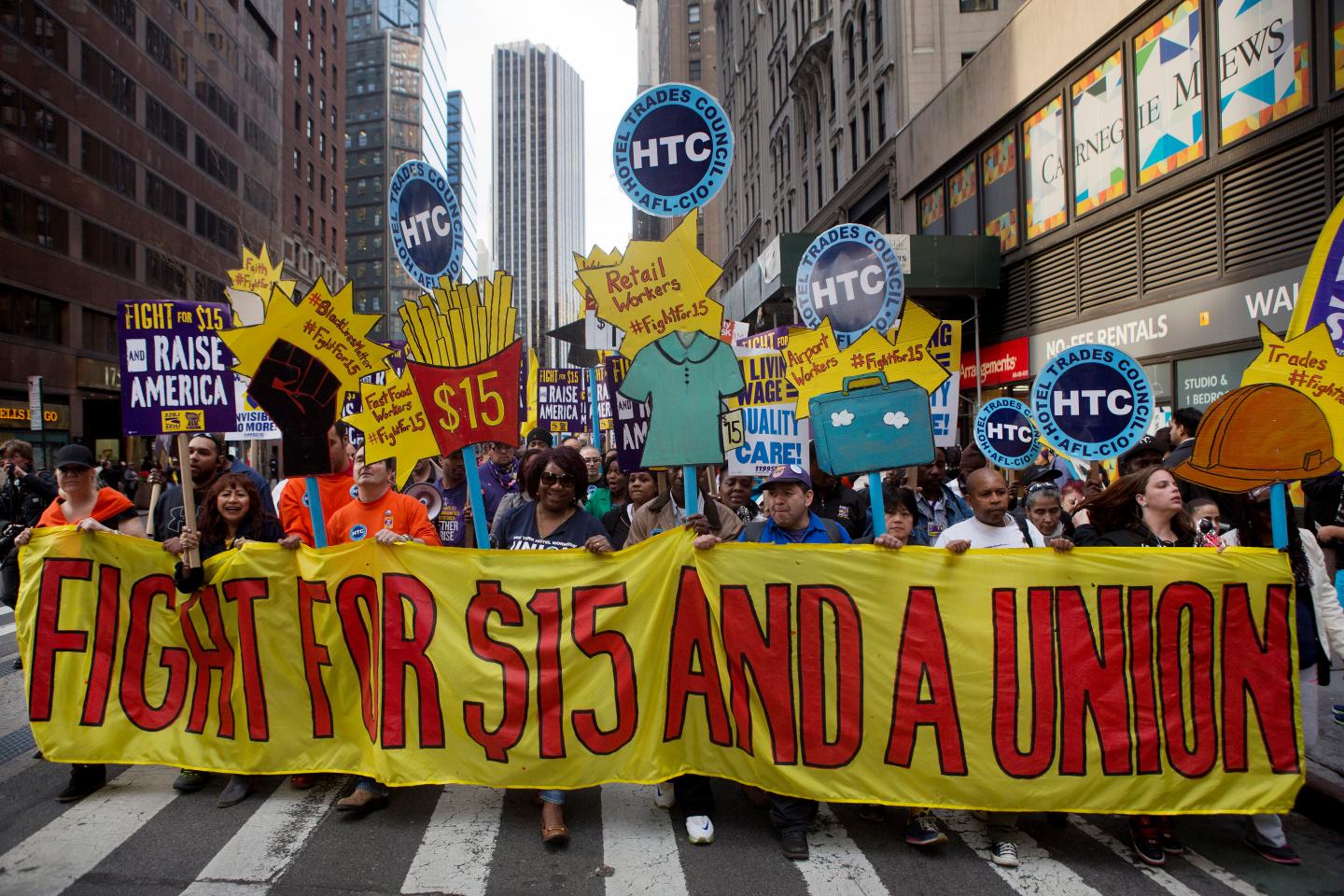
Protesters hold signs at a rally in support of minimum wage increase in New York, U.S., on Wednesday, April 15, 2015. Fast-food workers held rallies in 236 U.S. cities Wednesday in their biggest protest yet for higher pay and union rights. Photographer: Victor J. Blue/Bloomberg
Protesters hold signs at a rally in support of minimum wage increase in New York, U.S., on Wednesday, April 15, 2015. Fast-food workers held rallies in 236 U.S. cities Wednesday in their biggest protest yet for higher pay and union rights. Photographer: Victor J. Blue/BloombergPhotograph by Victor J. Blue—Bloomberg Finance LP via Getty Images
Add Fortune on Google for similar content.

Economic inequality is the looming issue of the 2016 campaign. The presidential debates have focused on personalities and inflammatory topics like immigration, but the underlying cause of voter frustration is the lack of wage growth.

Bernie Sanders has been the only candidate to focus on inequality, and so far no major policy proposal has emerged on either side to address the issue. But if there’s a single policy idea that could galvanize voters, it could be the call to hike the federal minimum wage, now a paltry $7.25 an hour.

Sanders backs a drastic leap to $15; Hillary Clinton would go to $12. The top GOP contenders oppose any increase at all. Sen. Marco Rubio, for instance, has called the prospect of raising the minimum wage “a disaster.”

Polls, however, overwhelmingly support an increase. Fourteen states hiked their minimums on January 1 (California and Massachusetts led the pack at $10 an hour). Meanwhile, the federal minimum hasn’t moved since 2009. Adjusted for inflation, it is lower than in 1968. A half-century is a long time to wait for a raise.

Under present law, people who work full-time can still fall short of the basic necessities of life. A fulltime mother of two who worked 40-hour-weeks at the federal minimum would gross $15,080 a year–well below the poverty line.

Opponents say hiking the minimum wage would be fruitless and perhaps cost jobs. But while their arguments shouldn’t be taken lightly On balance, though, the critics are wrong. There is a strong economic and moral case for a slow and steady increase.

The reason free-market arguments against the minimum wage fail—at least for moderate increases—is that the labor market does not behave according to the classic supply-and-demand model taught in Economics 101.

If labor markets were simply guided by the invisible hand, unemployment would not exist. In tough times, firms would cut wages rather than lay off workers. This is how the market in hamburgers works. McDonald’s doesn’t stop selling Big Macs in a recession; it lowers their price.

But employers do not cut the price of labor. As Arthur Okun, the economist and Lyndon Johnson adviser, explained, labor markets are governed by an “invisible handshake”—an implicit contract between firms and employees. Firms are reluctant to cut wages owing to an unspoken obligation to their workers. Even if they could find and retrain new workers (a costly business) willing to accept less, they are fearful of upsetting morale. Conversely, most workers do not scour the want ads every day for a job that might pay more, because switching jobs exacts a cost in time and effort.

What does this have to do with minimum wages? Plenty. Perhaps the most persuasive-seeming argument against an increase is that many people who earn the minimum are not actually poor: They are teenagers from middle-class homes.

The flaw in this argument is that hiking the minimum wage has a surprising side effect across the bottom half of the wage scale. Even if teens are the largest group getting the minimum wage, low-wage adult workers benefit when the wage is increased, because firms feel a responsibility to increase pay for workers further up the scale.

This result is inconsistent with classical theory, according to which firms would never raise salaries unless forced to. But it is documented by the newer school of behavioral economics. According to a 1986 paper by eventual Nobel Prize winner Daniel Kahneman, co-authored with Jack Knetsch and Richard Thaler, workers care about more than merely maximizing wealth. Notions of fairness keep them from working at too low a wage, even though they will obviously be poorer if they don’t work at all. Economists call this individual minimum the “reservation wage.” (The reservation wage differs across job categories; a bricklayer will accept a lower wage than a doctor.)

Kahneman, Knetsch, and Thaler showed that people’s notion of fairness is influenced by a “neutral reference point.” For most employees, the usual reference points are the wages of other workers at the same firm. Think about it: If wages in the outside world rose faster than yours, you probably would stay on the job, at least for a while. But if you were the only person at your firm passed up for a raise, you’d likely look elsewhere.

Not coincidentally, when the government mandates a hike for a firm’s lowest-paid workers, employers (governed by that invisible handshake) feel pressure to boost other workers’ wages as well. According to more recent research by another trio of economists, Armin Falk, Ernst Fehr, and Christian Zehnder, after a hike in the minimum, “a substantial share” of higher-paid workers also demand raises. “The minimum wage leads to a kind of ratchet effect in workers’ perception of what constitutes a fair wage,” the authors wrote. In a converse illustration, after a hike in the minimum wage, low-paid workers who do not get a raise tend to work less hard. They suddenly feel underpaid.

A frequent argument against the minimum wage is that the earned income tax credit, which provides tax refunds to low-wage workers, is a better vehicle. But neither policy is wholly adequate. Short of a radical increase, the EITC should be a complement to the minimum wage—not a substitute.

What about the claim that a higher minimum will cost jobs? Alan Krueger and David Card chilled that theory in a now-famous 1994 study, “Minimum Wages and Employment,” which found that New Jersey actually gained restaurant jobs after hiking the state’s minimum relative to neighboring Pennsylvania, which did not raise its minimum. This experiment has been replicated, with similar results in subsequent studies.

The fact that job losses do not occur is less surprising when you look away from the textbook and think about the real world. The typical business owner does not use a spreadsheet to calculate whether the incremental output of a new employee will be worth $7.25 an hour (or $8, or $9). Rather, they hire staff when they think it will enable them to serve more customers. A business that is humming will not sack a worker just because the minimum wage is lifted by a buck.

There’s an important caveat: This detour from strict supply and demand can work only for moderate increases. At some wage (pick a number: $15 an hour, $20), the arithmetic becomes overwhelming. A few cities, such as Seattle, recently have imposed Sanders-level wage hikes; early returns suggest that Seattle has indeed suffered restaurant job losses.

Therefore, most economists favor a moderate increase—which is also favored by common sense. “There are positive effects on morale, positive effects on retention—more people want to work,” says Krueger, who was President Obama’s economic adviser from 2011 to 2013. In effect, a minimum wage nudges employers to adopt a pay scale where they, also, are better off. “It’s not what [classical] economics tells us,” Krueger says. “But companies care about their social hierarchies.”

About the Author
By Roger Lowenstein
See full bioRight Arrow Button Icon
Add Fortune on Google for similar content.

Latest in Leadership

Finance
Lorem ipsum dolor sit amet, consectetur adipiscing elit, sed do eiusmod tempor incididunt ut labore et dolore magna aliqua. Ut enim ad minim veniam
By Fortune Editors
October 20, 2025
Finance
Lorem ipsum dolor sit amet, consectetur adipiscing elit, sed do eiusmod tempor incididunt ut labore et dolore magna aliqua. Ut enim ad minim veniam
By Fortune Editors
October 20, 2025
Finance
Lorem ipsum dolor sit amet, consectetur adipiscing elit, sed do eiusmod tempor incididunt ut labore et dolore magna aliqua. Ut enim ad minim veniam
By Fortune Editors
October 20, 2025
Finance
Lorem ipsum dolor sit amet, consectetur adipiscing elit, sed do eiusmod tempor incididunt ut labore et dolore magna aliqua. Ut enim ad minim veniam
By Fortune Editors
October 20, 2025
Finance
Lorem ipsum dolor sit amet, consectetur adipiscing elit, sed do eiusmod tempor incididunt ut labore et dolore magna aliqua. Ut enim ad minim veniam
By Fortune Editors
October 20, 2025
Finance
Lorem ipsum dolor sit amet, consectetur adipiscing elit, sed do eiusmod tempor incididunt ut labore et dolore magna aliqua. Ut enim ad minim veniam
By Fortune Editors
October 20, 2025

Most Popular

Finance
Lorem ipsum dolor sit amet, consectetur adipiscing elit, sed do eiusmod tempor incididunt ut labore et dolore magna aliqua. Ut enim ad minim veniam
By Fortune Editors
October 20, 2025
Finance
Lorem ipsum dolor sit amet, consectetur adipiscing elit, sed do eiusmod tempor incididunt ut labore et dolore magna aliqua. Ut enim ad minim veniam
By Fortune Editors
October 20, 2025
Finance
Lorem ipsum dolor sit amet, consectetur adipiscing elit, sed do eiusmod tempor incididunt ut labore et dolore magna aliqua. Ut enim ad minim veniam
By Fortune Editors
October 20, 2025
Finance
Lorem ipsum dolor sit amet, consectetur adipiscing elit, sed do eiusmod tempor incididunt ut labore et dolore magna aliqua. Ut enim ad minim veniam
By Fortune Editors
October 20, 2025
Finance
Lorem ipsum dolor sit amet, consectetur adipiscing elit, sed do eiusmod tempor incididunt ut labore et dolore magna aliqua. Ut enim ad minim veniam
By Fortune Editors
October 20, 2025
Finance
Lorem ipsum dolor sit amet, consectetur adipiscing elit, sed do eiusmod tempor incididunt ut labore et dolore magna aliqua. Ut enim ad minim veniam
By Fortune Editors
October 20, 2025
Fortune Secondary Logo
Rankings
  • 100 Best Companies
  • Fortune 500
  • Global 500
  • Fortune 500 Europe
  • Most Powerful Women
  • World's Most Admired Companies
  • See All Rankings
  • Lists Calendar
Sections
  • Finance
  • Fortune Crypto
  • Features
  • Leadership
  • Health
  • Commentary
  • Success
  • Retail
  • Mpw
  • Tech
  • Lifestyle
  • CEO Initiative
  • Asia
  • Politics
  • Conferences
  • Europe
  • Newsletters
  • Personal Finance
  • Environment
  • Magazine
  • Education
Customer Support
  • Frequently Asked Questions
  • Customer Service Portal
  • Privacy Policy
  • Terms Of Use
  • Single Issues For Purchase
  • International Print
Commercial Services
  • Advertising
  • Fortune Brand Studio
  • Fortune Analytics
  • Fortune Conferences
  • Business Development
  • Group Subscriptions
About Us
  • About Us
  • Press Center
  • Work At Fortune
  • Terms And Conditions
  • Site Map
  • About Us
  • Press Center
  • Work At Fortune
  • Terms And Conditions
  • Site Map
  • Facebook icon
  • Twitter icon
  • LinkedIn icon
  • Instagram icon
  • Pinterest icon

Latest in Leadership

Emily Blunt is worth $80 million and just pocketed $15 million for her latest film—but she once wanted to be a Spanish translator for the UN
SuccessCareers
Emily Blunt is worth $80 million and just pocketed $15 million for her latest film—but she once wanted to be a Spanish translator for the UN
By Orianna Rosa RoyleJuly 2, 2026
2 hours ago
Trump’s 927-page disclosure is just a normal Tuesday for direct indexing and crypto wealth managers
InvestingDonald Trump
Trump’s 927-page disclosure is just a normal Tuesday for direct indexing and crypto wealth managers
By Catherina GioinoJuly 1, 2026
11 hours ago
How foodservice giant Sodexo is embracing AI and robotics to reshape the kitchen
NewslettersCIO Intelligence
How foodservice giant Sodexo is embracing AI and robotics to reshape the kitchen
By John KellJuly 1, 2026
16 hours ago
U.S. Polo Assn. CEO J. Michael Prince
SuccessThe Promotion Playbook
U.S. Polo Assn. CEO was told he wasn’t right for a promotion—so he ‘outworked’ anyone else who wanted the job for 6 months straight
By Orianna Rosa RoyleJuly 1, 2026
18 hours ago
Nikesh Arora, chief executive officer at Palo Alto Networks
SuccessJobs
CEO of $248 billion cybersecurity company says workers are about to face a ‘Darwinian moment’ thanks to AI: Evolve or get cut
By Emma BurleighJuly 1, 2026
18 hours ago
DHL plane being refuelled at airport by man in high-vis jacket
EuropeAviation
The Iran conflict saw jet fuel prices soar—when you use 1.88 million tonnes a year, how you respond really matters (just ask DHL)
By Sam ForsdickJuly 1, 2026
20 hours ago

Most Popular

As Big Tech showers employees with perks to win the talent war, Nvidia built a nearly $5 trillion company by making people pay for their own lunch
Big Tech
As Big Tech showers employees with perks to win the talent war, Nvidia built a nearly $5 trillion company by making people pay for their own lunch
By Marco Quiroz-GutierrezJuly 1, 2026
1 day ago
MacKenzie Scott alone accounted for one-third of America's $19.2 billion in megagifts last year
Success
MacKenzie Scott alone accounted for one-third of America's $19.2 billion in megagifts last year
By Sydney LakeJune 25, 2026
7 days ago
The Supreme Court's birthright citizenship ruling hands the U.S. economy a $7.7 trillion win
Newsletters
The Supreme Court's birthright citizenship ruling hands the U.S. economy a $7.7 trillion win
By Diane BradyJuly 1, 2026
24 hours ago
Current price of oil as of July 1, 2026
Personal Finance
Current price of oil as of July 1, 2026
By Joseph HostetlerJuly 1, 2026
20 hours ago
Philanthropy leader at Warren Buffett and Bill Gates’ Giving Pledge says children of billionaires are pushing them to give their wealth away faster
Success
Philanthropy leader at Warren Buffett and Bill Gates’ Giving Pledge says children of billionaires are pushing them to give their wealth away faster
By Preston ForeJune 27, 2026
5 days ago
Elon Musk on MacKenzie Scott giving away $26 billion of her fortune: 'Sadly,' it makes the world a worse place
Success
Elon Musk on MacKenzie Scott giving away $26 billion of her fortune: 'Sadly,' it makes the world a worse place
By Sydney LakeJune 29, 2026
3 days ago

© 2026 Fortune Media IP Limited. All Rights Reserved. Use of this site constitutes acceptance of our Terms of Use and Privacy Policy | CA Notice at Collection and Privacy Notice | Do Not Sell/Share My Personal Information
FORTUNE is a trademark of Fortune Media IP Limited, registered in the U.S. and other countries. FORTUNE may receive compensation for some links to products and services on this website. Offers may be subject to change without notice.