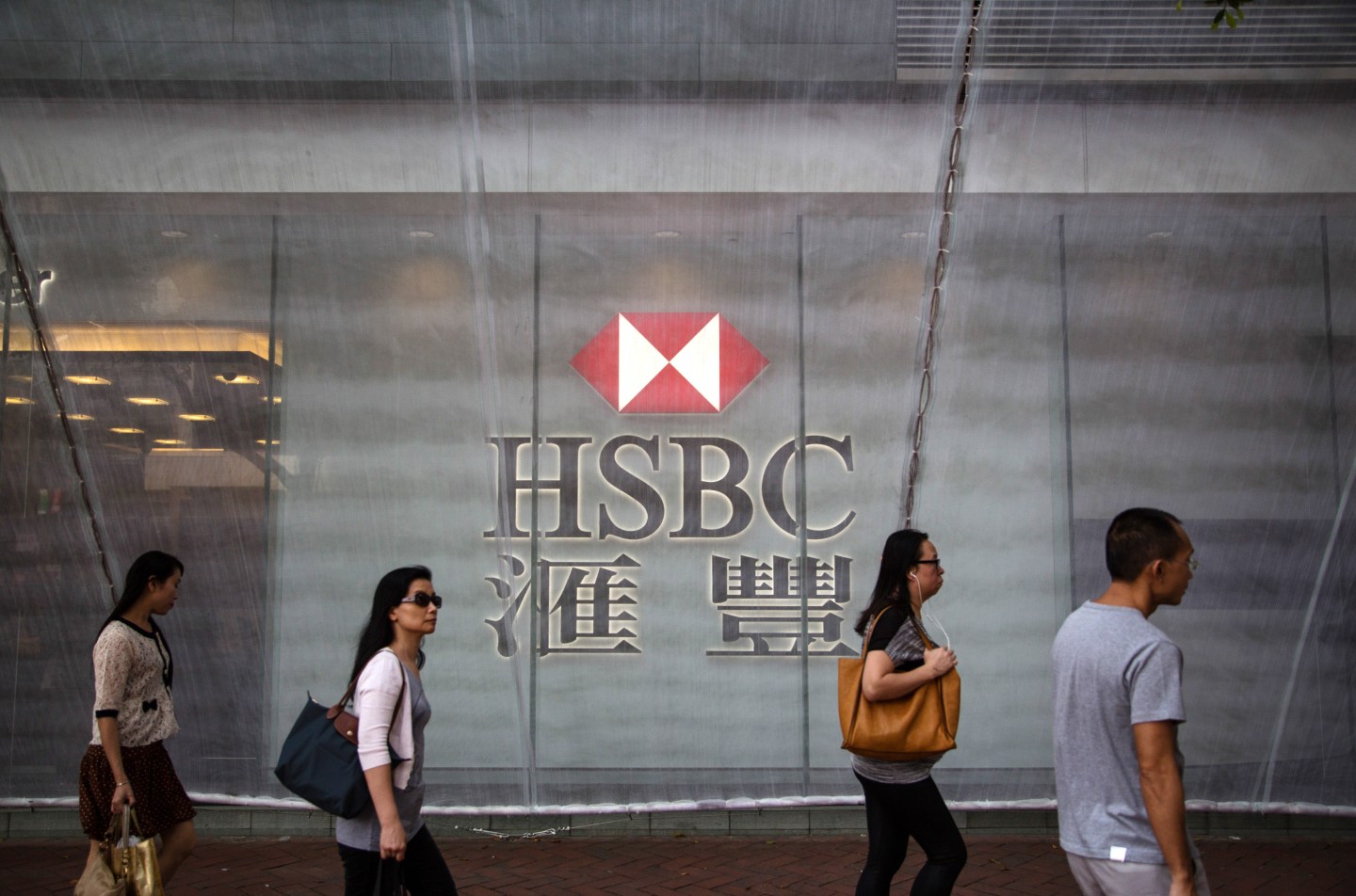
HSBC Plc (HSBC), one of the world’s biggest banks, has decided to keep its headquarters in the U.K. after all.
The decision, taken unanimously by the bank’s board on Sunday, comes after a sharp change of circumstances since the bank announced its review last April: the British government watered down a tax on banking assets that HSBC said targeted it disproportionately. At the same time, the potential benefits of relocating to Hong Kong (always the most likely alternative for the erstwhile Hongkong and Shanghai Banking Corporation) have dwindled due to China’s slowdown and Beijing’s increasingly heavy-handed control over the former British colony.
After heavy lobbying, Britain announced in July it would cut its ‘banking levy’ and instead introduce an 8% surcharge on banks’ profits, a move that is expected to spread the burden of taxation more evenly across the sector.
However, the more important part of the calculation is that the risk-reward balance of being based in Greater China has shifted. Even by official data that are viewed with widespread skepticism internationally, China’s growth has slowed to the lowest level in 25 years. Reports of a sharp rise in problem loans in China’s state-dominated banking system make expansion in the country (beyond the 20% stake it already holds in Bank of Communications) a riskier prospect.
But another factor likely to have weighed on HSBC minds is that the degree of commercial and political autonomy enjoyed by Hong Kong has come under increasing threat in the last year. Hong Kong’s lawmakers sided with Beijing in cracking down on protests against the erosion of electoral freedoms at the end of 2014. A disturbing number of financiers, both Chinese and foreign, have been caught up in investigations into the ‘speculation’ behind the collapse of the Chinese stock market bubble, with more than one institution being forced by stock exchange regulations into explaining the absence and/or reappearance of its executives.
At the same time, the Hong Kong financial market has become vulnerable to increasing volatility caused by the flood of capital out of China and Beijing’s efforts to stop it. In recent weeks, interbank lending rates have fluctuated wildly as the authorities moved to stop the ‘offshore’ renminbi rate, which is supposed to trade freely, from deviating too far from the ‘official’ rate on the mainland.
China’s long transition from a completely closed capital account to a free one means that there are many potential regulatory pitfalls in intermediating flows of money into or out of the country. Trade data for January, released Monday, hinted heavily at a big rise in the filing of bogus trade invoices between mainland companies and Hong Kong-domiciled entities to get round the remaining controls on getting money out of China.
HSBC has already been on the wrong side of the law too often in recent years when it comes to moving money internationally, most notably paying a $1.9 billion fine after laundering money on behalf of Mexican drug gangs and facilitating tax avoidance by thousands of European customers through its private bank in Switzerland. Moving to Hong Kong now would put it in a position where it might easily be caught in a politically-charged crossfire in a battle over the Chinese currency before too long.
Such uncertainties raise the bar for a move whose costs are estimated by analysts at well over $1 billion–an additional expense that would have offset much of the $3.4 billion in savings that the bank is currently trying to squeeze out of its business.
Another reason why HSBC probably did not move was that it would be stepping into a completely different business environment that could have hurt its share price in the long term, said Prof. Andre Spicer of Cass Business School in London.
“All the evidence shows that when firms move headquarters, they start to copy their new neighbours. This would have meant that HSBC would slowly become more like a Chinese firm,” Spicer said. “That would have meant a culture which emphasises personal connections over almost anything else and a large role for the state. The share price of HSBC would have more closely followed other firms located in Hong Kong. This could have been dangerous in a world where China is looking uncertain.”