• Home
  • Latest
  • Fortune 500
  • Finance
  • Tech
  • Leadership
  • Lifestyle
  • Rankings
  • Multimedia
CommentaryAffirmative Action

What this U.S. Supreme Court Justice Gets Wrong About Diversity

By
Willemien Kets
Willemien Kets
Down Arrow Button Icon
By
Willemien Kets
Willemien Kets
Down Arrow Button Icon
December 16, 2015, 12:17 PM ET
Supreme Court
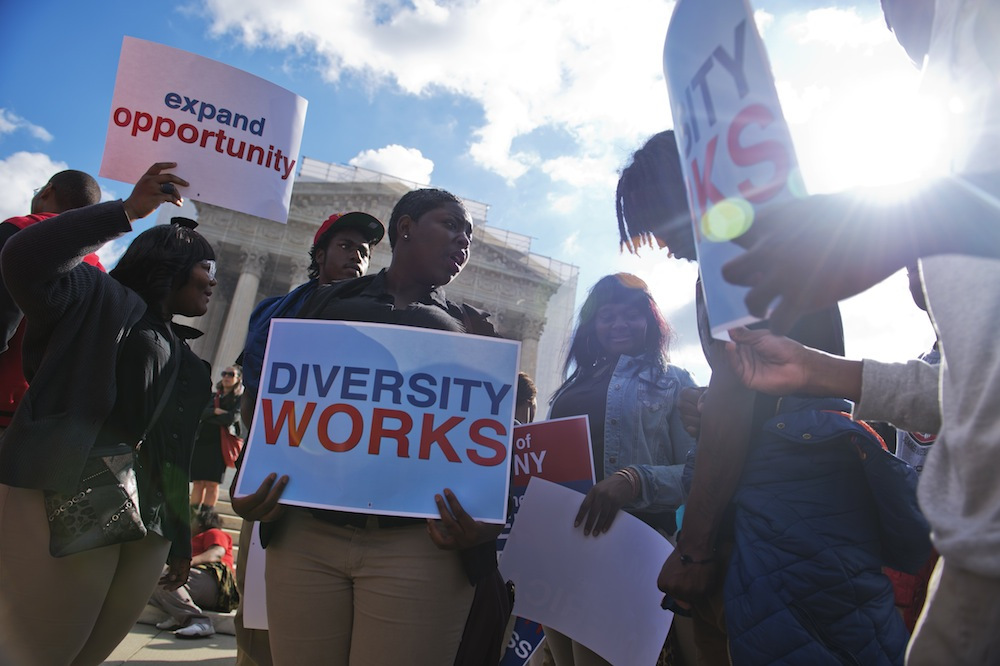
Photo by Tom Williams—CQ Roll Call

The Supreme Court recently heard the latest challenge to an affirmative action plan at the University of Texas at Austin. While the debate is complex and ongoing, it has changed dramatically in the past decade: affirmative action in university admissions started in the late 1960s as an effort to stimulate racial integration and foster equal opportunity. In the 2003, landmark case Grutter v. Bollinger, the Supreme Court hardly discussed discrimination and fairness, but instead focused on whether promoting diversity is a “compelling interest.”

In the present Supreme Court case, this shift away from discrimination and fairness is even more pronounced. Chief Justice John G. Roberts Jr. seemed unconvinced of the value of diversity in at least some settings. “What unique perspective does a minority student bring to a physics class?” he asked last Wednesday.

My research with Alvaro Sandroni suggests an answer: Diverse groups are less conformist and more willing to go against the status quo if that leads to better outcomes. Whether a physics graduate goes on to work at a tech company, becomes a scientist, or ends up as a manager, it will be critical for her success as well as her employer’s whether she is an original thinker.

We used a mathematical model to study the effects of diversity. The basic idea is simple: Diversity can push people out of their comfort zone, and the resulting uncertainty may make them more open to try out new ideas.

Think about it. If all students have the same background, a student may be hesitant to raise his hand in a class discussion and share a crazy idea. He knows how the other students think, and can see exactly why they would dismiss it.

In a more diverse group, it may be less clear what ideas people are receptive to. That may create an openness to new ideas that is absent in groups with congruent expectations. If a student can’t predict how others will react, then perhaps he’d be more willing to share a crazy idea.

Companies such as Pixar thrive because they understand the value of unpredictability. After releasing three blockbuster movies, the animation company brought in Brad Bird, a director who had just come off a movie that had been a financial failure “to come shake things up.” The strategy was successful: the team produced a movie, The Incredibles, that went on to win two Oscars.

True, Bird is not an outsider in the sense of being a minority or a woman. Nonetheless, he was an outsider — in the sense that he came to Pixar from Warner Brothers and was the first director who was not from the homegrown Pixar farm team. He engaged the black sheep and hired people who had no experience with Pixar’s animation technology. In diverse groups, everyone is a bit of an outsider. That makes it harder to anticipate how others will react. That can lead to more conflicts and misunderstandings. However, if there is no clear group norm, we are also less likely to hold on to outdated practices.

To be sure, mathematical models have their limitations. It is impossible to include all factors that play a role in real life, so our analysis is necessarily abstract. However, the predictions are consistent with extensive data that suggests that diversity pays off precisely when it is critical to be innovative. Also, experiments have demonstrated that people are more likely to voice unique perspectives and less likely to conform when there is more diversity, consistent with our model.

If diverse groups are less conformist than more homogeneous ones, then the benefits of diversity may apply much more broadly than previously thought. It is well-known that cognitive diversity – differences in skills and information – can lead to superior performance, as Chief Justice Roberts suggested. However, our research suggests that even if different groups have exactly the same skills and knowledge, diversity pays off. So, class diversity benefits students in all fields. And, the benefits apply equally to all groups – both minority and majority groups gain.

Improving diversity is a direct way to challenge conformity and make us all a little bit more open to trying out new things. That is a “compelling interest” indeed.

Willemien Kets is an assistant professor of managerial economics and decision sciences at Kellogg School of Management at Northwestern University.


 

About the Author
By Willemien Kets
See full bioRight Arrow Button Icon

Latest in Commentary

Finance
Lorem ipsum dolor sit amet, consectetur adipiscing elit, sed do eiusmod tempor incididunt ut labore et dolore magna aliqua. Ut enim ad minim veniam
By Fortune Editors
October 20, 2025
Finance
Lorem ipsum dolor sit amet, consectetur adipiscing elit, sed do eiusmod tempor incididunt ut labore et dolore magna aliqua. Ut enim ad minim veniam
By Fortune Editors
October 20, 2025
Finance
Lorem ipsum dolor sit amet, consectetur adipiscing elit, sed do eiusmod tempor incididunt ut labore et dolore magna aliqua. Ut enim ad minim veniam
By Fortune Editors
October 20, 2025
Finance
Lorem ipsum dolor sit amet, consectetur adipiscing elit, sed do eiusmod tempor incididunt ut labore et dolore magna aliqua. Ut enim ad minim veniam
By Fortune Editors
October 20, 2025
Finance
Lorem ipsum dolor sit amet, consectetur adipiscing elit, sed do eiusmod tempor incididunt ut labore et dolore magna aliqua. Ut enim ad minim veniam
By Fortune Editors
October 20, 2025
Finance
Lorem ipsum dolor sit amet, consectetur adipiscing elit, sed do eiusmod tempor incididunt ut labore et dolore magna aliqua. Ut enim ad minim veniam
By Fortune Editors
October 20, 2025

Most Popular

Finance
Lorem ipsum dolor sit amet, consectetur adipiscing elit, sed do eiusmod tempor incididunt ut labore et dolore magna aliqua. Ut enim ad minim veniam
By Fortune Editors
October 20, 2025
Finance
Lorem ipsum dolor sit amet, consectetur adipiscing elit, sed do eiusmod tempor incididunt ut labore et dolore magna aliqua. Ut enim ad minim veniam
By Fortune Editors
October 20, 2025
Finance
Lorem ipsum dolor sit amet, consectetur adipiscing elit, sed do eiusmod tempor incididunt ut labore et dolore magna aliqua. Ut enim ad minim veniam
By Fortune Editors
October 20, 2025
Finance
Lorem ipsum dolor sit amet, consectetur adipiscing elit, sed do eiusmod tempor incididunt ut labore et dolore magna aliqua. Ut enim ad minim veniam
By Fortune Editors
October 20, 2025
Finance
Lorem ipsum dolor sit amet, consectetur adipiscing elit, sed do eiusmod tempor incididunt ut labore et dolore magna aliqua. Ut enim ad minim veniam
By Fortune Editors
October 20, 2025
Finance
Lorem ipsum dolor sit amet, consectetur adipiscing elit, sed do eiusmod tempor incididunt ut labore et dolore magna aliqua. Ut enim ad minim veniam
By Fortune Editors
October 20, 2025
Fortune Secondary Logo
Rankings
  • 100 Best Companies
  • Fortune 500
  • Global 500
  • Fortune 500 Europe
  • Most Powerful Women
  • Future 50
  • World’s Most Admired Companies
  • See All Rankings
Sections
  • Finance
  • Fortune Crypto
  • Features
  • Leadership
  • Health
  • Commentary
  • Success
  • Retail
  • Mpw
  • Tech
  • Lifestyle
  • CEO Initiative
  • Asia
  • Politics
  • Conferences
  • Europe
  • Newsletters
  • Personal Finance
  • Environment
  • Magazine
  • Education
Customer Support
  • Frequently Asked Questions
  • Customer Service Portal
  • Privacy Policy
  • Terms Of Use
  • Single Issues For Purchase
  • International Print
Commercial Services
  • Advertising
  • Fortune Brand Studio
  • Fortune Analytics
  • Fortune Conferences
  • Business Development
  • Group Subscriptions
About Us
  • About Us
  • Editorial Calendar
  • Press Center
  • Work At Fortune
  • Diversity And Inclusion
  • Terms And Conditions
  • Site Map
  • About Us
  • Editorial Calendar
  • Press Center
  • Work At Fortune
  • Diversity And Inclusion
  • Terms And Conditions
  • Site Map
  • Facebook icon
  • Twitter icon
  • LinkedIn icon
  • Instagram icon
  • Pinterest icon

Latest in Commentary

assis
CommentaryIBM
The digital sovereignty dilemma is a false choice — here’s how enterprises can have both
By Ana Paula AssisApril 9, 2026
14 hours ago
housing
CommentaryHousing
The housing market has been frozen for 3 years. Here’s why this spring could finally change that
By Jessica LautzApril 8, 2026
1 day ago
curtin
CommentaryInfrastructure
TE Connectivity CEO: the real promise of AI is long-term transformation, not short-term efficiency gains
By Terrence CurtinApril 7, 2026
2 days ago
philip
CommentaryEducation
I just became CEO of one of education’s Big 3. Here’s why AI will never replace a great teacher
By Philip MoyerApril 7, 2026
2 days ago
omar
Commentarydisruption
Pearson CEO: the AI job apocalypse is a Silicon Valley story. The data tells a different one
By Omar AbboshApril 6, 2026
3 days ago
no kings
CommentaryLeadership
America’s CEOs have become reluctant guardians of democracy
By Jeffrey Sonnenfeld and Stephen HenriquesApril 6, 2026
3 days ago

Most Popular

The U.S. government is spending $88 billion a month in interest on national debt—equal to spending on defense and education combined
Economy
The U.S. government is spending $88 billion a month in interest on national debt—equal to spending on defense and education combined
By Fortune EditorsApril 9, 2026
12 hours ago
The U.S. had a national debt ‘home run’ in its grasp, says Jamie Dimon. But the government did nothing, and now its best option is crisis management
Economy
The U.S. had a national debt ‘home run’ in its grasp, says Jamie Dimon. But the government did nothing, and now its best option is crisis management
By Fortune EditorsApril 8, 2026
2 days ago
2 years ago, Saudi Arabia quietly canceled the ‘petrodollar’ deal with America that wired the world economy for 50 years. Then war broke out in Iran
Energy
2 years ago, Saudi Arabia quietly canceled the ‘petrodollar’ deal with America that wired the world economy for 50 years. Then war broke out in Iran
By Fortune EditorsApril 7, 2026
2 days ago
Self-made billionaire MrBeast says his work-life balance is nonexistent and calls it a ‘miracle’ if he works less than 15-hour days: ‘I live to work’
Success
Self-made billionaire MrBeast says his work-life balance is nonexistent and calls it a ‘miracle’ if he works less than 15-hour days: ‘I live to work’
By Fortune EditorsApril 8, 2026
1 day ago
Gen Z workers are so fearful AI will take their job they’re intentionally sabotaging their company’s AI rollout
AI
Gen Z workers are so fearful AI will take their job they’re intentionally sabotaging their company’s AI rollout
By Fortune EditorsApril 8, 2026
1 day ago
Gen Z doesn't want your full-time job. They want several part-time roles, and it's reshaping the entire workforce
Success
Gen Z doesn't want your full-time job. They want several part-time roles, and it's reshaping the entire workforce
By Fortune EditorsApril 9, 2026
15 hours ago

© 2026 Fortune Media IP Limited. All Rights Reserved. Use of this site constitutes acceptance of our Terms of Use and Privacy Policy | CA Notice at Collection and Privacy Notice | Do Not Sell/Share My Personal Information
FORTUNE is a trademark of Fortune Media IP Limited, registered in the U.S. and other countries. FORTUNE may receive compensation for some links to products and services on this website. Offers may be subject to change without notice.









