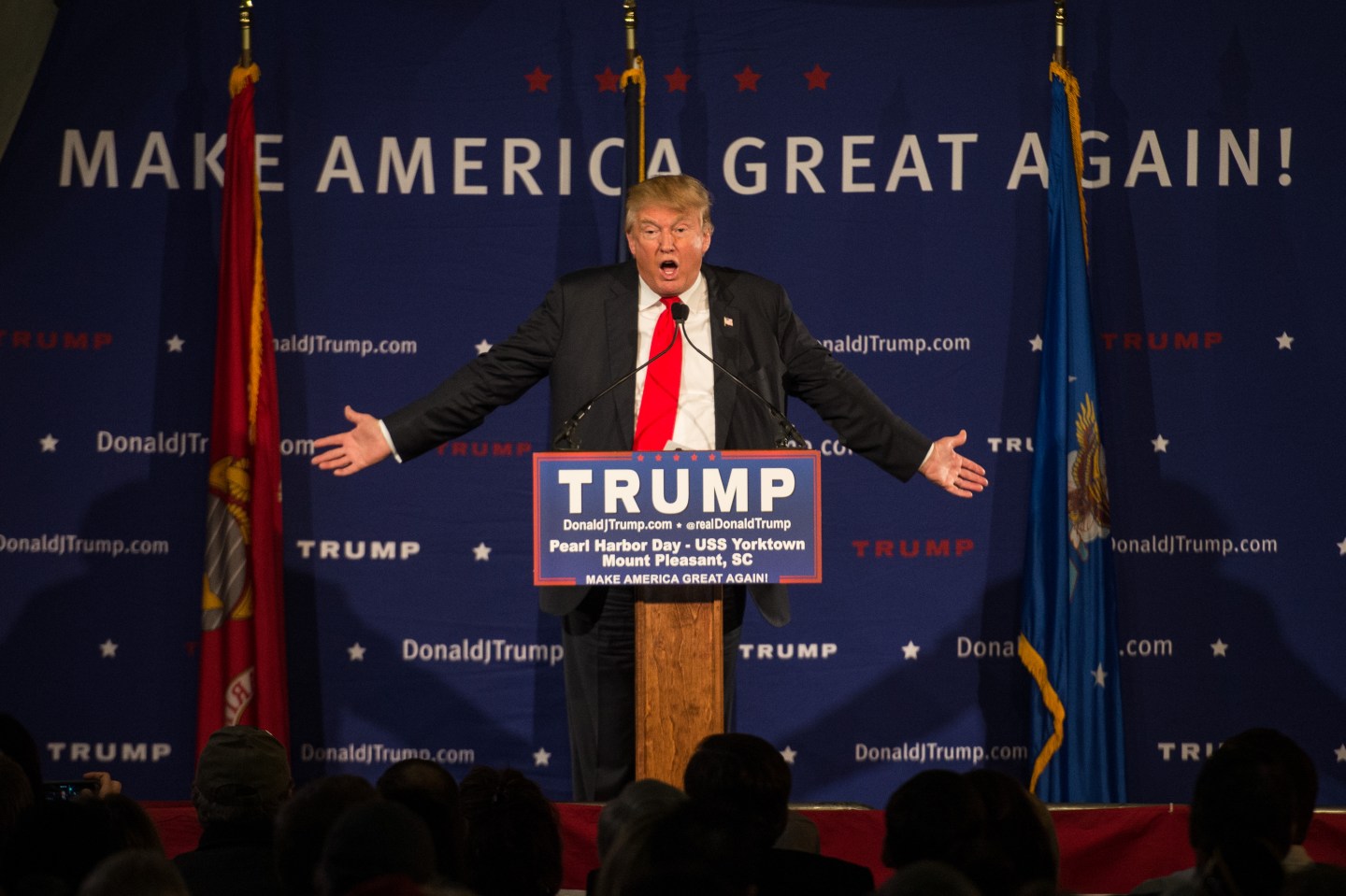
Many pundits such as David Brooks expect the Trump bubble to burst and his support to fade as voters get more serious about the election and give Trump and his rhetoric and policy positions a closer look. But supposedly knowledgeable observers have been predicting Trump’s fade for months. Meanwhile, recent polls show him leading the field with more support among Republicans than ever. Here are some social psychological principles that make sense of the “Trump phenomenon.”
Let’s ignore for the moment the fact that Trump embodies many behaviors people claim to not like in leaders—self-promotion, unbridled self-confidence, and the disregard of many social conventions such as being polite, for example—even as many workplaces and people select and promote leaders for precisely those things. There is yet another important psychological process working to help Trump: people with money and other trappings of success receive more favorable evaluations from others, regardless of how the success was achieved. This is because success creates positive attributions about the successful individual.
Begin with the fact that people prefer congruent cognitions—a psychological principle that forms the foundation of the late social psychologist Leon Festinger’s theory of cognitive dissonance. For example, if people can be induced to do a task for minimal to no financial reward—the insufficient justification condition—they will come to believe they like the task as a way of making sense of their behavior. That is because it is inconsistent to do something you don’t like for no reward. Therefore, you must have enjoyed the experience.
It is incongruent to believe that Trump is, on the one hand, rich and successful, and on the other hand, unintelligent, incompetent, ineffective, and not a good leader. To maintain cognitive consistency, people are motivated to infer intelligence and many other positive traits from the mere fact of success. This phenomenon was demonstrated 40 years ago in the context of group performance by U.C. Berkeley professor Barry Staw. Staw found that when individuals were told a group had done well, they attributed all sorts of positive attributes to that group. In part, that’s because people carry around in their heads lay theories of the causes of good performance and use those theories to ascribe characteristics to high performing groups—or individuals. And that’s partially because it would be psychologically inconsistent to believe that high performing groups do not have attributes logically associated with high performance.
A subsequent study asked whether people’s actual experience in groups might overcome this bias. After all, personal experience should provide concrete evidence that should counter such assumptions. But much to the study authors’ surprise, they replicated Staw’s effect exactly, noting that, “group history did not rival performance feedback as a cue for individual perceptions.”
This effect applies to individuals as well. To take one prosaic example, a colleague who teaches at the business school at Duke happened to be behind two students walking out of a CEO’s speech at the school. Even though the speech contained meaningless platitudes, logical inconsistencies, and statements at odds with many facts, the talk was warmly received. My friend overheard one student say to the other something to the effect of, “Well, he’s incredibly rich, so he must be smart.” Thus, the talk was viewed as brilliant, regardless of the errors.
For people to believe that individuals (or organizations) are economically successful but incompetent or not virtuous would also violate people’s strong desire to believe that the world is a just and fair place. As described by social psychologist Melvin Lerner decades ago, the “just world hypothesis” guides people’s judgments. For instance, in one classic paradigm, when bad (or good) things randomly happen to people—and even when the observers know the events are random—these observers change their judgments and attributions to make the bad or good fortune explainable and deserved.
Because Trump’s reputation rests largely on his wealth and success, as Forbes has noted, no one has been more interested in the magazines’ rankings and assessments of his wealth than Trump. And Trump is always quick to challenge the idea that his current net worth is not significantly different than his inheritance compounded at a typical stock market return over time. Early in his campaign, he included statements about his wealth in his speeches (“I’m really rich”), with the implicit suggestion that the wealth was a signal of his acumen and other leadership attributes. Recently, The Economist reported on a Trump rally in Sarasota, Florida. The reporter noted, “Many interviewees offered the thought that ‘He’s a rich businessman, so he knows what he’s doing.’”
And if you’re thinking, “surely there are other candidates—and people—who would be subject to this same effect,” you are right. The problem for Carly Fiorina is that she was fired from Hewlett-Packard and therefore her business record is endlessly contested. The problem for Meg Whitman in her race a few years ago for governor of California was that she was running as a Republican in a very Democratic state—and there are obviously limits to the strength of the effects I am describing.
But notice the conversations and events around you. Every day, you can see people’s statements being accorded undue status and weight because they are wealthy and successful, even in domains irrelevant to their presumed expertise. After all, people pay attention to Jenny McCarthy, the successful actress and model, on the subject of vaccines even though she has no professionally relevant medical or scientific credentials.
Success causes people to be perceived as competent and smart, almost regardless of what they say or do, because of people’s desire to believe in a just world. To maintain logically consistent perceptions of the world, people attribute intelligence and skill to those who are successful.
Trump’s polling success rests at least in part on the perception that “he is a rich businessman” who therefore must be smart and a great leader. And that perception is not going away unless and until people attack his business record, not his incendiary language and ever-changing political positions.
Jeffrey Pfeffer is the Thomas D. Dee II Professor of Organizational Behavior at the Graduate School of Business, Stanford University, and the author of Leadership BS: Fixing Workplaces and Careers One Truth at a Time.