• Home
  • News
  • Fortune 500
  • Tech
  • Finance
  • Leadership
  • Lifestyle
  • Rankings
  • Multimedia
LeadershipBernie Sanders

President Bernie Sanders: Bad for bankers, perhaps not so bad for banks

By
Ben Geier
Ben Geier
Down Arrow Button Icon
By
Ben Geier
Ben Geier
Down Arrow Button Icon
October 21, 2015, 2:22 PM ET
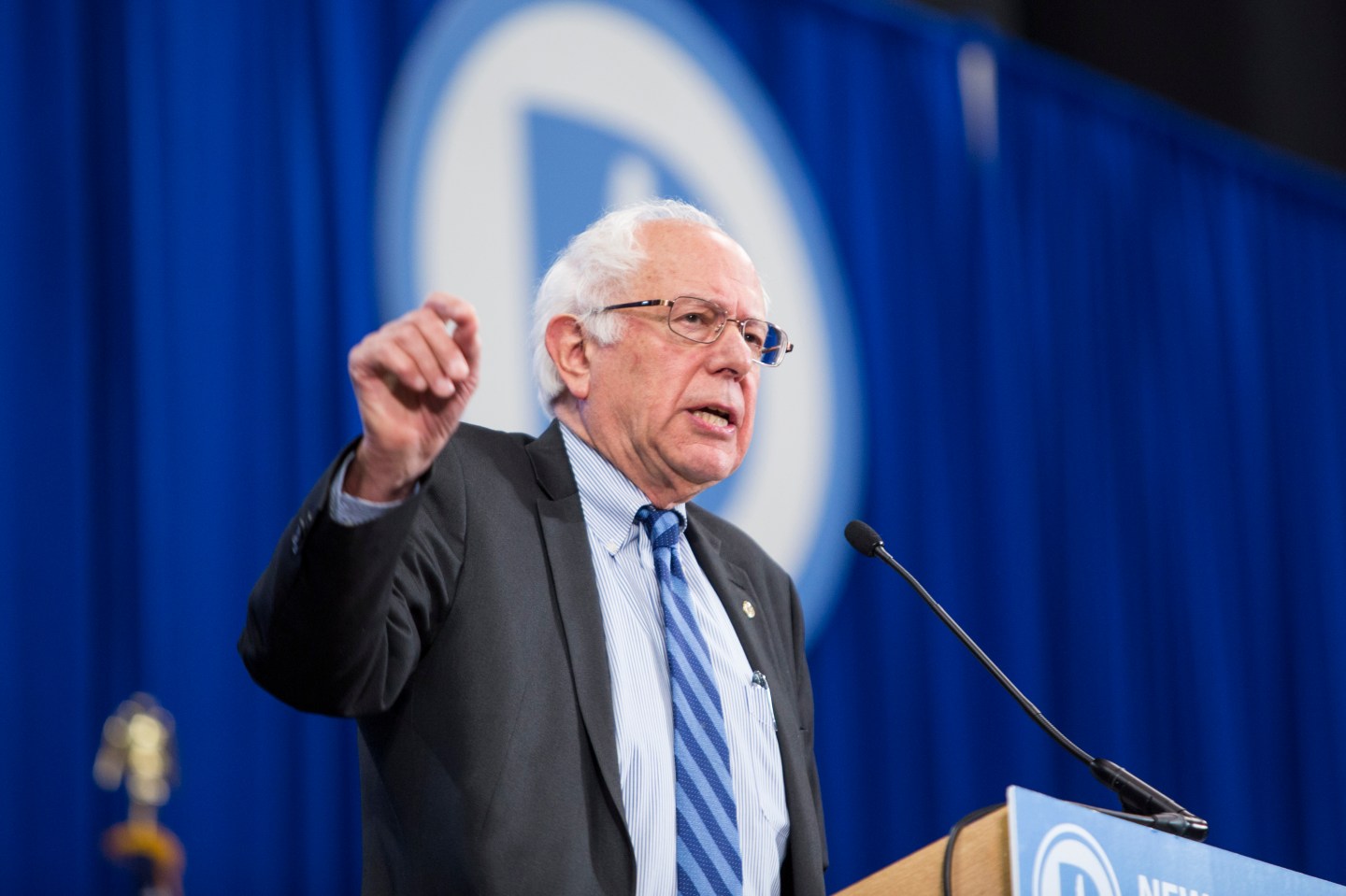
Democratic Candidates Attend New Hampshire Democratic Party Convention
Democratic Presidential candidate Senator Bernie Sanders (I-VT) talks on stage during the New Hampshire Democratic Party State Convention on September 19, 2015 in Manchester, New Hampshire. Photograph by Scott Eisen — Getty Images

One year ago, the idea of a Bernie Sanders presidency was laughable. Hillary Clinton may not be the perfect candidate, the thinking it went, but there was no way Democrats would vote for a septuagenarian, democratic-socialist, Independent Senator from Vermont; one who honeymooned in the Soviet Union and offered support for the socialist Sandinistas in Nicaragua in the 1980s. There was no way that guy had any chance to be president, right?

Wrong.

As of the most recent polls, the Real Clear Politics average has Sanders polling at 25% nationally. Yes, that’s nearly 20 points behind Clinton, but for a candidate with views that are on the fringe of American politics, it is remarkable. Yes, it is still a long shot, but the American political world now has to reckon with the fact that a Sanders administration is possible.

If there’s one group that is likely shaking at the thought of a President Sanders, it’s the financial sector.

“The biggest impact would be Jamie Dimon’s and Lloyd Blankfein’s bonus,” said Dennis Kelleher, founder of non-partisan advocacy group Better Markets. “And that is not a net loss to the country.”

Kelleher points out that Sanders’ plan for Wall Street regulation isn’t particularly detailed, at least compared to those put forward by Clinton and Martin O’Malley. Still, his campaign website makes his primary objective clear:

It is time to break up the largest financial institutions in the country. The six largest financial institutions in this country today hold assets equal to about 60% of the nation’s gross domestic product. These six banks issue more than two-thirds of all credit cards and over 35 percent of all mortgages. They control 95 percent of all derivatives and hold more than 40 percent of all bank deposits in the United States.

We must break up too-big-to-fail financial institutions. Those institutions received a $700 billion bailout from the US taxpayer, and more than $16 trillion in virtually zero interest loans from the Federal Reserve. Despite that, financial institutions made over $152 billion in profit in 2014 – the most profitable year on record, and three of the four largest financial institutions are 80 percent bigger today than they were before we bailed them out.

So yes, if you’re an executive at one of those huge financial institutions—and according to legislation Sanders introduced in May, there are actually eight such firms: Bank of America, Bank of New York Mellon, Citigroup, Goldman Sachs, JPMorgan Chase, Morgan Stanley, State Street and Wells Fargo—you aren’t going to like what Sanders is proposing. He wants to break up your company and take a bite into your firm’s bottom line, which most likely means a lower bonus.

But for the financial services industry as a whole, Kelleher thinks this might actually be good. He points to the breakup of Standard Oil in the early 20th century as an example. After the monopoly was broken up, “we ended up with six to eight big regional oil companies,” he notes, which led to increased competition and lower prices. He also points to the breakup of big phone companies, which in turned spurred competition that led to mobile technologies and all the smart phone wonders we have today.

Remember, the financial sector is more than just the 10 biggest banks, and the 10 biggest banks are made up of far more people than just their top executives. So while there is no doubt that Sanders’ plan of putting a cap on the size of any given bank (perhaps tied to a firm’s assets as a percentage of GDP) would be bad for those at the top, it might not spell bad news for the industry as a whole.

Not having such massive banking players at the top could allow smaller, regional banks to compete. Kelleher points out that even for Goldman Sachs, being forced to be smaller may be a blessing in disguise. At their current size, the bureaucracy involved in operating the biggest banks is massive. Kelleher notes that when a bank exceeds $100 billion in assets, the economies of scale actually start to move in the wrong direction and banks become less efficient.

Of course, none of this will stop the banks from complaining, says NYU Stern School of Business Professor Larry White. “There’s nothing that one can think about Bernie Sanders that is going to be interpreted as a good thing from the perspective of the firms that are in or around the financial sector,” he says.

For those at the very top of the pyramid, that may well be true. For the rest of the finance industry, though, perhaps not.


About the Author
By Ben Geier
See full bioRight Arrow Button Icon

Latest in Leadership

SuccessCareers
Elon Musk and Bill Gates warn that AI will kill all jobs within 20 years. ‘That’s not what we’re seeing,’ LinkedIn exec says
By Orianna Rosa RoyleDecember 5, 2025
4 minutes ago
Paul Atkins
CommentaryCorporate Governance
Turning public companies into private companies: the SEC’s retreat from transparency and accountability
By Andrew BeharDecember 5, 2025
45 minutes ago
C-SuiteFortune 500 CEO Interview
Bristol Myers Squibb CEO Chris Boerner says company culture was the missing piece of his ‘patent cliff’ plan
By Diane BradyDecember 5, 2025
5 hours ago
Shuntaro Furukawa, president of Nintendo Co., speaks during a news conference in Osaka, Japan, on Thursday, April 25, 2019. Nintendo gave a double dose of disappointment by posting earnings below analyst estimates and signaled that it would not introduce a highly anticipated new model of the Switch game console at a June trade show. Photographer: Buddhika Weerasinghe/Bloomberg via Getty Images
NewslettersCEO Daily
Nintendo’s 98% staff retention rate means the average employee has been there 15 years
By Nicholas GordonDecember 5, 2025
5 hours ago
Co-founder and chief executive officer of Nvidia Corp., Jensen Huang attends the 9th edition of the VivaTech trade show at the Parc des Expositions de la Porte de Versailles on June 11, 2025, in Paris.
C-SuiteNvidia
Before running the world’s most valuable company, Jensen Huang was a 9-year-old janitor in Kentucky
By Eva RoytburgDecember 5, 2025
5 hours ago
Future of WorkBrainstorm Design
The workplace needs to be designed like an ‘experience,’ says Gensler’s Ray Yuen, as employees resist the return to office
By Angelica AngDecember 5, 2025
7 hours ago

Most Popular

placeholder alt text
Economy
Two months into the new fiscal year and the U.S. government is already spending more than $10 billion a week servicing national debt
By Eleanor PringleDecember 4, 2025
1 day ago
placeholder alt text
Success
‘Godfather of AI’ says Bill Gates and Elon Musk are right about the future of work—but he predicts mass unemployment is on its way
By Preston ForeDecember 4, 2025
23 hours ago
placeholder alt text
Success
Nearly 4 million new manufacturing jobs are coming to America as boomers retire—but it's the one trade job Gen Z doesn't want
By Emma BurleighDecember 4, 2025
23 hours ago
placeholder alt text
Success
Nvidia CEO Jensen Huang admits he works 7 days a week, including holidays, in a constant 'state of anxiety' out of fear of going bankrupt
By Jessica CoacciDecember 4, 2025
22 hours ago
placeholder alt text
Economy
Tariffs and the $38 trillion national debt: Kevin Hassett sees ’big reductions’ in deficit while Scott Bessent sees a ‘shrinking ice cube’
By Nick LichtenbergDecember 4, 2025
21 hours ago
placeholder alt text
Health
Bill Gates decries ‘significant reversal in child deaths’ as nearly 5 million kids will die before they turn 5 this year
By Nick LichtenbergDecember 4, 2025
1 day ago
Rankings
  • 100 Best Companies
  • Fortune 500
  • Global 500
  • Fortune 500 Europe
  • Most Powerful Women
  • Future 50
  • World’s Most Admired Companies
  • See All Rankings
Sections
  • Finance
  • Leadership
  • Success
  • Tech
  • Asia
  • Europe
  • Environment
  • Fortune Crypto
  • Health
  • Retail
  • Lifestyle
  • Politics
  • Newsletters
  • Magazine
  • Features
  • Commentary
  • Mpw
  • CEO Initiative
  • Conferences
  • Personal Finance
  • Education
Customer Support
  • Frequently Asked Questions
  • Customer Service Portal
  • Privacy Policy
  • Terms Of Use
  • Single Issues For Purchase
  • International Print
Commercial Services
  • Advertising
  • Fortune Brand Studio
  • Fortune Analytics
  • Fortune Conferences
  • Business Development
About Us
  • About Us
  • Editorial Calendar
  • Press Center
  • Work At Fortune
  • Diversity And Inclusion
  • Terms And Conditions
  • Site Map

© 2025 Fortune Media IP Limited. All Rights Reserved. Use of this site constitutes acceptance of our Terms of Use and Privacy Policy | CA Notice at Collection and Privacy Notice | Do Not Sell/Share My Personal Information
FORTUNE is a trademark of Fortune Media IP Limited, registered in the U.S. and other countries. FORTUNE may receive compensation for some links to products and services on this website. Offers may be subject to change without notice.