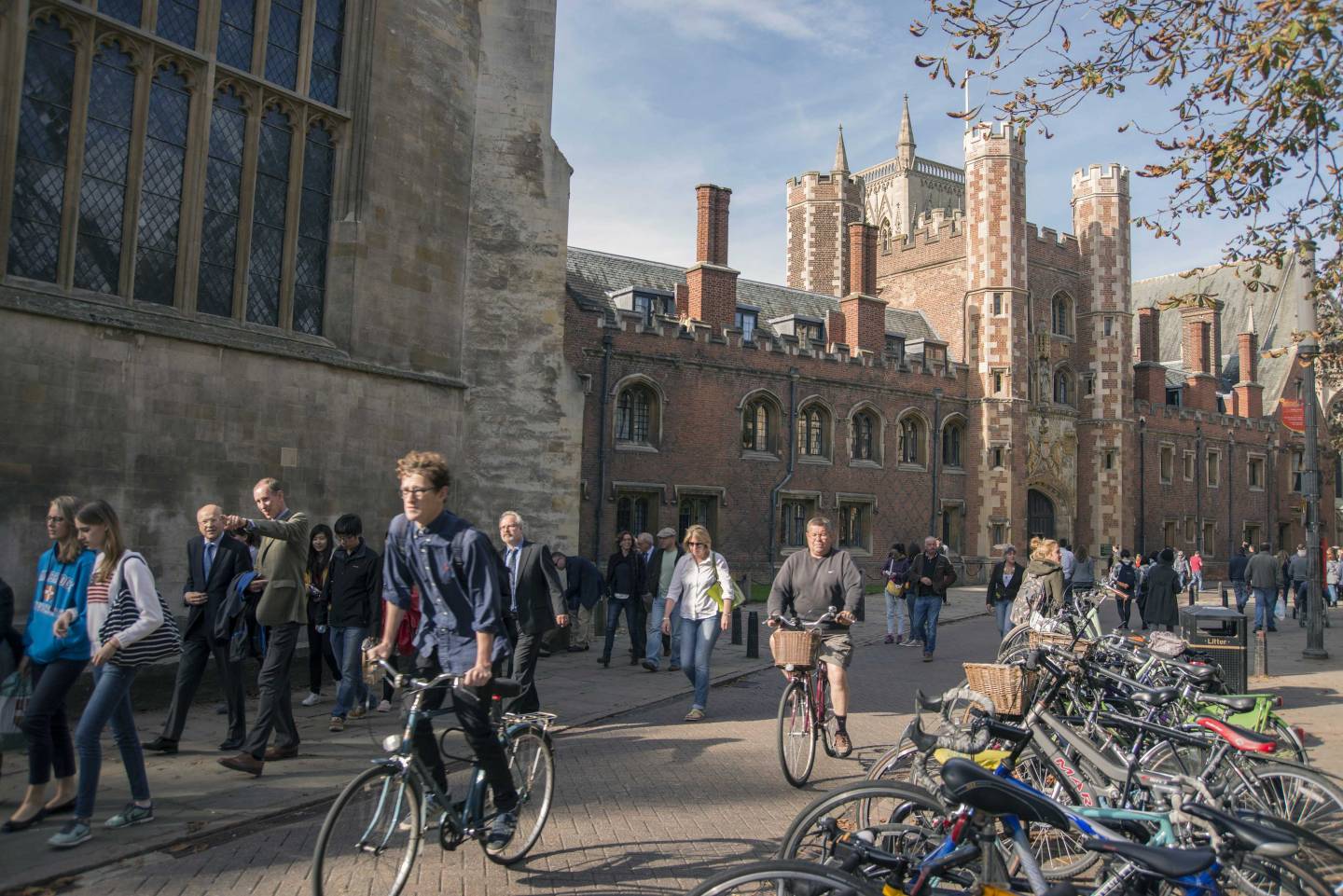
Students have come back to college. But not all to the United States.
The idea that a student would study in another country is not a new concept. The media frequently reports on the number of international students studying in the United States. And that is exactly how we tend to think about it — students from other countries coming to the United States.
Yet, a growing number of U.S. students are now looking overseas for their college degree. Germany alone, with its essentially free higher education system, is drawing a fair number of prospective U.S. college students. Some 4,660 U.S. students were enrolled in German universities last year — a number that has increased by 20% in three years.
While the number of U.S. students attending college in Germany remains very small relative to the some 21 million individuals pursuing a post-secondary education, it represents two important shifts in the international student market: a rapidly increasing global market for international students and a growing number of U.S. students looking to earn degrees overseas.
As a researcher of international education, a key concern for me is understanding the ways in which the changing global economy is reshaping educational opportunities and potentially how the U.S. dominance in the international education market is being threatened.
U.S. students studying abroad
There is no central source that tracks the total number of U.S. students enrolled in foreign institutions.
There is also no international repository of enrollment trends worldwide. In the U.S., the federal government tracks enrollments in domestic higher education institutions. In addition, the Institute of International Education (IIE)’s annual Open Doors report gathers data about American students at U.S. colleges studying abroad for academic credit.
In fact, there were about 290,000 students studying abroad for academic credit, but not a full degree, in the 2012 academic year, more than double the number who studied abroad 15 years earlier. However, these numbers do not include students pursuing a full degree from an overseas institution, as they are not tracked by the U.S. government.
But based on national data sets, IIE’s Project Atlas has put together a patchwork picture about students pursuing college degrees elsewhere.
According to a Project Atlas report (the most recent aggregated data on this issue), there were more than 43,000 U.S. students enrolled in degree programs in foreign countries in 2010 (this is in addition to the number of students studying abroad not for a degree). However, it should be noted that Project Atlas, has data only from the IIE’s 13 partnering nations. So these data may actually undercount the number of students enrolled in such programs.
Even so, based on these data, we can confidently say that the United Kingdom was the leading destination for U.S. students. Most U.S. students (72%) in this data set head to anglophone countries. Master’s degree programs are the most popular option (followed by undergraduate programs and then doctoral).
Recent reports, such as those about Germany, suggest that the number of students pursuing a degree outside of their home country, including students moving outside of the U.S., is growing rapidly. But, in order to gather information about U.S. citizens who pursue degrees elsewhere, that information must be gathered from those nations.
Growing competition for international students
The fact is that today, there is a large market for students in higher education.
In 2000, according to UNESCO’s Education at a Glance, there were only 2.1 million students studying abroad in both short-term and full-degree programs. Today, there are roughly 4.5 million.
And, the competition for those students has become quite fierce. Today, countries like China, South Korea, Mexico, Russia, Taiwan, Thailand, Argentina, Brazil and Chile, who once primarily sent students abroad, have enacted policies and strategies to actively recruit international students.
In fact, according to our research, places like Singapore, Malaysia and United Arab Emirates want to become regional educational hubs – serving students from their neighboring countries.
With this increase, the market for international students has also become quite volatile in the last decade. Many of the earlier entrants to this market are losing share.
For instance, even though the total number of international students studying in the U.S. continues to grow, the U.S. market share has dropped from 23% in 2000 to 16% in 2012. Countries such as Germany, France, South Africa and Belgium have also lost about 5% market share collectively, with Germany and France having the largest remaining share of the group at about 6% each.
At the same time, places like China, Canada, the United Kingdom, Russia, Korea and New Zealand each picked up larger proportion of the market, with the United Kingdom and Russia both gaining two points of the market and the others a little less. In fact, at 13% of the market share and growing, the United Kingdom may be on track to overtake the U.S.’ market lead.
Opening up borders
In such a market, some countries are taking advantage of their language of instruction which can offer a competitive advantage, while others are offering low-cost or even free tuition.
So, nations whose language of instruction is widely spoken elsewhere, such as English, French and Spanish, are becoming leading receivers of international students.
Some countries, such as Austria, France, Germany and Norway, are providing de facto free education for all students, including those from foreign countries.
This low cost of education can help countries attract students already looking to go abroad as well as elicit attention from students looking for alternatives to the high costs of higher education in their own countries.
Countries are getting much savvier about their efforts to recruit foreign students — adopting more student-friendly immigration policies, offering financial incentives and even setting national strategic recruitment goals.
The German government, for instance, has a goal of attracting 350,000 international students by 2020. To do so, Germany is actively recruiting students and lowering barriers to entry.
Today, an increasing number of degree programs offered in Germany are in English and searchable through a national database. They have even amended their laws to make it easier for international students to work while going to school. The German academic exchange service, DAAD, also provides scholarships to offset the cost of other academic and living expense.
Competing for brain power
Attracting international students, then, is not just about bringing in tuition dollars. Countries offering free or reduced tuition are often seeking to rebuild national workforce as their domestic population ages and younger talent pools shrink.
So, Canada, Germany, the Netherlands and Sweden are now developing study-to-work pathways and “train and retain policies” to encourage international students to transition into the workplace. Some of these efforts are paying off. Students are not only choosing to study abroad, but many are also staying abroad after they graduate.
For example, a survey of more than 11,000 international students in Germany found that three in 10 plan to stay in Germany permanently after their studies and four in 10 plan to stay for at least 10 years.
A globally competitive market
The increasing number of students pursuing their college years in a foreign country is symptomatic of two important trends. First, it reflects a rapidly changing world economy, where it is not only the workforce opportunities that are global, but also the educational experiences that prepare students for those opportunities. As a result, more and more students from both developed and developing countries are looking beyond their national borders for their collegiate experience.
Second, as economies become more knowledge-based, the competition for brains is heating up. The U.S. has long dominated this market. But as more nations have seen international students as part of their strategic interests, the U.S. market has begun to shrink significantly.
Without a similar strategic national interest, will the U.S.’ dominance fall all together?
Jason Lane is an associate professor of education policy and co-director of the Cross-Border Education Research Team at the University of Albany, State University of New York. This article originally appeared on The Conversation.