For a few days last week it looked like the private spaceflight industry was poised for a tectonic realignment.
Industry reports claimed that legacy rocket engine maker Aerojet Rocketdyne made a $2 billion cash offer to buy United Launch Alliance (ULA). For those unaware, ULA is a 50/50 joint venture between Boeing (BA) and Lockheed Martin (LMT) and the U.S. national security establishment’s sole launch provider for large satellites.
However, a week later, it seems the deal was called off. A Boeing spokesperson dismissed the proposed deal, saying Boeing leadership never seriously entertained the offer.
The deal could’ve created a rocket-building behemoth by combining Aerojet’s propulsion supply chain and ULA’s Atlas V launch vehicles by positioning the new group to better compete with Elon Musk’s SpaceX, the current market disruptor in the launch space. It certainly would’ve altered the competitive landscape, tying together multiple legacy aerospace companies and their accumulated technological know-how.
Even though the deal fell apart, it didn’t prevent the private spaceflight industry from undergoing some significant change last week. Jeff Bezos’ Blue Origin—a so-called NewSpace venture— wasn’t explicitly involved in the Aerojet-ULA deal, but does play a role in the industry’s future. Aerojet’s attempted purchase of ULA underscores Blue Origin’s emerging clout in the private spaceflight arena, and just how much money some companies would spend to try to control it.
“I think it suggests Blue Origin is a major disruptive force,” says Carissa Christensen, a founder and managing partner at aerospace and defense consulting firm The Tauri Group. “This whole conversation wouldn’t be happening without Blue Origin and its relationship with ULA. And that’s fascinating.”
To understand Blue Origin’s role in this drama, one has to delve a bit into the economics of rocket building. The rocket business is both capital intensive and highly specialized, with a very limited number of potential customers in line to purchase any given piece of hardware. As such, it’s important for companies in the space to have long-term commitments; developing and testing new clean-sheet rocket engines can take four to five years and cost tens (if not hundreds) of millions of dollars. A company without contracts can quickly find itself in trouble.
Aerojet Rocketdyne is currently developing an engine called the AR-1 for ULA’s Atlas V rockets (Congress is trying to wean ULA and the Atlas V off of its current engine, the Russian-built RD-180). However in an ongoing effort to trim costs and better compete with SpaceX, ULA is developing a new rocket called Vulcan. Vulcan also needs rocket engines, and Aerojet would very much like the AR-1 to fill that role. But last year, in a move that surprised many in the industry, ULA tapped Blue Origin to develop a potential engine for Vulcan as well.
Blue Origin’s BE-4 engine represents a departure from traditional rocket engine technology. It runs on liquid methane rather than the typical kerosene-based rocket fuel powering most liquid-fueled rockets today. Keeping methane in a liquid state requires some additional technological complexity in the way of cooling systems and tanks that maintain temperatures of nearly 300 below zero Fahrenheit. Yet Blue Origin’s BE-4 seems to be the favorite at ULA, a point reiterated just last week. On September 10—after Aerojet’s rumored bid for ULA was announced and later quashed by Boeing—ULA announced that it had entered an agreement with Blue Origin to help expand its production capabilities for the BE-4.
If ULA goes with Blue Origin’s engine for Vulcan it’s clearly bad news for Aerojet. So while an Aerojet-ULA tie up would create plenty of product synergies and efficiencies, what Aerojet really wants for its $2 billion is a steady customer.
“I think objectively such a deal would be a very smart deal for Aerojet if they could close it,” Christensen says. “They have a limited customer base and ULA has been looking seriously at Blue Origin as a supplier. So if Aerojet could make this work through an acquisition and force its own supplier relationship, that would be very good for Aerojet.”
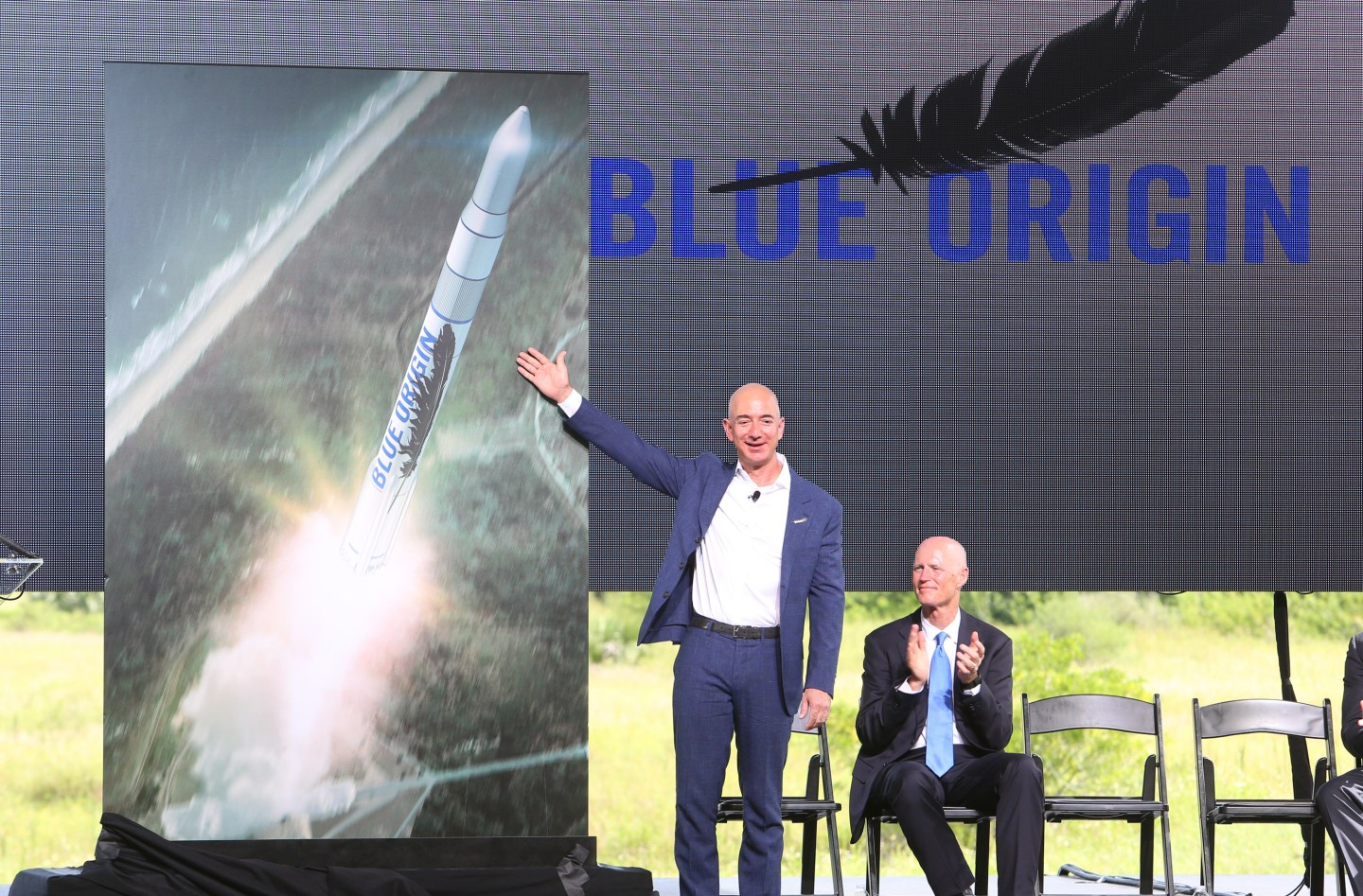
Given the events of the past few days, such a deal doesn’t appear likely. Meanwhile, Blue Origin has in the span of a week unveiled plans for a new reusable orbital rocket, a new Florida-based facility for manufacturing, testing, and launching the company’s rockets and rocket engines (including the BE-4). It also quietly provoked a competitor to put $2 billion on the table.
That marks a huge change in stature for Bezos’s secretive space startup, which has received far less federal money and attention than competitors like SpaceX (through NASA’s commercial crew program) or Aerojet Rocketdyne (as contractor for the main engine on the Space Shuttle and for NASA’s upcoming Space Launch System). Though the private spaceflight industry didn’t see a blockbuster multi-billion-dollar deal this past week, it may have witnessed something more significant behind the scenes.
“What’s happening right now is happening because of the relationship between ULA and Blue Origin and its affect on Aerojet,” Christensen says. “It’s just amazing that a truly commercial company is in there making that impact.”
Sign up for Data Sheet, Fortune’s daily newsletter about the business of technology.
For more about NewSpace technology, check out the following Fortune video: