• Home
  • News
  • Fortune 500
  • Tech
  • Finance
  • Leadership
  • Lifestyle
  • Rankings
  • Multimedia
CommentaryFinancial Crisis

Biggest lesson from financial crisis: Wall Street gets what it wants

By
Dean Baker
Dean Baker
and
Bethany Cianciolo
Bethany Cianciolo
Down Arrow Button Icon
By
Dean Baker
Dean Baker
and
Bethany Cianciolo
Bethany Cianciolo
Down Arrow Button Icon
September 16, 2015, 9:50 AM ET
APTOPIX Wall Street
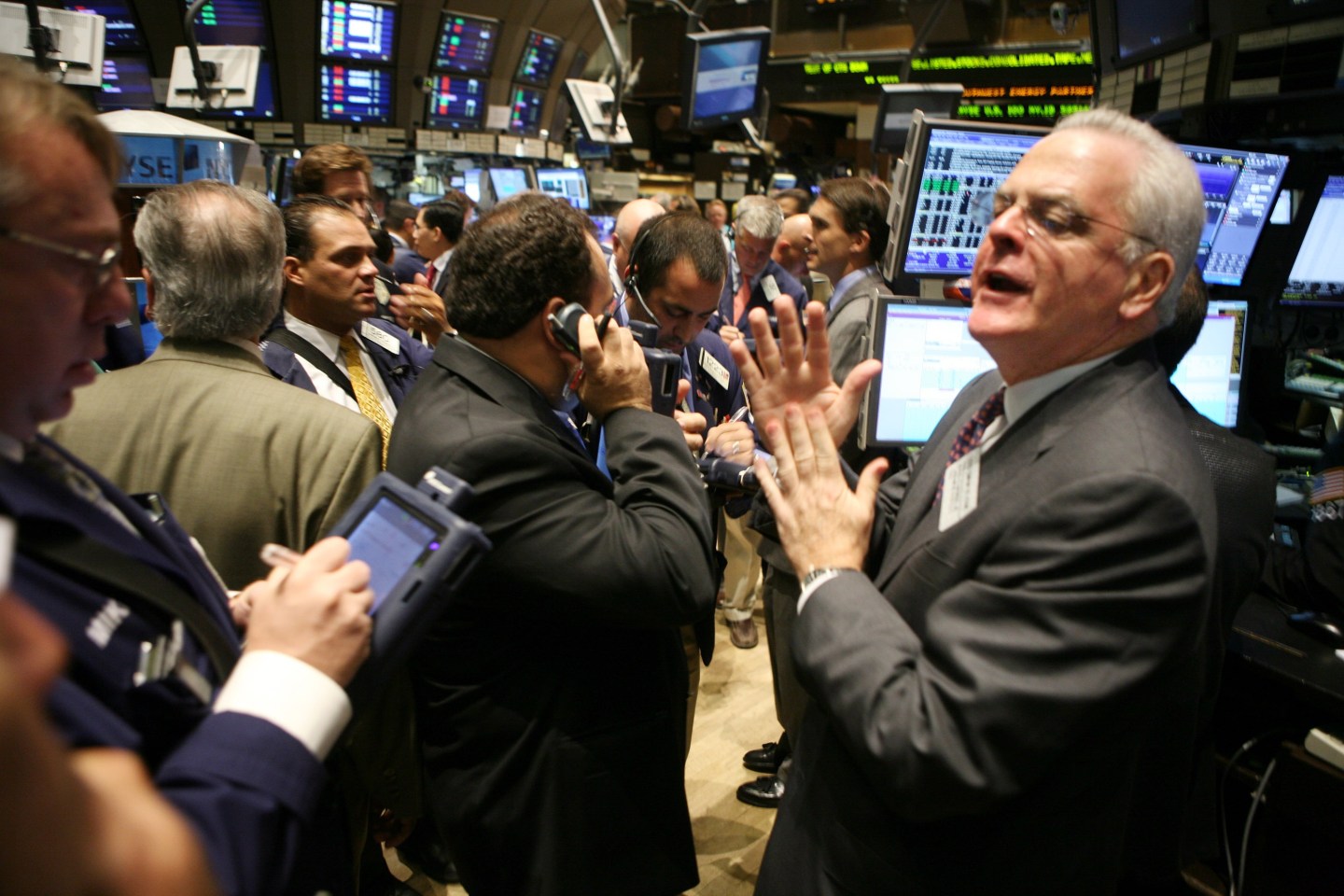
Traders, Specialists and Floor Officials gather around the trading post where Lehman Brothers stock is traded on the floor of the New York Stock Exchange as the market opens Wednesday, Sept. 10, 2008. Stock prices rose early Wednesday, staging a partial rebound from a steep sell-off after investors grew encouraged that Lehman Brothers Holdings Inc. is close to a deal to sell a majority stake in its investment management business and bring in much-needed capital. (AP Photo/David Karp)Photograph by David Karp — AP

Seven years ago this week, the world’s financial system was teetering on the brink of collapse. The bankruptcy of Lehman Brothers had completely shaken confidence in the banking industry. First, no one could trust the banks books; no one knew how much bad debt banks were concealing. Second, the too big to fail insurance seemed not to exist. After all, if Lehman was not too big to fail, who was?

At that point, policy could have gone two directions. One direction would have been to take advantage of this moment and let the market work its magic. The bloated financial structure that had developed over the last three decades was collapsing from its own excesses. The industry would have paid the price for the issuing and packaging of hundreds of billions of dollars of fraudulent loans, as they finally ran out of suckers to buy the junk.

The other route was to have the government rush to the rescue and keep Wall Street largely intact. This would involve an enormous amount of below market interest rate loans from the Fed and Treasury and an even larger amount of loan guarantees.

As we all know, we went the route of the Wall Street bailout. When the House of Representatives responded to an outcry from constituents across the political spectrum and voted down the original bailout, the Wall Street gang doubled down.

They endlessly pushed the line that we would face another Great Depression if Congress didn’t rescue Wall Street. Leading news outlets like the New York Times, National Public Radio, and the PBS News Hour were filled with stories about how we would be condemned to a decade of double digit unemployment if the government didn’t bailout Citigroup (C) and Goldman Sachs (GS)

The implication was that we somehow had forgotten how to do fiscal policy – the government would not know how to spend money – if the Wall Street banks went under. Federal Reserve Board Chair Ben Bernanke, along with Treasury Secretary Hank Paulson, and Timothy Geithner, who was then head of the New York Fed, led the charge. Bernanke apparently had no problem warning of a second Great Depression even though just a few years earlier he had mocked people who questioned the government’s ability to generate demand by pointing out that the government “… has a technology, called a printing press….”

There is no doubt that the initial downturn would have been worse if the banks were allowed to fail. But it is difficult to envision the force that would prevent us from rebooting the economy and getting it back up to its capacity without the albatross of a bloated financial sector. Would the ghost of Citigroup prevent members of Congress from supporting stimulus, something even Republicans had done in large numbers in February of 2008?

The story of the decade of double-digit unemployment from which we were supposedly spared by the bailout depends on Congress sitting on its hands and doing nothing through the worst slump in 70 years. This is a political prediction, not an issue of economics. And it is a political prediction that has absolutely zero basis in modern history.

Seven years after the Lehman collapse, the country is still far from recovering. We are still down between 3 million to 4 million jobs from the trend growth path. For most workers, real wages still have not recovered to their pre-recession level. And millions of families have lost their homes due to either or both the bad timing of having bought at bubble-inflated prices or having taken out a high-risk loan.

Meanwhile, Wall Street is doing just fine. The big banks are bigger than ever. And the folks who lead the bailout, like Timothy Geithner, who as President Obama’s Treasury Secretary made “no more Lehmans” his motto, are making multi-million dollar salaries.

And of course no Wall Street types were prosecuted for issuing or passing on fraudulent mortgages. In short, Wall Street gets what it wants, the people who help along the way get their rewards, and the rest of the country … well, life is tough.

Dean Baker is a macroeconomist and co-director of the Center for Economic and Policy Research in Washington, DC. He previously worked as a senior economist at the Economic Policy Institute and an assistant professor at Bucknell University.


About the Authors
By Dean Baker
See full bioRight Arrow Button Icon
By Bethany Cianciolo
See full bioRight Arrow Button Icon

Latest in Commentary

Matt Rogers
CommentaryInfrastructure
I built the first iPhone with Steve Jobs. The AI industry is at risk of repeating an early smartphone mistake
By Matt RogersDecember 4, 2025
7 hours ago
Jerome Powell
CommentaryFederal Reserve
Fed officials like the mystique of being seen as financial technocrats, but it’s time to demystify the central bank
By Alexander William SalterDecember 4, 2025
7 hours ago
Rakesh Kumar
CommentarySemiconductors
China does not need Nvidia chips in the AI war — export controls only pushed it to build its own AI machine
By Rakesh KumarDecember 3, 2025
1 day ago
Rochelle Witharana is Chief Financial and Investment Officer for The California Wellness Foundation
Commentarydiversity and inclusion
Fund managers from diverse backgrounds are delivering standout returns and the smart money is slowly starting to pay attention
By Rochelle WitharanaDecember 3, 2025
1 day ago
Ayesha and Stephen Curry (L) and Arndrea Waters King and Martin Luther King III (R), who are behind Eat.Play.Learn and Realize the Dream, respectively.
Commentaryphilanthropy
Why time is becoming the new currency of giving
By Arndrea Waters King and Ayesha CurryDecember 2, 2025
2 days ago
Trump
CommentaryTariffs and trade
The trade war was never going to fix our deficit
By Daniel BunnDecember 2, 2025
2 days ago

Most Popular

placeholder alt text
Economy
Two months into the new fiscal year and the U.S. government is already spending more than $10 billion a week servicing national debt
By Eleanor PringleDecember 4, 2025
10 hours ago
placeholder alt text
North America
Jeff Bezos and Lauren Sánchez Bezos commit $102.5 million to organizations combating homelessness across the U.S.: ‘This is just the beginning’
By Sydney LakeDecember 2, 2025
2 days ago
placeholder alt text
Economy
Ford workers told their CEO 'none of the young people want to work here.' So Jim Farley took a page out of the founder's playbook
By Sasha RogelbergNovember 28, 2025
6 days ago
placeholder alt text
Success
‘Godfather of AI’ says Bill Gates and Elon Musk are right about the future of work—but he predicts mass unemployment is on its way
By Preston ForeDecember 4, 2025
5 hours ago
placeholder alt text
North America
Anonymous $50 million donation helps cover the next 50 years of tuition for medical lab science students at University of Washington
By The Associated PressDecember 2, 2025
2 days ago
placeholder alt text
Economy
Scott Bessent calls the Giving Pledge well-intentioned but ‘very amorphous,’ growing from ‘a panic among the billionaire class’
By Nick LichtenbergDecember 3, 2025
1 day ago
Rankings
  • 100 Best Companies
  • Fortune 500
  • Global 500
  • Fortune 500 Europe
  • Most Powerful Women
  • Future 50
  • World’s Most Admired Companies
  • See All Rankings
Sections
  • Finance
  • Leadership
  • Success
  • Tech
  • Asia
  • Europe
  • Environment
  • Fortune Crypto
  • Health
  • Retail
  • Lifestyle
  • Politics
  • Newsletters
  • Magazine
  • Features
  • Commentary
  • Mpw
  • CEO Initiative
  • Conferences
  • Personal Finance
  • Education
Customer Support
  • Frequently Asked Questions
  • Customer Service Portal
  • Privacy Policy
  • Terms Of Use
  • Single Issues For Purchase
  • International Print
Commercial Services
  • Advertising
  • Fortune Brand Studio
  • Fortune Analytics
  • Fortune Conferences
  • Business Development
About Us
  • About Us
  • Editorial Calendar
  • Press Center
  • Work At Fortune
  • Diversity And Inclusion
  • Terms And Conditions
  • Site Map

© 2025 Fortune Media IP Limited. All Rights Reserved. Use of this site constitutes acceptance of our Terms of Use and Privacy Policy | CA Notice at Collection and Privacy Notice | Do Not Sell/Share My Personal Information
FORTUNE is a trademark of Fortune Media IP Limited, registered in the U.S. and other countries. FORTUNE may receive compensation for some links to products and services on this website. Offers may be subject to change without notice.