• Home
  • News
  • Fortune 500
  • Tech
  • Finance
  • Leadership
  • Lifestyle
  • Rankings
  • Multimedia
TechUnited States Air Force

The U.S. Air Force is building a supercomputer to cut through its own red tape

By
Clay Dillow
Clay Dillow
Down Arrow Button Icon
By
Clay Dillow
Clay Dillow
Down Arrow Button Icon
September 15, 2015, 8:29 AM ET
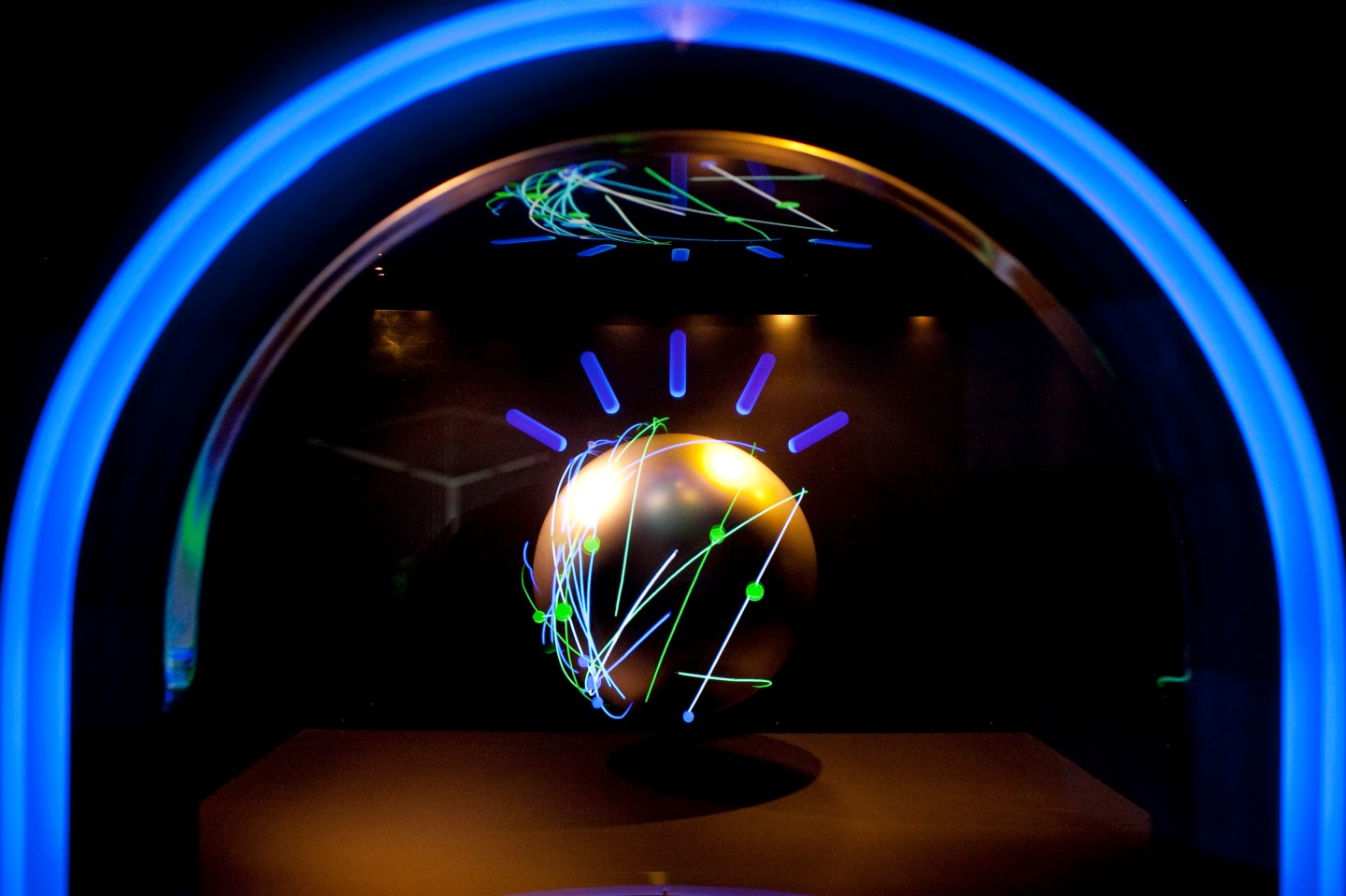
Watson computer at IBM in New York City
NEW YORK CITY, NY- MAY 27: IBM Watson's computer housing case. IBM's Watson computer is best known for winning Jeopardy, unaware of time constraints, while playing against humans. Some of Watson's other features are based in problem solving across many different careers. A demonstration showed how quickly Watson is able to diagnose illnesses, and provided a real life case that took doctors and nurses six days to diagnose, and only ended with the correct diagnosis because a nurse had seen the disease before. Based on symptoms input, Watson was able to correctly diagnose in minutes. The demonstration took place at IBM Watson's New York City, New York office on May 27, 2015. (Photo by Andrew Spear for The Washington Post via Getty Images.)Photograph by Andrew Spear — The Washington Post/Getty Images

As part of the U.S. federal government’s most sprawling bureaucracies, the Air Force knows a thing or two about red tape and complex bureaucratic processes.

So, perhaps it’s appropriate that in its effort to combat unnecessary red tape, the USAF isn’t taking any half measures. In order to smooth out its acquisition process and review new technologies and equipment more efficiently, the Air Force is building a state-of-the-art “cognitive computer” specifically designed to analyze large amounts of data.

In other words, the Pentagon is building a cutting-edge supercomputer to battle its own bureaucracy.

“In general, when we talk about where the Air Force is today versus 20 to 30 years ago, people say it takes so much longer to get things done,” Dr. Camron Gorguinpour, director of the USAF’s office of Transformational Innovation, says. “People ask why it takes so much longer. And the answer is, typically, complexity.”

Cognitive computers function more like the human brain, making them capable of tasks that are very difficult for regular computing machines. While they are not artificially intelligent in the sci-fi sense, they do possess the ability to think critically, learn from experience, and comprehend context. And critically, cognitive computers are able to interface with humans through natural language. In other words, they speak English.

Readers who recall IBM’s (IBM) supercomputer from a 2011 episode of Jeopardy! are already somewhat familiar with how this computing paradigm works. Cognitive computers can respond to queries that don’t fit neatly into a pre-programmed set of questions and responses. That’s key for navigating something like the USAF acquisitions process, Gorguinpour says, especially for small business that don’t have the resources to field a team of acquisition experts.

Using the new tool, businesses will be able to enter a question into a query bar, much like conducting a Google search. However, instead of being directed to a dense and lengthy list of acquisitions requirements or links to various opaque Pentagon documents, users would get a simple answer.

The bureaucracy-slaying cognitive machine marks the first technology initiative from the Air Force’s young Transformational Innovation Office in its attempt to reduce complexity and ultimately trim cost.

The office—about one year old—was created under the USAF acquisitions office specifically to bend the cost curve within the USAF acquisitions process. Last fall, some officers within the Air Force approached Gorguinpour’s office curious about using IBM’s Watson for Air Force applications.

In a demo conducted with IBM shortly thereafter, the Air Force uploaded its reams of acquisition regulations and put the software through its paces. The demonstration showed promise, Gorguinpour says. Natural language questions tended to produce coherent natural language answers.

On July 31 the Air Force awarded two companies—Applied Research in Acoustics, LLC, in Washington, D.C., and KalScott Engineering in Lawrence, Kansas—to take the initiative to the next level. The companies will better train Watson in acquisition regulations to sharpen its responses and improve the user interface so that it’s easier for the public to use. The initial nine-month effort is already underway, with delivery of a first product slated for April of next year.

Ultimately the Air Force is trying to make it easier for the contractors it already does business with, and enable companies that don’t typically interact with the federal government to engage in the USAF acquisitions process as well, Gorguinpour says. Doing so will increase the Air Force’s options, increase competition for contracts, and help smaller businesses with smart technology bring new solutions to the Air Force.

“This is part of a bigger context of work that we have underway,” Gorguinpour says. “The idea is to bend the cost-curve, and we’ve got 20-something more things in progress, pushing on multiple fronts.”

Bringing the power of cognitive computing to bear on the problem of bureaucratic inefficiency could pay dividends across the service branches as well as for the contractors that do business with the USAF. And the real transformational insights may come as much from those people as from the cognitive computer itself. “We’re going to learn a lot from developing it at first,” Gorguinpour says. “And once we release it in beta we’ll learn a lot a more.”

Sign up for Data Sheet, Fortune’s daily newsletter about the business of technology.</em

About the Author
By Clay Dillow
See full bioRight Arrow Button Icon

Latest in Tech

InnovationVenture Capital
This Khosla Ventures-backed startup is using AI to personalize cancer care
By Allie GarfinkleDecember 4, 2025
42 minutes ago
AIEye on AI
Companies are increasingly falling victim to AI impersonation scams. This startup just raised $28M to stop deepfakes in real time
By Sharon GoldmanDecember 4, 2025
1 hour ago
Jensen Huang
SuccessBillionaires
Nvidia CEO Jensen Huang admits he works 7 days a week, including holidays, in a constant ‘state of anxiety’ out of fear of going bankrupt
By Jessica CoacciDecember 4, 2025
1 hour ago
Ted Pick
BankingData centers
Morgan Stanley considers offloading some of its data-center exposure
By Esteban Duarte, Paula Seligson, Davide Scigliuzzo and BloombergDecember 4, 2025
1 hour ago
Zuckerberg
EnergyMeta
Meta’s Zuckerberg plans deep cuts for Metaverse efforts
By Kurt Wagner and BloombergDecember 4, 2025
2 hours ago
Pichai
Big TechAlphabet
Alphabet’s AI chips are a potential $900 billion ‘secret sauce’
By Ryan Vlastelica and BloombergDecember 4, 2025
2 hours ago

Most Popular

placeholder alt text
Economy
Two months into the new fiscal year and the U.S. government is already spending more than $10 billion a week servicing national debt
By Eleanor PringleDecember 4, 2025
6 hours ago
placeholder alt text
North America
Jeff Bezos and Lauren Sánchez Bezos commit $102.5 million to organizations combating homelessness across the U.S.: ‘This is just the beginning’
By Sydney LakeDecember 2, 2025
2 days ago
placeholder alt text
Economy
Ford workers told their CEO 'none of the young people want to work here.' So Jim Farley took a page out of the founder's playbook
By Sasha RogelbergNovember 28, 2025
6 days ago
placeholder alt text
North America
Anonymous $50 million donation helps cover the next 50 years of tuition for medical lab science students at University of Washington
By The Associated PressDecember 2, 2025
2 days ago
placeholder alt text
Economy
Scott Bessent calls the Giving Pledge well-intentioned but ‘very amorphous,’ growing from ‘a panic among the billionaire class’
By Nick LichtenbergDecember 3, 2025
1 day ago
placeholder alt text
AI
IBM CEO warns there’s ‘no way’ hyperscalers like Google and Amazon will be able to turn a profit at the rate of their data center spending
By Marco Quiroz-GutierrezDecember 3, 2025
1 day ago
Rankings
  • 100 Best Companies
  • Fortune 500
  • Global 500
  • Fortune 500 Europe
  • Most Powerful Women
  • Future 50
  • World’s Most Admired Companies
  • See All Rankings
Sections
  • Finance
  • Leadership
  • Success
  • Tech
  • Asia
  • Europe
  • Environment
  • Fortune Crypto
  • Health
  • Retail
  • Lifestyle
  • Politics
  • Newsletters
  • Magazine
  • Features
  • Commentary
  • Mpw
  • CEO Initiative
  • Conferences
  • Personal Finance
  • Education
Customer Support
  • Frequently Asked Questions
  • Customer Service Portal
  • Privacy Policy
  • Terms Of Use
  • Single Issues For Purchase
  • International Print
Commercial Services
  • Advertising
  • Fortune Brand Studio
  • Fortune Analytics
  • Fortune Conferences
  • Business Development
About Us
  • About Us
  • Editorial Calendar
  • Press Center
  • Work At Fortune
  • Diversity And Inclusion
  • Terms And Conditions
  • Site Map

© 2025 Fortune Media IP Limited. All Rights Reserved. Use of this site constitutes acceptance of our Terms of Use and Privacy Policy | CA Notice at Collection and Privacy Notice | Do Not Sell/Share My Personal Information
FORTUNE is a trademark of Fortune Media IP Limited, registered in the U.S. and other countries. FORTUNE may receive compensation for some links to products and services on this website. Offers may be subject to change without notice.