One of the big mysteries of Monday’s market turmoil has been why global markets suddenly decided that they needed to follow China’s?
Granted, the deflation of the bubble there has been an extraordinary horror-show, but until today most investors in western markets had accepted that it was largely a law unto itself, given the capital account restrictions and other local peculiarities that make the mainland stock market a law unto itself.
The most likely answer is still that it’s perceptions of the Chinese economy, rather than the Chinese stock market, that matter most to global investors. And for all that we’ve read about a housing bubble collapse, massive, decades-long over-investment in unproductive assets and all the other capital misallocation crimes that state-controlled economies are heirs to, the world has generally believed that Beijing had a plan that wise and capable people were in control, and that they had the tools and the will to avoid a disaster. And this is still the consensus opinion. Who else in the world has delivered eye-popping growth constantly for 20 years, after all?
It’s important to remember, however, that the stock market is not a priority for the people that run China–certainly not when measured next to geopolitical rivalries with Japan and the U.S., the economic imperatives of sourcing raw materials like oil, or disasters like the apocalyptic warehouse explosion in Tianjin.
As such, it has seemed very much that the authorities’ response to the problem was driven mainly by the desire to minimize the amount of time that the Politburo devoted to it, mainly by throwing money at the market through state-owned finance houses, and allowing listed companies to make full use of trading suspension rules. No market, no problem.
But as Monday showed, even such huge-scale interventions ($200 billion is a conservative estimate) aren’t working. And if the Politburo can’t fix the stock market, investors are no longer as sure that it can fix the much more important issues of the real Chinese economy. Beijing’s decision two weeks ago to let the yuan depreciate against the dollar for the first time in 21 years may have been modest and overdue but the impact on global market psychology was huge because it was so obviously a retreat by a government that has dictated its own rules as long as most people in the investing business can remember (the first of which was: the yuan does not devalue against the dollar).
Once you accept that it is global investors’ fears about the Chinese economy, rather than its stock market per se, that drove Monday’s carnage, things become easier to understand. Because while virtually no-one outside China is exposed to the Shanghai and Shenzhen casions, most of the world is exposed to its economy.
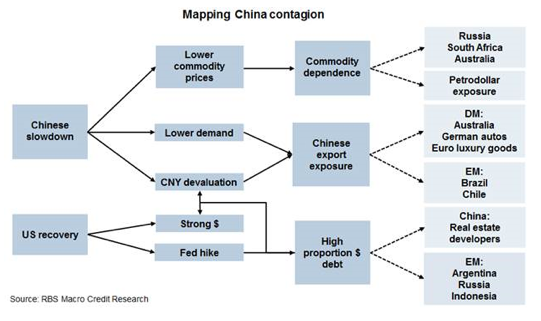
As this helpful ‘contagion map’ from RBS’s Alberto Gallo shows, the vectors are many: Countries from Russia to Argentina and South Africa are dependent on Chinese demand for their commodities; German carmakers and French and Italian luxury goods makers depend on Chinese consumers (Daimler and LVMH are down over 20% since the devaluation vs 17% and 15% for the DAX and CAC 40); and many international investors hold dollar-denominated debt issued by Chinese companies that no longer looks a good bet if the yuan is depreciating.
Clearly things aren’t all bad. As Tim Cook’s e-mail to CNBC’s Jim Cramer shows, Chinese consumers are still buying stuff they want (and retail sales are still growing over 10% a year even if they are slowing down over the longer term — see chart below from ieconomics.com)

It was Cook’s comments that turned the market mood round on Monday. But a raft of companies from LVMH and Burberry Group Plc to Volkswagen have either already cut their outlooks for sales there, or are already suffering (profit at Tata Motors, the parent company of Jaguar Land Rover, fell 29% in the first half as Chinese sales slumped).