• Home
  • News
  • Fortune 500
  • Tech
  • Finance
  • Leadership
  • Lifestyle
  • Rankings
  • Multimedia
Arts & Entertainment

Will movie theaters ever respond to the mass shootings?

By
Erik Sherman
Erik Sherman
Down Arrow Button Icon
By
Erik Sherman
Erik Sherman
Down Arrow Button Icon
August 7, 2015, 12:55 PM ET
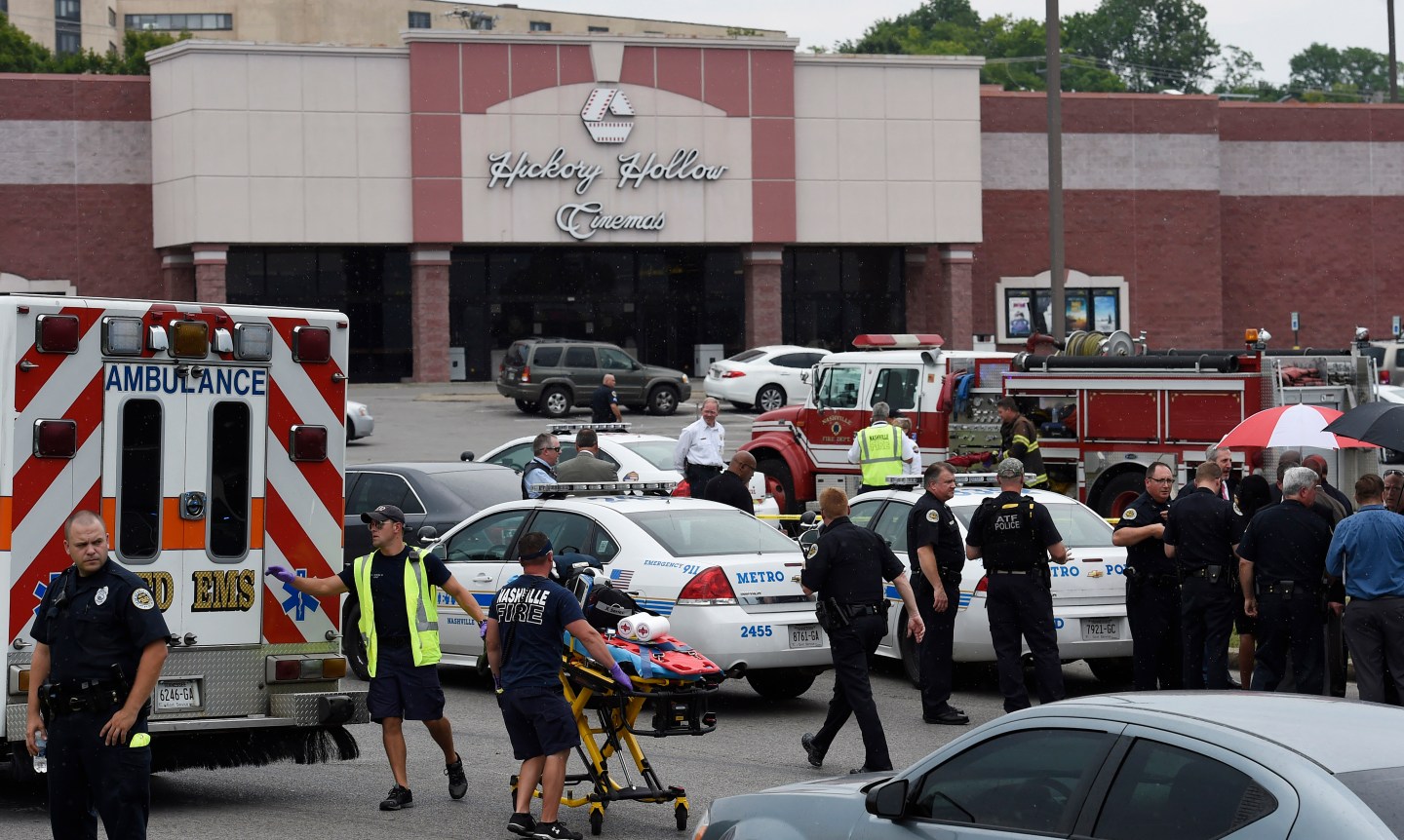
APTOPIX Theater Shooting Tennessee
Emergency personnel gather outside Carmike Hickory 8 movie theater following a shooting Wednesday, Aug. 5, 2015, in Antioch, Tenn. A suspect wielding a hatchet and a gun inside the Nashville-area movie theater died after exchanging gunshots with a SWAT team that stormed the theater, police said. (AP Photo/Mark Zaleski)Photograph by Mark Zaleski — AP

Wednesday saw a sad milestone, another movie theater shooting, in the Nashville, Tennessee area. A few weeks ago, there was a shooting that left three moviegoers dead in Lafayette, Louisiana, and the July 2012 shooting of 12 people at a theater in Aurora, Colorado is still etched in people’s memories (defendant James Holmes was found guilty of that shooting last month).

So, the question arises: what changes are theaters making to protect customers and to keep their businesses going?

The answer? Probably not much, if anything, has changed, nor is it likely to in the near future. Fortune contacted some of the largest U.S. theaters chains — Regal Entertainment, AMC Entertainment, and Cinemark Theatres — but none responded to requests for comment. And despite the fact that there have been three mass shootings in movie theaters since 2012, overall, movie ticket sales have remained relatively strong. In 2014, American box office receipts of $10.4 billion were down 5% from the previous year. The number of tickets sold and the average number sold per person declined by 6% over the same period.

Consumers seem to still trust going to theaters.

Chris Johnson, CEO of Classic Cinemas, which runs 104 screens in 13 Illinois locations, said that business was initially off after the Aurora, Colorado shooting three years ago in which 12 died and 70 were injured. However, sales didn’t drop.

“We had a real positive attendance last night and there was no step back yesterday when [the Tennessee shooting] happened,” Johnson told Fortune. “It’s a very unfortunate situation, but people still fly, still go to school, still go to church, still go to malls, and every other place where there’s been an unfortunate incident. I don’t want to disregard it because it bothers me immensely, but really, from a long-term perspective, you’re basically [asking whether] people are going to go outside ever again, and I don’t see that happening. People are going to continue to go out.”

The cost of beefed up security

Additionally, moviegoers don’t seem to want to turn the experience into something like entering an airport. Immediately following the most recent shooting in Tennessee, some theatergoers told the Arizona Republic that movie operators should beef up security through activity like checking bags. But metal detectors don’t appear to be popular. According to a July study by research firm C4, conducted days after the Lafayette shooting, moviegoers had mixed feelings over the installation of additional security in theaters.

Even with one third saying they wanted to see metal detectors and even armed security, only 13% of them would pay $3 more per ticket for the additional security.

Given that operating a checkpoint can run between $250,000 and $1 million a year, beefing up security would likely result in higher ticket prices for consumers.

Would more security prevent tragedies?

Not only can security be expensive, but there’s also the question of how well it can work. In Aurora, the convicted shooter James Holmes was allegedly unarmed when he bought his ticket. Only after entering did he prop open an emergency door and return with body armor and weapons.

Still, Bob Brzenchek, an assistant professor of criminal justice at Philadelphia-based Peirce College, argues that there is more theaters could — and should — do to prevent future tragedies. “It’s crucial that they address where their vulnerabilities are,” he said. “There needs to be an emergency action plan in place. They need to get in the minds of these folks and think of every different scenario,” working with local authorities.

Because, if there’s a sequel to Wednesday’s shooting, theater operators may have no choice but to beef up their response.


About the Author
By Erik Sherman
See full bioRight Arrow Button Icon

Latest in Arts & Entertainment

Big TechStreaming
Trump warns Netflix-Warner deal may pose antitrust ‘problem’
By Hadriana Lowenkron, Se Young Lee and BloombergDecember 7, 2025
6 hours ago
Arts & EntertainmentReligion
This pastor fills up arenas with young people by not sugarcoating the Bible, serving a generation ‘gravitating towards that authenticity and truth’
By Charlotte Kramon and The Associated PressDecember 7, 2025
14 hours ago
MagazineWarren Buffett
Warren Buffett: Business titan and cover star
By Indrani SenDecember 7, 2025
19 hours ago
Arts & EntertainmentMedia
Former Amazon Studios boss warns the Netflix-Warner Bros. deal will make Hollywood ‘a system that circles a single sun’
By Jason MaDecember 6, 2025
2 days ago
Raul Rocha Cantú
LawCrime
Miss Universe co-owner gets bank accounts frozen as part of probe into drugs, fuel and arms trafficking
By Fabiola Sánchez and The Associated PressDecember 6, 2025
2 days ago
Zaslav, Sarandos
BankingMedia
A Thanksgiving dealmaking sprint helped Netflix win Warner Bros.
By Michelle F. Davis and BloombergDecember 6, 2025
2 days ago

Most Popular

placeholder alt text
Real Estate
The 'Great Housing Reset' is coming: Income growth will outpace home-price growth in 2026, Redfin forecasts
By Nino PaoliDecember 6, 2025
2 days ago
placeholder alt text
AI
Nvidia CEO says data centers take about 3 years to construct in the U.S., while in China 'they can build a hospital in a weekend'
By Nino PaoliDecember 6, 2025
2 days ago
placeholder alt text
Economy
The most likely solution to the U.S. debt crisis is severe austerity triggered by a fiscal calamity, former White House economic adviser says
By Jason MaDecember 6, 2025
1 day ago
placeholder alt text
Economy
JPMorgan CEO Jamie Dimon says Europe has a 'real problem’
By Katherine Chiglinsky and BloombergDecember 6, 2025
1 day ago
placeholder alt text
Big Tech
Mark Zuckerberg rebranded Facebook for the metaverse. Four years and $70 billion in losses later, he’s moving on
By Eva RoytburgDecember 5, 2025
3 days ago
placeholder alt text
Uncategorized
Transforming customer support through intelligent AI operations
By Lauren ChomiukNovember 26, 2025
11 days ago
Rankings
  • 100 Best Companies
  • Fortune 500
  • Global 500
  • Fortune 500 Europe
  • Most Powerful Women
  • Future 50
  • World’s Most Admired Companies
  • See All Rankings
Sections
  • Finance
  • Leadership
  • Success
  • Tech
  • Asia
  • Europe
  • Environment
  • Fortune Crypto
  • Health
  • Retail
  • Lifestyle
  • Politics
  • Newsletters
  • Magazine
  • Features
  • Commentary
  • Mpw
  • CEO Initiative
  • Conferences
  • Personal Finance
  • Education
Customer Support
  • Frequently Asked Questions
  • Customer Service Portal
  • Privacy Policy
  • Terms Of Use
  • Single Issues For Purchase
  • International Print
Commercial Services
  • Advertising
  • Fortune Brand Studio
  • Fortune Analytics
  • Fortune Conferences
  • Business Development
About Us
  • About Us
  • Editorial Calendar
  • Press Center
  • Work At Fortune
  • Diversity And Inclusion
  • Terms And Conditions
  • Site Map

© 2025 Fortune Media IP Limited. All Rights Reserved. Use of this site constitutes acceptance of our Terms of Use and Privacy Policy | CA Notice at Collection and Privacy Notice | Do Not Sell/Share My Personal Information
FORTUNE is a trademark of Fortune Media IP Limited, registered in the U.S. and other countries. FORTUNE may receive compensation for some links to products and services on this website. Offers may be subject to change without notice.