• Home
  • Latest
  • Fortune 500
  • Finance
  • Tech
  • Leadership
  • Lifestyle
  • Rankings
  • Multimedia
FinancePuerto Rico

The arcane 100-year-old law to blame for Puerto Rico’s woes

By
Chris Matthews
Chris Matthews
Down Arrow Button Icon
By
Chris Matthews
Chris Matthews
Down Arrow Button Icon
August 6, 2015, 12:09 PM ET
Puerto Rico Teeters On Edge Of Massive Default
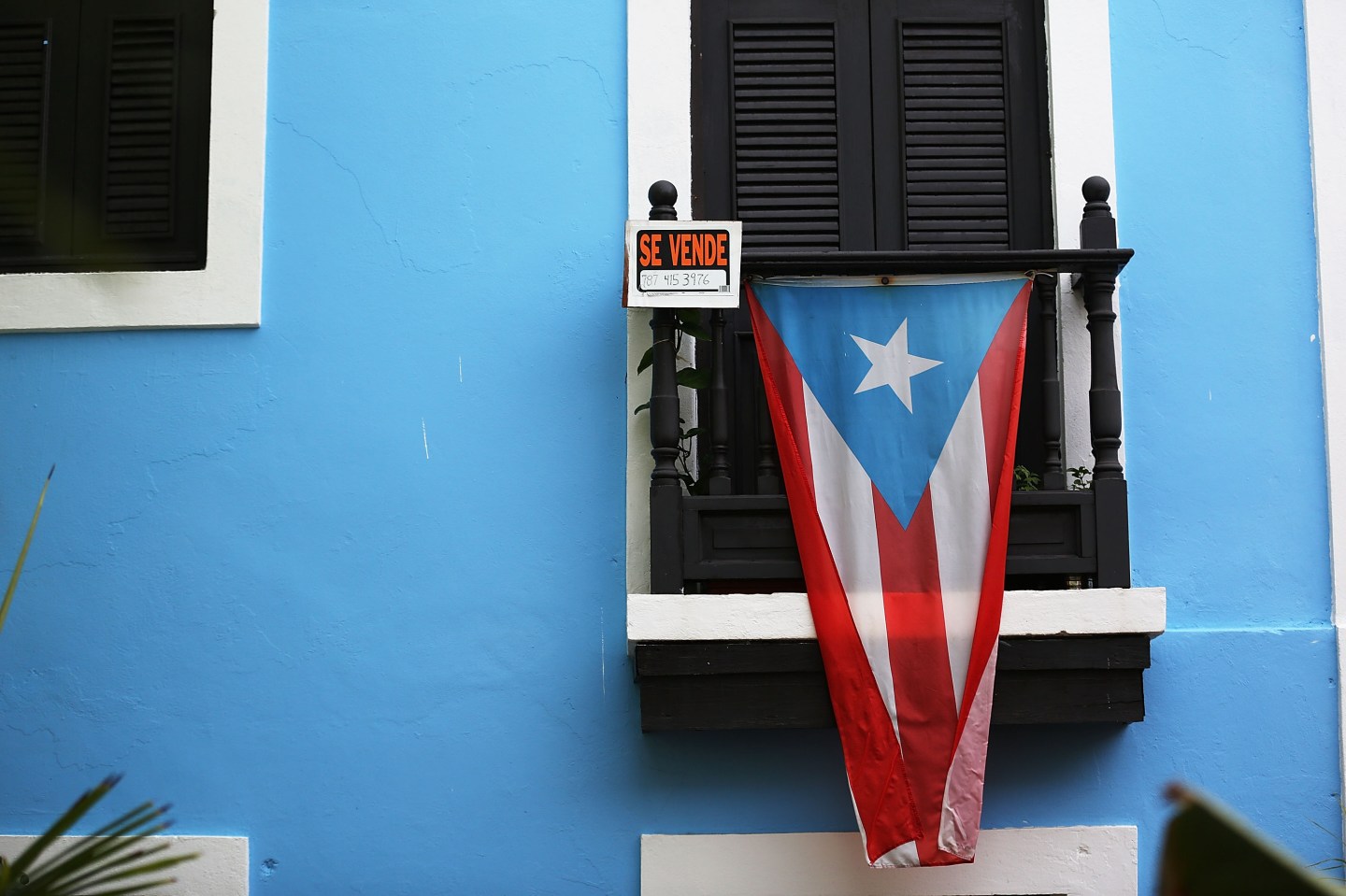
SAN JUAN, PUERTO RICO - JULY 01: A for sale sign is seen hanging from a balcony next to a Puerto Rican flag in Old San Juan as the island's residents deal with the government's $72 billion debt on July 1, 2015 in San Juan, Puerto Rico. Governor of Puerto Rico Alejandro García Padilla said in a speech recently that the people of Puerto Rico will have to make sacrifices and share the responsibilities to help pull the island out of debt. (Photo by Joe Raedle/Getty Images)Photograph by Joe Raedle–Getty Images

Puerto Rico is hurtling headlong into what could be the largest municipal default in United States’ history, and investors are kind of freaking out about it.

While the Puerto Rican government failed to make a relatively small $58 million payment due on its Public Finance Corp (PFC) bonds on August 1, the government took an even more dramatic step on Monday afternoon to convince investors that the island’s government is serious in its intentions to demand debt reduction. According to a report published Wednesday by Dealbook, Puerto Rico’s government also stopped making contributions to its general obligations fund. The report continues:

Unlike the bond payments that went into default on Monday, the ones coming due are on general obligation bonds—the kind many investors have been led to believe would never go into default because the issuer’s full faith, credit and taxing authority stand behind them.

If the island misses a payment on the general obligation bonds coming due on January 1, ““it would be an earthquake for the markets,” Matt Fabian, a partner at Municipal Market Analytics, a financial research firm, told Dealbook.

As with any debt crisis, there is plenty of blame to go around. Puerto Rico borrowed too much, sure, but by definition, this means that lenders were too eager to lend to a government whose economy and population have been shrinking for roughly a decade. But eager they were. A 2012 report by the Wall Street Journal describes how, “investors have flocked to its bonds because they have something fund managers crave: They pay high interest rates.”

On top of that, these bonds gave investors an even rarer advantage: a so-called “triple-tax exemption,” because investors don’t have to pay local, state, or federal taxes on income derived from owning Puerto Rican government debt. In other words, the combination of a reach for yield, tax incentives, and the belief that default is impossible all contributed to a debt crisis that is likely not going to end well. If the recent defaults in Argentina and Greece are any guide, it will be average Puerto Rican citizens who suffer the worst consequences, rather than those who borrowed or lent in the run up to this crisis.

But why, exactly, is the Puerto Rican government debt tax exempt?

The answer can be traced back to the Spanish American War, after which Puerto Rico became a possession of the United States, along with Guam and the Philippines. Despite its overwhelming victory over the Spanish, the U.S. government was divided over what to do with its new territories. José Alberto Cabranes, who later went on to become the first Puerto Rican to be appointed to a federal judgeship, published an exhaustive review of the legislative deliberations over the question of Puerto Rico’s political fate following America’s annexation of the island.

The debate culminated in the 1917 Jones–Shafroth Act, which both conferred American citizenship on Puerto Ricans and reformed the colonial government there. It also barred the federal government or any state or locality from taxing income from Puerto Rican government bonds. Why exactly Congress included this last provision is unclear, but what is clear is that Congress wanted to fund the government of Puerto Rico as cheaply as possible and through import and export taxes rather than those on income.

The idea that Puerto Rico’s government would be funded differently than the governments of other U.S. territories marked a reversal from what leaders proposed immediately following the annexation of the island in 1898. Writes Cabranes:

The original plans of the McKinley administration and the Republican congressional leadership for Puerto Rico seemed to call for the island’s “incorporation” into the United States—that is, annexation of Puerto Rico as an integral part of the United States and the bestowal of a constitutional and political status comparable to other American territories destined for statehood.

But such an arrangement would have required free trade between Puerto Rico and the United States, a prospect that agricultural interests on the mainland frowned upon. Soon, President McKinley and the ruling Republican party changed their tune and advocated for Puerto Rico to remain a colony, with only token representation in Congress and governed by different tax laws than the mainland. As William Sulzer, Democratic Representative from New York said:

Why, then, was the change made? Well, it is said, and not denied, that the majority of the Ways and Means Committee made this change at the request of the sugar trust, the tobacco trust, and the whisky trust. I believe this to be the truth about the matter. The agents of the trusts dictated this unjust discrimination against the citizens of Puerto Rico. . . . You dare not disobey the trusts. They own and control the Republican Party.

There were motivations beyond profit to keep Puerto Rico in territorial limbo. Some in Congress were opposed to annexing the territory at all. Others only wanted to do it if Puerto Rico could be put on a path to statehood. Others resisted incorporating places like Puerto Rico simply on racial grounds, as the island was home to hundreds of thousands of people with African roots. What the Congressional record makes clear, however, is that the actual welfare of the Puerto Rican people has never been of primary concern to Congress.

This is still the case today. Despite the fact that Puerto Rico’s debt crisis is partially the fault of Congress, it looks like Congress isn’t ready to do anything to help the island rectify the situation, for its own partisan reasons. Whether it’s starting the process to grant the island statehood (which island residents are now if favor of), or granting the island’s government the ability to go through the Chapter 9 bankruptcy process, Congress doesn’t seem ready to make policy decisions on Puerto Rico’s future based on what is best for Puerto Ricans themselves.


About the Author
By Chris Matthews
See full bioRight Arrow Button Icon

Latest in Finance

Finance
Lorem ipsum dolor sit amet, consectetur adipiscing elit, sed do eiusmod tempor incididunt ut labore et dolore magna aliqua. Ut enim ad minim veniam
By Fortune Editors
October 20, 2025
Finance
Lorem ipsum dolor sit amet, consectetur adipiscing elit, sed do eiusmod tempor incididunt ut labore et dolore magna aliqua. Ut enim ad minim veniam
By Fortune Editors
October 20, 2025
Finance
Lorem ipsum dolor sit amet, consectetur adipiscing elit, sed do eiusmod tempor incididunt ut labore et dolore magna aliqua. Ut enim ad minim veniam
By Fortune Editors
October 20, 2025
Finance
Lorem ipsum dolor sit amet, consectetur adipiscing elit, sed do eiusmod tempor incididunt ut labore et dolore magna aliqua. Ut enim ad minim veniam
By Fortune Editors
October 20, 2025
Finance
Lorem ipsum dolor sit amet, consectetur adipiscing elit, sed do eiusmod tempor incididunt ut labore et dolore magna aliqua. Ut enim ad minim veniam
By Fortune Editors
October 20, 2025
Finance
Lorem ipsum dolor sit amet, consectetur adipiscing elit, sed do eiusmod tempor incididunt ut labore et dolore magna aliqua. Ut enim ad minim veniam
By Fortune Editors
October 20, 2025

Most Popular

Finance
Lorem ipsum dolor sit amet, consectetur adipiscing elit, sed do eiusmod tempor incididunt ut labore et dolore magna aliqua. Ut enim ad minim veniam
By Fortune Editors
October 20, 2025
Finance
Lorem ipsum dolor sit amet, consectetur adipiscing elit, sed do eiusmod tempor incididunt ut labore et dolore magna aliqua. Ut enim ad minim veniam
By Fortune Editors
October 20, 2025
Finance
Lorem ipsum dolor sit amet, consectetur adipiscing elit, sed do eiusmod tempor incididunt ut labore et dolore magna aliqua. Ut enim ad minim veniam
By Fortune Editors
October 20, 2025
Finance
Lorem ipsum dolor sit amet, consectetur adipiscing elit, sed do eiusmod tempor incididunt ut labore et dolore magna aliqua. Ut enim ad minim veniam
By Fortune Editors
October 20, 2025
Finance
Lorem ipsum dolor sit amet, consectetur adipiscing elit, sed do eiusmod tempor incididunt ut labore et dolore magna aliqua. Ut enim ad minim veniam
By Fortune Editors
October 20, 2025
Finance
Lorem ipsum dolor sit amet, consectetur adipiscing elit, sed do eiusmod tempor incididunt ut labore et dolore magna aliqua. Ut enim ad minim veniam
By Fortune Editors
October 20, 2025
Fortune Secondary Logo
Rankings
  • 100 Best Companies
  • Fortune 500
  • Global 500
  • Fortune 500 Europe
  • Most Powerful Women
  • Future 50
  • World’s Most Admired Companies
  • See All Rankings
Sections
  • Finance
  • Fortune Crypto
  • Features
  • Leadership
  • Health
  • Commentary
  • Success
  • Retail
  • Mpw
  • Tech
  • Lifestyle
  • CEO Initiative
  • Asia
  • Politics
  • Conferences
  • Europe
  • Newsletters
  • Personal Finance
  • Environment
  • Magazine
  • Education
Customer Support
  • Frequently Asked Questions
  • Customer Service Portal
  • Privacy Policy
  • Terms Of Use
  • Single Issues For Purchase
  • International Print
Commercial Services
  • Advertising
  • Fortune Brand Studio
  • Fortune Analytics
  • Fortune Conferences
  • Business Development
About Us
  • About Us
  • Editorial Calendar
  • Press Center
  • Work At Fortune
  • Diversity And Inclusion
  • Terms And Conditions
  • Site Map
Fortune Secondary Logo
  • About Us
  • Editorial Calendar
  • Press Center
  • Work At Fortune
  • Diversity And Inclusion
  • Terms And Conditions
  • Site Map
  • Facebook icon
  • Twitter icon
  • LinkedIn icon
  • Instagram icon
  • Pinterest icon

Latest in Finance

Young dejected worker on phone
SuccessGen Z
USAA CEO says Gen Z ‘are not going to be as well off’ as boomers and Gen Xers—they need to take ownership of their success, he urges
By Emma BurleighMarch 1, 2026
4 hours ago
EconomyFinance
Ray Dalio, Scott Bessent and House members from both sides of the aisle are rallying around a ‘3% solution’ to tame the out of control national debt
By Shawn TullyMarch 1, 2026
5 hours ago
An older man wears an American flag.
EconomyRecession
Your grandparents are the reason the U.S. isn’t in a recession right now. That won’t last forever
By Eleanor PringleMarch 1, 2026
5 hours ago
U.S. President Donald Trump delivers the State of the Union address during a joint session of Congress in the House Chamber at the Capitol on February 24, 2026 in Washington, D.C.
EnergyData centers
Your utility bills keep going up. Here’s everyone you can blame—AI data centers included
By Jordan BlumMarch 1, 2026
7 hours ago
protest
Middle EastMiddle East
A month before Iran strikes, Trump told Iranian protesters help was on the way amid a government crackdown
By Aamer Madhani, Josh Boak and The Associated PressFebruary 28, 2026
12 hours ago
khamenei
Middle EastMiddle East
Iranian Supreme Leader Khamenei dies after major attack by Israel and the U.S., Iranian state media confirms
By Jon Gambrell, Melanie Lidman, Josh Boak, Eric Tucker and The Associated PressFebruary 28, 2026
13 hours ago

Most Popular

placeholder alt text
Success
Japanese companies are paying older workers to sit by a window and do nothing—while Western CEOs demand super-AI productivity just to keep your job
By Orianna Rosa RoyleFebruary 27, 2026
2 days ago
placeholder alt text
Middle East
Iran is now on 'death ground' amid existential threat from U.S. attacks and could 'go big' in retaliation, former NATO commander warns
By Jason MaFebruary 28, 2026
21 hours ago
placeholder alt text
AI
The week the AI scare turned real and America realized maybe it isn't ready for what's coming
By Nick LichtenbergFebruary 28, 2026
1 day ago
placeholder alt text
Success
Walmart exec says U.S. workforces needs to take inspiration from China where ‘5 year-olds are learning DeepSeek’
By Preston ForeFebruary 27, 2026
2 days ago
placeholder alt text
Personal Finance
Current price of gold as of February 27, 2026
By Danny BakstFebruary 27, 2026
2 days ago
placeholder alt text
Middle East
Dubai’s worst nightmare unfolds as Iran strikes Gulf neighbors
By Dana Khraiche, Fiona MacDonald and BloombergFebruary 28, 2026
17 hours ago

© 2026 Fortune Media IP Limited. All Rights Reserved. Use of this site constitutes acceptance of our Terms of Use and Privacy Policy | CA Notice at Collection and Privacy Notice | Do Not Sell/Share My Personal Information
FORTUNE is a trademark of Fortune Media IP Limited, registered in the U.S. and other countries. FORTUNE may receive compensation for some links to products and services on this website. Offers may be subject to change without notice.