
• Home
  • Latest
  • Fortune 500
  • Finance
  • Tech
  • Leadership
  • Lifestyle
  • Rankings
  • Multimedia

Trendingnow

1

The millennial generation has split, new Fed research shows: Those over 35 are edging toward boomer-style wealth, while everyone else falls behind

2

Spain lifted the World Cup, but the IRS still gets a cut of its $50 million pay day as players, coaches and refs all face complex U.S. “jock taxes”

3

The $39 trillion U.S. national debt isn’t as high as Japan’s and Singapore’s relative to economy size—and yet it's still worse somehow

1

The millennial generation has split, new Fed research shows: Those over 35 are edging toward boomer-style wealth, while everyone else falls behind

2

Spain lifted the World Cup, but the IRS still gets a cut of its $50 million pay day as players, coaches and refs all face complex U.S. “jock taxes”

3

The $39 trillion U.S. national debt isn’t as high as Japan’s and Singapore’s relative to economy size—and yet it's still worse somehow
TechMedia

Advertising isn’t the solution to the media’s problems — it is the problem

By
Mathew Ingram
Mathew Ingram
Down Arrow Button Icon
By
Mathew Ingram
Mathew Ingram
Down Arrow Button Icon
July 21, 2015, 1:26 PM ET
170902510
Businessman using computer mouse and typing on laptopPhotograph by Paul Bradbury — Getty Images/OJO Images RF
Add Fortune on Google for similar content.

Back in the good old days of traditional media, advertisers and publishers were the best of friends. Publishers of newspapers and magazines and other things enjoyed a monopoly on information distribution, and therefore commanded a large share of the attention of readers, and advertisers piggy-backed on that monopoly, which in turn helped to pay the freight for all of that content.

Unfortunately, the Internet has changed all of that, and now the advertising business is as much a threat to traditional media entities as it is a friend.

In part, that’s because advertisers now have a range of other attractive intermediaries they can deal with instead. They can buy Facebook ads that allow them to target users on a far more granular level than any media company could ever offer, and they can buy Twitter promoted tweets, and Snapchat ads—and they can even go direct to readers and create their own magazines and news websites, which many have.

No more monopoly

All of this has dismantled any monopoly or near-monopoly that traditional publishers had on content delivery or attention. But that’s not the worst of it. That’s just level one of what is increasingly becoming a multi-level bloodbath for media companies.
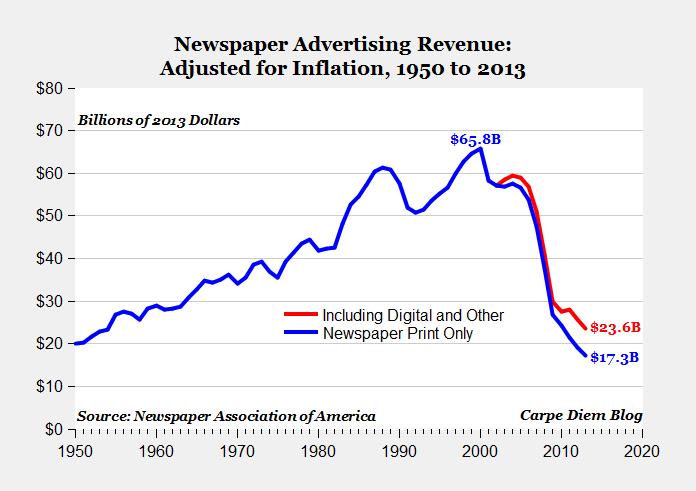
newspaper-ad-revenue


In addition to losing control, advertising itself has also been transformed by the rise of new technologies, the most important of which is what’s called “programmatic” advertising. In a nutshell, this is ad delivery driven entirely by algorithms. Software looks at what users have seen or clicked on, chooses ads from various networks and automatically places them. Virtually no humans are involved—just data.

From a publisher’s point of view, this creates a number of problems. One is that because of the massive explosion of supply—an almost unlimited number of webpages, as opposed to a strictly controlled number of newspaper and magazine pages—and the use of software instead of expensive human beings, digital advertising generates orders of magnitude less revenue than it used to (there’s also a huge problem with ad fraud).


This has also proven to be a disaster for readers and web users. The combination of publishers’ desperation to generate more revenue and the rise of programmatic and other tools has created a kind of perfect storm. The result is a web filled with useless and annoying banner ads, popups, pop-unders, page takeovers, un-killable auto-play videos and other monstrosities—including the use of literally hundreds of tracking agents, cookies, super-cookies and other invasive tools.

A new arms race

Many users have responded to this by ignoring advertising completely—click-through rates on banner ads are so low it would take an electron microscope to even see them (the industry average is 0.1%). And in order to help them do so, many use ad blocking software, which instantly removes any and all advertising.
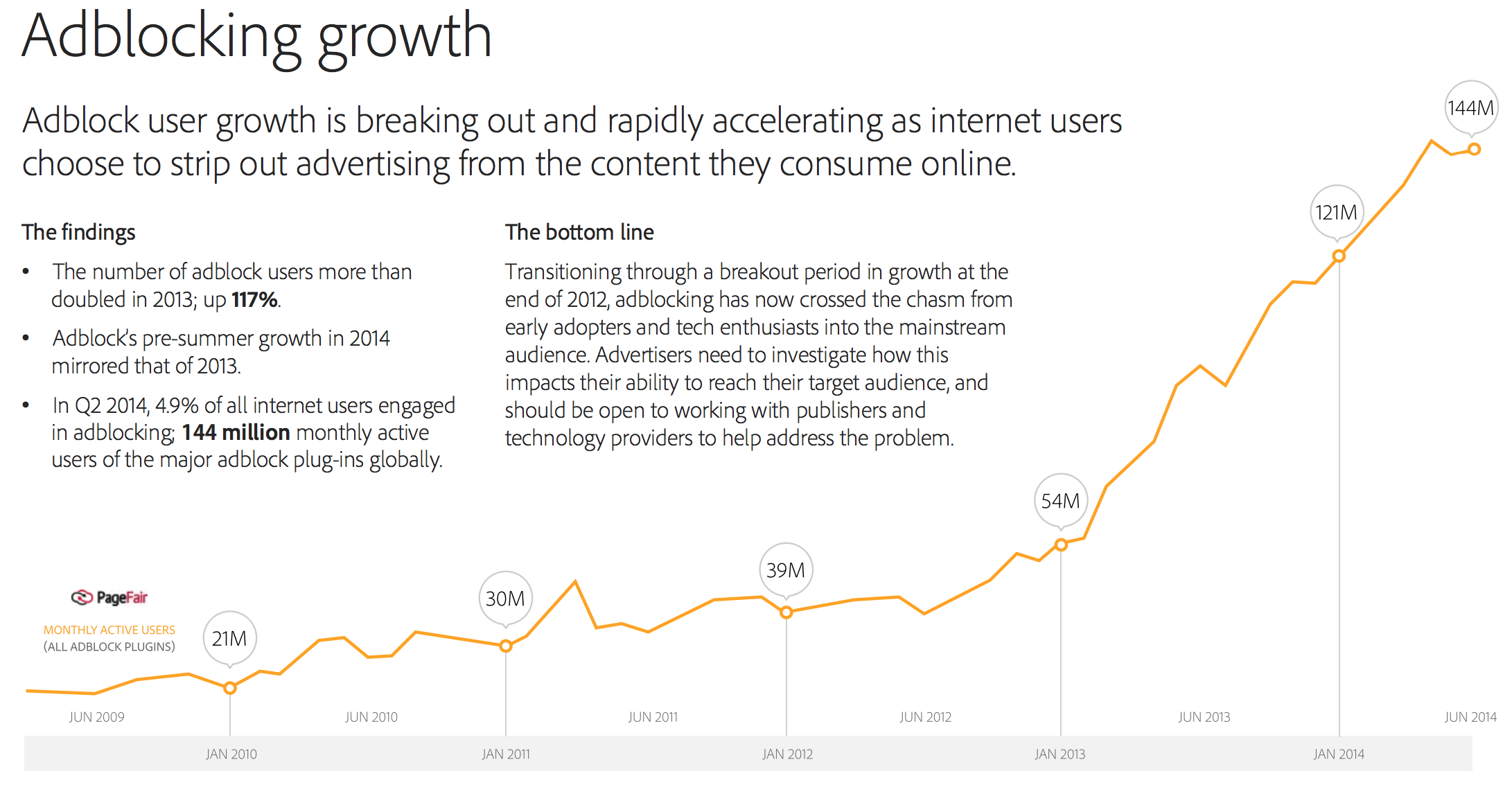
Ad blocking usage


This has resulted in a kind of arms race, in which ad blockers develop new ways of tracking and killing ads, and publishers feverishly hire companies to find tricks and hacks that will get around those tools. On top of all that, many of the advertising methods publishers use don’t work at all on mobile devices, due to screen size and the way users behave when they are using a smartphone.

As bad as all of this is, however, it is about to get even worse: Apple said recently that the next version of its Safari browser will have ad-blocking built in, making it even easier for users to avoid ads—except the ones that Apple includes in its upcoming News app, of course.

More power for Facebook

The bottom line is that the hellish landscape that is web and mobile advertising has done nothing to improve the financial health of publishers and content creators, and at the same time has given even more power to platforms and middlemen like Apple and Facebook. A big part of the reason why Facebook’s “Instant Articles” pitch is so appealing to media companies is that their own mobile app and mobile browsing experience is not only terrible for users but also financially irrelevant.

Facebook Instant Article - Article
Courtesy of Facebook


From that point of view, if Facebook can offer mobile versions of a media partner’s pages that load much faster and can also deliver a large chunk of the advertising revenue it generates—revenue that is almost certain to be far larger than the media company can produce on its own, since Facebook’s ads are so much more effective—then where’s the downside?

[fortune-brightcove videoid=4308507330001]


The downside, of course, is that Facebook and Google and Apple wind up controlling the flow of content in a very real sense, because they now operate the levers that determine who sees what content, and also who sees which ads. So not only are they the dominant (and growing) method by which many Internet users find and share news and other content, but they are also becoming the pre-dominant way in which advertisers reach those users. Where does that leave traditional media entities?

As technology analyst Ben Thompson has said a number of times, there is a great reckoning coming for media companies of all kinds, and what’s happening with advertising is a major source of fuel for that bonfire. What ultimately emerges at the end of that process remains unclear.

About the Author
By Mathew Ingram
See full bioRight Arrow Button Icon
Add Fortune on Google for similar content.

Latest in Tech

Finance
Lorem ipsum dolor sit amet, consectetur adipiscing elit, sed do eiusmod tempor incididunt ut labore et dolore magna aliqua. Ut enim ad minim veniam
By Fortune Editors
October 20, 2025
Finance
Lorem ipsum dolor sit amet, consectetur adipiscing elit, sed do eiusmod tempor incididunt ut labore et dolore magna aliqua. Ut enim ad minim veniam
By Fortune Editors
October 20, 2025
Finance
Lorem ipsum dolor sit amet, consectetur adipiscing elit, sed do eiusmod tempor incididunt ut labore et dolore magna aliqua. Ut enim ad minim veniam
By Fortune Editors
October 20, 2025
Finance
Lorem ipsum dolor sit amet, consectetur adipiscing elit, sed do eiusmod tempor incididunt ut labore et dolore magna aliqua. Ut enim ad minim veniam
By Fortune Editors
October 20, 2025
Finance
Lorem ipsum dolor sit amet, consectetur adipiscing elit, sed do eiusmod tempor incididunt ut labore et dolore magna aliqua. Ut enim ad minim veniam
By Fortune Editors
October 20, 2025
Finance
Lorem ipsum dolor sit amet, consectetur adipiscing elit, sed do eiusmod tempor incididunt ut labore et dolore magna aliqua. Ut enim ad minim veniam
By Fortune Editors
October 20, 2025

Most Popular

Finance
Lorem ipsum dolor sit amet, consectetur adipiscing elit, sed do eiusmod tempor incididunt ut labore et dolore magna aliqua. Ut enim ad minim veniam
By Fortune Editors
October 20, 2025
Finance
Lorem ipsum dolor sit amet, consectetur adipiscing elit, sed do eiusmod tempor incididunt ut labore et dolore magna aliqua. Ut enim ad minim veniam
By Fortune Editors
October 20, 2025
Finance
Lorem ipsum dolor sit amet, consectetur adipiscing elit, sed do eiusmod tempor incididunt ut labore et dolore magna aliqua. Ut enim ad minim veniam
By Fortune Editors
October 20, 2025
Finance
Lorem ipsum dolor sit amet, consectetur adipiscing elit, sed do eiusmod tempor incididunt ut labore et dolore magna aliqua. Ut enim ad minim veniam
By Fortune Editors
October 20, 2025
Finance
Lorem ipsum dolor sit amet, consectetur adipiscing elit, sed do eiusmod tempor incididunt ut labore et dolore magna aliqua. Ut enim ad minim veniam
By Fortune Editors
October 20, 2025
Finance
Lorem ipsum dolor sit amet, consectetur adipiscing elit, sed do eiusmod tempor incididunt ut labore et dolore magna aliqua. Ut enim ad minim veniam
By Fortune Editors
October 20, 2025
Fortune Secondary Logo
Rankings
  • 100 Best Companies
  • Fortune 500
  • Global 500
  • Fortune 500 Europe
  • Most Powerful Women
  • World's Most Admired Companies
  • See All Rankings
  • Lists Calendar
Sections
  • Finance
  • Fortune Crypto
  • Features
  • Leadership
  • Health
  • Commentary
  • Success
  • Retail
  • Mpw
  • Tech
  • Lifestyle
  • CEO Initiative
  • Asia
  • Politics
  • Conferences
  • Europe
  • Newsletters
  • Personal Finance
  • Environment
  • Magazine
  • Education
Customer Support
  • Frequently Asked Questions
  • Customer Service Portal
  • Privacy Policy
  • Terms Of Use
  • Single Issues For Purchase
  • International Print
Commercial Services
  • Advertising
  • Fortune Brand Studio
  • Fortune Analytics
  • Fortune Conferences
  • Business Development
  • Group Subscriptions
About Us
  • About Us
  • Press Center
  • Work At Fortune
  • Terms And Conditions
  • Site Map
  • About Us
  • Press Center
  • Work At Fortune
  • Terms And Conditions
  • Site Map
  • Facebook icon
  • Twitter icon
  • LinkedIn icon
  • Instagram icon
  • TikTok icon
  • YouTube icon

Latest in Tech

European travel platform Omio raises $10 million and buys Rail Europe as it chases Asia’s tourism market 
Asiatourism
European travel platform Omio raises $10 million and buys Rail Europe as it chases Asia’s tourism market 
By Nicholas GordonJuly 24, 2026
4 hours ago
Meet SLB: The $70 billion oil services giant poised to cash in on AI data centers and the post-Strait of Hormuz oil exploration boom
Magazineoil and gas
Meet SLB: The $70 billion oil services giant poised to cash in on AI data centers and the post-Strait of Hormuz oil exploration boom
By Jordan BlumJuly 24, 2026
4 hours ago
tokens
AIAI agents
‘You just hired a million bad employees’: How the brief tokenmaxxing era delivered the opposite of what it promised
By Nick LichtenbergJuly 24, 2026
4 hours ago
AMD’s Lisa Su defends open-source AI following Hugging Face security breach caused by OpenAI agents
AIAdvanced Micro Devices
AMD’s Lisa Su defends open-source AI following Hugging Face security breach caused by OpenAI agents
By Sebastian HerreraJuly 23, 2026
12 hours ago
Alphabet Inc. and Google CEO Sundar Pichai speaks during the inauguration of a Google Artificial Intelligence (AI) hub in Paris on February 15, 2024. (
Big TechWall Street
AI is forcing Big Tech to do something it’s never done: Spend more than it earns, and Wall Street hates it
By Eva RoytburgJuly 23, 2026
13 hours ago
Innovaccer's founders sit in chairs on a stage
AIData
Innovaccer’s CEO walked away from Disney and NASA to fix healthcare’s data mess. Now the startup has crossed $200 million in ARR
By Lily Mae LazarusJuly 23, 2026
13 hours ago

Most Popular

The millennial generation has split, new Fed research shows: Those over 35 are edging toward boomer-style wealth, while everyone else falls behind
Real Estate
The millennial generation has split, new Fed research shows: Those over 35 are edging toward boomer-style wealth, while everyone else falls behind
By Nick LichtenbergJuly 22, 2026
2 days ago
Spain lifted the World Cup, but the IRS still gets a cut of its $50 million pay day as players, coaches and refs all face complex U.S. “jock taxes”
Personal Finance
Spain lifted the World Cup, but the IRS still gets a cut of its $50 million pay day as players, coaches and refs all face complex U.S. “jock taxes”
By Joshua HongJuly 23, 2026
1 day ago
The $39 trillion U.S. national debt isn’t as high as Japan’s and Singapore’s relative to economy size—and yet it's still worse somehow
Economy
The $39 trillion U.S. national debt isn’t as high as Japan’s and Singapore’s relative to economy size—and yet it's still worse somehow
By Sasha RogelbergJuly 23, 2026
20 hours ago
Current price of oil as of July 23, 2026
Personal Finance
Current price of oil as of July 23, 2026
By Joseph HostetlerJuly 23, 2026
1 day ago
Scott Bessent casually says the U.S. has more than $1 trillion in gold—and that it doesn’t matter for the dollar
Economy
Scott Bessent casually says the U.S. has more than $1 trillion in gold—and that it doesn’t matter for the dollar
By Sasha RogelbergJuly 22, 2026
2 days ago
Jensen Huang made his $172 billion fortune on AI chips. His family's $75 million gift to Vanderbilt argues art decides what technology is for
Big Tech
Jensen Huang made his $172 billion fortune on AI chips. His family's $75 million gift to Vanderbilt argues art decides what technology is for
By Sydney LakeJuly 23, 2026
1 day ago

© 2026 Fortune Media IP Limited. All Rights Reserved. Use of this site constitutes acceptance of our Terms of Use and Privacy Policy | CA Notice at Collection and Privacy Notice | Do Not Sell/Share My Personal Information
FORTUNE is a trademark of Fortune Media IP Limited, registered in the U.S. and other countries. FORTUNE may receive compensation for some links to products and services on this website. Offers may be subject to change without notice.