• Home
  • Latest
  • Fortune 500
  • Finance
  • Tech
  • Leadership
  • Lifestyle
  • Rankings
  • Multimedia
CommentaryDodd-Frank

Five years later, Dodd-Frank naysayers are still wrong

By
Dean Baker
Dean Baker
Down Arrow Button Icon
July 16, 2015, 5:00 AM ET
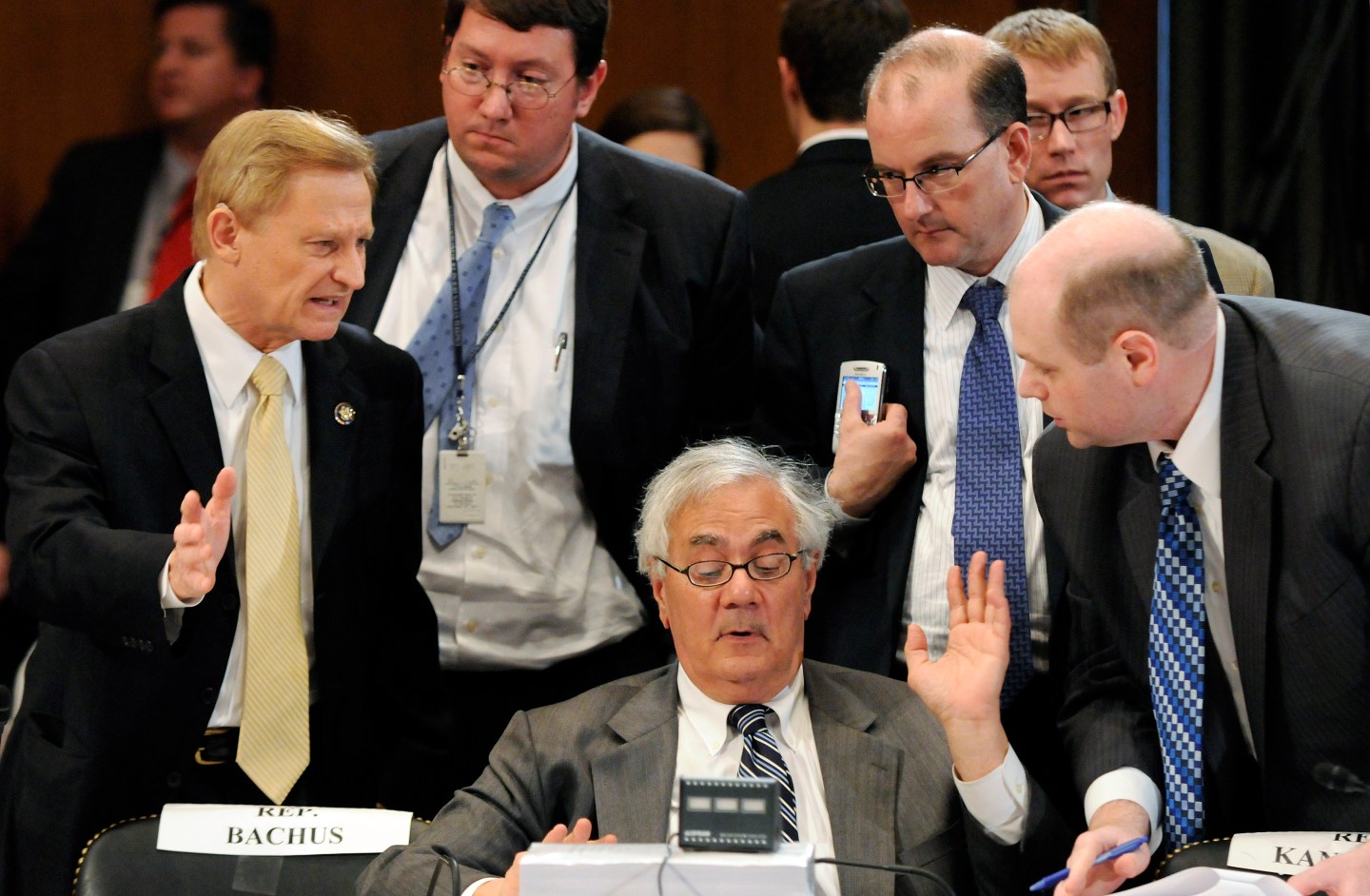
Frank talks with a group including Bachus during a recess from a committee conference on Wall Street reform on Capitol Hill
House Financial Services Committee Chairman Barney Frank (D-MA), center, talks with a group during a recess from a committee conference on Wall Street reform to hammer out sweeping changes in financial regulation legislation on Capitol Hill in Washington June 24, 2010. Photograph by Jonathan Ernst — Reuters

As we approach the fifth anniversary of the passage of the Dodd-Frank financial reform bill next week, it is worth reflecting on the history of the opposition to the bill. This is useful because opponents of the bill would still like to roll back many of the bill’s provisions, if not its outright repeal.

First and foremost the complaint was that the bill would make it more difficult for businesses to raise capital. This argument has not held up well in the last five years. Certainly the businesses that can raise money in the stock market have little basis for complaint. With price to earnings ratios in the stock market at their highest level since the tech bubble, these companies can raise money at extraordinarily low prices.

This is true for bonds as well, as we see both very low interest rates and unusually low spreads between the interest rate paid by even relatively high risk companies and Treasury bonds. In fact, these spreads are so low that Federal Reserve Chair Janet Yellen saw fit to warn markets about a bubble in the high yield market last summer. And for smaller businesses, according to the Federal Reserve Board’s data, banks made an average of more than $230 billion in new loans in the last three years, up from an average of just over $200 billion in the 3 years before the crash.

We also had warnings that the Consumer Financial Protection Bureau (CFPB) — the creation of which was authorized by Dodd-Frank — was going to impose such high costs through rules and regulations that it would sharply limit access to consumer credit. This also does not appear to be happening. Consumer credit overall is up by almost a third since the passage of Dodd-Frank. In fact, the news in the consumer credit market is in the abuses in the subprime auto loan market, a market not covered by the CFPB thanks to lobbying by the auto dealers.

While the dire predictions of Dodd-Frank opponents have not panned out, they recently have adopted a new theme. Dodd-Frank is supposedly crushing liquidity. While that sounds terribly ominous, it’s not clear what the critics mean by this or even what they think they mean.

Liquidity means that markets are smooth moving and that people who want to buy or sell assets – stocks, bonds, derivatives, etc. – can do so in a relatively short period of time while reasonably certain of the price. If there have been accounts of people being unable to sell their Treasury bonds, shares of GE stock (GE), or futures on corn and wheat, the Dodd-Frank opponents have neglected to call them to our attention.

In fact, the one piece of evidence they can muster to support the argument is the unusual swing in Treasury bond prices on October 15th, 2014. For reasons that no one has been able to clearly explain, the yields on 10-year Treasury bonds fell sharply in early morning trading. They then reversed course so that yield ended down by 6 basis points for the day. This is a substantial, but not unusual movement for a single day.

This swing meant that some traders may have earned or lost a substantial amount of money that day, but those not directly engaged in trading probably were not even aware of the unusual price swings. They had no impact on the economy.

It is important to show that the liquidity complaints have no merit both to protect existing reforms and also to open the path to going further. After all, a modest financial transactions tax will certainly lower trading volume, but still leave our markets at least as liquid as they were 20 years ago.

The bottom line is that the lack of liquidity on major markets can be a serious concern, but we just have no reason to believe that it is one now or likely to be as a result of Dodd- Frank or other financial reforms. One peculiar day in October doesn’t change that reality.

Dean Baker is a macroeconomist and co-director of the Center for Economic and Policy Research in Washington, DC. He previously worked as a senior economist at the Economic Policy Institute and an assistant professor at Bucknell University.


About the Author
By Dean Baker
See full bioRight Arrow Button Icon

Latest in Commentary

Finance
Lorem ipsum dolor sit amet, consectetur adipiscing elit, sed do eiusmod tempor incididunt ut labore et dolore magna aliqua. Ut enim ad minim veniam
By Fortune Editors
October 20, 2025
Finance
Lorem ipsum dolor sit amet, consectetur adipiscing elit, sed do eiusmod tempor incididunt ut labore et dolore magna aliqua. Ut enim ad minim veniam
By Fortune Editors
October 20, 2025
Finance
Lorem ipsum dolor sit amet, consectetur adipiscing elit, sed do eiusmod tempor incididunt ut labore et dolore magna aliqua. Ut enim ad minim veniam
By Fortune Editors
October 20, 2025
Finance
Lorem ipsum dolor sit amet, consectetur adipiscing elit, sed do eiusmod tempor incididunt ut labore et dolore magna aliqua. Ut enim ad minim veniam
By Fortune Editors
October 20, 2025
Finance
Lorem ipsum dolor sit amet, consectetur adipiscing elit, sed do eiusmod tempor incididunt ut labore et dolore magna aliqua. Ut enim ad minim veniam
By Fortune Editors
October 20, 2025
Finance
Lorem ipsum dolor sit amet, consectetur adipiscing elit, sed do eiusmod tempor incididunt ut labore et dolore magna aliqua. Ut enim ad minim veniam
By Fortune Editors
October 20, 2025

Most Popular

Finance
Lorem ipsum dolor sit amet, consectetur adipiscing elit, sed do eiusmod tempor incididunt ut labore et dolore magna aliqua. Ut enim ad minim veniam
By Fortune Editors
October 20, 2025
Finance
Lorem ipsum dolor sit amet, consectetur adipiscing elit, sed do eiusmod tempor incididunt ut labore et dolore magna aliqua. Ut enim ad minim veniam
By Fortune Editors
October 20, 2025
Finance
Lorem ipsum dolor sit amet, consectetur adipiscing elit, sed do eiusmod tempor incididunt ut labore et dolore magna aliqua. Ut enim ad minim veniam
By Fortune Editors
October 20, 2025
Finance
Lorem ipsum dolor sit amet, consectetur adipiscing elit, sed do eiusmod tempor incididunt ut labore et dolore magna aliqua. Ut enim ad minim veniam
By Fortune Editors
October 20, 2025
Finance
Lorem ipsum dolor sit amet, consectetur adipiscing elit, sed do eiusmod tempor incididunt ut labore et dolore magna aliqua. Ut enim ad minim veniam
By Fortune Editors
October 20, 2025
Finance
Lorem ipsum dolor sit amet, consectetur adipiscing elit, sed do eiusmod tempor incididunt ut labore et dolore magna aliqua. Ut enim ad minim veniam
By Fortune Editors
October 20, 2025
Rankings
  • 100 Best Companies
  • Fortune 500
  • Global 500
  • Fortune 500 Europe
  • Most Powerful Women
  • Future 50
  • World’s Most Admired Companies
  • See All Rankings
Sections
  • Finance
  • Leadership
  • Success
  • Tech
  • Asia
  • Europe
  • Environment
  • Fortune Crypto
  • Health
  • Retail
  • Lifestyle
  • Politics
  • Newsletters
  • Magazine
  • Features
  • Commentary
  • Mpw
  • CEO Initiative
  • Conferences
  • Personal Finance
  • Education
Customer Support
  • Frequently Asked Questions
  • Customer Service Portal
  • Privacy Policy
  • Terms Of Use
  • Single Issues For Purchase
  • International Print
Commercial Services
  • Advertising
  • Fortune Brand Studio
  • Fortune Analytics
  • Fortune Conferences
  • Business Development
About Us
  • About Us
  • Editorial Calendar
  • Press Center
  • Work At Fortune
  • Diversity And Inclusion
  • Terms And Conditions
  • Site Map

Latest in Commentary

layoffs
CommentaryLayoffs
The AI layoff wave is just beginning — and it’s by design
By Kevin OakesDecember 17, 2025
15 hours ago
Norbert Jung
Commentary
Factory 2030 runs on more than code. As a CEO, I see the power of agentic AI—and the trust gap that we must close
By Norbert JungDecember 17, 2025
18 hours ago
TD Jakes
CommentaryReligion
To heal a divided nation, America’s next chapter must rediscover a common unity
By T.D. JakesDecember 16, 2025
2 days ago
tree
CommentaryInflation
Colorado is suffering from Christmas Tree inflation because Denver imports most of them—from North Carolina and the Pacific Northwest
By Ali Besharat and The ConversationDecember 16, 2025
2 days ago
Charles Lamanna
CommentaryMicrosoft
I lead Microsoft’s enterprise AI agent strategy. Here’s what every company should know about how agents will rewrite work
By Charles LamannaDecember 15, 2025
3 days ago
Julian Braithwaite is the Director General of the International Alliance for Responsible Drinking
CommentaryProductivity
Gen Z is drinking 20% less than Millennials. Productivity is rising. Coincidence? Not quite
By Julian BraithwaiteDecember 13, 2025
5 days ago

Most Popular

placeholder alt text
Economy
America's $38 trillion national debt 'exacerbates generational imbalances' with Gen Z and millennials paying the price, warns think tank
By Eleanor PringleDecember 16, 2025
2 days ago
placeholder alt text
Success
As millions of Gen Zers face unemployment, McDonald's CEO dishes out some tough love career advice for navigating the market: ‘You've got to make things happen for yourself’
By Preston ForeDecember 16, 2025
2 days ago
placeholder alt text
Innovation
An MIT roboticist who cofounded bankrupt Roomba maker iRobot says Elon Musk's vision of humanoid robot assistants is 'pure fantasy thinking'
By Marco Quiroz-GutierrezDecember 16, 2025
2 days ago
placeholder alt text
Economy
The $38 trillion national debt is to blame for over $1 trillion in annual interest payments from here on out, CRFB says
By Nick LichtenbergDecember 17, 2025
12 hours ago
placeholder alt text
AI
IBM, AWS veteran says 90% of your employees are stuck in first gear with AI, just asking it to ‘write their mean email in a slightly more polite way’
By Marco Quiroz-GutierrezDecember 16, 2025
1 day ago
placeholder alt text
Success
Meetings are not work, says Southwest Airlines CEO—and he’s taking action, by blocking his calendar every afternoon from Wednesday to Friday 
By Preston ForeDecember 15, 2025
3 days ago

© 2025 Fortune Media IP Limited. All Rights Reserved. Use of this site constitutes acceptance of our Terms of Use and Privacy Policy | CA Notice at Collection and Privacy Notice | Do Not Sell/Share My Personal Information
FORTUNE is a trademark of Fortune Media IP Limited, registered in the U.S. and other countries. FORTUNE may receive compensation for some links to products and services on this website. Offers may be subject to change without notice.