• Home
  • Latest
  • Fortune 500
  • Finance
  • Tech
  • Leadership
  • Lifestyle
  • Rankings
  • Multimedia
LeadershipMarco Rubio

Marco Rubio takes a page from Obama’s book, literally

By
Tory Newmyer
Tory Newmyer
Down Arrow Button Icon
By
Tory Newmyer
Tory Newmyer
Down Arrow Button Icon
July 8, 2015, 2:58 PM ET
Marco Rubio
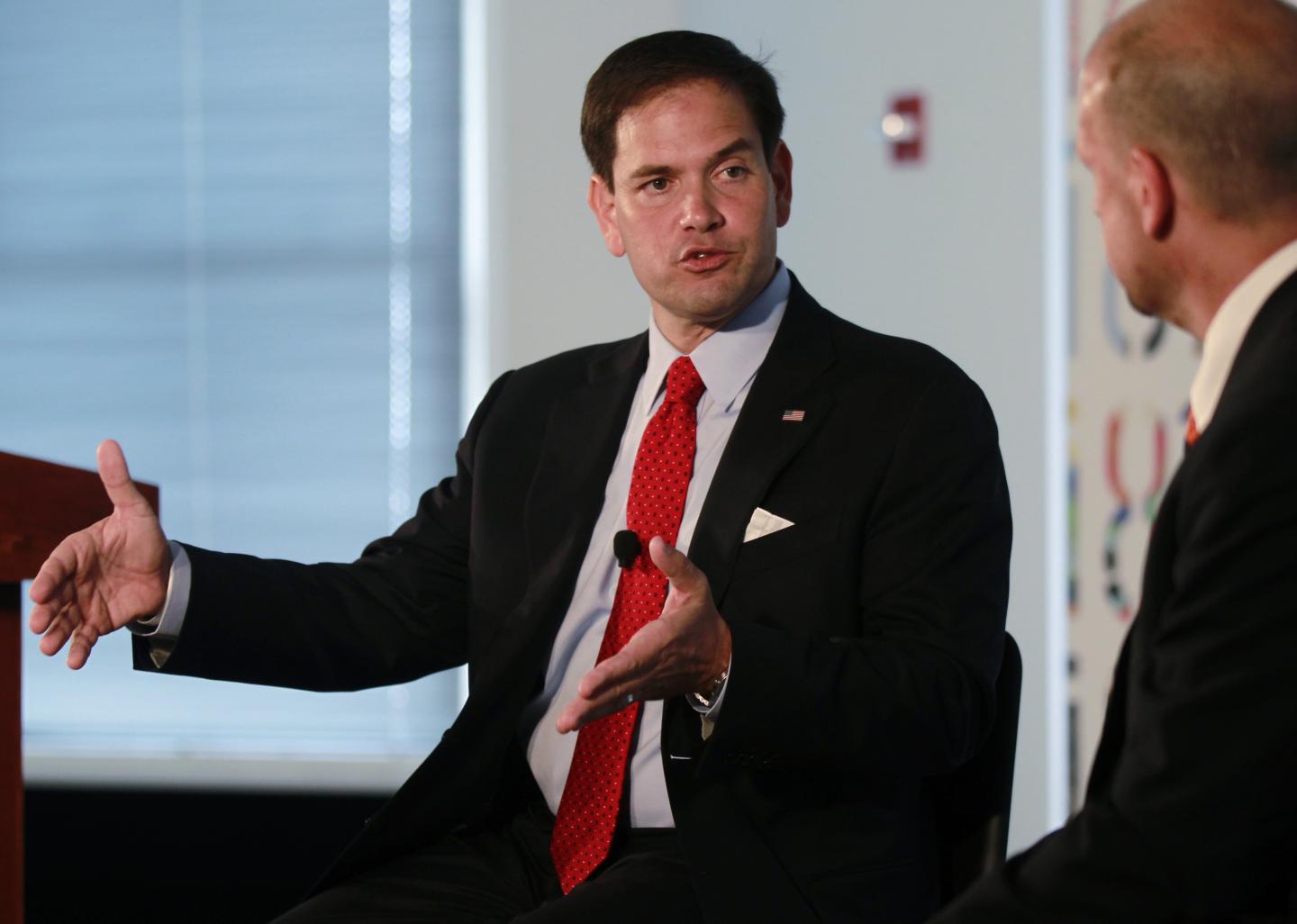
Republican presidential candidate Sen. Marco Rubio, R-Fla., speaks at 1871, an entrepreneurial hub for digital startups Tuesday, July 7, 2015, in Chicago. Rubio outlined a plan to lower corporate tax rates, loosen Internet regulation and broaden college accreditation, in his first major domestic policy speech as a presidential candidate. (AP Photo/Christian K. Lee)Photograph by Christian K. Lee — AP

Florida Sen. Marco Rubio gave a big speech on Tuesday, spelling out his view of the challenges facing American economic growth and a framework for how, as president, he’d tackle them. His theme: the twinned forces of technology and globalization require bold thinking to ensure the working and middle classes aren’t left behind.

The address by the top-tier Republican contender was, naturally, a bit of an exercise in positioning. Rubio, 44 years young, offered himself as a “new president for a new age,” singularly suited to captain the country through world-rattling transformation. And he backed it up with some policy grist, including proposals to slash corporate tax rates and shake up the higher education system.

Early reviews from across the ideological spectrum have been positive. From the left, Vox’s Ezra Klein writes the speech reaffirmed why Rubio is “the Republican the Clinton camp should fear most: he’s working his way towards a message that wraps his campaign in the problems and solutions of the future.” Klein notes that Rubio’s diagnosis, more than his prescriptions, marked a break from years of Republican arguments that everything ailing the economy traces back to Obama’s disastrous leadership. “It’s an apolitical theory of our economic problems,” he writes.

The American Enterprise Institute’s Jim Pethokoukis agreed with that assessment, writing that Rubio’s “non-Obamacentric” evaluation of the macroeconomic trends buffeting American workers was “the best part” of the speech.

Here’s Rubio, from that portion:

The result is that the path to the middle class is narrower today than it has been for generations, and the American Dream so many achieved in the last century is in peril. This hardship is not the result of a cyclical economic downturn that will naturally correct itself. It is born of a fundamental transformation to the very nature of our economy, the disruptions of which have been prolonged and compounded by the failure of our leaders, our policies, and our institutions to transform accordingly.

There are two primary forces behind this transformation. The first is radical technological progress—including the development of the Internet, information technologies, wireless and mobile capabilities, robotics, and more. The second has risen partly from the first, and that is globalization. From where you sit, you can sell a product to someone on the other side of the world almost as easily as to the person on your left or right. This has pulled us into competition with dozens of other nations for businesses, jobs, talent, and innovation.

Over the last two decades, not a single industry has been untouched by these forces, and the disruptions have triggered a cascade of anxiety. Fewer Americans believe in the viability of the American Dream today than during the worst of the financial crisis in 2009. Many pundits and media outlets stoke these fears, painting a dreary picture of the future in which automation and outsourcing continue to shatter the American workforce.

The most striking thing about Rubio’s analysis here isn’t simply that it refrains from pinning blame on Obama; it’s that, with some light editing, Obama himself could have delivered it.

The president’s economic brains have long pointed to the fifth chapter of The Audacity of Hope, the book Obama wrote in anticipation of his first White House bid, as the urtext of his economic philosophy. In it, Obama describes two formative trips he took as a U.S. Senator, the first to Google’s gleaming Mountain View headquarters and the second to the struggling town of Galesburg, Ill., where Maytag had announced massive layoffs as it shifted operations to Mexico. The juxtaposition—of technology’s promise to unleash wealth and job creation against globalization’s war on our industrial base—brought home for the freshman senator what policy makers were up against. “You’ll get little argument these days, from either the left or the right, with the notion that we’re going through a fundamental economic transformation,” Obama wrote nearly a decade, and a financial crisis, before Rubio delivered the same appraisal. He continued:

Advances in digital technology, fiber optics, the Internet, satellites, and transportation have effectively leveled the economic barriers between countries and continents. Pools of capital scour the earth in search of the best returns, with trillions of dollars moving across borders with only a few keystrokes. The collapse of the Soviet Union, the institution of market-based reforms in India and China, the lowering of trade barriers, and the advent of big-box retailers like Wal-Mart have brought several billion people into direct competition with American companies and American workers. Whether or not the world is flat, as columnist and author Thomas Friedman says, it is certainly getting flatter every day.

There’s no doubt that globalization has brought significant benefits to American consumers. It’s lowered prices on goods once considered luxuries, from big-screen TVs to peaches in winter, and increased the purchasing power of low-income Americans. It’s helped keep inflation in check, boosted returns for millions of Americans now invested in the stock market, provided new markets for U.S. goods and services, and allowed countries like China and India to dramatically reduce poverty, which over the long term makes for a more stable world.

But there’s also no denying that globalization has greatly increased economic instability for millions of ordinary Americans.

Obama went on to offer a history lesson, plotting the fitful evolution of the American market system from its colonial era inception all the way into the 21st century. In the debate over its future, Obama argued that both parties were wrong, mired in tired old arguments. He called for a “new economic consensus,” a preview of his attempt to equate his own relative youth with the opportunity to slough off stale partisan conflicts. Sound familiar?

No one would suggest Obama and Rubio are made of the same ideological stuff. Rubio’s tax plan, for one, is a non-starter with this administration—though the New York Times does point out some striking similarities between the higher-ed reforms the Florida senator rolled out in his Tuesday speech and proposals from Obama administration in the same vein. But to the extent that Rubio is looking to distinguish himself from the GOP field with a sober-minded read of macroeconomic dynamics, he is borrowing from Obama’s (winning) playbook.

About the Author
By Tory Newmyer
See full bioRight Arrow Button Icon

Latest in Leadership

Finance
Lorem ipsum dolor sit amet, consectetur adipiscing elit, sed do eiusmod tempor incididunt ut labore et dolore magna aliqua. Ut enim ad minim veniam
By Fortune Editors
October 20, 2025
Finance
Lorem ipsum dolor sit amet, consectetur adipiscing elit, sed do eiusmod tempor incididunt ut labore et dolore magna aliqua. Ut enim ad minim veniam
By Fortune Editors
October 20, 2025
Finance
Lorem ipsum dolor sit amet, consectetur adipiscing elit, sed do eiusmod tempor incididunt ut labore et dolore magna aliqua. Ut enim ad minim veniam
By Fortune Editors
October 20, 2025
Finance
Lorem ipsum dolor sit amet, consectetur adipiscing elit, sed do eiusmod tempor incididunt ut labore et dolore magna aliqua. Ut enim ad minim veniam
By Fortune Editors
October 20, 2025
Finance
Lorem ipsum dolor sit amet, consectetur adipiscing elit, sed do eiusmod tempor incididunt ut labore et dolore magna aliqua. Ut enim ad minim veniam
By Fortune Editors
October 20, 2025
Finance
Lorem ipsum dolor sit amet, consectetur adipiscing elit, sed do eiusmod tempor incididunt ut labore et dolore magna aliqua. Ut enim ad minim veniam
By Fortune Editors
October 20, 2025

Most Popular

Finance
Lorem ipsum dolor sit amet, consectetur adipiscing elit, sed do eiusmod tempor incididunt ut labore et dolore magna aliqua. Ut enim ad minim veniam
By Fortune Editors
October 20, 2025
Finance
Lorem ipsum dolor sit amet, consectetur adipiscing elit, sed do eiusmod tempor incididunt ut labore et dolore magna aliqua. Ut enim ad minim veniam
By Fortune Editors
October 20, 2025
Finance
Lorem ipsum dolor sit amet, consectetur adipiscing elit, sed do eiusmod tempor incididunt ut labore et dolore magna aliqua. Ut enim ad minim veniam
By Fortune Editors
October 20, 2025
Finance
Lorem ipsum dolor sit amet, consectetur adipiscing elit, sed do eiusmod tempor incididunt ut labore et dolore magna aliqua. Ut enim ad minim veniam
By Fortune Editors
October 20, 2025
Finance
Lorem ipsum dolor sit amet, consectetur adipiscing elit, sed do eiusmod tempor incididunt ut labore et dolore magna aliqua. Ut enim ad minim veniam
By Fortune Editors
October 20, 2025
Finance
Lorem ipsum dolor sit amet, consectetur adipiscing elit, sed do eiusmod tempor incididunt ut labore et dolore magna aliqua. Ut enim ad minim veniam
By Fortune Editors
October 20, 2025
Fortune Secondary Logo
Rankings
  • 100 Best Companies
  • Fortune 500
  • Global 500
  • Fortune 500 Europe
  • Most Powerful Women
  • World's Most Admired Companies
  • See All Rankings
  • Lists Calendar
Sections
  • Finance
  • Fortune Crypto
  • Features
  • Leadership
  • Health
  • Commentary
  • Success
  • Retail
  • Mpw
  • Tech
  • Lifestyle
  • CEO Initiative
  • Asia
  • Politics
  • Conferences
  • Europe
  • Newsletters
  • Personal Finance
  • Environment
  • Magazine
  • Education
Customer Support
  • Frequently Asked Questions
  • Customer Service Portal
  • Privacy Policy
  • Terms Of Use
  • Single Issues For Purchase
  • International Print
Commercial Services
  • Advertising
  • Fortune Brand Studio
  • Fortune Analytics
  • Fortune Conferences
  • Business Development
  • Group Subscriptions
About Us
  • About Us
  • Press Center
  • Work At Fortune
  • Terms And Conditions
  • Site Map
  • About Us
  • Press Center
  • Work At Fortune
  • Terms And Conditions
  • Site Map
  • Facebook icon
  • Twitter icon
  • LinkedIn icon
  • Instagram icon
  • Pinterest icon

Latest in Leadership

old
Commentaryaffordability
The American household just took an 81% margin cut. Wall Street hasn’t priced it in
By Katica RoyMay 2, 2026
37 minutes ago
mackenzie
Commentaryphilanthropy
Stop donating to Harvard and the Ivy League. There’s a better option that MacKenzie Scott already figured out
By Ed Smith-LewisMay 2, 2026
3 hours ago
Blackstone’s Steve Schwarzman built a program to teach young leaders about China. It’s harder to get into than Harvard
C-SuiteFinance
Blackstone’s Steve Schwarzman built a program to teach young leaders about China. It’s harder to get into than Harvard
By Shawn TullyMay 2, 2026
5 hours ago
cox
C-SuiteWealth
Billionaires have a problem money can’t solve: They don’t know how to talk to their kids
By Nick LichtenbergMay 1, 2026
18 hours ago
male engineer working under pylon
EnergyElectricity
Utility CEOs pocket $626 million as American energy bills hit record highs
By Tristan BoveMay 1, 2026
18 hours ago
Fortune 500 Power Moves: Which executives gained and lost power this week
C-SuiteFortune 500 Power Moves
Fortune 500 Power Moves: Which executives gained and lost power this week
By Fortune EditorsMay 1, 2026
20 hours ago

Most Popular

Scott Bessent on financial literacy: 'it drives me crazy' to see young men in blue-collar construction jobs playing the lottery
Personal Finance
Scott Bessent on financial literacy: 'it drives me crazy' to see young men in blue-collar construction jobs playing the lottery
By Fatima Hussein and The Associated PressMay 1, 2026
23 hours ago
China dominates the world's lithium supply. The U.S. just found 328 years' worth in its own backyard
North America
China dominates the world's lithium supply. The U.S. just found 328 years' worth in its own backyard
By Jake AngeloApril 30, 2026
2 days ago
The U.S. economy is booming — just not where 50 million Americans live
Commentary
The U.S. economy is booming — just not where 50 million Americans live
By Derek KilmerMay 1, 2026
1 day ago
Current price of oil as of May 1, 2026
Personal Finance
Current price of oil as of May 1, 2026
By Joseph HostetlerMay 1, 2026
24 hours ago
A Chick-fil-A worker got fired and then showed up behind the register to allegedly refund himself over $80,000 in mac and cheese
Law
A Chick-fil-A worker got fired and then showed up behind the register to allegedly refund himself over $80,000 in mac and cheese
By Catherina GioinoMay 1, 2026
19 hours ago
Apple cofounder Ronald Wayne—whose stake would be worth up to $400 billion had he not sold it in 1976—says that at 91, he has no regrets
Success
Apple cofounder Ronald Wayne—whose stake would be worth up to $400 billion had he not sold it in 1976—says that at 91, he has no regrets
By Preston ForeApril 27, 2026
5 days ago

© 2026 Fortune Media IP Limited. All Rights Reserved. Use of this site constitutes acceptance of our Terms of Use and Privacy Policy | CA Notice at Collection and Privacy Notice | Do Not Sell/Share My Personal Information
FORTUNE is a trademark of Fortune Media IP Limited, registered in the U.S. and other countries. FORTUNE may receive compensation for some links to products and services on this website. Offers may be subject to change without notice.