• Home
  • Latest
  • Fortune 500
  • Finance
  • Tech
  • Leadership
  • Lifestyle
  • Rankings
  • Multimedia

Trendingnow

1

Jensen Huang made his $172 billion fortune on AI chips. His family's $75 million gift to Vanderbilt argues art decides what technology is for

2

The millennial generation has split, new Fed research shows: Those over 35 are edging toward boomer-style wealth, while everyone else falls behind

3

The $39 trillion U.S. national debt isn’t as high as Japan’s and Singapore’s relative to economy size—and yet it's still worse somehow

1

Jensen Huang made his $172 billion fortune on AI chips. His family's $75 million gift to Vanderbilt argues art decides what technology is for

2

The millennial generation has split, new Fed research shows: Those over 35 are edging toward boomer-style wealth, while everyone else falls behind

3

The $39 trillion U.S. national debt isn’t as high as Japan’s and Singapore’s relative to economy size—and yet it's still worse somehow
Tech

This startup is looking to revolutionize lithium ion batteries

By
Katie Fehrenbacher
Katie Fehrenbacher
Down Arrow Button Icon
By
Katie Fehrenbacher
Katie Fehrenbacher
Down Arrow Button Icon
June 22, 2015, 7:30 AM ET
Photograph by Jacob Belcher
Add Fortune on Google for similar content.

All eyes have been on Tesla’s planned massive battery factory, under construction just outside of Reno. But on the other side of the country, in Cambridge, Mass., you’ll find an undercover startup that’s been toiling away at a totally different way to design and make what company executives say is a better battery for the power grid and electric cars.

The company, 24M, which came out of stealth mode on Monday, is working on a new type of lithium ion battery that it says is vastly cheaper than what’s currently on the market. The company describes their innovation as “the most significant advancement in lithium-ion technology in more than two decades,” and if the battery can deliver on its promise it could help deliver low cost batteries for important new emerging markets.

Over the years there have been dozens of young startups that have tried to disrupt the battery industry with new ideas. But few actually pull it off. 24M will face intense competition in a crowded market that favors large companies like the battery giants Panasonic and LG in Asia.

MIT battery scientist Yet-Ming Chiang founded 24M in 2010 by spinning it out of his previous battery company A123 Systems. The idea was to create a battery that could store more energy while shrinking the other materials in the battery the he believed could be made smaller.

Chiang wondered if there was a way to significantly grow the electrode, which is the heart of the battery and used for charging and discharging. Meanwhile, he wanted to make parts smaller like the separators between the electrodes, which keep the anode and cathode segregated, or the currency collector, which receives electrons from the external battery circuit.

Now five years later, Chiang and his team of 50 people, say they’ve found a way to ditch more than 80% of the non-energy storing materials, and increase the size of the electrode by over five times compared to a traditional lithium ion battery. If a cross section of a standard lithium ion battery looks like a very complex seven layer cake, a cross section of a 24M battery looks like a two layer cake with a hefty anode and cathode.

An image of a cross section of a conventional lithium ion battery and a battery made by 24M.Image courtesy of 24M
Courtesy of 24M

Chiang tells Fortune that if the company can show that its process is superior to the standard, he would expect that everyone would want to use it to make lithium ion batteries. “For me, the ultimate win would be if this would become the defacto standard for battery production around the world,” said Chiang.

Designing a battery this way enables an entirely new way of manufacturing it. The team calls 24M’s battery “semi-solid” because the development starts with the energy storage material — the electrode — in a semi-solid, fluid state. Traditional lithium ion battery manufacturing makes thin, solid electrodes.

The way 24M makes the semi-solid electrode is part of the company’s secret sauce, so it’s a little unclear just exactly how it does it. But Chiang says the team uses “pretty interesting nanotechnology,” to engineer how the batteries conduct electricity.

Traditional lithium ion battery manufacturing largely uses roll-to-roll processing, which takes a thin wet coating of the electrode material, applies it to a thin metal foil and then dries the electrodes in big drying ovens. When the thin electrodes are finally dry and hardened, they are snapped together to make a cell and the liquid electrolyte is added.

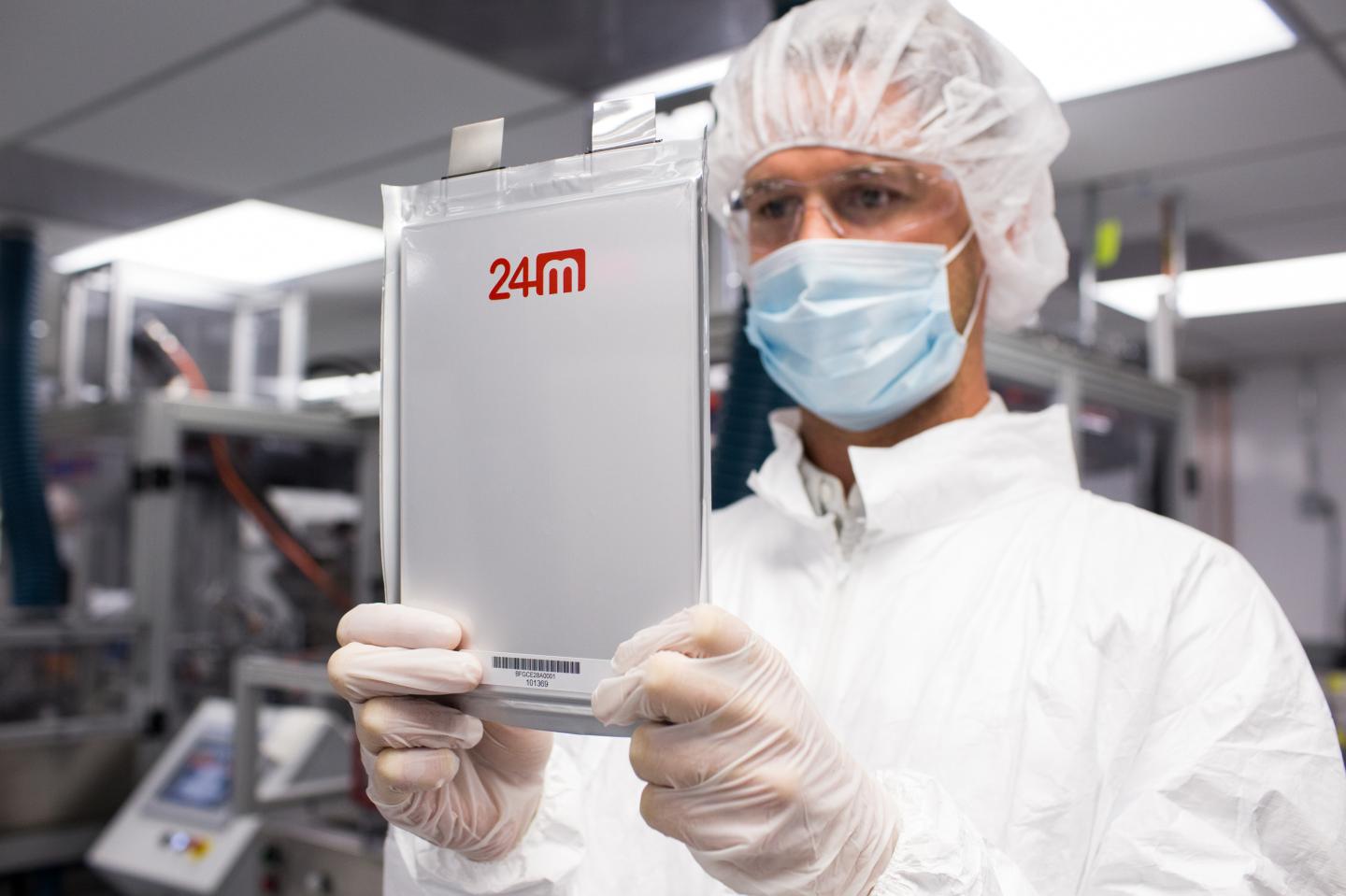
A battery made by 24M, which the startup says is lower cost, safer, and conformable.Jacob Belcher Jake Belcher Photography 2015
Photograph by Jacob Belcher

Chiang says most battery factories churn out batteries this way because it was the dominant technology adopted from magnetic tape factories in Japan in the 1980’s and 1990’s. That industry has tanked as data storage technology has evolved, but the processes are still deeply embedded in lithium ion battery production.

The problem with this method, according to Chiang, is that it’s complex, it takes a long time, and there’s limited ways to scale up the process other than to just make the battery manufacturing line longer. This requires a lot of money upfront to build a huge factory.

24M’s factory designs remove the big dryers, vastly reduces the number of steps, and enables a factory to be made in a more modular way, requiring less upfront investment. The company says its battery cells can be made in one-fifth of the time of a conventional battery.

A few blocks south of Massachusetts Avenue in Cambridge, 24M has a 32,000 square foot pilot facility where it’s churned out about 9,000 early batteries in this new way. The company is already shipping these sample batteries to partners and potential customers. The batteries could be installed in test applications in the field as early as 2016. 24M wants to build a larger production plant in 2017.

With its simpler manufacturing, 24M’s batteries are supposed to be much less expensive than standard lithium ion batteries. By 2020, the company says its battery costs will be less than $100 per kilowatt-hour. Some of the most low cost lithium ion batteries coming out of rival factories today are closer to $200 and $250 per kilowatt-hour. Tesla is looking to lower the cost of its batteries, from these already low levels, by a third through both massive scale and improvements in chemistry.

Chiang, and 24M’s CEO, serial tech entrepreneur Throop Wilder, are eager to describe 24M’s technology as “a platform” that could disrupt the current lithium ion battery industry. The idea is that any company could use this design and manufacturing plan to make any type of battery using mostly off-the-shelf parts, equipment and materials, just combined in a new way.

But the 24M executives aren’t interested in licensing out their tech to start. They want to make batteries.

The sample batteries, and the first of their batteries to market, will likely be used on the grid by utilities and at commercial buildings. There’s a growing market for utilities and building owners to buy energy from battery farms during peak grid times or paired with new solar and wind farms. After grid batteries, 24M could sell batteries for electric vehicles, too.

To date, 24M has raised $50 million in two rounds of funding from VCs Charles River Ventures and North Bridge Venture Partners, as well as industrial and manufacturing partners including Japanese industrial company IHI, and Thai conglomerate PTT.

That venture capitalists were willing to back an early stage battery technology is unusual in this day and age. Many venture capitalists got burned by investing in young, manufacturing-focused energy tech years ago, and the battery industry has been littered with new startups that have tried to build large battery factories and stumbled.

Chiang knows this side of the industry all too well. A123 System, his previous company, started raising money from VCs a decade ago. It went public with one of the largest IPOs of 2009, making its early investors a profit. But as A123 Systems built up its production, and the market for electric vehicles grew more slowly than anticipated, the company struggled and eventually filed for bankruptcy. In 2013 Chinese giant Wanxiang Group bought most of the assets, while other companies bought various divisions.

Chiang, who’s still an advisor to A123 Systems, says A123 was “ahead of its time,” and points out that the company is now in a good place, doubling its current manufacturing. But the ups and downs of the founder’s former company highlight just how difficult the battery market is for a startup that’s looking to do something brand new.


About the Author
By Katie Fehrenbacher
See full bioRight Arrow Button Icon
Add Fortune on Google for similar content.

Latest in Tech

Finance
Lorem ipsum dolor sit amet, consectetur adipiscing elit, sed do eiusmod tempor incididunt ut labore et dolore magna aliqua. Ut enim ad minim veniam
By Fortune Editors
October 20, 2025
Finance
Lorem ipsum dolor sit amet, consectetur adipiscing elit, sed do eiusmod tempor incididunt ut labore et dolore magna aliqua. Ut enim ad minim veniam
By Fortune Editors
October 20, 2025
Finance
Lorem ipsum dolor sit amet, consectetur adipiscing elit, sed do eiusmod tempor incididunt ut labore et dolore magna aliqua. Ut enim ad minim veniam
By Fortune Editors
October 20, 2025
Finance
Lorem ipsum dolor sit amet, consectetur adipiscing elit, sed do eiusmod tempor incididunt ut labore et dolore magna aliqua. Ut enim ad minim veniam
By Fortune Editors
October 20, 2025
Finance
Lorem ipsum dolor sit amet, consectetur adipiscing elit, sed do eiusmod tempor incididunt ut labore et dolore magna aliqua. Ut enim ad minim veniam
By Fortune Editors
October 20, 2025
Finance
Lorem ipsum dolor sit amet, consectetur adipiscing elit, sed do eiusmod tempor incididunt ut labore et dolore magna aliqua. Ut enim ad minim veniam
By Fortune Editors
October 20, 2025

Most Popular

Finance
Lorem ipsum dolor sit amet, consectetur adipiscing elit, sed do eiusmod tempor incididunt ut labore et dolore magna aliqua. Ut enim ad minim veniam
By Fortune Editors
October 20, 2025
Finance
Lorem ipsum dolor sit amet, consectetur adipiscing elit, sed do eiusmod tempor incididunt ut labore et dolore magna aliqua. Ut enim ad minim veniam
By Fortune Editors
October 20, 2025
Finance
Lorem ipsum dolor sit amet, consectetur adipiscing elit, sed do eiusmod tempor incididunt ut labore et dolore magna aliqua. Ut enim ad minim veniam
By Fortune Editors
October 20, 2025
Finance
Lorem ipsum dolor sit amet, consectetur adipiscing elit, sed do eiusmod tempor incididunt ut labore et dolore magna aliqua. Ut enim ad minim veniam
By Fortune Editors
October 20, 2025
Finance
Lorem ipsum dolor sit amet, consectetur adipiscing elit, sed do eiusmod tempor incididunt ut labore et dolore magna aliqua. Ut enim ad minim veniam
By Fortune Editors
October 20, 2025
Finance
Lorem ipsum dolor sit amet, consectetur adipiscing elit, sed do eiusmod tempor incididunt ut labore et dolore magna aliqua. Ut enim ad minim veniam
By Fortune Editors
October 20, 2025
Fortune Secondary Logo
Rankings
  • 100 Best Companies
  • Fortune 500
  • Global 500
  • Fortune 500 Europe
  • Most Powerful Women
  • World's Most Admired Companies
  • See All Rankings
  • Lists Calendar
Sections
  • Finance
  • Fortune Crypto
  • Features
  • Leadership
  • Health
  • Commentary
  • Success
  • Retail
  • Mpw
  • Tech
  • Lifestyle
  • CEO Initiative
  • Asia
  • Politics
  • Conferences
  • Europe
  • Newsletters
  • Personal Finance
  • Environment
  • Magazine
  • Education
Customer Support
  • Frequently Asked Questions
  • Customer Service Portal
  • Privacy Policy
  • Terms Of Use
  • Single Issues For Purchase
  • International Print
Commercial Services
  • Advertising
  • Fortune Brand Studio
  • Fortune Analytics
  • Fortune Conferences
  • Business Development
  • Group Subscriptions
About Us
  • About Us
  • Press Center
  • Work At Fortune
  • Terms And Conditions
  • Site Map
  • About Us
  • Press Center
  • Work At Fortune
  • Terms And Conditions
  • Site Map
  • Facebook icon
  • Twitter icon
  • LinkedIn icon
  • Instagram icon
  • TikTok icon
  • YouTube icon

Latest in Tech

EU says TikTok failed to shield minors’ accounts from adults, exposing kids to predators
CybersecurityTikTok
EU says TikTok failed to shield minors’ accounts from adults, exposing kids to predators
By Sam McNeil and The Associated PressJuly 24, 2026
3 hours ago
Vladimir Putin and Xi Jinping shaking hands
PoliticsChina
China adds 14 European firms to export control list in tit-for-tat over EU’s Russia sanctions
By The Associated PressJuly 24, 2026
3 hours ago
t
EnergyWhite House
Trump promises cheaper power from data centers. Analysts say bills could jump 40%
By Josh Boak, Matthew Daly and The Associated PressJuly 24, 2026
5 hours ago
sk
LawSouth Korea
South Korea’s ‘divorce of the century’ results in order for SK chair to pay ex-wife $640 million
By The Associated PressJuly 24, 2026
5 hours ago
brockman speaks on stage
AIOpenAI
OpenAI President says rogue AI attack on Hugging Face ‘is indicative of the times we are in’ as the company continues to investigate incident
By Emily ForliniJuly 24, 2026
6 hours ago
craig
CommentaryPharmaceutical Industry
Big pharma’s patent cliff meets a new biotech Cold War: We need to outrun China, not outlaw it
By Craig GarthwaiteJuly 24, 2026
6 hours ago

Most Popular

Jensen Huang made his $172 billion fortune on AI chips. His family's $75 million gift to Vanderbilt argues art decides what technology is for
Big Tech
Jensen Huang made his $172 billion fortune on AI chips. His family's $75 million gift to Vanderbilt argues art decides what technology is for
By Sydney LakeJuly 23, 2026
1 day ago
The millennial generation has split, new Fed research shows: Those over 35 are edging toward boomer-style wealth, while everyone else falls behind
Real Estate
The millennial generation has split, new Fed research shows: Those over 35 are edging toward boomer-style wealth, while everyone else falls behind
By Nick LichtenbergJuly 22, 2026
2 days ago
The $39 trillion U.S. national debt isn’t as high as Japan’s and Singapore’s relative to economy size—and yet it's still worse somehow
Economy
The $39 trillion U.S. national debt isn’t as high as Japan’s and Singapore’s relative to economy size—and yet it's still worse somehow
By Sasha RogelbergJuly 23, 2026
1 day ago
'The demographic dividend of the last 40 years is ending': J.P. Morgan says the world is running out of the two things that kept interest rates down
Economy
'The demographic dividend of the last 40 years is ending': J.P. Morgan says the world is running out of the two things that kept interest rates down
By Eleanor PringleJuly 24, 2026
11 hours ago
Spain lifted the World Cup, but the IRS still gets a cut of its $50 million pay day as players, coaches and refs all face complex U.S. “jock taxes”
Personal Finance
Spain lifted the World Cup, but the IRS still gets a cut of its $50 million pay day as players, coaches and refs all face complex U.S. “jock taxes”
By Joshua HongJuly 23, 2026
1 day ago
Current price of oil as of July 23, 2026
Personal Finance
Current price of oil as of July 23, 2026
By Joseph HostetlerJuly 23, 2026
1 day ago

© 2026 Fortune Media IP Limited. All Rights Reserved. Use of this site constitutes acceptance of our Terms of Use and Privacy Policy | CA Notice at Collection and Privacy Notice | Do Not Sell/Share My Personal Information
FORTUNE is a trademark of Fortune Media IP Limited, registered in the U.S. and other countries. FORTUNE may receive compensation for some links to products and services on this website. Offers may be subject to change without notice.