• Home
  • Latest
  • Fortune 500
  • Finance
  • Tech
  • Leadership
  • Lifestyle
  • Rankings
  • Multimedia
Leadership

Here are the cities that need a $15 minimum wage the most

Claire Zillman
By
Claire Zillman
Claire Zillman
Editor, Leadership
Down Arrow Button Icon
Claire Zillman
By
Claire Zillman
Claire Zillman
Editor, Leadership
Down Arrow Button Icon
May 23, 2015, 2:04 PM ET
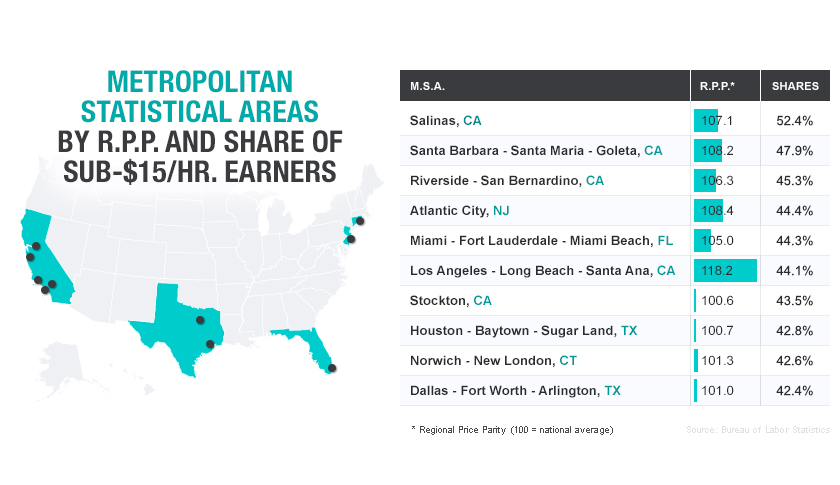
U.S. cities that need $15 minimum wage the most
Graphic by Analee Kasudia

The Los Angeles City Council this week voted 14-1 to pass a $15 minimum wage for the city. The hike, which will go into effect over the next five years, further solidifies the $15 minimum as the new national standard.

New York City seems poised to follow suit. This month, New York Governor Andrew Cuomo announced plans to convene a panel to consider a wage increase for the fast-food industry, a change that can become law without a vote in the legislature.

There are plenty of arguments against this high of a minimum wage, including one made by Berkshire Hathaway CEO Warren Buffetton Friday, in which he called for an expanded earned income tax credit rather than a $15 per hour wage. But like it or not, the $15 per hour train is gaining steam. It had already made stops in Seattle and San Francisco before pulling into L.A. Should others follow suit? That question prompted Fortune to examine which U.S. city residents would benefit the most from a $15 per hour minimum wage. We asked David Cooper, an economic analyst at the Economic Policy Institute, for help.

We first wanted to determine which cities had the largest share of sub-$15 per hour earners, where a minimum wage boost to $15 would presumably have the biggest direct effect, not in absolute numbers but by percentage of the working population. (One caveat here: we used the Bureau of Labor Statistics’ data for metropolitan statistical areas—geographical areas with high population density and consistent economies that don’t necessarily contain just one city and might reach beyond a city’s official limits.)

It turns out that there are plenty of metropolitan areas—especially in the South—where 45%, 50%, and even 55% of the working population earn less than $15 per hour. (Another caveat, because of the size of some of these areas, some percentages have margins of error up to 4.3%.) For example, in the part of Texas that encompasses McAllen, Edinburg, and Pharr, which is located in the state’s southeast corner near the Mexican border, just over 68% of its workforce earns less than $15 per hour.

But when you examine how much it costs to live in that region—which Cooper measured using regional price parity, the price of goods and services in that area versus the national average—you get a different picture. The RPP there is 85, on a scale where the overall national RPP is equal to 100, which means goods and services in that area are cheaper than the national average. To take that factor into account, we looked at the most expensive places to live, as measured by RPP, and used the U.S.’s average share of sub-$15 per hour earners—42.4%—as a cutoff for the share of low-wage workers.

The map above shows the metropolitan areas that turned up. L.A., which will soon have a $15 per hour minimum wage when Mayor Eric Garcetti signs the recently passed measure into law, makes the list. It’s one of five California areas in the top 10.

The list picks up on the fact that there’s “greater inequality in cities where there’s a high cost of living and where wages are low,” says Chris Tilly, director of the UCLA Institute for Research on Labor and Employment.

In the old, rust belt wage structure, there was a healthy population of middle wage income earners. Men worked in manufacturing; women held clerical jobs. But the bottom has dropped out of the middle class, in part, because of the reduction in traditional manufacturing jobs. As cities begin to orient themselves to newer, techonology-driven economies, there’s very little middle ground. You either work in high tech (engineers, etc.,) and its ecosystem (lawyers, accountants) or you’re left at the bottom, Tilly says. Cities with large immigrant populations also tend to have a wide disconnect between the cost of living and wages.

Missing from this list is, notably, New York City. The metropolitan statistical area that includes New York (plus parts of New Jersey and Long Island) has the second highest regional price parity on our list—122.2, behind only Honolulu’s 122.9. But the New York area’s share of sub-$15 per hour workers is 36%, considerably lower than the the national average of 42.4%. Then again, with a national average as high as 42.4%, it sounds like there’s plenty of room for improvement all across the U.S.


About the Author
Claire Zillman
By Claire ZillmanEditor, Leadership
LinkedIn iconTwitter icon

Claire Zillman is a senior editor at Fortune, overseeing leadership stories. 

See full bioRight Arrow Button Icon

Latest in Leadership

Asiathe future of work
The CEO of one of Asia’s largest co-working space providers says his business has more in common with hotels
By Angelica AngDecember 12, 2025
3 hours ago
Donald Trump
HealthHealth Insurance
‘Tragedy in the making’: Top healthcare exec on why insurance will spike to subsidize a tax cut to millionaires and billionaires
By Nick LichtenbergDecember 12, 2025
10 hours ago
three men in suits, one gesturing
AIBrainstorm AI
The fastest athletes in the world can botch a baton pass if trust isn’t there—and the same is true of AI, Blackbaud exec says
By Amanda GerutDecember 12, 2025
11 hours ago
Brainstorm AI panel
AIBrainstorm AI
Creative workers won’t be replaced by AI—but their roles will change to become ‘directors’ managing AI agents, executives say
By Beatrice NolanDecember 12, 2025
11 hours ago
Ryan Serhant lifts his arms at the premiere of Owning Manhattan, his Netflix show
Successrelationships
Ryan Serhant, a real estate mogul who’s met over 100 billionaires, reveals his best networking advice: ‘Every room I go into, I use the two C’s‘
By Dave SmithDecember 12, 2025
12 hours ago
Fei-Fei Li, the "Godmother of AI," says she values AI skills more than college degrees when hiring software engineers for her tech startup.
AITech
‘Godmother of AI’ says degrees are less important in hiring than how quickly you can ‘superpower yourself’ with new tools
By Nino PaoliDecember 12, 2025
13 hours ago

Most Popular

placeholder alt text
Economy
Tariffs are taxes and they were used to finance the federal government until the 1913 income tax. A top economist breaks it down
By Kent JonesDecember 12, 2025
19 hours ago
placeholder alt text
Success
Apple cofounder Ronald Wayne sold his 10% stake for $800 in 1976—today it’d be worth up to $400 billion
By Preston ForeDecember 12, 2025
15 hours ago
placeholder alt text
Success
At 18, doctors gave him three hours to live. He played video games from his hospital bed—and now, he’s built a $10 million-a-year video game studio
By Preston ForeDecember 10, 2025
3 days ago
placeholder alt text
Success
40% of Stanford undergrads receive disability accommodations—but it’s become a college-wide phenomenon as Gen Z try to succeed in the current climate
By Preston ForeDecember 12, 2025
14 hours ago
placeholder alt text
Success
Palantir cofounder calls elite college undergrads a ‘loser generation’ as data reveals rise in students seeking support for disabilities, like ADHD
By Preston ForeDecember 11, 2025
2 days ago
placeholder alt text
Arts & Entertainment
'We're not just going to want to be fed AI slop for 16 hours a day': Analyst sees Disney/OpenAI deal as a dividing line in entertainment history
By Nick LichtenbergDecember 11, 2025
1 day ago
Rankings
  • 100 Best Companies
  • Fortune 500
  • Global 500
  • Fortune 500 Europe
  • Most Powerful Women
  • Future 50
  • World’s Most Admired Companies
  • See All Rankings
Sections
  • Finance
  • Leadership
  • Success
  • Tech
  • Asia
  • Europe
  • Environment
  • Fortune Crypto
  • Health
  • Retail
  • Lifestyle
  • Politics
  • Newsletters
  • Magazine
  • Features
  • Commentary
  • Mpw
  • CEO Initiative
  • Conferences
  • Personal Finance
  • Education
Customer Support
  • Frequently Asked Questions
  • Customer Service Portal
  • Privacy Policy
  • Terms Of Use
  • Single Issues For Purchase
  • International Print
Commercial Services
  • Advertising
  • Fortune Brand Studio
  • Fortune Analytics
  • Fortune Conferences
  • Business Development
About Us
  • About Us
  • Editorial Calendar
  • Press Center
  • Work At Fortune
  • Diversity And Inclusion
  • Terms And Conditions
  • Site Map

© 2025 Fortune Media IP Limited. All Rights Reserved. Use of this site constitutes acceptance of our Terms of Use and Privacy Policy | CA Notice at Collection and Privacy Notice | Do Not Sell/Share My Personal Information
FORTUNE is a trademark of Fortune Media IP Limited, registered in the U.S. and other countries. FORTUNE may receive compensation for some links to products and services on this website. Offers may be subject to change without notice.