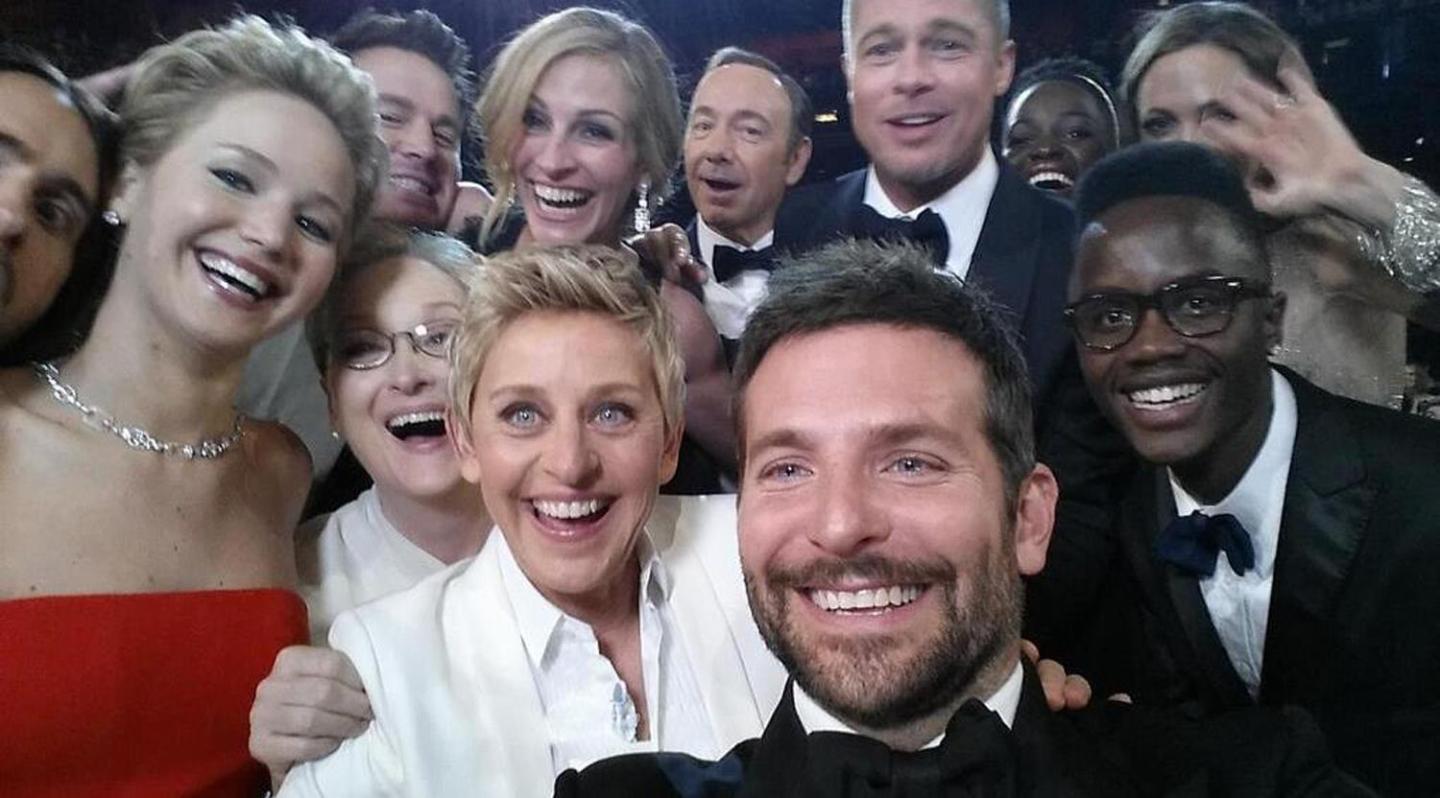
Not everyone remembers which film won Best Picture at last year’s Academy Awards (Answer: 12 Years a Slave). But even the most acute Oscar amnesiac will recall the defining moment when host Ellen DeGeneres snapped the Twitter selfie seen ’round the world.
In a fresh burst of spontaneity, DeGeneres pushed the old-school ceremony into the digital-era deep end, wrangling the likes of Angelina Jolie, Brad Pitt, Julia Roberts, Meryl Streep and Jennifer Lawrence to participate in a splashy group photo that gained 3.4 million retweets and helped bring the show its best numbers in 14 years with 45 million viewers.
“We broke records and we broke Twitter,” said Neil Meron, who produces the big event alongside Craig Zadan. “The Oscar gods shone very bright on us that night.”
Suddenly, social media became a No. 1 heavy hitter in the Oscars Economy — a way to drive eyeballs to the broadcast and create revenue for all the players involved, from host network ABC to the advertisers to the rising stars hoping the increased exposure will lead to bigger and better acting opportunities (plus a salary bump).
The DeGeneres selfie stunt — captured on a Samsung smartphone — fetched an estimated $800 million to $1 billion for the tech company, ad agency Publicis boasted afterward, making the case that social shares plus celebrities plus live television equals big bucks if you’ve got a product to hawk.
Or ratings pressure to live up to.
“What we’re doing is specifically reaching out to all the platforms on social media — and because we had such tremendous success last year with it — we want to capitalize on that success and grow it,” said Meron of this year’s Feb. 22 telecast, teasing “massing engagement” with social powerhouses like Twitter (TWTR), Facebook (FB) and Instagram.
Their third year at the helm, Meron and Zadan — the savvy team behind recent NBC musical revivals of Sound of Music and Peter Pan as well as a string of movie and Broadway hits — will again add pizzazz with boldfaced singers, on the level of Barbra Streisand (in 2013) and U2 (2014), to dangle before viewers who have yet to see (or may not have access to) many of the smaller films honored.
“We get a lot of people who come to it knowing that they’re not going to make any money,” said Zadan. “The host doesn’t make more than two cents, and performers make two cents, and presenters don’t make any money. Nobody makes any money, but you’re doing it because you want to be part of the Oscars.”
The 2015 emcee, Neil Patrick Harris, will earn upward of $15,000 per union guidelines, while a top-tier singer such as Streisand collects at least $2,400 to perform a non-nominated song. (Crooning a tune that’s up for an award? That’s a starting fee of $3,500.)
The Academy of Motion Picture Arts and Sciences, a nonprofit, made $93.8 million off the Oscars in 2013, a $4 million boost from the year before, according to financial records. A significant chunk of that pile came courtesy of ABC parent company Disney (DIS) via a $75 million-a-year contract to air the show that expires in 2020.
Meanwhile, the organization that year racked up almost $40 million in awards-associated expenses including the costs of hiring thousands of staff, building the set, staging the crowd-pleasing performances and rolling out a seemingly endless red carpet on which nominees parade in expensive custom gowns and tuxes and million-dollar borrowed jewels. The organization also footed the $1.8 million bill for the annual Governors Ball, the glitzy after-party catered by Wolfgang Puck and his flowing champagne, caviar-encrusted pizzas and many, many truffles.
(The Academy did not have 2014’s financial data available at publication time.)
“You have to really, really prioritize as to what you want to spend your money on and what you’re going to get the biggest bang for,” said Meron, discussing the tricky dance of staying in-budget. “So we make sure that the sets are designed for the show, we get to repurpose them and make sure that we get maximum usage out of them.”
Outside the Dolby Theatre, a ripple effect of revenue flows into local businesses, from hot-ticket hotels, restaurants and limo services to hairstylists, make-up artists and manicurists on call for midnight touch-ups as clients depart the Governors Ball en route to the extra-VIP Vanity Fair bash.
According to LA-based economist Roy Weinstein, who studied the impact of 2013’s awards on the city, the frenzy infused some $216 million into the economy and stands to drop even more dollars in the future amid a development boom downtown and in other trendy areas close to the action.
“There are new hotels going up that are going to be beautiful, modern skyscraper hotels … and that additional five-star hotel capacity is going to stimulate events like the Oscars and the Emmys, the Grammys, the Golden Globes, People’s Choice, all of them, to find ways to expand their events,” said Weinstein. “You know, it’s, ‘If you build it, they will come.'”
Then Weinstein, too, dropped the all-important S-word: Social Media.
“That seems to be something that can enhance the buzz — both before, during and after these events, which can only be good for the economic impact of these events,” he said.
And with the rise of hate-tweeting (the phenomenon wherein a hive mind congregates to collectively snark, eviscerating Anne Hathaway and anyone in her path), Meron and Zadan are learning to take the good with the bad. After all, unscripted flubs can unravel in real-time, fueling the Twitter-verse with extra ammo for jokes. (Two words: Adele Dazeem.)
“You also have to understand that if somebody says something really positive, somebody else might say, ‘Oh I gotta see this and turn on the show.’ If somebody says, ‘Oh my god the most outrageous thing I’ve ever seen, this is really bad,’ they’ll turn on the show,” said Zadan, calling the Oscars a “blood sport.”
“So no matter what extreme they go to, they’ll bring you a bigger audience,” he said. “And since you have no control over what they say, you just are grateful for the enormity of the Twitter following.”
Erin Carlson is an entertainment writer and former editor at The Hollywood Reporter. Follow her on Twitter at @ErinLCarlson.