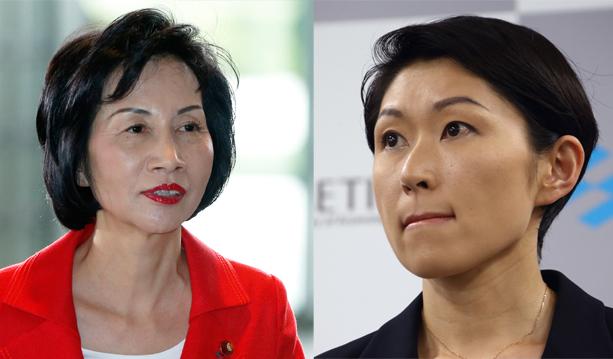
When it comes to unraveling what is going on with Japan’s push to get more women into leadership, it seems quite a lot is getting lost in translation.
On Monday, less than two months after Japanese Prime Minister Shinzo Abe appointed five women to his cabinet, two of them — Trade and Industry Minister Yuko Obuchi and Justice Minister Midori Matsushima — resigned due to separate scandals. Some prominent news outlets have framed the resignations as a very public knock against Abe’s goal to have women in 30% of leadership positions in all fields by 2020. Yet a deeper look at those particular women and the political landscape in Japan may tell a different story.
Glen Fukushima, a Senior Fellow at the Center for American Progress, spoke with Fortune about the shakeup in Abe’s cabinet.
Give me a little background on Prime Minister Abe’s cabinet.
Prime Minister Abe has been in office since 2012. He has been remarkably disciplined in having his cabinet ministers not say or do anything that could lead to their resignations — which often happens in Japan. There has been a real turnover of Ministers and Prime Ministers over the last couple of decades. There has been a great deal of hope placed on the Abe government and the public opinion polls have shown that support.
What was the reaction when he decided to bring five women into his cabinet in September?
It got him a lot of praise publicly, especially outside of Japan. But of the five women he appointed, four of them were pretty conservative people. So people in Japan were looking at these appointments as giving mixed signals. On the one hand, it was significant that he had five women in his cabinet, on the other hand, with the exception of Trade and Industry Minister Yuko Obuchi, the other four had been known to be pretty conservative women who were not pushing for women’s enhanced roles in the workplace.
Tell me more about Obuchi, who resigned earlier this week.
Many people thought she was inexperienced and too young to be a cabinet member. She is only 40 years old. Obuchi was appointed because although she is young, there was an expectation that she would grow into the job and eventually be groomed to be, perhaps, the first female prime minister of Japan.
So why did she have to resign?
There were some irregularities in the campaign financing for her elections. The funding group that she is the head of had some dealing with the company where her brother-in-law is the director and there are also allegations of her subsidizing trips to the theater. It’s pretty petty stuff, but there are all of these very intricate campaign-financing laws. Because the media and opposition parties made such a big deal out of it, she decided that if she immediately resigned and gets over it that it will blow over quickly. Eventually, she will be able to recover from it. If she stayed on, it could have damaged her long-term career. She has at least another 30 years, if not more, in her political career.
What about Justice Minister Midori Matsushima who also resigned last week?
Matsushima is a conservative friend of the Prime Minister. She apparently distributed some fans to her constituents and the opposition party seized on this and claimed that it was an illegal campaign contribution. She then made some comments about it that were very controversial. Her whole attitude about it was very antagonistic. She is a feisty person. Apparently, she also decided that she would have to step down. In Matsushima’s case, I think it was the calculation of the people around Abe that she would be a liability to the government.
What is her successor like?
Yoko Kamikawa is more of a liberal than her predecessor. She used to be Minister of State for Gender Equality. In many ways, you can place more hope on her than on her predecessor when it comes to progressive policies for women.
So are these two women leaving their posts a big dig on “womenomics” like a lot of American media outlets are saying?
No, I don’t think so. Most people in Japan are of the view that the appointment of five women to the cabinet was positive. But most of the polls show that only about 30% or 40% of people think Prime Minister Abe will advance the position of women in the workplace. Part of that is because just appointing a few women to the cabinet or just setting aside a budget to build some daycare centers is not going to solve the problem. It is a very fundamental, structural problem that is going to take a lot of time and a lot of effort to be resolved.
To subscribe to Caroline Fairchild’s daily newsletter on the world’s most powerful women, go to www.getbroadsheet.com.