• Home
  • Latest
  • Fortune 500
  • Finance
  • Tech
  • Leadership
  • Lifestyle
  • Rankings
  • Multimedia

Trendingnow

1

Analysts expected oil to surge above $200 but China has quietly kept prices half of that—and can’t for much longer

2

Corporate America has been draining the world's water. Matt Damon's new campaign calls on Gap, Starbucks, and Amazon to help give it back

3

Marc Lore’s robots make 500 burrito bowls an hour. A human can make 45

1

Analysts expected oil to surge above $200 but China has quietly kept prices half of that—and can’t for much longer

2

Corporate America has been draining the world's water. Matt Damon's new campaign calls on Gap, Starbucks, and Amazon to help give it back

3

Marc Lore’s robots make 500 burrito bowls an hour. A human can make 45
Aerospace

3D-printing a better rocket

By
Andrew Nusca
Andrew Nusca
and
Andrew Zaleski
Andrew Zaleski
Down Arrow Button Icon
By
Andrew Nusca
Andrew Nusca
and
Andrew Zaleski
Andrew Zaleski
Down Arrow Button Icon
September 30, 2014, 1:40 PM ET
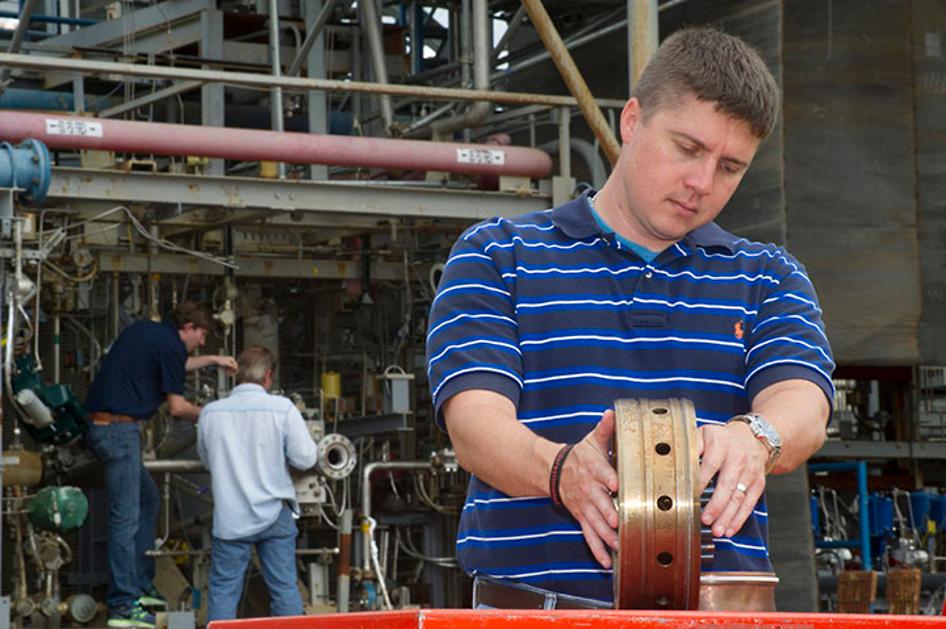
NASA 3D Printing rocket injector
NASA 3D Printing rocket injectorCourtesy: NASA/MSFC/Emmett Given

Consider the injector. It’s a lowly little engine part about as big as a basketball, small compared to the more photographic components that surround it. Its job, however, is big. On a rocket, it shoots hydrogen gas and liquid oxygen into a combustion chamber to create the thrust needed to send that rocket into space. It also needs to endure the trip.

A conventional rocket engine injector may be composed of a hundred different pieces, making it costly to assemble. On an object that costs several hundred thousand dollars per launch, and billions in development costs, any savings are welcome. It’s one reason why the cash-strapped National Aeronautics and Space Administration has been toying around with rocket parts made using an additive manufacturing process, better known as 3D printing.

In August, the agency test-fired a 3D-printed injector that withstood a record 20,000 pounds of thrust, which actually isn’t all that impressive. Paired with rocket boosters and the rest, the complete Space Launch System—a new heavy-lift vehicle that will power NASA’s deep-space missions starting in 2017—will create 9.2 million pounds of thrust at liftoff, the equivalent in horsepower of 208,000 Corvette engines revving up at once. What is impressive is the fact that the injector had just two parts and could produce 10 times as much thrust as any previously 3D-printed injector.

For NASA, additive manufacturing represents a way for the agency to stretch its technological capabilities and its $17 billion budget as it looks to build the next class of rocket engines to take its aircraft onto asteroids and to Mars. “The advances in the technology are finally getting to the point where we can see parts additively manufactured for demanding NASA applications,” says Dale Thomas, associate technical director at NASA’s Marshall Space Flight Center in Huntsville, Ala., where NASA has been trying out a variety of 3D-printed propulsion parts for more than a year. What the agency lacks, however, is the knowledge required to judge just how well 3D-printed engine parts will stand up during space flight. “We don’t understand the material properties really well and how they behave under stress,” Thomas says.

Enter the Integrated Product Team, a partnership formed in late May between the Marshall Center, the University of Alabama in Huntsville (as in “Go Chargers,” not “Roll Tide”), and the U.S. Army Aviation and Missile Research Development and Engineering Center, known as AMRDEC. The question at the central of the partnership: Is there a way to 3D-print material strong enough to insert into a working aircraft?

There is good reason to be uncertain about3D-printing parts that can be used in missiles topped with warheads or rockets ferrying astronauts. Which powdered metals will be easiest to print and strongest to deploy? What 3D-printing machines will work the best? The three groups believe that, by pooling their resources and trading notes, they will save time and taxpayer dollars developing additive manufacturing processes useful to the private sector, the military, and space exploration. They also believe they will manufacture higher-quality parts—lighter, stronger—than those created today through conventional machining techniques.

For the military, that means lighter missile components that can still handle vibrations during flight.

“You always want to save weight for an aviation platform. How do you save weight? Machine the part in a way to minimize frequency vibrations,” says James Lackey, acting director of AMRDEC in Huntsville. “Only through additive layering can you take advantage of what a mathematical formula tells you this design solution needs.”

Conventional machining can be thought of as subtractive manufacturing. You begin with a block of some material and gradually chop some off, a process that constrains the types of parts that can be designed. Additive manufacturing is different. Imagine instead a laser-centering machine that heats up and fuses together successive layers of powdered metals—inconel alloys, grades of steel, titanium, aluminum—to construct simpler rocket engine components. This is how NASA created the injector it test-fired a year ago.

“Those little boogers are incredibly complex,” Thomas says. “When you’re trying to manufacture them you throw away more than you use. With additive [we] can make an injector that in the past took about 15 to 20 pieces.”

Lackey and Thomas agree that the space agency’s foray into 3D printing is still in its earliest days. There is no working budget within AMRDEC or the Marshall Center for additive manufacturing experiments because both centers are still determining which 3D-printing technologies they need to invest in. Phillip Farrington, a professor of industrial and systems engineering and engineering management at the University of Alabama, says that whatever knowledge is gained through the Integrated Product Team could also be applied to streamlining manufacturing processes for automobiles, trains, and ships (a research project in which he’s currently engaged).

Right now, the work being done with additive manufacturing at the Marshall Space Flight Center shows the most promise, a reflection of the progress Thomas and his team are making in using the technology to not only manufacture injectors, but also valves, nozzles, and other parts necessary for propulsion in rocket engines.

“We’re seeing parts that can only be made using additive methods,” Thomas says. “We’re never going to get away from the traditional manufacturing process. But additive is going to have some real game-changing benefits.”

About the Authors
Andrew Nusca
By Andrew NuscaEditorial Director, Brainstorm; author, Fortune Tech
Instagram iconLinkedIn iconTwitter icon

Andrew Nusca is the editorial director of Brainstorm, Fortune's innovation-obsessed community and event series. He also authors Fortune Tech, Fortune’s flagship tech newsletter.

See full bioRight Arrow Button Icon
By Andrew Zaleski
See full bioRight Arrow Button Icon

Latest in

Finance
Lorem ipsum dolor sit amet, consectetur adipiscing elit, sed do eiusmod tempor incididunt ut labore et dolore magna aliqua. Ut enim ad minim veniam
By Fortune Editors
October 20, 2025
Finance
Lorem ipsum dolor sit amet, consectetur adipiscing elit, sed do eiusmod tempor incididunt ut labore et dolore magna aliqua. Ut enim ad minim veniam
By Fortune Editors
October 20, 2025
Finance
Lorem ipsum dolor sit amet, consectetur adipiscing elit, sed do eiusmod tempor incididunt ut labore et dolore magna aliqua. Ut enim ad minim veniam
By Fortune Editors
October 20, 2025
Finance
Lorem ipsum dolor sit amet, consectetur adipiscing elit, sed do eiusmod tempor incididunt ut labore et dolore magna aliqua. Ut enim ad minim veniam
By Fortune Editors
October 20, 2025
Finance
Lorem ipsum dolor sit amet, consectetur adipiscing elit, sed do eiusmod tempor incididunt ut labore et dolore magna aliqua. Ut enim ad minim veniam
By Fortune Editors
October 20, 2025
Finance
Lorem ipsum dolor sit amet, consectetur adipiscing elit, sed do eiusmod tempor incididunt ut labore et dolore magna aliqua. Ut enim ad minim veniam
By Fortune Editors
October 20, 2025

Most Popular

Finance
Lorem ipsum dolor sit amet, consectetur adipiscing elit, sed do eiusmod tempor incididunt ut labore et dolore magna aliqua. Ut enim ad minim veniam
By Fortune Editors
October 20, 2025
Finance
Lorem ipsum dolor sit amet, consectetur adipiscing elit, sed do eiusmod tempor incididunt ut labore et dolore magna aliqua. Ut enim ad minim veniam
By Fortune Editors
October 20, 2025
Finance
Lorem ipsum dolor sit amet, consectetur adipiscing elit, sed do eiusmod tempor incididunt ut labore et dolore magna aliqua. Ut enim ad minim veniam
By Fortune Editors
October 20, 2025
Finance
Lorem ipsum dolor sit amet, consectetur adipiscing elit, sed do eiusmod tempor incididunt ut labore et dolore magna aliqua. Ut enim ad minim veniam
By Fortune Editors
October 20, 2025
Finance
Lorem ipsum dolor sit amet, consectetur adipiscing elit, sed do eiusmod tempor incididunt ut labore et dolore magna aliqua. Ut enim ad minim veniam
By Fortune Editors
October 20, 2025
Finance
Lorem ipsum dolor sit amet, consectetur adipiscing elit, sed do eiusmod tempor incididunt ut labore et dolore magna aliqua. Ut enim ad minim veniam
By Fortune Editors
October 20, 2025
Fortune Secondary Logo
Rankings
  • 100 Best Companies
  • Fortune 500
  • Global 500
  • Fortune 500 Europe
  • Most Powerful Women
  • World's Most Admired Companies
  • See All Rankings
  • Lists Calendar
Sections
  • Finance
  • Fortune Crypto
  • Features
  • Leadership
  • Health
  • Commentary
  • Success
  • Retail
  • Mpw
  • Tech
  • Lifestyle
  • CEO Initiative
  • Asia
  • Politics
  • Conferences
  • Europe
  • Newsletters
  • Personal Finance
  • Environment
  • Magazine
  • Education
Customer Support
  • Frequently Asked Questions
  • Customer Service Portal
  • Privacy Policy
  • Terms Of Use
  • Single Issues For Purchase
  • International Print
Commercial Services
  • Advertising
  • Fortune Brand Studio
  • Fortune Analytics
  • Fortune Conferences
  • Business Development
  • Group Subscriptions
About Us
  • About Us
  • Press Center
  • Work At Fortune
  • Terms And Conditions
  • Site Map
  • About Us
  • Press Center
  • Work At Fortune
  • Terms And Conditions
  • Site Map
  • Facebook icon
  • Twitter icon
  • LinkedIn icon
  • Instagram icon
  • Pinterest icon

Latest in

defense
PoliticsDefense
Trump says Europe freeloads on defense. Britain’s own (former) Defense Secretary just agreed
By Jill Lawless, Danica Kirka and The Associated PressJune 11, 2026
3 hours ago
Why is it so hard to get ROI from AI? Because building from first principles isn’t easy
NewslettersEye on AI
Why is it so hard to get ROI from AI? Because building from first principles isn’t easy
By Jeremy KahnJune 11, 2026
6 hours ago
SpaceX lowballed its bankers on fees. Goldman Sachs has another way to win big
Startups & VentureFinance
SpaceX lowballed its bankers on fees. Goldman Sachs has another way to win big
By Shawn TullyJune 11, 2026
7 hours ago
Traders work on the floor of the New York Stock Exchange during afternoon trading on June 10, 2026 in New York City.
InvestingWall Street
Bank of America told investors to ‘take profits.’ Then the Nasdaq fell 7%
By Eva RoytburgJune 11, 2026
7 hours ago
Three ways that Asia’s enterprises are adopting AI—and where they are falling behind
CommentaryOracle
Three ways that Asia’s enterprises are adopting AI—and where they are falling behind
By Garrett IlgJune 11, 2026
8 hours ago
Full Coverage Car Insurance: What It Covers, What It Costs, and Who Needs It
Personal FinanceInsurance
Full Coverage Car Insurance: What It Covers, What It Costs, and Who Needs It
By Joseph HostetlerJune 11, 2026
8 hours ago

Most Popular

Analysts expected oil to surge above $200 but China has quietly kept prices half of that—and can’t for much longer
Energy
Analysts expected oil to surge above $200 but China has quietly kept prices half of that—and can’t for much longer
By Sasha RogelbergJune 10, 2026
1 day ago
Corporate America has been draining the world's water. Matt Damon's new campaign calls on Gap, Starbucks, and Amazon to help give it back
Environment
Corporate America has been draining the world's water. Matt Damon's new campaign calls on Gap, Starbucks, and Amazon to help give it back
By Catherina GioinoJune 9, 2026
3 days ago
Marc Lore’s robots make 500 burrito bowls an hour. A human can make 45
Innovation
Marc Lore’s robots make 500 burrito bowls an hour. A human can make 45
By Amanda GerutJune 9, 2026
2 days ago
Current price of oil as of June 11, 2026
Personal Finance
Current price of oil as of June 11, 2026
By Joseph HostetlerJune 11, 2026
16 hours ago
Pentagon accuses Alibaba, Baidu and BYD, three of China's biggest companies, of supporting the Chinese military
Asia
Pentagon accuses Alibaba, Baidu and BYD, three of China's biggest companies, of supporting the Chinese military
By Kate O'Keeffe and BloombergJune 8, 2026
3 days ago
Costco CEO Ron Vachris rose from forklift driver to the C-suite without a college degree: ‘Don’t chase a title’ is the career advice that got him there
Success
Costco CEO Ron Vachris rose from forklift driver to the C-suite without a college degree: ‘Don’t chase a title’ is the career advice that got him there
By Preston ForeJune 8, 2026
4 days ago

© 2026 Fortune Media IP Limited. All Rights Reserved. Use of this site constitutes acceptance of our Terms of Use and Privacy Policy | CA Notice at Collection and Privacy Notice | Do Not Sell/Share My Personal Information
FORTUNE is a trademark of Fortune Media IP Limited, registered in the U.S. and other countries. FORTUNE may receive compensation for some links to products and services on this website. Offers may be subject to change without notice.