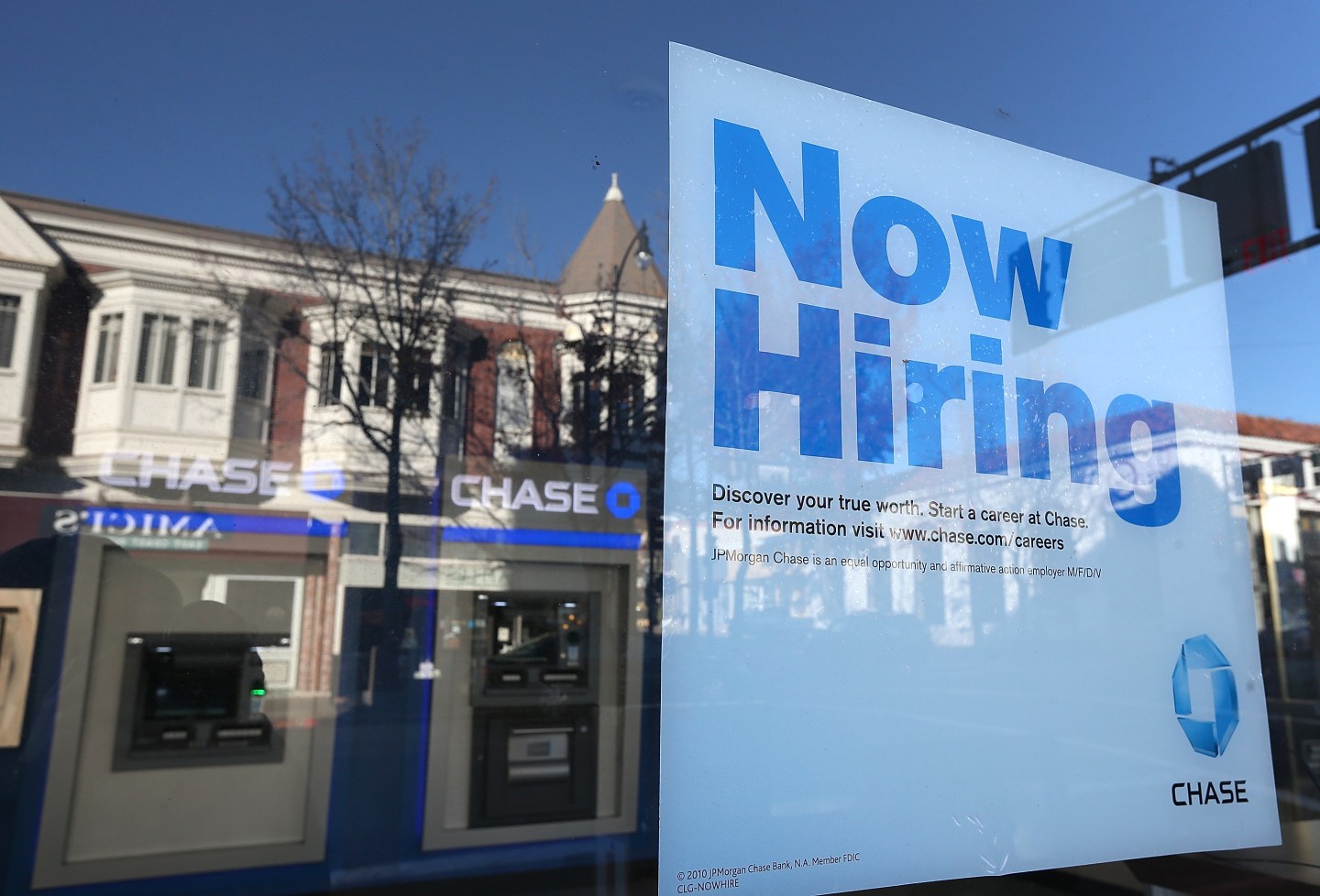
Americans have never felt better about their job security, at least according to a new Gallup poll released Thursday. Respondents who have a full or part-time job were asked how satisfied they are with the security of their jobs, and 58% said, “completely.”

As you can see, the poll only dates back to 1993, but the fact that Americans are happier with job security today than at any point in the past 20 years is pretty surprising. After all, that period contains the mid-1990s, one of the eras kindest to American laborers, when unemployment was historically low and wages consistently rising. Then again, people aren’t necessarily the best judges of their own economic situations, and it’s possible that this is a misperception of the job market rather than a real phenomenon.
So are Americans really fooling themselves? Not entirely. It’s quite possible that those Americans with jobs just feel more secure after a long recession and tepid recovery in which U.S. companies cut labor costs to the bone, and have been very slow to start rehiring again. But enthusiasm with which firms let workers go also means that a lot of companies are doing more than ever with fewer workers, and have very little wiggle room to let more workers go:

The above graph shows the four-week moving average of initial jobless claims, or the number of newly unemployed workers filing for unemployment benefits, as well as the size of the labor force. As you can see, the number of newly-fired workers is quite low, even as the labor force has continued to grow. In other words, there is actually a historically small percentage of the labor market getting fired these days, which backs up the the perception that job security is pretty good right now.
That being said, there’s pretty much no reason to believe that job security is better today than in the late 90s. Not only did average jobless claims bottom out in the year 2000, but the labor market was so tight that wages rose on average 1.7% per year after inflation, compared with falling real wages today.
So what can explain the fact that more Americans feel so secure in their jobs? The aforementioned fact that we’re coming out of a time of such radical job insecurity is surely one reason. But another reason why we feel more secure in our jobs today than in the go-go 90s is that workers from the 1990s likely had much better memories of an era when jobs were even more secure, an era that spanned from the end of World War Two and begin to peter out in in the 1980s.
University of North Carolina Professor Arne Kalleberg published a book Good Jobs, Bad Jobs which in part studied the decline in job security from the 1970s until today. He writes:
“Job insecurity and stability–and the resulting uncertainty–has increased in the United States since the 1970s. The conclusion is supported by evidence from diverse indicators: the growth of nonstandard, market-mediated work arrangements; the decline in employer tenure; the increase in rates of involuntary job loss for certain groups; the growth in the share of unemployment that is long-term; and the increase in workers’ perceptions that they will be laid off or otherwise lose their jobs.”
One fact that illustrates this trend in particular is the fact that until the 1980s, the Bureau of Labor Statistics didn’t even count the number of displaced workers who were involuntarily fired from their jobs until the mid 1980s, an anecdote that Kallberg argues, “is very telling, as it indicates that it was widely believed that this was not really a systemic, large-scale problem before then.” Kallberg points to data that shows that proportion of prime working age men who were permanently laid off from their jobs increased by nearly 100% between the 1970s and 1990s.
The reason for this, Kallberg argues, is mostly cultural. There was a fundamental shift during the 1970s and 1980s that was motivated in part by an increase in foreign competition in which firms started looking at labor strictly as a cost to be manipulated and outright cut in order to boost company performance and short term profits. Before then it was much more common for employers to avoid layoffs at all cost out of deference to the suffering they might cause. But today, Kallberg writes, “The growth of insecurity has redefined the meaning of the psychological contract between employers and their employees; it no longer points to an exchange of effort and loyalty for the promise of a secure job and future advancement.”
In other words, in the 1990s, Americans had much stronger memories of a post-war order in which the employer-employee relationship was built around loyalty rather than strictly the bottom line. Today’s workforce, however, was brought up in a much more transactional culture, and it’s likely enough to see a sharp decline in layoffs to make them feel relatively secure.