Remember the euro crisis? If not, take a look at the markets today to remind yourself.
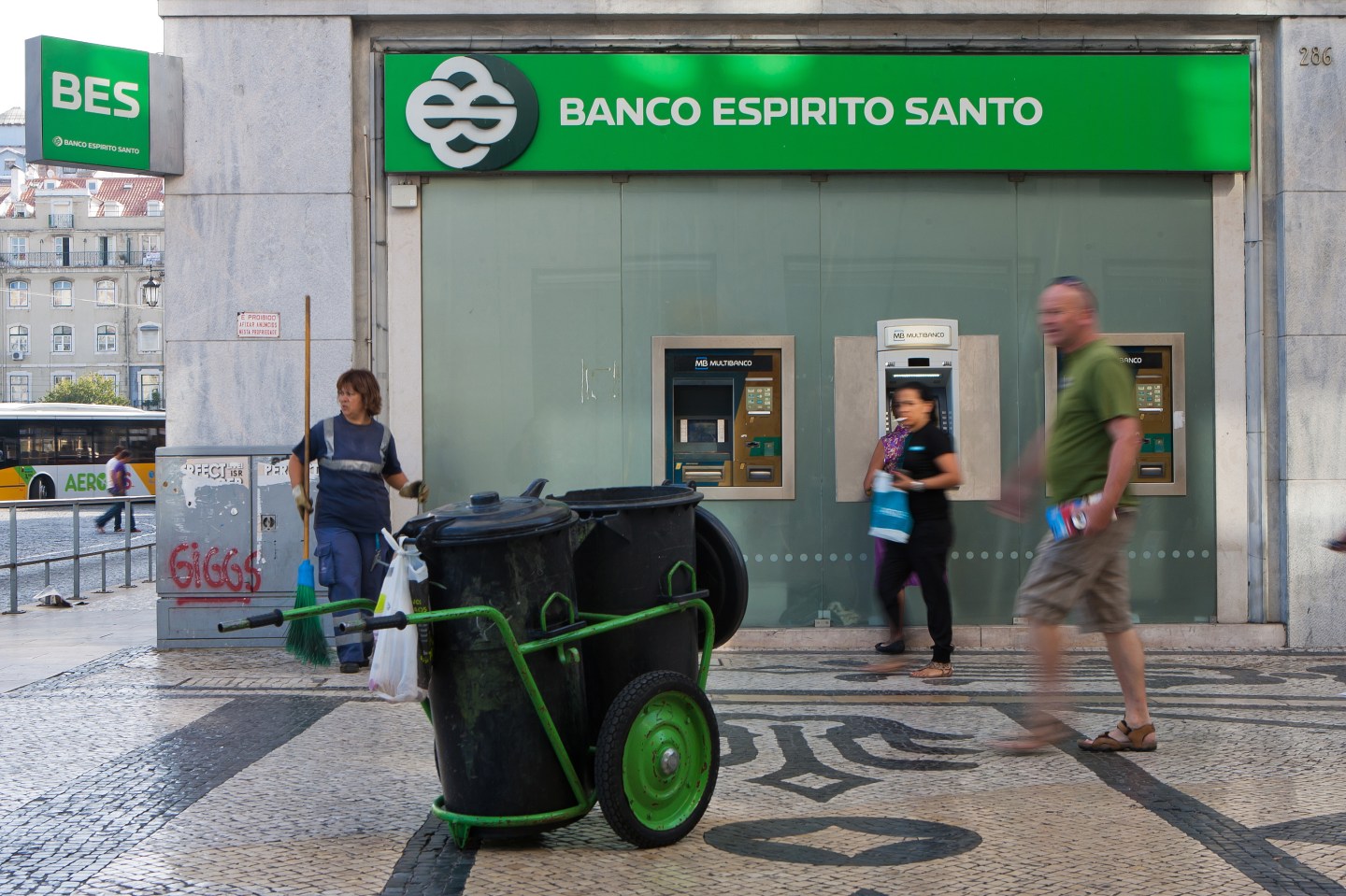
European markets have taken a hard fall out of bed Thursday, on fears for the strength of Portugal’s largest listed bank, Banco Espirito Santo SA, whose shares were suspended in Lisbon after falling 17%.
The Euro Stoxx 600 index is down 1.0%, the main Lisbon index is down 4.2%, and the bond yields of governments on the stressed periphery of the euro zone have shot up, while yields on bonds perceived as safe, like Germany’s, have fallen as investors flee to quality. Gold prices, another barometer of fear, are up 1.1% at a three-month high of $1,338.80 an ounce.
As so often with the eurozone, it’s not so much the proximate cause of the turmoil that’s worrying: it’s what that cause says about the eurozone’s broader failings: its lack of a common treasury to back its currency, its slowness in cleaning up its banks, and the risk that its weakest members will never be able to repay their debts.
Nor does it help that both France and Italy both announced shock falls in manufacturing output in May earlier Thursday, further denting confidence in the eurozone’s ability to grow its way out of its problems.
B.E.S.’s woes have been leaking out gradually for months. Like many European banks, it has created ever more arcane shareholding and voting structures over the years to ensure that the descendants of its founder keep control, despite the fact that they now only hold 25%, and even that only indirectly.
That structure (pictured below), which was propped up by forcing an affiliated fund manager to make massive indirect loans to B.E.S. during the crisis, is now unraveling, although it still isn’t clear where exactly the problem assets are (it’s possible they might not actually be on the bank’s balance sheet).

But so much for the problems of a dying banking dynasty. What’s more important is that the Portuguese government’s borrowing costs have shot up by 0.36% in the last two days to 3.98% today, a three-month high.
As Raoul Ruparel, an analyst with the Open Europe think-tank, points out, “the sovereign-bank loop has not been fully broken, and fears clearly remain regarding bailouts and backstops.”
In other words, the old problem–that many of Europe’s banks are bust, their governments are too weak to save them–still hasn’t been solved.
The eurozone in principle agreed mechanisms that were supposed to solve this last year: the E.U. agreed a grandly-titled Bank Recovery and Resolution Directive to ensure shareholders and bondholders pay first for future bank failures; it put the E.C.B. in charge of supervising 130 of the eurozone’s largest banks, and created a Single Resolution Mechanism to stop those banks hiding their problems behind cozy arrangements with national supervisors and governments.
But B.E.S. has fallen into a huge crack between the political agreements and the date when the new rules will kick in. The B.R.R.D. and S.R.M. only enter into force in 2016. The E.C.B., meanwhile, takes over as supervisor in November this year, and it appears to have been the Portuguese central bank’s preparations for that–going through the books and exposures of its largest institutions–that started this snowball rolling six months ago.
For markets, that begs the question of what skeletons might be shaken out of other eurozone cupboards as the E.C.B. prepares to take over. And it explains why it isn’t only Portugal’s bond yields that are rising today. Italy’s 10-year yield is up 0.12 percent, Spain’s is up 0.07 percent, Greece’s is up 0.22 percent.
Only a couple of months ago, Portugal exited its €78 billion bail-out without even requesting a precautionary credit line as a safety net. Markets, meanwhile, were snapping up new bond and stock offerings from eurozone banks, sedated by promises of endless cheap money from the E.C.B.. They even started to lend to Greece again.
But Thursday’s news showed how quickly fear can still run through the system in the absence of proper backstops: Banco Popular Espanol SA, one of Spain’s largest banks, canceled the sale of a contingent convertible bond, while Greece itself cut the size of a planned three-year bond to only €1.5 billion, half of what it had hoped.
Christian Schulz, an economist with German investment bank Berenberg in London, said however there’s no reason to think that the crisis is coming back in a meaningful way.
“The one thing I would worry about is a bank run, but they have the tools to stop even that,” Schulz said. He said that correlation–banker-speak for people dumping and/or buying everything at once in response to the same piece of news–“is unavoidable for a short period of time.”