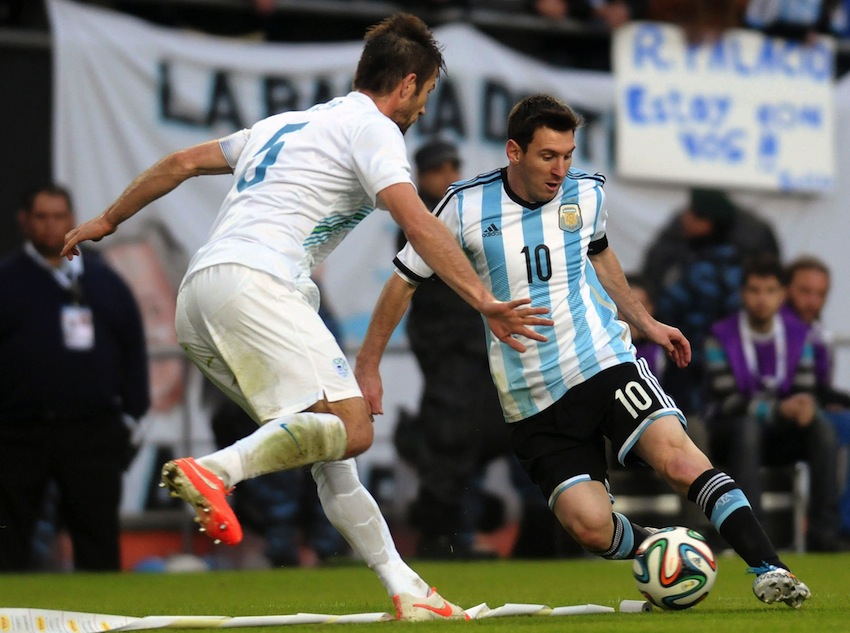
If this year’s World Cup ends up with its share of winning free kicks, give a little credit to the ball.
A big part of scoring with a free kick comes down to the roughness of the ball, according to a paper published this week in the French journal Les Editions de l’Ecole Polytechnique. This year’s “Brazuca”, the official ball of the World Cup currently underway in Brazil, appears to fit the bill. John Bush, the Massachusetts Institute of Technology professor who authored the study, estimated that the ball’s seams are over 50% longer than the much-maligned and almost slippery “Jabulani” ball from 2010 World Cup in South Africa.
He concluded that this year’s ball, manufactured by Adidas, are more predictable in flight, which makes them easier to score with. Smoother balls, in contrast, are more difficult to control because they are more likely to take off in an unexpected direction.
“The details of the flow of air around the ball are complicated, and in particular they depend on how rough the ball is,” said Bush, a professor of applied mathematics whose study examined the aerodynamics of soccer balls. “If the ball is perfectly smooth, it bends the wrong way.”
Bush credits what is called the Magnus Effect for a ball’s behavior. It was first described by Isaac Newton, the English physicist, who saw how topspin in tennis causes the ball to dip while backspin flattens out the trajectory. A curveball in baseball is another example from sports: A pitcher throws the ball with especially tight topspin, or side spin, and the ball curves in the direction of the spin.
A similar thing happens in soccer with free kicks, corner kicks and even other kinds of passing between players. A player like David Beckham, the retired free kick master, applies spin when kicking the ball, creating rotation that causes it to curve – a right-footed player will brush toward the outside of the ball causing it to curl right-to-left while a left-footed player’s shot will curl left to right.
Bush attributes this effect to the way the surface of the ball creates motion at the “boundary layer” between the spinning ball and the air. The rougher the ball, the easier it is to create the textbook spin that causes the Magnus Effect.
In his paper, Bush said the ball alone doesn’t always determine its direction. Another key component, he said, is the how the ball is struck and the amount of time a players foot makes contact with the ball. Contact times can vary by as much as 20%, being larger for the softer ball. Players also strategically search for the sweet spot, with the best favoring the valve side of the ball where the ball is relatively stiff.
“The contact time will, in general, determine the ability of the shooter to control the ball,” Bush writes. “In particular, the longer the contact time, the more readily the shooter can impart spin to the ball when trying to bend it.”
Of course, it helps to have the power and technique of international superstars like Beckham or Portugal’s Ronaldo, who can leave an opponent starstruck with balls that seem to magically bend their way around a defensive wall and into the net.