Change is on the way in the Arab world, with Egypt the latest focal point. Here I review recent events and their implications for world oil markets.
I begin with a timeline, if not to connect the dots, at least to collect the dots in a single list.
• Sudan, Jan 9-15: Country holds a referendum whose apparent outcome will be a split of South Sudan into its own a separate country.
• Lebanon, Jan 12: Key cabinet ministers resign in protest against impending indictments from a U.N.-backed investigation into the 2005 assassination of former prime minister Rafiq al-Hariri, toppling the governing coalition. U.S. Secretary of State Hillary Clinton offered this assessment:
We view what happened today as a transparent effort by those forces inside Lebanon, as well as interests outside Lebanon, to subvert justice and undermine Lebanon’s stability and progress.
• Tunisia, Jan 14: President Ben Ali flees the country in response to widespread protests.
• Iraq, Jan 17-27: Over 200 people killed in a spate of recent bombings, a sharp and tragic increase from the recent norm.
• Egypt, Jan 29:Cairo appears to be near anarchy as a result of an uprising against President Mubarak.
• Yemen, Jan 29:Demonstrations and rallies have resulted in clashes with police, with unclear implications at this point for the stability of the regime.
An optimist might see the common thread in many of these developments to be the realization across parts of the Arab world of the power of popular will to overthrow dictators, the first step toward democracy and a better life for the people. A pessimist might see in at least some of these situations deliberately orchestrated chaos for purposes of seizing power by a new group of would-be ruthless leaders. A realist might acknowledge the possibility of both factors in play at once, and worry that ideologically motivated uprisings have often turned out to be usurped by groups with their own highly anti-democratic agenda. In the event that some of the transitions of power prove to be more chaotic than peaceful, let me comment on their potential to disrupt world oil markets.
| Country | Oil production | % of world total |
|---|---|---|
| Lebanon | 0 | 0.0 |
| Tunisia | 80 | 0.1 |
| Yemen | 258 | 0.3 |
| Sudan | 508 | 0.6 |
| Egypt | 662 | 0.8 |
| Libya | 1,789 | 2.1 |
| Algeria | 2,157 | 2.5 |
| Iraq | 2,384 | 2.7 |
| Iran | 4,237 | 4.9 |
| Saudi Arabia | 10,187 | 11.7 |
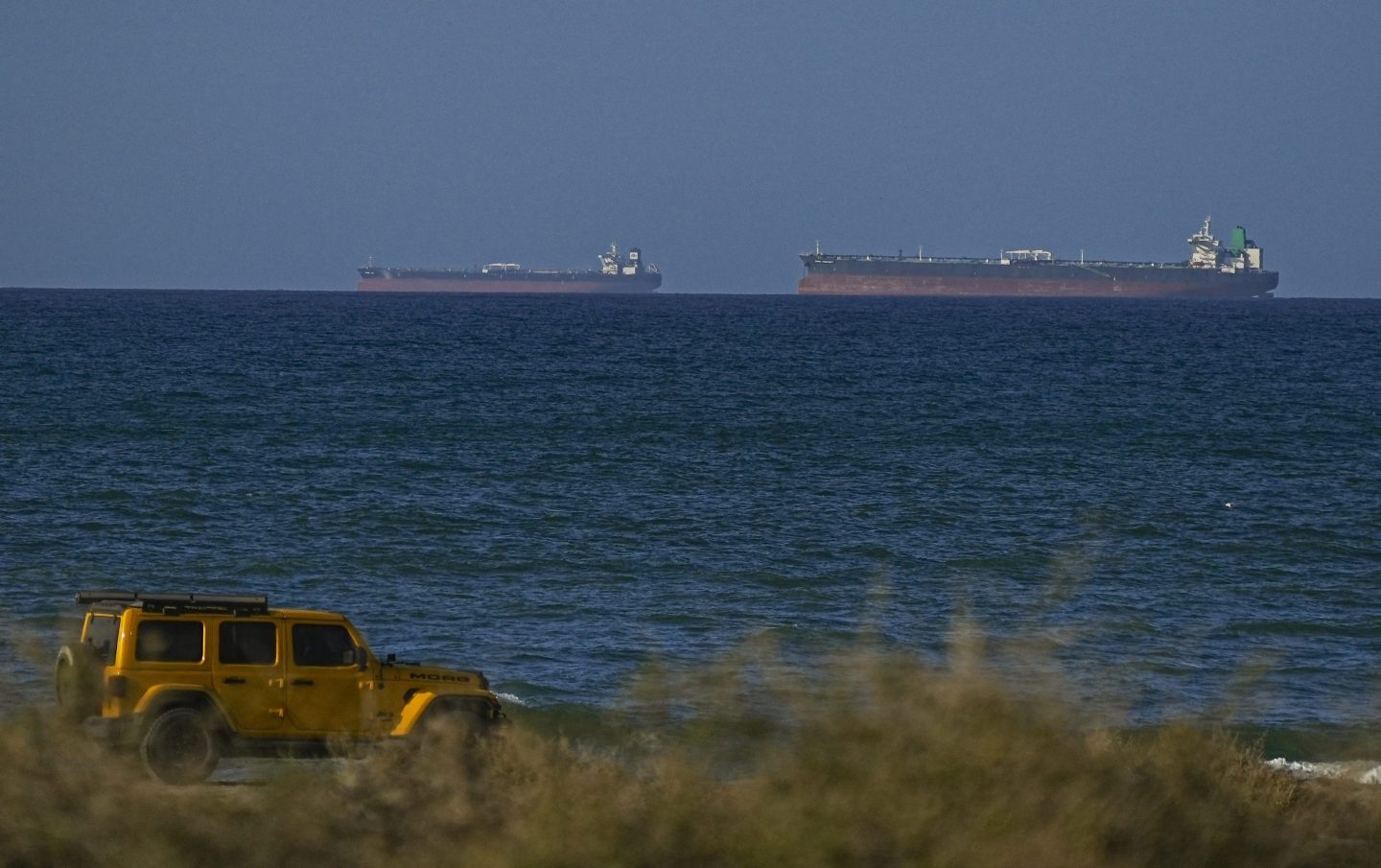
The table above reports the recent levels of oil production in the countries mentioned above and some of their neighbors. For the most part, the popular uprisings so far have been in the “have-nots” of the Arab world, with modest levels of oil production relative to the members of OPEC. Of the countries facing a likely immediate transition of power, the most important in terms of oil markets is Egypt, with 2/3 mb/d of its own production and another million barrels of oil being transported each day through the Suez Canal plus 1.1 mb/d crossing Egypt via the SUMED pipeline.
In my recent paper surveying historical oil shocks I discuss the Suez Crisis of 1956-57 in detail. In that episode, sunken ships blocked traffic through the canal for a considerable period. Pumping stations for the Iraq Petroleum Company’s pipeline through Syria were also sabotaged. At its peak, the episode removed about 10% of global oil production, a bigger percentage disruption than any subsequent oil shock. It took half a year for production from the Middle East to get back to normal, though there was enough excess capacity elsewhere in the world to bring global production back up to the levels at which it had been before the crisis within 3 months.

My paper notes this description of what the original Suez Crisis meant for Europe at the time, taken from the New York Times on December 1, 1956:
LONDON, December 1– Europe’s oil shortage resulting from the Suez Canal crisis was being felt more fully this week-end…. Dwindling gasoline supplies brought sharp cuts in motoring, reductions in work weeks and the threat of layoffs in automobile factories.
There was no heat in some buildings; radiators were only tepid in others. Hotels closed off blocks of rooms to save fuel oil…. [T]he Netherlands, Switzerland, and Belgium have banned [Sunday driving]. Britain, Denmark, and France have imposed rationing.
Nearly all British automobile manufacturers have reduced production and put their employees on a 4-day instead of a 5-day workweek…. Volvo, a leading Swedish car manufacturer, has cut production 30%.
In both London and Paris, long lines have formed outside stations selling gasoline…. Last Sunday, the Automobile Association reported that 70% of the service stations in Britain were closed.
Dutch hotel-keepers estimated that the ban on Sunday driving had cost them up to 85% of the business they normally would have expected.
A closure of the Suez Canal at the present time would not be as economically damaging as the original. For one thing, there is less oil going through the canal today (1 mb/d in 2009 compared with 1.5 mb/d in 1956), and that flow is a significantly smaller fraction of the world total (1.1% today versus 8.8% then).
I think the bigger worry for oil markets would be that the process may yet spill over into other key oil-producing countries. Iraq will be a huge factor in determining medium-term growth in world oil production, and Iran is twice as important as Iraq in terms of current production. And should we see the temporary cessation of Saudi production, it would be an event without historical parallel.
I do not know where current developments will lead. But I am quite confident in the conclusion from my survey of historical oil shocks:
given the record of geopolitical instability in the Middle East, and the projected phenomenal surge in demand from the newly industrialized countries, it seems quite reasonable to expect that within the next decade we will have [an additional observation] with which to inform our understanding of the economic consequences of oil shocks.
By James Hamilton, Econbrowser. James D. Hamilton is Professor of Economics at the University of California, San Diego.