• Home
  • Latest
  • Fortune 500
  • Finance
  • Tech
  • Leadership
  • Lifestyle
  • Rankings
  • Multimedia

Too big to fail? How would we know?

By
Heidi N. Moore
Heidi N. Moore
Down Arrow Button Icon
By
Heidi N. Moore
Heidi N. Moore
Down Arrow Button Icon
July 9, 2010, 3:41 PM ET

A systemic risk council has the power to unwind banks that are too big to fail. Now we just have to figure out what that means.

By Heidi N. Moore, contributor

One example of the upside-down, through-the-looking-glass world of financial reform: We still don’t know what “too big to fail” means, or what systemic risk is, but oh boy, now we sure do know who has the authority to decide. As usual, it’s mostly in the hands of Federal Reserve chairman Ben Bernanke.

Economist Simon Johnson, who co-writes the excellent Baseline Scenario blog, points out today that people have largely ignored one of the most significant parts of financial reform: The Kanjorski amendment, which gives the government the power to wind down a financial firm that it deems too big to fail. Significantly, the bill it’s attached to gives that authority to a group of regulators — the systemic risk council, a kind of 10-person regulatory supreme court led by Ben Bernanke. It would take seven out of the 10 votes to make any decisions, Johnson points out, but that doesn’t change the fact that it’s a major shift in power.

There is no question that this is a political victory for Bernanke, who is a savvy politician. It’s also a victory for former Treasury Secretary Hank Paulson, who, while promoting his book earlier this year, was also stumping for the ability to wind down failing financial firms, known as “resolution authority.” Paulson and Bernanke’s interests have been aligned in giving Treasury and the Fed more financial power; financial historians will remember that Paulson’s first suggestion to Congress during the financial crisis was to give him all the power.

But the problem still remains that we seem to be approaching the problem backwards and sideways. It’s akin to giving a police officer a gun before he has knowledge of the law. Very few experts can conclusively say that they know when a bank is too big to fail or what they should do about it; the subject has been under discussion for over two years, and there are still few guiding voices on the matter.

Johnson notes the same problem, suggesting that regulators might have to end up outsourcing their decision making: “And congressional committees can call upon the responsible people to explain how they determine whether a megabank is or is not dangerous. What are the risk metrics they use? To what extent do they take on board outside opinions? How much do they consult with the bank itself?”

These are good questions, and for the past two years they have remained unanswerable. No one knew, for instance, that the fall of Lehman Brothers, a mid-size investment bank, would be responsible for stopping the entire financial system cold because it was so deeply interconnected with its rivals. In the New Yorker earlier this year, journalist James Stewart reported that while Paulson — a former banker, remember — was watching Merrill Lynch and Lehman in August and September 2008, a banker asked him whether he had looked at AIG.” Paulson’s answer: “Why? What’s happening with AIG?”

That is not to say that Paulson was ignorant of risks in the financial system, just that crises necessarily show up problems where most people don’t think to look, and even savvy regulators are caught unawares by the unpredictability of troubled markets.

Even now, the problem of “too big to fail” is impossible to diagnose, unless we admit that nearly all our big banks are too big — and too interconnected — to fail. The post-crisis wave of acquisitions caused intense concentration of financial assets in a handful of the biggest banks: Citigroup (C), Bank of America (BAC), JP Morgan (JPM), Wells Fargo (WFC), and, to a lesser extent, Morgan Stanley (MS) and Goldman Sachs (GS). Those who take deposits are all high above the U.S. deposit cap; many still have significant amounts of so-called “toxic,” or unsaleable, assets that are marked up in value only because of accounting rules. Mortgages of all kinds still pose trouble, with even the rich walking away from their debts now at the rate of one in seven homeowners who hold mortgages above $1 million in value. Leverage ratios have come down, but not by so much that the banks can easily be called healthy. And European banks, so similar in so many ways to their U.S. cousins and equal business partners, are facing insolvency worries.

The problem with Lehman was never recognizing from the get-go that it was too big to fail; the problem was the cleanup. When Lehman and AIG (AIG) imploded, government regulators lacked the authority to get involved in private trading contracts and rework the terms, so they could offer no help to counter-parties.

The resolution authority, though, does have a bit of a belt-and-suspenders aspect to it. Another part of the financial reform bill — the Lincoln Amendment — calls for banks to trade many derivatives through clearinghouses. The purpose of the clearinghouses is to give transparency to derivatives and prevent them from taking down the financial system.

What that means is that a clearinghouse system is in place to make sure that banks don’t use derivatives to get too big to fail, but if the clearinghouses don’t work, then federal regulators and the systemic risk council can step in. (By the way, according to the bill, clearinghouses can’t get federal assistance. It will be interesting to see how that plays out in the real case of failure.)

The Kanjorski amendment may not be, by any means, a bad thing. It may well be a good, or even a great, thing. It is just, like everything else in reform, a too-vague thing.

–Heidi Moore is Sweeping the Street while Colin Barr is on vacation.

About the Author
By Heidi N. Moore
See full bioRight Arrow Button Icon

Latest in

Finance
Lorem ipsum dolor sit amet, consectetur adipiscing elit, sed do eiusmod tempor incididunt ut labore et dolore magna aliqua. Ut enim ad minim veniam
By Fortune Editors
October 20, 2025
Finance
Lorem ipsum dolor sit amet, consectetur adipiscing elit, sed do eiusmod tempor incididunt ut labore et dolore magna aliqua. Ut enim ad minim veniam
By Fortune Editors
October 20, 2025
Finance
Lorem ipsum dolor sit amet, consectetur adipiscing elit, sed do eiusmod tempor incididunt ut labore et dolore magna aliqua. Ut enim ad minim veniam
By Fortune Editors
October 20, 2025
Finance
Lorem ipsum dolor sit amet, consectetur adipiscing elit, sed do eiusmod tempor incididunt ut labore et dolore magna aliqua. Ut enim ad minim veniam
By Fortune Editors
October 20, 2025
Finance
Lorem ipsum dolor sit amet, consectetur adipiscing elit, sed do eiusmod tempor incididunt ut labore et dolore magna aliqua. Ut enim ad minim veniam
By Fortune Editors
October 20, 2025
Finance
Lorem ipsum dolor sit amet, consectetur adipiscing elit, sed do eiusmod tempor incididunt ut labore et dolore magna aliqua. Ut enim ad minim veniam
By Fortune Editors
October 20, 2025

Most Popular

Finance
Lorem ipsum dolor sit amet, consectetur adipiscing elit, sed do eiusmod tempor incididunt ut labore et dolore magna aliqua. Ut enim ad minim veniam
By Fortune Editors
October 20, 2025
Finance
Lorem ipsum dolor sit amet, consectetur adipiscing elit, sed do eiusmod tempor incididunt ut labore et dolore magna aliqua. Ut enim ad minim veniam
By Fortune Editors
October 20, 2025
Finance
Lorem ipsum dolor sit amet, consectetur adipiscing elit, sed do eiusmod tempor incididunt ut labore et dolore magna aliqua. Ut enim ad minim veniam
By Fortune Editors
October 20, 2025
Finance
Lorem ipsum dolor sit amet, consectetur adipiscing elit, sed do eiusmod tempor incididunt ut labore et dolore magna aliqua. Ut enim ad minim veniam
By Fortune Editors
October 20, 2025
Finance
Lorem ipsum dolor sit amet, consectetur adipiscing elit, sed do eiusmod tempor incididunt ut labore et dolore magna aliqua. Ut enim ad minim veniam
By Fortune Editors
October 20, 2025
Finance
Lorem ipsum dolor sit amet, consectetur adipiscing elit, sed do eiusmod tempor incididunt ut labore et dolore magna aliqua. Ut enim ad minim veniam
By Fortune Editors
October 20, 2025
Fortune Secondary Logo
Rankings
  • 100 Best Companies
  • Fortune 500
  • Global 500
  • Fortune 500 Europe
  • Most Powerful Women
  • Future 50
  • World’s Most Admired Companies
  • See All Rankings
Sections
  • Finance
  • Fortune Crypto
  • Features
  • Leadership
  • Health
  • Commentary
  • Success
  • Retail
  • Mpw
  • Tech
  • Lifestyle
  • CEO Initiative
  • Asia
  • Politics
  • Conferences
  • Europe
  • Newsletters
  • Personal Finance
  • Environment
  • Magazine
  • Education
Customer Support
  • Frequently Asked Questions
  • Customer Service Portal
  • Privacy Policy
  • Terms Of Use
  • Single Issues For Purchase
  • International Print
Commercial Services
  • Advertising
  • Fortune Brand Studio
  • Fortune Analytics
  • Fortune Conferences
  • Business Development
About Us
  • About Us
  • Editorial Calendar
  • Press Center
  • Work At Fortune
  • Diversity And Inclusion
  • Terms And Conditions
  • Site Map
Fortune Secondary Logo
  • About Us
  • Editorial Calendar
  • Press Center
  • Work At Fortune
  • Diversity And Inclusion
  • Terms And Conditions
  • Site Map
  • Facebook icon
  • Twitter icon
  • LinkedIn icon
  • Instagram icon
  • Pinterest icon

Latest in

Young dejected worker on phone
SuccessGen Z
USAA CEO says Gen Z ‘are not going to be as well off’ as boomers and Gen Xers—they need to take ownership of their success, he urges
By Emma BurleighMarch 1, 2026
1 hour ago
EconomyFinance
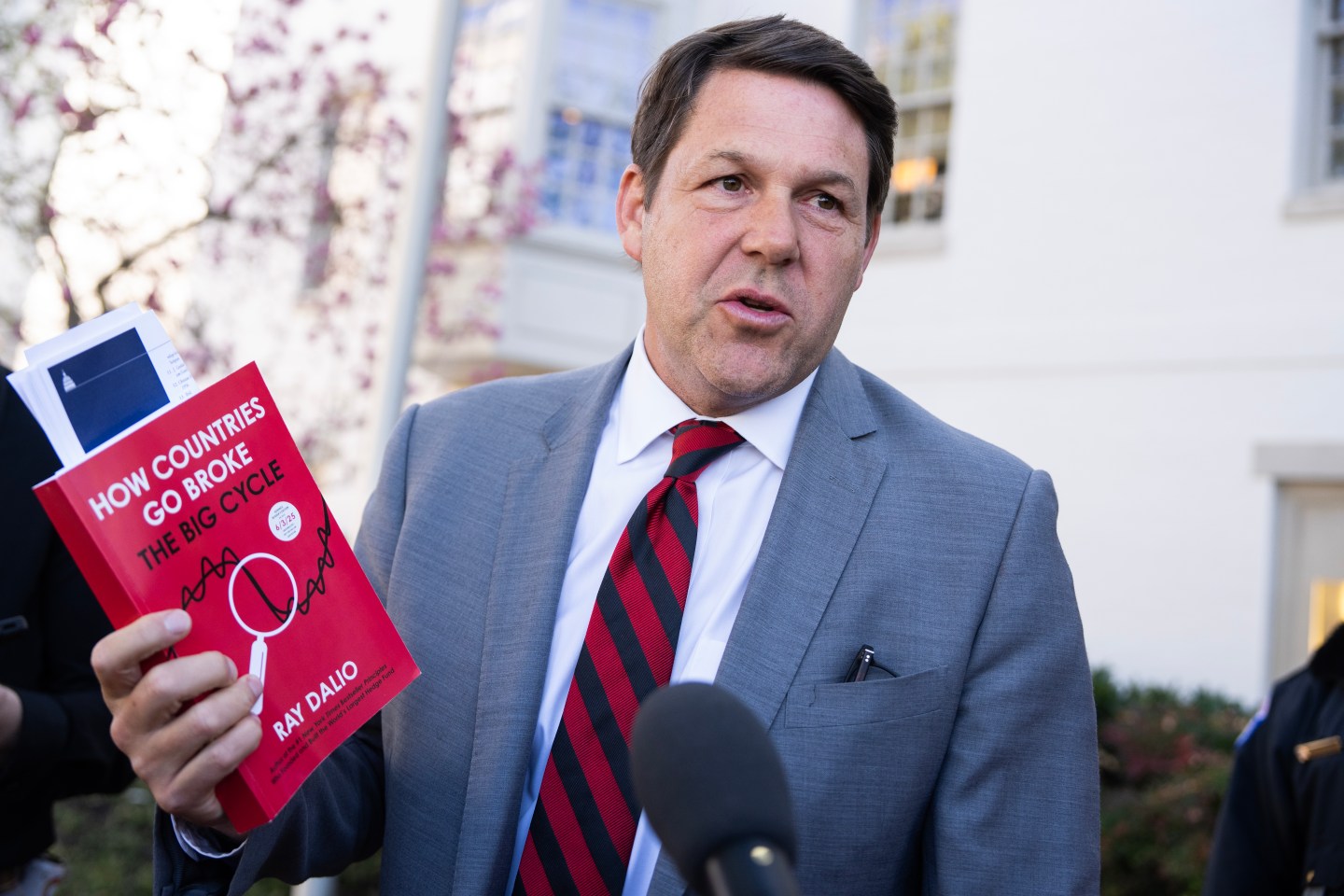
Ray Dalio, Scott Bessent and House members from both sides of the aisle are rallying around a ‘3% solution’ to tame the out of control national debt
By Shawn TullyMarch 1, 2026
2 hours ago
heitmann
CommentaryEntrepreneurship
Here’s how to build something that lasts, from the founder of a $300 million bootstrapped company that’s been growing for 28 years straight
By Tim HeitmannMarch 1, 2026
2 hours ago
An older man wears an American flag.
EconomyRecession
Your grandparents are the reason the U.S. isn’t in a recession right now. That won’t last forever
By Eleanor PringleMarch 1, 2026
2 hours ago
U.S. President Donald Trump delivers the State of the Union address during a joint session of Congress in the House Chamber at the Capitol on February 24, 2026 in Washington, D.C.
EnergyData centers
Your utility bills keep going up. Here’s everyone you can blame—AI data centers included
By Jordan BlumMarch 1, 2026
4 hours ago
UN
Middle EastMiddle East
Israel, U.S. stiff-arm U.N. during emergency Security Council meeting
By Edith M. Lederer, Farnoush Amiri and The Associated PressFebruary 28, 2026
10 hours ago

Most Popular

placeholder alt text
Success
Japanese companies are paying older workers to sit by a window and do nothing—while Western CEOs demand super-AI productivity just to keep your job
By Orianna Rosa RoyleFebruary 27, 2026
2 days ago
placeholder alt text
AI
The week the AI scare turned real and America realized maybe it isn't ready for what's coming
By Nick LichtenbergFebruary 28, 2026
1 day ago
placeholder alt text
Middle East
Iran is now on 'death ground' amid existential threat from U.S. attacks and could 'go big' in retaliation, former NATO commander warns
By Jason MaFebruary 28, 2026
19 hours ago
placeholder alt text
Success
Walmart exec says U.S. workforces needs to take inspiration from China where ‘5 year-olds are learning DeepSeek’
By Preston ForeFebruary 27, 2026
2 days ago
placeholder alt text
Personal Finance
Current price of gold as of February 27, 2026
By Danny BakstFebruary 27, 2026
2 days ago
placeholder alt text
Middle East
Dubai’s worst nightmare unfolds as Iran strikes Gulf neighbors
By Dana Khraiche, Fiona MacDonald and BloombergFebruary 28, 2026
14 hours ago

© 2026 Fortune Media IP Limited. All Rights Reserved. Use of this site constitutes acceptance of our Terms of Use and Privacy Policy | CA Notice at Collection and Privacy Notice | Do Not Sell/Share My Personal Information
FORTUNE is a trademark of Fortune Media IP Limited, registered in the U.S. and other countries. FORTUNE may receive compensation for some links to products and services on this website. Offers may be subject to change without notice.