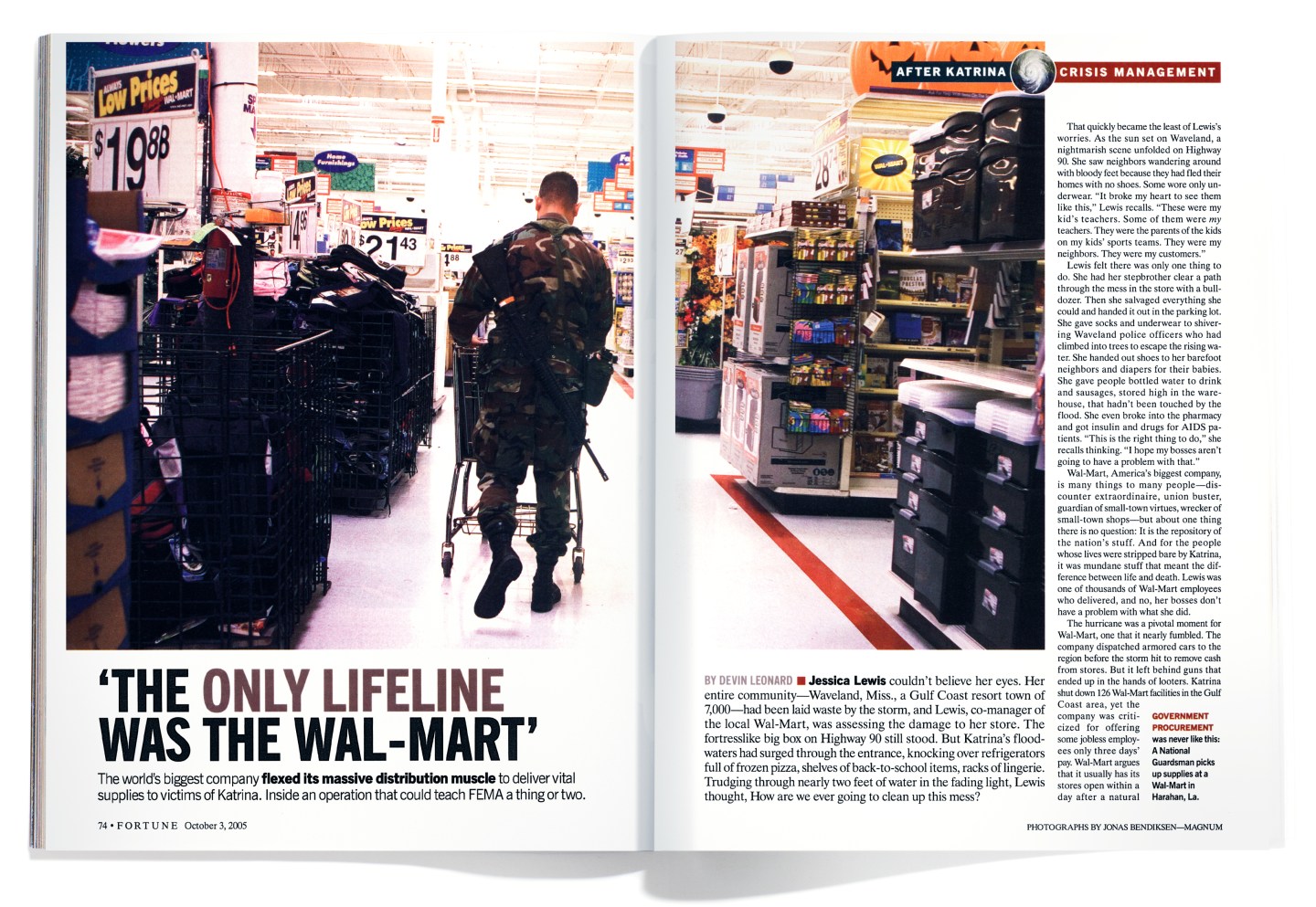
Jessica Lewis couldn’t believe her eyes. Her entire community—Waveland, Miss., a Gulf Coast resort town of 7,000—had been laid waste by the storm, and Lewis, co-manager of the local Wal-Mart, was assessing the damage to her store. The fortresslike big box on Highway 90 still stood. But Katrina’s floodwaters had surged through the entrance, knocking over refrigerators full of frozen pizza, shelves of back-to-school items, racks of lingerie. Trudging through nearly two feet of water in the fading light, Lewis thought, How are we ever going to clean up this mess?
That quickly became the least of Lewis’s worries. As the sun set on Waveland, a nightmarish scene unfolded on Highway 90. She saw neighbors wandering around with bloody feet because they had fled their homes with no shoes. Some wore only underwear. “It broke my heart to see them like this,” Lewis recalls. “These were my kid’s teachers. Some of them were my teachers. They were the parents of the kids on my kids’ sports teams. They were my neighbors. They were my customers.”
Lewis felt there was only one thing to do. She had her stepbrother clear a path through the mess in the store with a bulldozer. Then she salvaged everything she could and handed it out in the parking lot. She gave socks and underwear to shivering Waveland police officers who had climbed into trees to escape the rising water. She handed out shoes to her barefoot neighbors and diapers for their babies. She gave people bottled water to drink and sausages, stored high in the warehouse, that hadn’t been touched by the flood. She even broke into the pharmacy and got insulin and drugs for AIDS patients. “This is the right thing to do,” she recalls thinking. “I hope my bosses aren’t going to have a problem with that.”
Wal-Mart, America’s biggest company, is many things to many people—discounter extraordinaire, union buster, guardian of small-town virtues, wrecker of small-town shops—but about one thing there is no question: It is the repository of the nation’s stuff. And for the people whose lives were stripped bare by Katrina, it was mundane stuff that meant the difference between life and death. Lewis was one of thousands of Wal-Mart employees who delivered, and no, her bosses don’t have a problem with what she did.
The hurricane was a pivotal moment for Wal-Mart, one that it nearly fumbled. The company dispatched armored cars to the region before the storm hit to remove cash from stores. But it left behind guns that ended up in the hands of looters. Katrina shut down 126 Wal-Mart facilities in the Gulf Coast area, yet the company was criticized for offering some jobless employees only three days’ pay. Wal-Mart argues that it usually has its stores open within a day after a natural disaster. To be fair, it also offered these workers small amounts of cash.
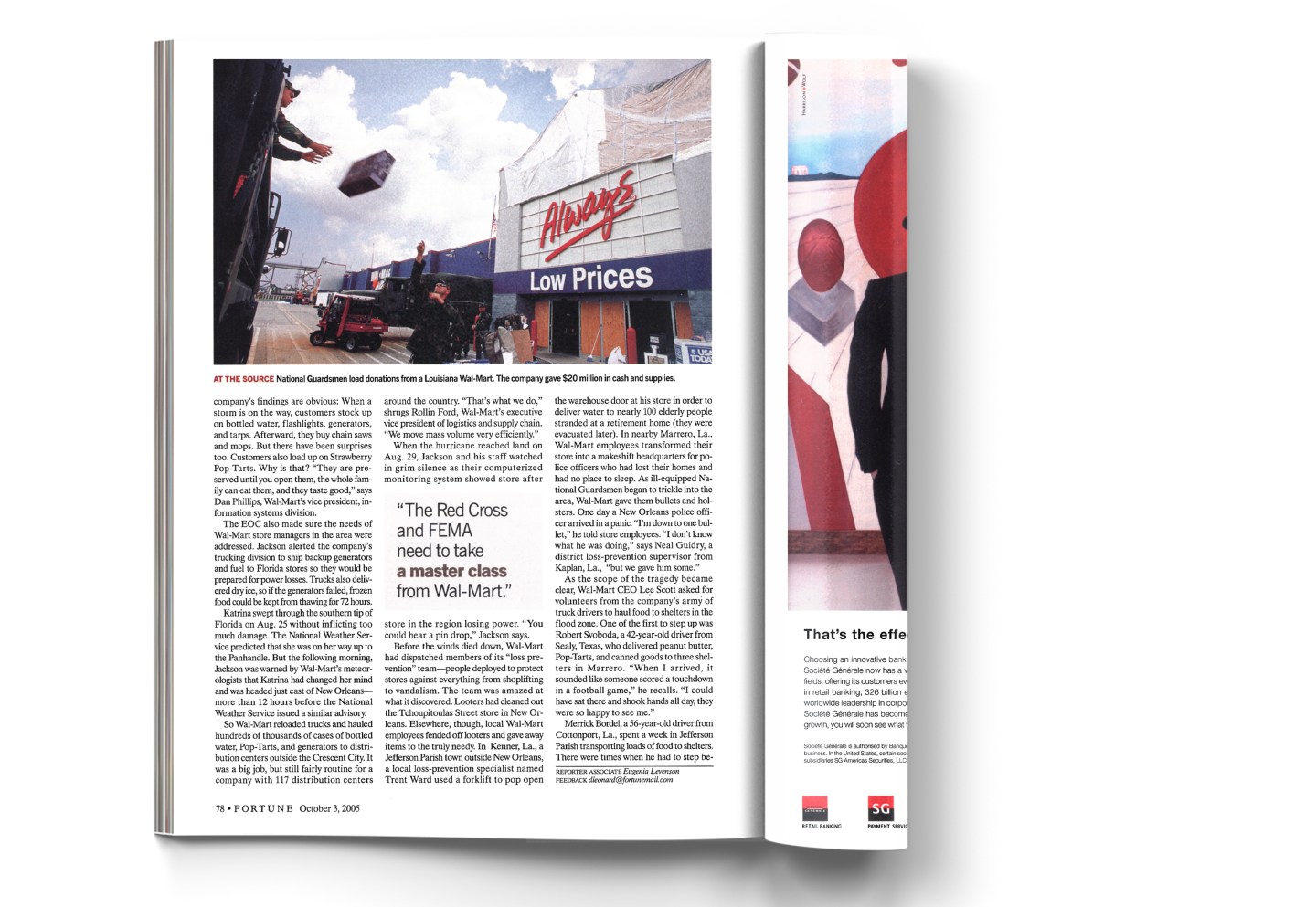
As the extent of the devastation became clear, however, Wal-Mart did a remarkable about-face. At the urging of CEO Lee Scott, its truckers hauled $3 million of supplies to the ravaged zone, arriving days before the Federal Emergency Management Agency in many cases. The company also contributed $17 million in cash to relief efforts. Wal-Mart also demonstrated how efficient it can be. As of Sept. 16, all but 13 of the facilities that Katrina had shut down were up and running again. The company had located 97% of the employees displaced by the storm and offered them jobs at any Wal-Mart operation in the country.
The result was a public relations coup—not a common occurrence for this company—but also something more. Wal-Mart likes to say it has three guiding principles enunciated by its late founder, Sam Walton: Respect the individual, serve the customer, and strive for excellence. In this case, the company honored Mr. Sam’s memory and saved lives. As Scott told a group of Wal-Mart officials recently: “I got a phone call from someone who said, ‘Do you think this will change the minds of our critics?'” No, he told the caller. But it sure quieted them down.

Wal-Mart began its response to Katrina on Aug. 23—six days before the storm rampaged through New Orleans. That was the day Jason Jackson, Wal-Mart’s director of business continuity, noticed that a storm off the coast of Florida had become a tropical depression and was headed for the state’s southern tip.
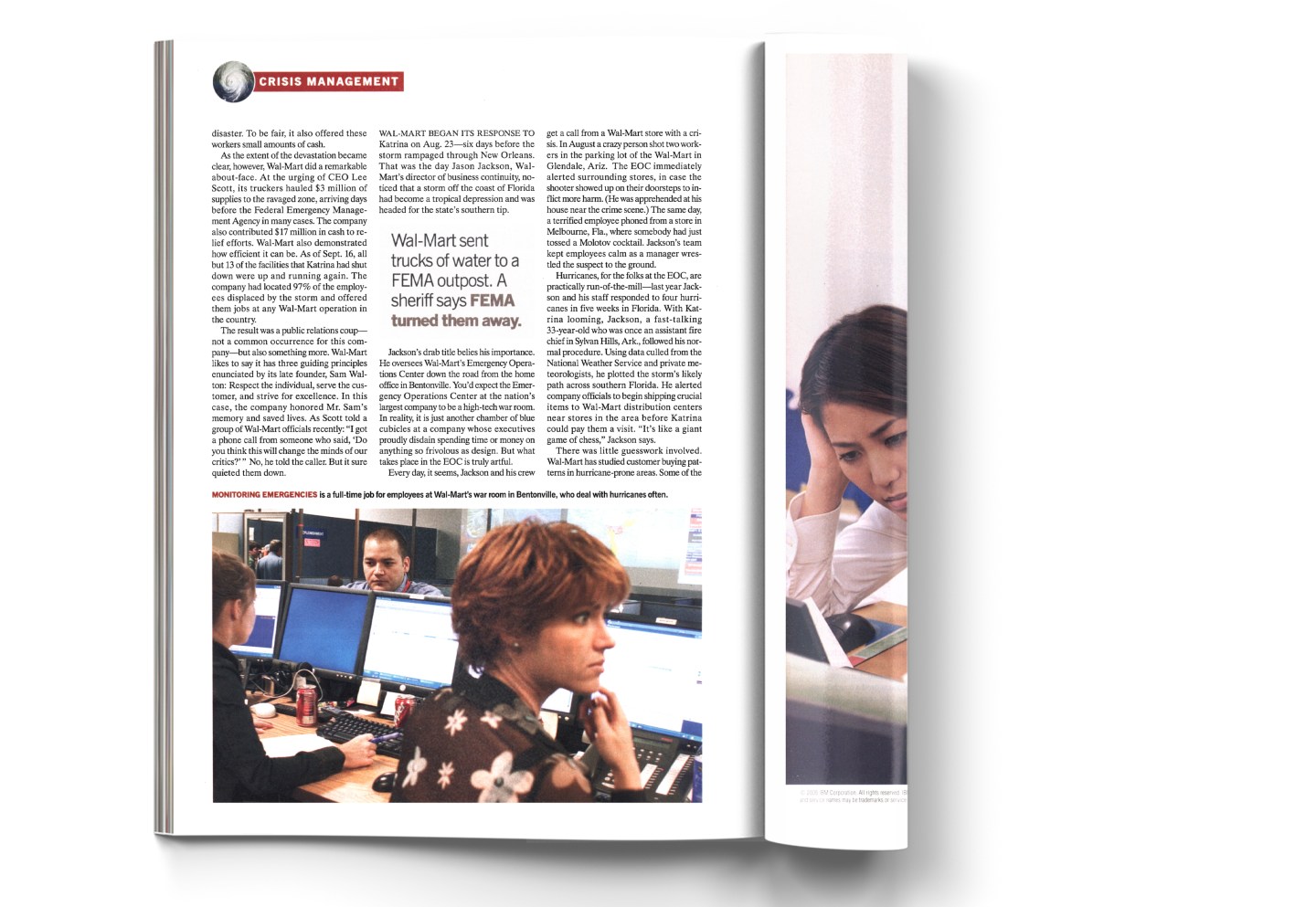
Jackson’s drab title belies his importance. He oversees Wal-Mart’s Emergency Operations Center down the road from the home office in Bentonville. You’d expect the Emergency Operations Center at the nation’s largest company to be a high-tech war room. In reality, it is just another chamber of blue cubicles at a company whose executives proudly disdain spending time or money on anything so frivolous as design. But what takes place in the EOC is truly artful.
Every day, it seems, Jackson and his crew get a call from a Wal-Mart store with a crisis. In August a crazy person shot two workers in the parking lot of the Wal-Mart in Glendale, Ariz. The EOC immediately alerted surrounding stores, in case the shooter showed up on their doorsteps to inflict more harm. (He was apprehended at his house near the crime scene.) The same day, a terrified employee phoned from a store in Melbourne, Fla., where somebody had just tossed a Molotov cocktail. Jackson’s team kept employees calm as a manager wrestled the suspect to the ground.
Hurricanes, for the folks at the EOC, are practically run-of-the-mill—last year Jackson and his staff responded to four hurricanes in five weeks in Florida. With Katrina looming, Jackson, a fast-talking 33-year-old who was once an assistant fire chief in Sylvan Hills, Ark., followed his normal procedure. Using data culled from the National Weather Service and private meteorologists, he plotted the storm’s likely path across southern Florida. He alerted company officials to begin shipping crucial items to Wal-Mart distribution centers near stores in the area before Katrina could pay them a visit. “It’s like a giant game of chess,” Jackson says.
There was little guesswork involved. Wal-Mart has studied customer buying patterns in hurricane-prone areas. Some of the company’s findings are obvious: When a storm is on the way, customers stock up on bottled water, flashlights, generators, and tarps. Afterward, they buy chain saws and mops. But there have been surprises too. Customers also load up on Strawberry Pop-Tarts. Why is that? “They are preserved until you open them, the whole family can eat them, and they taste good,” says Dan Phillips, Wal-Mart’s vice president, information systems division.
The EOC also made sure the needs of Wal-Mart store managers in the area were addressed. Jackson alerted the company’s trucking division to ship backup generators and fuel to Florida stores so they would be prepared for power losses. Trucks also delivered dry ice, so if the generators failed, frozen food could be kept from thawing for 72 hours.
Katrina swept through the southern tip of Florida on Aug. 25 without inflicting too much damage. The National Weather Service predicted that she was on her way up to the Panhandle. But the following morning, Jackson was warned by Wal-Mart’s meteorologists that Katrina had changed her mind and was headed just east of New Orleans–more than 12 hours before the National Weather Service issued a similar advisory.
So Wal-Mart reloaded trucks and hauled hundreds of thousands of cases of bottled water, Pop-Tarts, and generators to distribution centers outside the Crescent City. It was a big job, but still fairly routine for a company with 117 distribution centers around the country. “That’s what we do,” shrugs Rollin Ford, Wal-Mart’s executive vice president of logistics and supply chain. “We move mass volume very efficiently.”
The Red Cross and FEMA need to take a master class from Wal-Mart.
When the hurricane reached land on Aug. 29, Jackson and his staff watched in grim silence as their computerized monitoring system showed store after store in the region losing power. “You could hear a pin drop,” Jackson says.
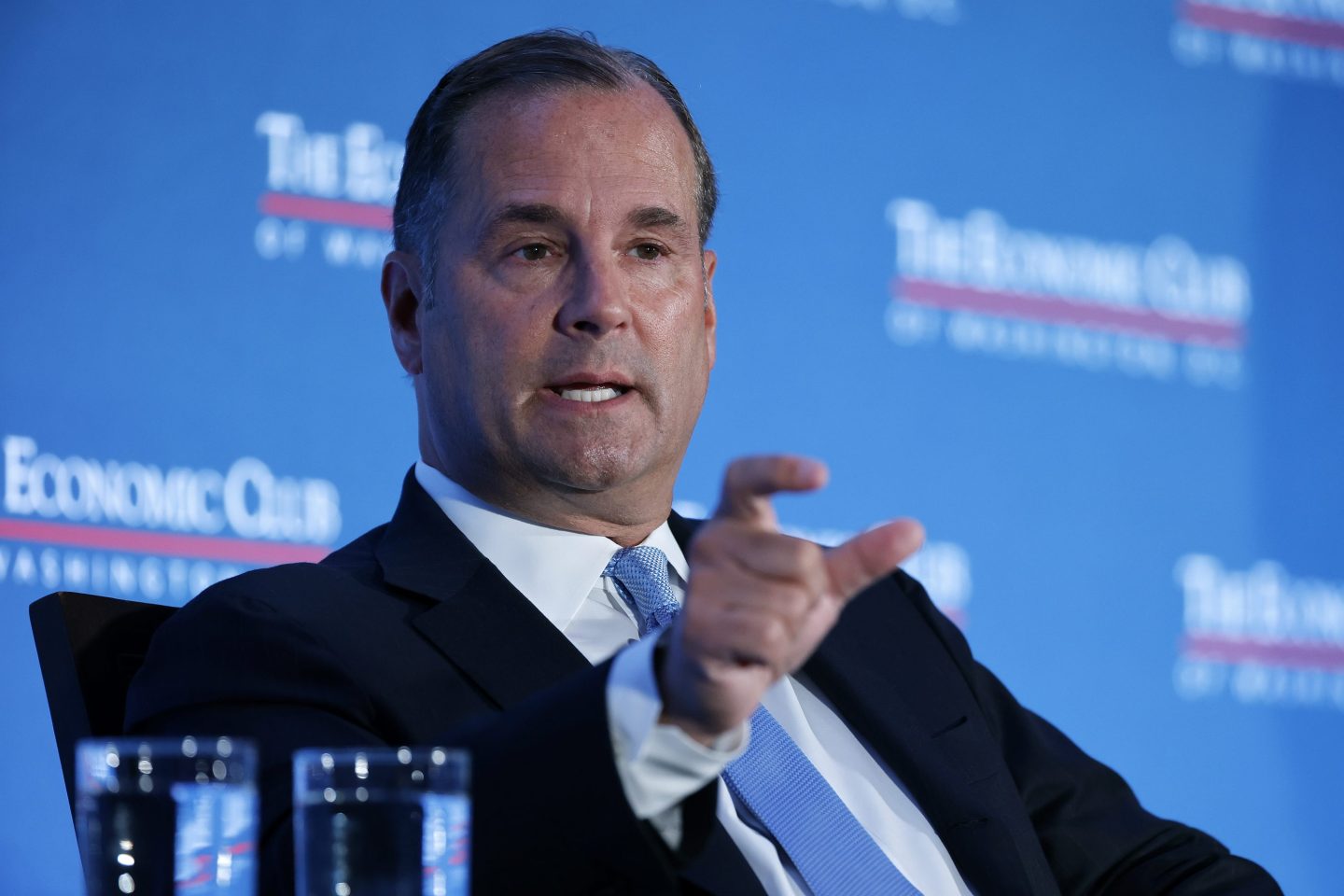
Before the winds died down, Wal-Mart had dispatched members of its “loss prevention” team–people deployed to protect stores against everything from shoplifting to vandalism. The team was amazed at what it discovered. Looters had cleaned out the Tchoupitoulas Street store in New Orleans. Elsewhere, though, local Wal-Mart employees fended off looters and gave away items to the truly needy. In Kenner, La., a Jefferson Parish town outside New Orleans, a local loss-prevention specialist named Trent Ward used a forklift to pop open the warehouse door at his store in order to deliver water to nearly 100 elderly people stranded at a retirement home (they were evacuated later). In nearby Marrero, La., Wal-Mart employees transformed their store into a makeshift headquarters for police officers who had lost their homes and had no place to sleep. As ill-equipped National Guardsmen began to trickle into the area, Wal-Mart gave them bullets and holsters. One day a New Orleans police officer arrived in a panic. “I’m down to one bullet,” he told store employees. “I don’t know what he was doing,” says Neal Guidry, a district loss-prevention supervisor from Kaplan, La., “but we gave him some.”
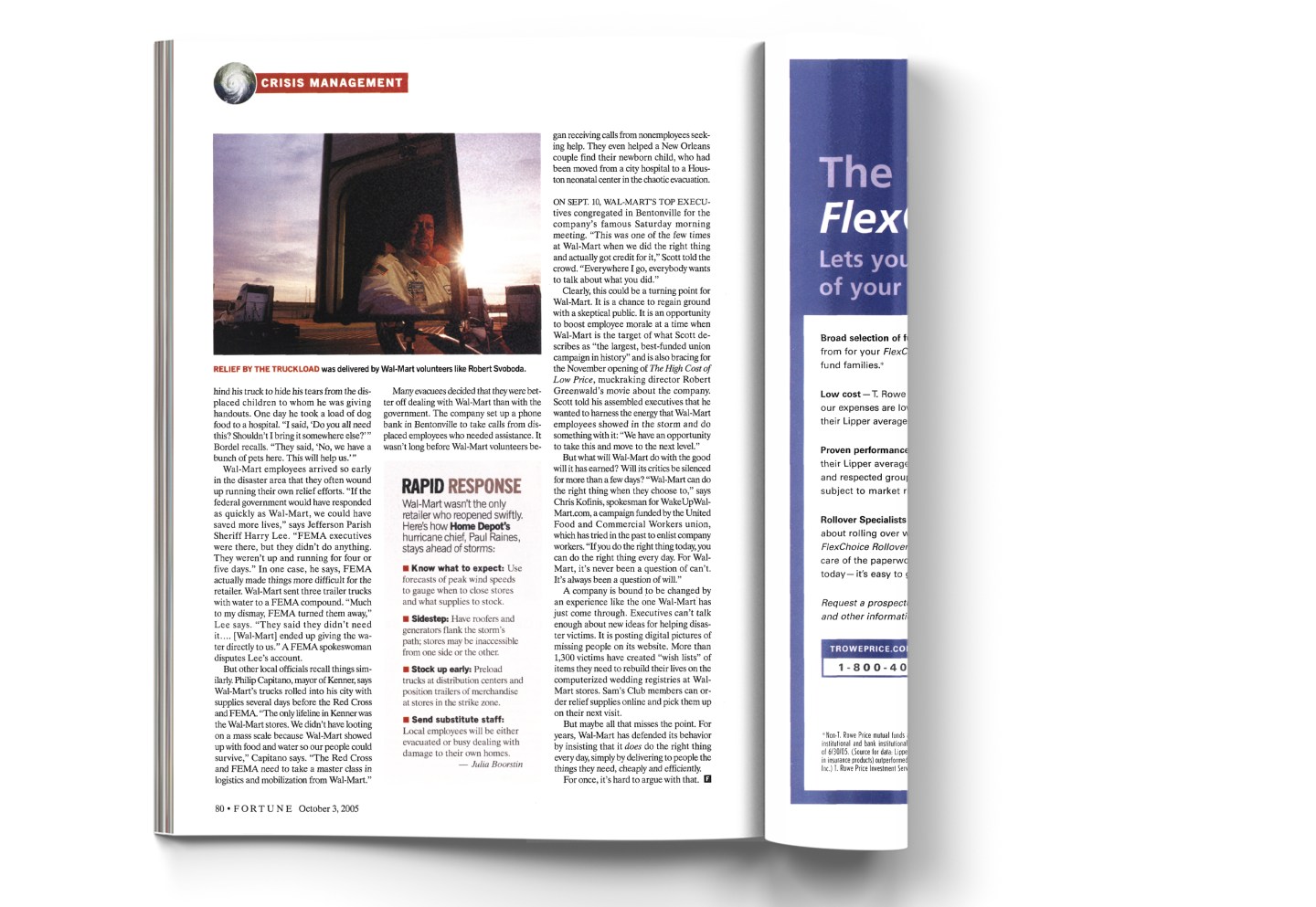
As the scope of the tragedy became clear, Wal-Mart CEO Lee Scott asked for volunteers from the company’s army of truck drivers to haul food to shelters in the flood zone. One of the first to step up was Robert Svoboda, a 42-year-old driver from Sealy, Texas, who delivered peanut butter, Pop-Tarts, and canned goods to three shelters in Marrero. “When I arrived, it sounded like someone scored a touchdown in a football game,” he recalls. “I could have sat there and shook hands all day, they were so happy to see me.”
Merrick Bordel, a 56-year-old driver from Cottonport, La., spent a week in Jefferson Parish transporting loads of food to shelters. There were times when he had to step behind his truck to hide his tears from the displaced children to whom he was giving handouts. One day he took a load of dog food to a hospital. “I said, ‘Do you all need this? Shouldn’t I bring it somewhere else?'” Bordel recalls. “They said, ‘No, we have a bunch of pets here. This will help us.'”
Wal-Mart sent trucks of water to a FEMA outpost. A sheriff says FEMA turned them away.
Wal-Mart employees arrived so early in the disaster area that they often wound up running their own relief efforts. “If the federal government would have responded as quickly as Wal-Mart, we could have saved more lives,” says Jefferson Parish Sheriff Harry Lee. “FEMA executives were there, but they didn’t do anything. They weren’t up and running for four or five days.” In one case, he says, FEMA actually made things more difficult for the retailer. Wal-Mart sent three trailer trucks with water to a FEMA compound. “Much to my dismay, FEMA turned them away,” Lee says. “They said they didn’t need it…. [Wal-Mart] ended up giving the water directly to us.” A FEMA spokeswoman disputes Lee’s account.
But other local officials recall things similarly. Philip Capitano, mayor of Kenner, says Wal-Mart’s trucks rolled into his city with supplies several days before the Red Cross and FEMA. “The only lifeline in Kenner was the Wal-Mart stores. We didn’t have looting on a mass scale because Wal-Mart showed up with food and water so our people could survive,” Capitano says. “The Red Cross and FEMA need to take a master class in logistics and mobilization from Wal-Mart.”
Many evacuees decided that they were better off dealing with Wal-Mart than with the government. The company set up a phone bank in Bentonville to take calls from displaced employees who needed assistance. It wasn’t long before Wal-Mart volunteers began receiving calls from nonemployees seeking help. They even helped a New Orleans couple find their newborn child, who had been moved from a city hospital to a Houston neonatal center in the chaotic evacuation.
On Sept. 10, Wal-Mart’s top executives congregated in Bentonville for the company’s famous Saturday morning meeting. “This was one of the few times at Wal-Mart when we did the right thing and actually got credit for it,” Scott told the crowd. “Everywhere I go, everybody wants to talk about what you did.”
Clearly, this could be a turning point for Wal-Mart. It is a chance to regain ground with a skeptical public. It is an opportunity to boost employee morale at a time when Wal-Mart is the target of what Scott describes as “the largest, best-funded union campaign in history” and is also bracing for the November opening of The High Cost of Low Price, muckraking director Robert Greenwald’s movie about the company. Scott told his assembled executives that he wanted to harness the energy that Wal-Mart employees showed in the storm and do something with it: “We have an opportunity to take this and move to the next level.”
But what will Wal-Mart do with the good will it has earned? Will its critics be silenced for more than a few days? “Wal-Mart can do the right thing when they choose to,” says Chris Kofinis, spokesman for WakeUpWal-Mart.com, a campaign funded by the United Food and Commercial Workers union, which has tried in the past to enlist company workers. “If you do the right thing today, you can do the right thing every day. For Wal-Mart, it’s never been a question of can’t. It’s always been a question of will.”
A company is bound to be changed by an experience like the one Wal-Mart has just come through. Executives can’t talk enough about new ideas for helping disaster victims. It is posting digital pictures of missing people on its website. More than 1,300 victims have created “wish lists” of items they need to rebuild their lives on the computerized wedding registries at Wal-Mart stores. Sam’s Club members can order relief supplies online and pick them up on their next visit.
But maybe all that misses the point. For years, Wal-Mart has defended its behavior by insisting that it does do the right thing every day, simply by delivering to people the things they need, cheaply and efficiently.
For once, it’s hard to argue with that.
Reporter associate: Eugenia Levenson
A version of this article appears in the Oct. 3, 2005 issue of Fortune.
The Fortune Archives newsletter unearths the Fortune stories that have had a lasting impact on business and culture between 1930 and today. Subscribe to receive it for free in your inbox every Sunday morning.