• Home
  • Latest
  • Fortune 500
  • Finance
  • Tech
  • Leadership
  • Lifestyle
  • Rankings
  • Multimedia
TechCybersecurity

‘Ick Factor’ and Biometrics Limit Market for Implanted Security Chips

Barb Darrow
By
Barb Darrow
Barb Darrow
Down Arrow Button Icon
Barb Darrow
By
Barb Darrow
Barb Darrow
Down Arrow Button Icon
August 2, 2017, 3:01 PM ET
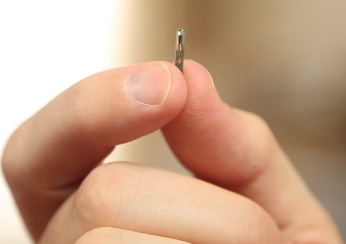
Embeddable microchip
Embeddable microchipThree Square Market

A Wisconsin vending machine company made a big splash last week when it announced that 50 of its employees would get chips implanted in their hands to facilitate wireless payment for snacks as part of a voluntary test program.

Some observers welcomed the idea as a cool way to pay for stuff (or log into computers) without carrying a phone, credit card, cash or keying in passwords.

Others viewed the prospect of being “implanted” with a microchip with less enthusiasm. They argued that the notion of a healthcare professional, or a tattoo artist as was reportedly the case of that Wisconsin company, injecting a rice-sized chip into someone’s hand, is unsettling.

There is a perceptible “ick” factor that people need to get over if such implants are to take off, says Paula Hunter, executive director of the NFC Forum.

NFC, or near-field communications, is wireless technology used by many chips to communicate with chip readers. NFC facilitates Apple (AAPL) Pay and Google (GOOGL) Wallet payments, for example.

The upside of an embedded chip is that users wouldn’t need to carry their phone, credit card, or cash. The downside? Have I mentioned the “ick” factor?

Still, there are precedents for human-implantable chips. For the past year, Epicenter, a Swedish company, has implanted chips in workers that give them access to the office and computers. Going back further, PositiveID, once known as VeriChip, once sold implantable chips for tracking people’s medical data. It stopped doing so seven years ago due to concerns that the chips might be used for surveillance.

Get Data Sheet, Fortune’s technology newsletter

Secure wireless log-in (minus the implants) is gaining traction. The new Tesla Model 3, introduced this week, offers both a Bluetooth-enabled mobile app as the vehicle’s key, and also comes with NFC-enabled cards for valets, mechanics, or others who may need to access and drive the vehicle.

Still, some see the need for people to carry anything—a phone, chip, card—to buy things or unlock their computers as so last decade.

Related: Wisconsin Company Holds Party to Implant Workers With Chips

“Getting an implantable chip sounds a lot like a drunken tattoo party—it’s a fun idea until you wake up the next morning,” says Brendan Miller, principal analyst with Forrester Research (FORR). For one thing, what happens when the technology changes and you need a new chip?

In his view, biometric technology, which enables a person’s fingerprint, retina, or voice to act as a key will be the next wave in security.

“NFC is fine for now,” Miller said. “It is fast, easy and secure if implemented properly and everyone has a mobile device so there is some ubiquity.”

Adopting biometrics will mean users won’t need their phone (or chip) to pay for lattes, unlock the office, or sign into their computers. “Your fingerprint itself can be payment authentication. And, facial recognition is getting really, really good, so that would work too,” Miller said.

With all that, there may still be a “creep” factor for people who distrust sharing too much of themselves with tech providers. But in Miller’s view, a face or fingerprint scan is a lot less creepy than implanting a foreign object in your body.
About the Author
Barb Darrow
By Barb Darrow
See full bioRight Arrow Button Icon

Latest in Tech

robots
InnovationRobots
‘The question is really just how long it will take’: Over 2,000 gather at Humanoids Summit to meet the robots who may take their jobs someday
By Matt O'Brien and The Associated PressDecember 12, 2025
3 hours ago
Man about to go into police vehicle
CryptoCryptocurrency
Judge tells notorious crypto scammer ‘you have been bitten by the crypto bug’ in handing down 15 year sentence 
By Carlos GarciaDecember 12, 2025
4 hours ago
three men in suits, one gesturing
AIBrainstorm AI
The fastest athletes in the world can botch a baton pass if trust isn’t there—and the same is true of AI, Blackbaud exec says
By Amanda GerutDecember 12, 2025
4 hours ago
Brainstorm AI panel
AIBrainstorm AI
Creative workers won’t be replaced by AI—but their roles will change to become ‘directors’ managing AI agents, executives say
By Beatrice NolanDecember 12, 2025
5 hours ago
Fei-Fei Li, the "Godmother of AI," says she values AI skills more than college degrees when hiring software engineers for her tech startup.
AITech
‘Godmother of AI’ says degrees are less important in hiring than how quickly you can ‘superpower yourself’ with new tools
By Nino PaoliDecember 12, 2025
7 hours ago
C-SuiteFortune 500 Power Moves
Fortune 500 Power Moves: Which executives gained and lost power this week
By Fortune EditorsDecember 12, 2025
7 hours ago

Most Popular

placeholder alt text
Economy
Tariffs are taxes and they were used to finance the federal government until the 1913 income tax. A top economist breaks it down
By Kent JonesDecember 12, 2025
13 hours ago
placeholder alt text
Success
At 18, doctors gave him three hours to live. He played video games from his hospital bed—and now, he’s built a $10 million-a-year video game studio
By Preston ForeDecember 10, 2025
3 days ago
placeholder alt text
Success
Palantir cofounder calls elite college undergrads a ‘loser generation’ as data reveals rise in students seeking support for disabilities, like ADHD
By Preston ForeDecember 11, 2025
1 day ago
placeholder alt text
Arts & Entertainment
'We're not just going to want to be fed AI slop for 16 hours a day': Analyst sees Disney/OpenAI deal as a dividing line in entertainment history
By Nick LichtenbergDecember 11, 2025
1 day ago
placeholder alt text
Uncategorized
Transforming customer support through intelligent AI operations
By Lauren ChomiukNovember 26, 2025
16 days ago
placeholder alt text
Success
40% of Stanford undergrads receive disability accommodations—but it’s become a college-wide phenomenon as Gen Z try to succeed in the current climate
By Preston ForeDecember 12, 2025
8 hours ago
Rankings
  • 100 Best Companies
  • Fortune 500
  • Global 500
  • Fortune 500 Europe
  • Most Powerful Women
  • Future 50
  • World’s Most Admired Companies
  • See All Rankings
Sections
  • Finance
  • Leadership
  • Success
  • Tech
  • Asia
  • Europe
  • Environment
  • Fortune Crypto
  • Health
  • Retail
  • Lifestyle
  • Politics
  • Newsletters
  • Magazine
  • Features
  • Commentary
  • Mpw
  • CEO Initiative
  • Conferences
  • Personal Finance
  • Education
Customer Support
  • Frequently Asked Questions
  • Customer Service Portal
  • Privacy Policy
  • Terms Of Use
  • Single Issues For Purchase
  • International Print
Commercial Services
  • Advertising
  • Fortune Brand Studio
  • Fortune Analytics
  • Fortune Conferences
  • Business Development
About Us
  • About Us
  • Editorial Calendar
  • Press Center
  • Work At Fortune
  • Diversity And Inclusion
  • Terms And Conditions
  • Site Map

© 2025 Fortune Media IP Limited. All Rights Reserved. Use of this site constitutes acceptance of our Terms of Use and Privacy Policy | CA Notice at Collection and Privacy Notice | Do Not Sell/Share My Personal Information
FORTUNE is a trademark of Fortune Media IP Limited, registered in the U.S. and other countries. FORTUNE may receive compensation for some links to products and services on this website. Offers may be subject to change without notice.