• Home
  • Latest
  • Fortune 500
  • Finance
  • Tech
  • Leadership
  • Lifestyle
  • Rankings
  • Multimedia
FinanceFreddie Mac

U.S. Angered as Freddie Mac Auditor Settles Investor Suit

By
Roger Parloff
Roger Parloff
Down Arrow Button Icon
By
Roger Parloff
Roger Parloff
Down Arrow Button Icon
October 26, 2016, 1:15 PM ET
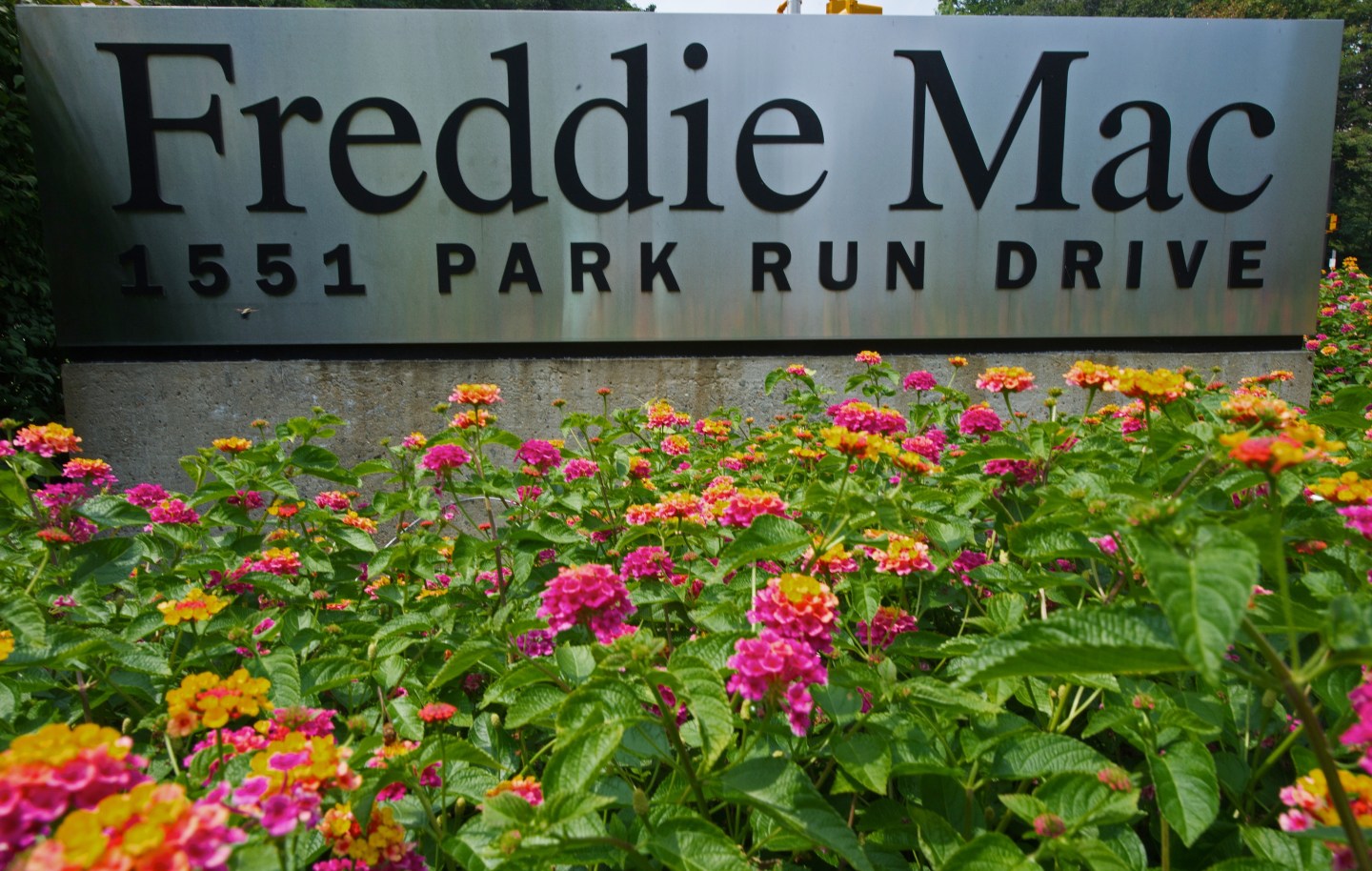
Colorful flowers are seen on August 11, 2010, at the entrance to the Freddie Mac offices in McLean, Virginia. Troubled US mortgage firm Freddie Mac reported August 9, 2010 a second quarter net loss of six billion dollars and sought another 1.8 billion dollars from the Treasury to contain the red ink.The government-backed company said its strategies to boost business and "sustainable homeownership" were taking hold but cited high unemployment posing "very real challenges" for the already embattled housing market.      AFP Photo/Paul J. Richards (Photo credit should read PAUL J. RICHARDS/AFP/Getty Images)
Colorful flowers are seen on August 11, 2010, at the entrance to the Freddie Mac offices in McLean, Virginia. Troubled US mortgage firm Freddie Mac reported August 9, 2010 a second quarter net loss of six billion dollars and sought another 1.8 billion dollars from the Treasury to contain the red ink.The government-backed company said its strategies to boost business and "sustainable homeownership" were taking hold but cited high unemployment posing "very real challenges" for the already embattled housing market. AFP Photo/Paul J. Richards (Photo credit should read PAUL J. RICHARDS/AFP/Getty Images)

It looks like some clever Freddie Mac shareholders may have actually got some of their money back, in compensation for the government’s effective nationalization of the mortgage finance giant in August 2012, which wiped out virtually all the value of their stock.

The money—or whatever the investors got in a confidential lawsuit settlement that was first announced to the judge on October 11 and then apparently completed by October 18, when the parties agreed to dismiss the case—didn’t come from the government itself, but rather from Freddie’s auditor from 2008 to 2013, PricewaterhouseCoopers, which was the sole defendant in the suit.

Nevertheless, Uncle Sam is mad about the deal. The government is trying to find out exactly what its terms were—and possibly to undo it. The Federal Housing Finance Agency, which has been Freddie Mac’s conservator since 2008, has asked a Miami federal judge to reopen the case in order to dismiss it again, but this time “without payment of any kind,” as it papers explain.

The odd dispute arose in one of the satellite lawsuits stemming from the government’s confiscation, in essence, of both Fannie Mae (FNMA) and Freddie Mac (FMCC) in 2012, when it dramatically changed the terms of a federal bailout of the two government-sponsored enterprises (GSEs), which began in 2008. (Fannie Mae is the popular name for the Federal National Mortgage Association and Freddie Mac refers to the Federal Home Loan Mortgage Corporation.)

U.S. District Judge Federico Moreno of Miami has scheduled a hearing Monday morning to decide what to do. The plaintiffs—23 individual investors plus investment managers Gator Capital, of Tampa, and Perini Capital, of Miami—are arguing that the judge no longer has jurisdiction, because the parties agreed to dismiss the case last Tuesday.

The shareholders sued PwC in March, claiming, in effect, that it helped federal regulators both to seize Freddie Mac in 2008 and to nationalize it is 2012—when it first became clear that the government had no intention of ever letting the GSEs pay back their debts and reemerge as independent companies—by portraying it as being in worse financial shape than it really was.

Specifically, the suit alleges that PwC “assisted government regulators and officers of Freddie Mac to destroy the value of Freddie Mac stock” by “manipulating the books . . . to overstate losses and understate its assets by hundreds of billions of dollars.” The suit alleges that these acts amounted to “negligent misrepresentations” and “aiding and abetting” of fiduciary breaches by Freddie’s own directors and by the federal officials who took over from them in 2008. A PwC spokeswoman said she couldn’t comment on any aspect of the suit due to a confidentiality agreement reached as part of the settlement. (The suit never reached the stage where PwC filed an answer in court responding to the accusations. FHFA and Treasury have denied any wrongdoing in numerous other suits.)

A few days before the suit against PwC was filed last March, a nearly identical suit was filed by Gator, Perini, and about 30 individuals—including some of the same ones—against Fannie Mae’s auditors, Deloitte & Touche. No settlement has been reached in that case.

To understand the whole mess, we need to take a couple steps back. In September 2008, as the nation’s economic system descended into crisis, with defaults on residential mortgages skyrocketing, FHFA’s director placed Fannie and Freddie into conservatorship, with FHFA acting as conservator. The stated goal was to ensure stability in the national housing market.

Over the next four years the GSEs received, under the terms of special bailout legislation, $189.5 billion in taxpayer money. In exchange, they issued special “senior preferred stock” to the Treasury under which they had an obligation to pay 10% interest on the bailout money they’d received. In early 2012, the GSEs began to make money again, together posting a healthy $8 billion in profits for the second quarter.

But in August 2012, a few days after posting that profit, Treasury and FHFA suddenly changed the terms of the GSEs’ special preferred stock. They replaced the 10% interest obligation with a requirement that the GSEs instead pay Treasury their entire profit each quarter in perpetuity (except for a small capital reserve that would gradually dwindle to nothing by 2018). The GSEs would, therefore, never emerge from conservatorship, and would, rather, be wound down and replaced with some other system of housing finance to be set up by Congress.

Government officials have claimed that they took this action because they feared the GSEs would start losing money again, and that taxpayers would end up on the hook again. In the months immediately following the momentous switch, however, the GSEs actually booked record profits. As of last November, by which time thousands of Fannie and Freddie investors—led by hedge fund Perry Capital and the Fairholme Group of mutual funds—had filed numerous suits in numerous courts, the GSEs had paid the government about $240 billion in exchange for the $189.5 billion bailout, or nearly $130 billion more than they would have paid under the original 10% coupon agreements.

Though the investor suits have been based on a wide range of legal theories, they fall into two main categories: those alleging that the momentous 2012 revision in bailout terms was beyond federal officials’ statutory powers and those alleging that it was an unconstitutional “taking” of shareholder property without just compensation—i.e., a violation of the Fifth Amendment.

Lawyers for the investor plaintiffs have speculated that the Treasury and FHFA officials responsible actually knew that the GSEs were healthy in 2012 (and possibly even in 2008) but confiscated their assets for opportunistic budgetary reasons, including, perhaps, the desire to postpone hitting the national debt ceiling at a time when Congress was threatening to shut down the government.

The two Miami suits against each GSE’s accounting firm were filed in state court, but were swiftly transferred to federal court by each defendant.

There, FHFA moved to oust the plaintiffs in each suit and to substitute itself, citing the federal law that created FHFA in July 2008. Under that statute, FHFA, when acting as a conservator, “succeeds to . . . all rights, titles, and privileges . . . of any stockholder” of a seized GSE. Thus, FHFA argues, only FHFA is empowered to bring shareholder litigation relating to Freddie Mac at this point, and it has not chosen to do so.

Before Judge Moreno could rule on that motion, the parties settled. Judge Moreno then dismissed FHFA’s substitution request as moot (i.e., no longer relevant). But last Monday FHFA asked once again to be permitted to oust the plaintiffs and undo the settlement. It would then dismiss the suit without seeking “payment of any kind.”

FHFA has also asked Judge Moreno to force the parties to show it the settlement deal by Friday.

The FHFA declined comment on the suit. Attorneys for the plaintiffs did not return an email seeking comment.

In the broader litigation, investors have had mixed results so far. In September 2014, U.S. District Judge Royce Lamberth of Washington, D.C., dismissed one group of consolidated investor suits, finding that FHFA and Treasury had acted within their statutory authority. His ruling was argued before a federal appeals court last April, and the appellate decision could come down any day.

In the Court of Federal Claims—where most of the constitutional “takings” cases are being heard—plaintiffs appear to be faring better, so far, with Judge Margaret Sweeney last month granting their request to force the Treasury Department, FHFA, and the White House to turn over documents which the latter had been seeking to withhold, citing various evidentiary privilege doctrines.

About the Author
By Roger Parloff
See full bioRight Arrow Button Icon

Latest in Finance

Finance
Lorem ipsum dolor sit amet, consectetur adipiscing elit, sed do eiusmod tempor incididunt ut labore et dolore magna aliqua. Ut enim ad minim veniam
By Fortune Editors
October 20, 2025
Finance
Lorem ipsum dolor sit amet, consectetur adipiscing elit, sed do eiusmod tempor incididunt ut labore et dolore magna aliqua. Ut enim ad minim veniam
By Fortune Editors
October 20, 2025
Finance
Lorem ipsum dolor sit amet, consectetur adipiscing elit, sed do eiusmod tempor incididunt ut labore et dolore magna aliqua. Ut enim ad minim veniam
By Fortune Editors
October 20, 2025
Finance
Lorem ipsum dolor sit amet, consectetur adipiscing elit, sed do eiusmod tempor incididunt ut labore et dolore magna aliqua. Ut enim ad minim veniam
By Fortune Editors
October 20, 2025
Finance
Lorem ipsum dolor sit amet, consectetur adipiscing elit, sed do eiusmod tempor incididunt ut labore et dolore magna aliqua. Ut enim ad minim veniam
By Fortune Editors
October 20, 2025
Finance
Lorem ipsum dolor sit amet, consectetur adipiscing elit, sed do eiusmod tempor incididunt ut labore et dolore magna aliqua. Ut enim ad minim veniam
By Fortune Editors
October 20, 2025

Most Popular

Finance
Lorem ipsum dolor sit amet, consectetur adipiscing elit, sed do eiusmod tempor incididunt ut labore et dolore magna aliqua. Ut enim ad minim veniam
By Fortune Editors
October 20, 2025
Finance
Lorem ipsum dolor sit amet, consectetur adipiscing elit, sed do eiusmod tempor incididunt ut labore et dolore magna aliqua. Ut enim ad minim veniam
By Fortune Editors
October 20, 2025
Finance
Lorem ipsum dolor sit amet, consectetur adipiscing elit, sed do eiusmod tempor incididunt ut labore et dolore magna aliqua. Ut enim ad minim veniam
By Fortune Editors
October 20, 2025
Finance
Lorem ipsum dolor sit amet, consectetur adipiscing elit, sed do eiusmod tempor incididunt ut labore et dolore magna aliqua. Ut enim ad minim veniam
By Fortune Editors
October 20, 2025
Finance
Lorem ipsum dolor sit amet, consectetur adipiscing elit, sed do eiusmod tempor incididunt ut labore et dolore magna aliqua. Ut enim ad minim veniam
By Fortune Editors
October 20, 2025
Finance
Lorem ipsum dolor sit amet, consectetur adipiscing elit, sed do eiusmod tempor incididunt ut labore et dolore magna aliqua. Ut enim ad minim veniam
By Fortune Editors
October 20, 2025
Rankings
  • 100 Best Companies
  • Fortune 500
  • Global 500
  • Fortune 500 Europe
  • Most Powerful Women
  • Future 50
  • World’s Most Admired Companies
  • See All Rankings
Sections
  • Finance
  • Leadership
  • Success
  • Tech
  • Asia
  • Europe
  • Environment
  • Fortune Crypto
  • Health
  • Retail
  • Lifestyle
  • Politics
  • Newsletters
  • Magazine
  • Features
  • Commentary
  • Mpw
  • CEO Initiative
  • Conferences
  • Personal Finance
  • Education
Customer Support
  • Frequently Asked Questions
  • Customer Service Portal
  • Privacy Policy
  • Terms Of Use
  • Single Issues For Purchase
  • International Print
Commercial Services
  • Advertising
  • Fortune Brand Studio
  • Fortune Analytics
  • Fortune Conferences
  • Business Development
About Us
  • About Us
  • Editorial Calendar
  • Press Center
  • Work At Fortune
  • Diversity And Inclusion
  • Terms And Conditions
  • Site Map
  • Facebook icon
  • Twitter icon
  • LinkedIn icon
  • Instagram icon
  • Pinterest icon

© 2026 Fortune Media IP Limited. All Rights Reserved. Use of this site constitutes acceptance of our Terms of Use and Privacy Policy | CA Notice at Collection and Privacy Notice | Do Not Sell/Share My Personal Information
FORTUNE is a trademark of Fortune Media IP Limited, registered in the U.S. and other countries. FORTUNE may receive compensation for some links to products and services on this website. Offers may be subject to change without notice.


Most Popular

placeholder alt text
Success
Gen Z Patriots quarterback Drake Maye still drives a 2015 pickup truck even after it broke down on the highway—despite his $37 million contract
By Sasha RogelbergFebruary 7, 2026
1 day ago
placeholder alt text
Success
Even with $850 billion to his name, Elon Musk admits ‘money can’t buy happiness.’ But billionaire Mark Cuban says it’s not so simple
By Preston ForeFebruary 6, 2026
2 days ago
placeholder alt text
Economy
Elon Musk warns the U.S. is '1,000% going to go bankrupt' unless AI and robotics save the economy from crushing debt
By Jason MaFebruary 7, 2026
21 hours ago
placeholder alt text
Success
Nestlé’s CEO drinks 8 coffees a day, but says Gen Z staffers are his secret to staying sharp by ‘learning constantly’
By Emma BurleighFebruary 5, 2026
3 days ago
placeholder alt text
AI
AI can make anyone rich: Mark Cuban says it could turn 'just one dude in a basement' into a trillionaire
By Sydney LakeFebruary 7, 2026
1 day ago
placeholder alt text
Success
Larry Ellison and Jeff Bezos have seen more than $66 billion swiped from their net worths since the start of this year as AI-driven slump sees tech billionaires’ wealth free-fall
By Emma BurleighFebruary 6, 2026
2 days ago

Latest in Finance

Tom Brady looks on prior to the game at AT&T Stadium on September 15, 2024 in Arlington, Texas.
Personal FinanceNFL
Tom Brady is making 15 times more as a Super Bowl commentator than he did playing in the big game thanks to $375 million contract 
By Eva RoytburgFebruary 8, 2026
2 hours ago
tipping
CommentaryTipping
I’m the chief growth officer at a payments app and I know how America really tips. Connecticut, I’m looking at you
By Ricardo CiciFebruary 8, 2026
2 hours ago
colorado
RetailGrocery
Grocery prices have surged 25% in Colorado since the pandemic with Kroger and Walmart sharing half the market. Enter Aldi
By Jack Buffington and The ConversationFebruary 8, 2026
3 hours ago
broker
CommentaryRecession
We studied 70 countries’ economic data for the last 60 years and something big about market crashes changed 25 years ago
By Josh Ederington, Jenny Minier and The ConversationFebruary 8, 2026
3 hours ago
birthday
CommentaryAmerican Dream
America marks its 250th birthday with a fading dream—the first time that younger generations will make less than their parents
By Mark Robert Rank and The ConversationFebruary 8, 2026
3 hours ago
Personal FinanceBill Gates
Bill Gates is shedding houses that are part of his $132 million Xanadu 2.0 compound—a reversal from his feelings about downsizing
By Sydney LakeFebruary 8, 2026
6 hours ago