• Home
  • Latest
  • Fortune 500
  • Finance
  • Tech
  • Leadership
  • Lifestyle
  • Rankings
  • Multimedia
Leadership

Why Trump Voters’ ‘Economic Anxiety’ Isn’t Just Secretly ‘Racism’

By
Tory Newmyer
Tory Newmyer
Down Arrow Button Icon
By
Tory Newmyer
Tory Newmyer
Down Arrow Button Icon
October 25, 2016, 4:43 PM ET
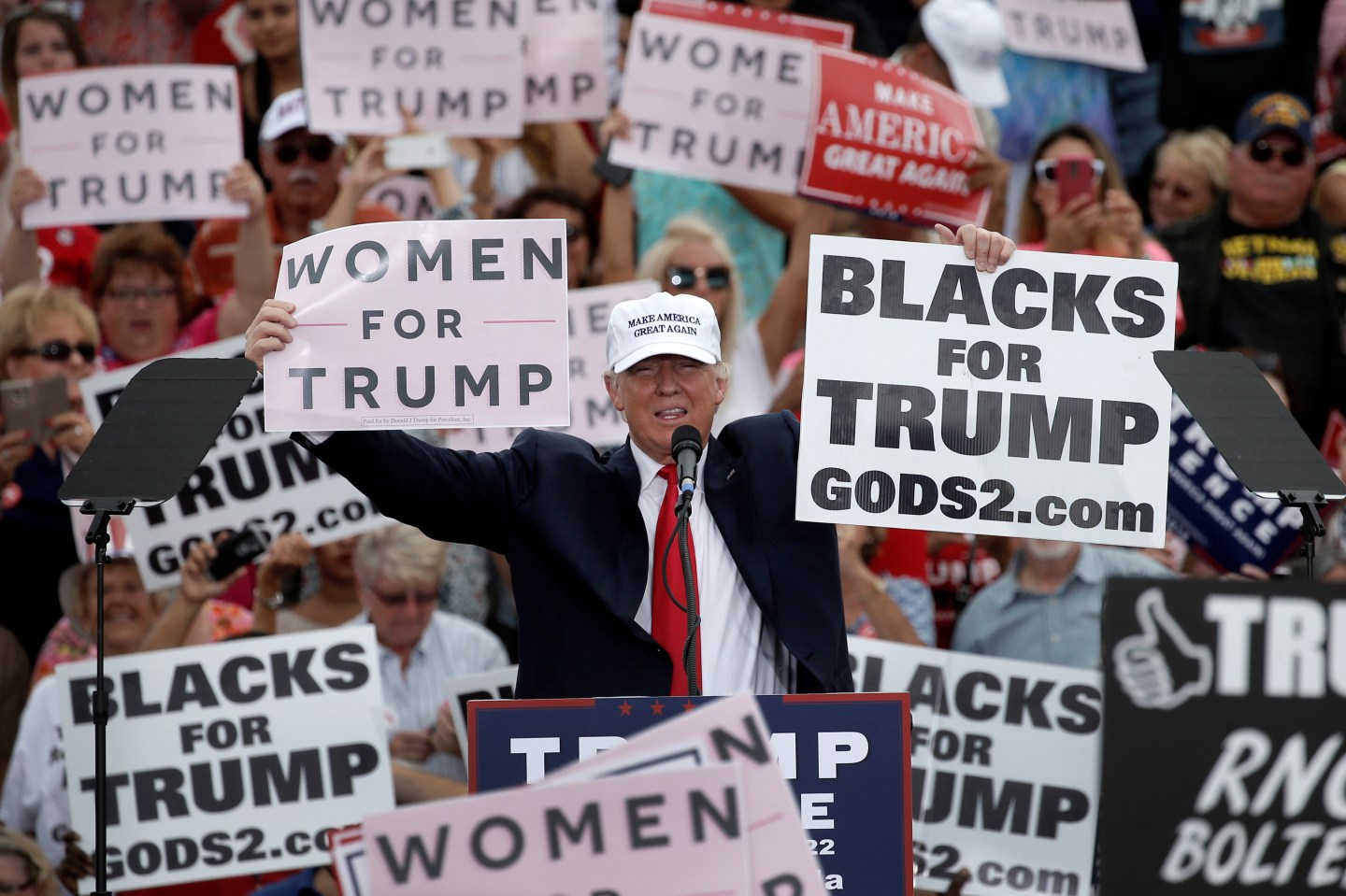
Republican U.S. presidential nominee Donald Trump holds up signs at the end of a campaign rally in Lakeland
Republican U.S. presidential nominee Donald Trump holds up signs at the end of a campaign rally in Lakeland, Florida, U.S., October 12, 2016. REUTERS/Mike Segar TPX IMAGES OF THE DAY - RTSRZSQMike Segar — Reuters

A question obsessing the rightwing political class is taking on new urgency as Donald Trump fades in the closing weeks of the campaign: What’s motivating his supporters?

Republicans already looking past Election Day at the massive party rebuilding project that awaits will need to settle on an answer before they can hope to pick up the pieces from what’s likely to be a shattering electoral defeat. The debate has broken down into roughly two camps: One holds that working-class whites have flocked to Trump out of fear their economic security is eroding; the other contends that’s merely an excuse for the real driving force behind his following, racial resentment. If most of Trump voters can be reached with a rational economic appeal, there should be room for them in a reconstituted conservative coalition. But if they’re moved primarily by anger at other groups, they just might be, in words Hillary Clinton used and then retracted, “irredeemable.”

Yet there may be a third explanation for what’s moving Trump’s voters: it’s not economic anxiety or racial resentment, it’s both. For that view, see The Populist Explosion, the new book by John B. Judis. Writing from the left, with a qualified admiration for the populist impulse, Judis contends that populist insurgencies historically have served as warning signs of larger brewing political crises.

The term “populist” traces its origins to late 19th century America, and Judis argues that early incarnation of the movement prefigured the New Deal, which adopted many of its earliest demands, including a graduated income tax and price supports for farmers. Three decades later, it was George Wallace, the son of a Roosevelt Democrat, who would channel popular backlash against Lyndon Johnson’s civil rights agenda into a rightwing populism (though he began and ended his public career as a Democrat). Wallace is remembered most prominently today as a committed segregationist who tried to stand athwart the civil rights movement. But Judis notes he was an economic populist first, who turned to race-baiting after losing a 1958 gubernatorial bid in Alabama to a KKK-backed rival. Throughout the 1960s, Wallace framed his opposition to integration as a defense of middle-income whites. “There’s a backlash against big government in this country,” he told Meet the Press in 1967. “This is a movement of the people.”

Wallace may be remembered by his commitment to segregation, Judis argues, but his approach was textbook rightwing populism: Defending a group that self-identifies as average against what they perceive as an unholy alliance between those above and below them.

Wallace’s followers migrated to the Republican Party, ending the New Deal coalition that bound Northern and Southern Democrats and accelerating the partisan realignment of the South that later enabled an era of GOP dominance. That era was defined by a new consensus that modified New Deal liberalism with supply-side economics and a more hands-off approach to industry.

Judis casts Trump as the heir to Wallace’s rightwing populism, backed by the same white working and middle-class voters suspicious of empowered elites. He argues that as a deeply flawed candidate, Trump could not only lose but in the process hobble the challenges to Republican orthodoxies that helped power his bid. Yet he makes the case that populism persists because it identifies real problems the two major parties are ignoring.

“George Wallace’s call for segregation forever was clearly racist, but he was right about the pitfalls of busing children of different races from one urban neighborhood to another,” Judis writes. “It did result in white flight to the suburbs and was in that sense self-defeating.”

Similarly, Trump’s protectionist solutions are cartoonish, but “there has been a problem with American trade with China and with unfettered capital mobility.” And if more polished candidates follow in Trump’s footsteps, the party will face a ongoing clash between its white working class and business wings. A reckoning may be a long time coming, but as Judis writes, echoing the economist Herbert Stein, “things that can’t go on forever, don’t.”

A version of this story originally appeared in Fortune’s newsletter, the CEO Daily. You can subscribe here.

About the Author
By Tory Newmyer
See full bioRight Arrow Button Icon

Latest in Leadership

Thompson
C-SuiteMedia
Atlantic CEO Nick Thompson on how he learned to ‘just keep moving forward’ after his famous firing at 22
By Nick LichtenbergDecember 14, 2025
2 hours ago
Chess master and co-founder of Chess.com, Danny Rensch
SuccessEntrepreneurs
Chess.com cofounder says it took a pinch of delusion to bring the traditional game online—and it’s a ‘requirement for every successful entrepreneur’
By Emma BurleighDecember 14, 2025
4 hours ago
JPMorganChase CEO Jamie Dimon says AI will eliminate jobs—and that soft skills will be more important than ever.
Future of WorkTech
Jamie Dimon says soft skills like emotional intelligence and communication are vital as AI eliminates roles
By Nino PaoliDecember 14, 2025
6 hours ago
Nicholas Thompson
C-SuiteBook Excerpt
I took over one of the most prestigious media firms while training for an ultramarathon. Here’s what I learned becoming CEO of The Atlantic
By Nicholas ThompsonDecember 13, 2025
1 day ago
Lauren Antonoff
SuccessCareers
Once a college dropout, this CEO went back to school at 52—but she still says the Gen Zers who will succeed are those who ‘forge their own path’
By Preston ForeDecember 13, 2025
1 day ago
Asiathe future of work
The CEO of one of Asia’s largest co-working space providers says his business has more in common with hotels
By Angelica AngDecember 12, 2025
1 day ago

Most Popular

placeholder alt text
Economy
Tariffs are taxes and they were used to finance the federal government until the 1913 income tax. A top economist breaks it down
By Kent JonesDecember 12, 2025
2 days ago
placeholder alt text
Success
Apple cofounder Ronald Wayne sold his 10% stake for $800 in 1976—today it’d be worth up to $400 billion
By Preston ForeDecember 12, 2025
2 days ago
placeholder alt text
Success
40% of Stanford undergrads receive disability accommodations—but it’s become a college-wide phenomenon as Gen Z try to succeed in the current climate
By Preston ForeDecember 12, 2025
2 days ago
placeholder alt text
Economy
The Fed just ‘Trump-proofed’ itself with a unanimous move to preempt a potential leadership shake-up
By Jason MaDecember 12, 2025
2 days ago
placeholder alt text
Success
Apple CEO Tim Cook out-earns the average American’s salary in just 7 hours—to put that into context, he could buy a new $439,000 home in just 2 days
By Emma BurleighDecember 12, 2025
2 days ago
placeholder alt text
Uncategorized
Transforming customer support through intelligent AI operations
By Lauren ChomiukNovember 26, 2025
18 days ago
Rankings
  • 100 Best Companies
  • Fortune 500
  • Global 500
  • Fortune 500 Europe
  • Most Powerful Women
  • Future 50
  • World’s Most Admired Companies
  • See All Rankings
Sections
  • Finance
  • Leadership
  • Success
  • Tech
  • Asia
  • Europe
  • Environment
  • Fortune Crypto
  • Health
  • Retail
  • Lifestyle
  • Politics
  • Newsletters
  • Magazine
  • Features
  • Commentary
  • Mpw
  • CEO Initiative
  • Conferences
  • Personal Finance
  • Education
Customer Support
  • Frequently Asked Questions
  • Customer Service Portal
  • Privacy Policy
  • Terms Of Use
  • Single Issues For Purchase
  • International Print
Commercial Services
  • Advertising
  • Fortune Brand Studio
  • Fortune Analytics
  • Fortune Conferences
  • Business Development
About Us
  • About Us
  • Editorial Calendar
  • Press Center
  • Work At Fortune
  • Diversity And Inclusion
  • Terms And Conditions
  • Site Map

© 2025 Fortune Media IP Limited. All Rights Reserved. Use of this site constitutes acceptance of our Terms of Use and Privacy Policy | CA Notice at Collection and Privacy Notice | Do Not Sell/Share My Personal Information
FORTUNE is a trademark of Fortune Media IP Limited, registered in the U.S. and other countries. FORTUNE may receive compensation for some links to products and services on this website. Offers may be subject to change without notice.