
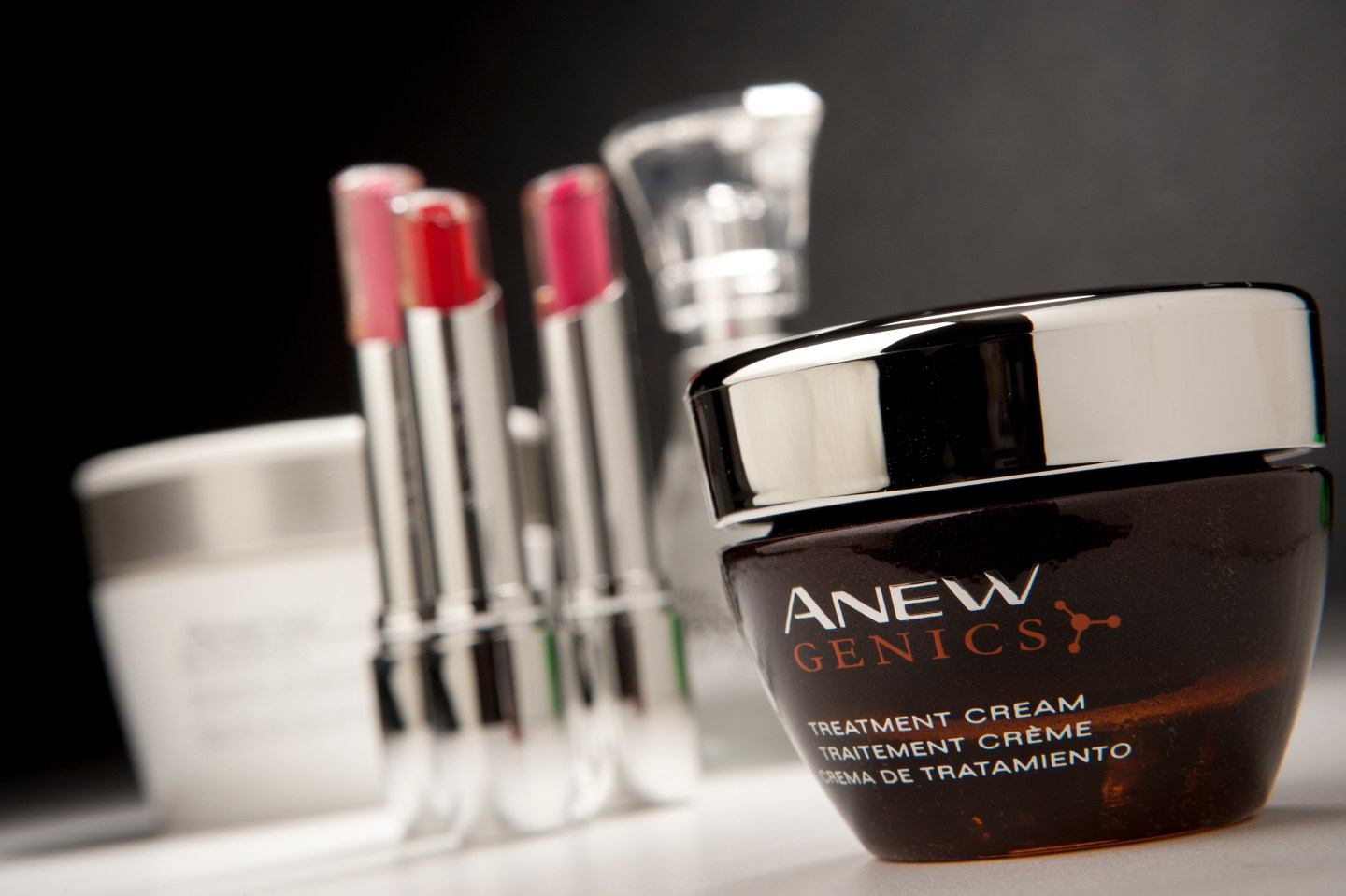
Few American brands have been as much a part of U.S. pop culture as Avon. The “Ding Dong, Avon Calling” tag line from the direct-selling beauty company’s 1950s and 1960s ads became part of the vernacular, and everyone for decades knew someone who was selling its lipstick and mascara for some extra money or even to make a living.
So it was particularly sad news on Thursday that Avon Products (AVP)—a company that traces its roots to 1886 New York, when a door-to-door bookseller was selling home-made perfumes—was carving out its North American business. Avon is selling 80.1% of that unit to turnaround expert and private equity firm Cerberus for $170 million so it can focus on salvaging its more promising but struggling overseas markets and improve its weakening finances.
Avon CEO Sheri McCoy took the helm in 2012, convinced she could turn things around and adamant that the already faltering U.S. business was key to the company’s identity. She still thinks that. “I do believe it’s fixable,” McCoy told Fortune in an interview on Thursday.
But in her nearly four years on the job, Avon’s North American sales have continued to collapse, falling by more than half between 2007 and 2014 (see graphic below), and the number of sales representatives, commonly called “Avon Ladies,” have shrunk each quarter.
McCoy has done everything from try to improve the commission structure, to introducing new computer systems to improve order management and payment for the reps, to a late effort to tap the Hispanic community. And yet results continued to disappoint.
Ultimately, Avon in the U.S. was undone by a confluence of factors.
“We were making progress but it was slow, so the pace of change was not where we wanted to see it,” McCoy said. And it seems that Avon ran out of time.
Here are five reasons Avon’s business faltered in the North America.
The rise of affordable quality beauty products: While Avon was trying to adapt to a world in which direct-selling is a tougher and tougher proposition in beauty, competitors came into the market with low-price, good quality products, most notably Ulta Beauty (ULTRA) and LVMH’s Sephora, which now has locations in hundreds of stores across the U.S. thanks to its partnership with J.C. Penney (JCP). Between 2010 and 2014, Ulta sales rose from $1.45 billion to $3.2 billion, while at Avon, North American sales fell from $2.2 billion to $1.2 billion. Adding to Avon’s pain, everyone from Target (TGT) to Kohl’s (KSS) to CVS Health (CVS) has gotten aggressive about improving their beauty sections.
Inadequate computer systems: Two years ago, Avon pulled the plug on a $125 million software upgrade that had been in the works for four years after a test run in Canada proved so awful, that it drove away the sales reps in big numbers. The system had been intended to improve order management and make tracking commissions easier, but Avon had to go back to the drawing board rather than risk losing more reps.
Coming late to e-commerce: Last year, Avon finally discovered e-commerce. In the summer of 2014, the company completed its first major overhaul of avon.com in 10 years. The new site had far more vivid and interactive product images, a trove of videos with beauty tips and recommendations, and features such as footage from Fashion Week. The site also had tools to help “reps” personalize their own sales sites and use Twitter, Facebook, and Instagram to send advice on new products to customers near and far. It was a good, but late, effort that didn’t really bridge the gap with rivals’ state-of-the-art sites. Adding to the pressure, e-commerce companies like Birchbox have grown quickly, making it hard for Avon to attract a new generation of shoppers.
Commission structure: Avon has tried to make improvements to its commission structure to make it easier for reps to make more money from their sales by getting a higher percentage of sales at a lower sales threshold. But it’s tough out there with rivals like Mary Kay Cosmetics offering generous compensation. What’s more, with Avon’s sales in decline, fewer prospective sales reps are even looking into working with Avon anymore.
Late to the Hispanic market: Though Hispanics have long made up a sizable part of the U.S. population and are proportionally big spenders on beauty, Avon was late to discover that segment. It was only in 2014 that Avon created marketing materials made specifically for its Hispanic reps, who sold far more products than non-Hispanics on a per capita basis..
To be fair, McCoy was trying to save a brand suffering from years of neglect and missteps (one was a misguided attempt a few years ago to go higher end). So now, under Cerberus, Avon will have more room to fix itself, far from the klieg lights of the financial markets, and continue to collaborate with the parent company, which will still take the lead on developing new products.
“Cerberus has spent a lot of time with us, they [have] done an extensive amount of due diligence. They would not put the money in if they didn’t believe in the future of direct selling, and of the brand in North America,” McCoy said.
As for McCoy, she now has one big distraction out of the way as she tries to prevent the same decline in the U.S. from occurring in key Avon markets like Brazil, Russia, and Mexico.