• Home
  • News
  • Fortune 500
  • Tech
  • Finance
  • Leadership
  • Lifestyle
  • Rankings
  • Multimedia
Commentaryclimate change

Blaming Terrorism on Climate Change Isn’t Just Stupid—It’s Dangerous

By
Peter Brookes
Peter Brookes
and
Bethany Cianciolo
Bethany Cianciolo
Down Arrow Button Icon
By
Peter Brookes
Peter Brookes
and
Bethany Cianciolo
Bethany Cianciolo
Down Arrow Button Icon
December 5, 2015, 10:30 AM ET
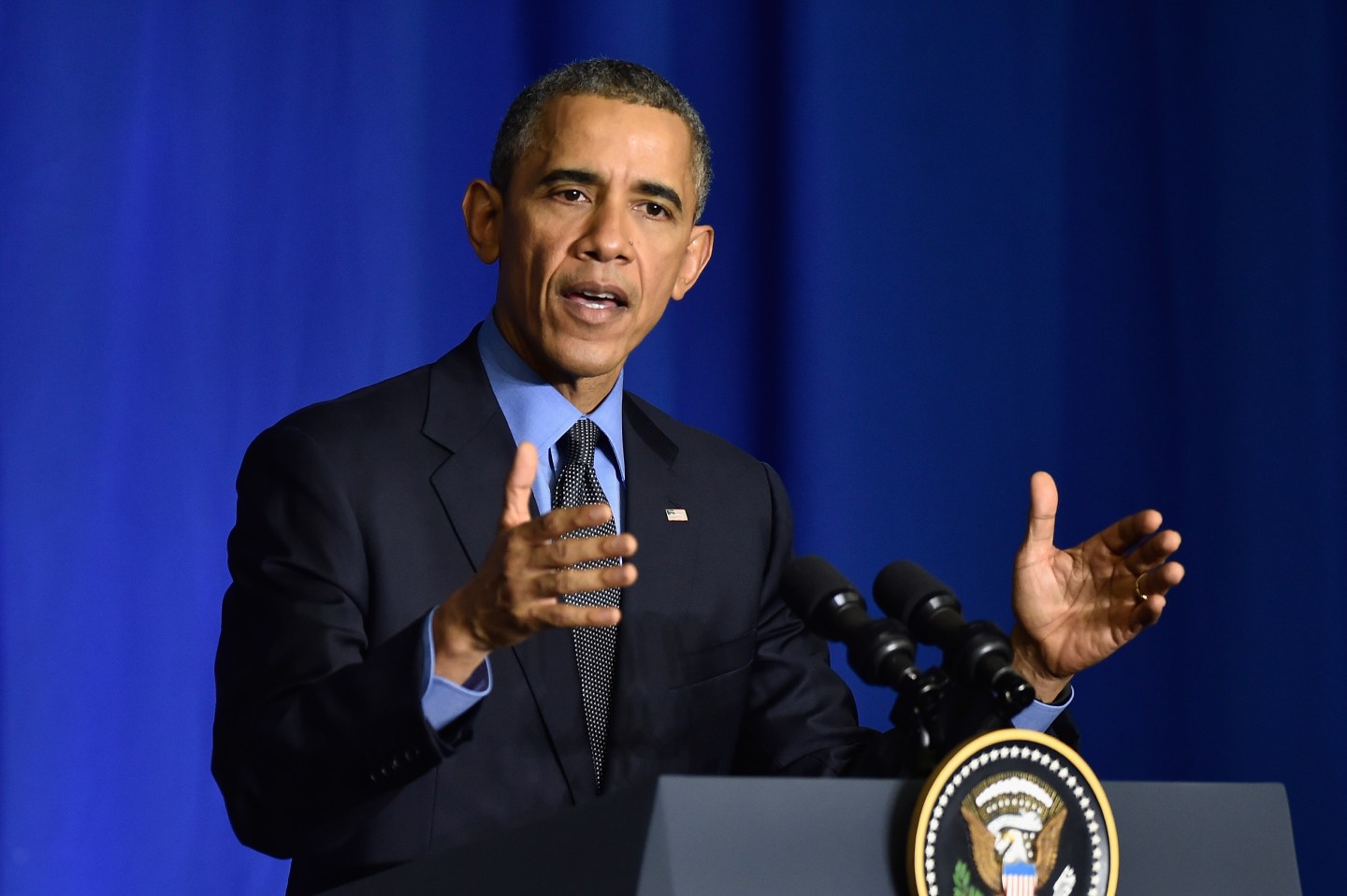
Obama Speaks Before Leaving COP21
PARIS, FRANCE - DECEMBER 01: U.S. President Barack Obama speaks during a press conference at the OECD Conference Centre before leaving the Conference On Climate Change COP21 on December 1, 2015 in Paris, France. Obama spoke about the economic impact of global warming and security risks before flying back to Washington. (Photo by Pascal Le Segretain/Getty Images)Photograph by Pascal Le Segretain via Getty Images

President Obama certainly knows how to use a red-hot news hook to highlight his agenda.

This week, during the United Nations Conference on Climate Change in Paris, he appeared to conflate climate change and terrorism. Coming hot on the heels of the ISIS massacres in the “City of Lights,” that kind of rhetoric was bound to get people’s attention.

In a CBS This Morning interview, he asserted that global warming will put people in desperate straits. And when “human beings are placed under strain,” he added, “then bad things happen. And if you look at world history, whenever people are desperate… that’s when ideologies arise that are dangerous.”

In addressing terrorism (aka dangerous ideologies) in the same breath as global warming, Obama leaves the impression that the two are connected. But a close reading shows that he stops short of claiming a direct cause-and-effect relationship between the two issues.

In Paris, for example, he framed the need for international cooperation on climate issues like this: “And in some ways, it’s [climate change] akin to the problem of terrorism and ISIL.” “In some ways” and “akin” are weasel words that suggest a linkage without really making one.

The Administration has a habit of gauzily tying global warming to rising terrorism. In Paris, Deputy National Security Adviser Ben Rhodes argued, “… the instability that we see in parts of Africa and the Middle East… can be magnified by the effects of climate change and extreme drought and extreme disruption.” And in October at the Universal Exposition in Milan, Secretary of State John Kerry said, “Now, I’m not telling you that the crisis in Syria was caused by climate change…. But the devastating drought clearly made a bad situation a lot worse.”

Read more: Why Prince Charles is right to link the Syrian war to climate change

The claim is always carefully hedged, but clearly the White House wants us to believe that climate change—once it really kicks in—will create or exacerbate all sorts of national security problems, including terrorism. It’s a great technique for generating a sense of urgency.

But the rhetorical construct, while interesting, is weak.

There seems to be no strong quantitative (i.e., empirical) evidence to prove a cause-and-effect relationship between changes in the climate and conflict. Moreover, as others have noted, how humans respond to change—be it climate change or any other type of change—is a matter of choice, not destiny.

Violent conflict aimed at grabbing land and other natural resources is certainly one possible response. But so, too, is cooperation. Indeed, that’s exactly what the nearly 200 countries are trying to do at the Paris climate conference. The Administration must believe cooperation is a viable response. Otherwise, why burn the fuel to fly to the Paris negotiations?

Climate change activists have been trying to create a sense of urgency about their concerns for nearly 50 years. It’s what sparked the first international Earth Day activities—only then the alarm was over global cooling.

While doomsday predictions still crop up (Al Gore, you’ll recall, warned us that the northern polar ice cap could be gone by now), most climate experts believe that any changes in climate will occur gradually, giving governments significant time to respond to it with various instruments of national power—diplomatic, informational, or economic. Military action is by no means the only option out there, and far from the most affordable or desirable.

Indeed, considering how the Administration stresses the primacy of diplomacy—whether it’s in dealing with the Iranian nuclear threat or reaching a political settlement in Syria—the idea that the world community can work together to tackle a challenge should appeal to it.

It’s understandable—and convenient—for the White House to bundle terrorism and climate change in the same messaging. Mentioning violent extremism is guaranteed to spike the attention paid to climate, an issue of high importance to team Obama but ranked at the bottom of polls asking about issues of most concern to the American people.

But it’s substantively wrong to link climate change and terrorism—whether directly or indirectly. And relating the two to create a sense of national security urgency is not only misleading—it’s dangerous because it distracts us from today’s very real, very immediate life-and-death threats from terrorism.

Dr. Peter Brookes is a Heritage Foundation senior fellow and a former deputy assistant secretary of defense.


About the Authors
By Peter Brookes
See full bioRight Arrow Button Icon
By Bethany Cianciolo
See full bioRight Arrow Button Icon

Latest in Commentary

jobs
Commentaryprivate equity
There is a simple fix for America’s job-quality crisis: actually give workers a piece of the business 
By Pete StavrosDecember 9, 2025
8 hours ago
Jon Rosemberg
CommentaryProductivity
The cult of productivity is killing us
By Jon RosembergDecember 9, 2025
8 hours ago
Trump
CommentaryTariffs and trade
AI doctors will be good at science but bad at business, and big talk with little action means even higher drugs prices: 10 healthcare predictions for 2026 from top investors
By Bob Kocher, Bryan Roberts and Siobhan Nolan ManginiDecember 9, 2025
8 hours ago
Google.org
CommentaryTech
Nonprofits are solving 21st century problems—they need 21st century tech
By Maggie Johnson and Shannon FarleyDecember 8, 2025
1 day ago
Will Dunham is President and Chief Executive Officer of the American Investment Council
CommentaryRetirement
Private equity is being villainized in the retirement debate — even as it provides diversification and outperforms public markets long-term
By Will DunhamDecember 8, 2025
1 day ago
Justin Hotard, CEO of Nokia
CommentaryGen Z
Nokia CEO: The workforce is becoming AI-native. Leadership has to evolve
By Justin HotardDecember 8, 2025
1 day ago

Most Popular

placeholder alt text
Real Estate
The 'Great Housing Reset' is coming: Income growth will outpace home-price growth in 2026, Redfin forecasts
By Nino PaoliDecember 6, 2025
3 days ago
placeholder alt text
Investing
Baby boomers have now 'gobbled up' nearly one-third of America's wealth share, and they're leaving Gen Z and millennials behind
By Sasha RogelbergDecember 8, 2025
1 day ago
placeholder alt text
Success
When David Ellison was 13, his billionaire father Larry bought him a plane. He competed in air shows before leaving it to become a Hollywood executive
By Dave SmithDecember 9, 2025
11 hours ago
placeholder alt text
Success
Craigslist founder signs the Giving Pledge, and his fortune will go to military families, fighting cyberattacks—and a pigeon rescue
By Sydney LakeDecember 8, 2025
1 day ago
placeholder alt text
Uncategorized
Transforming customer support through intelligent AI operations
By Lauren ChomiukNovember 26, 2025
13 days ago
placeholder alt text
Success
‘Godfather of AI’ says Bill Gates and Elon Musk are right about the future of work—but he predicts mass unemployment is on its way
By Preston ForeDecember 4, 2025
5 days ago
Rankings
  • 100 Best Companies
  • Fortune 500
  • Global 500
  • Fortune 500 Europe
  • Most Powerful Women
  • Future 50
  • World’s Most Admired Companies
  • See All Rankings
Sections
  • Finance
  • Leadership
  • Success
  • Tech
  • Asia
  • Europe
  • Environment
  • Fortune Crypto
  • Health
  • Retail
  • Lifestyle
  • Politics
  • Newsletters
  • Magazine
  • Features
  • Commentary
  • Mpw
  • CEO Initiative
  • Conferences
  • Personal Finance
  • Education
Customer Support
  • Frequently Asked Questions
  • Customer Service Portal
  • Privacy Policy
  • Terms Of Use
  • Single Issues For Purchase
  • International Print
Commercial Services
  • Advertising
  • Fortune Brand Studio
  • Fortune Analytics
  • Fortune Conferences
  • Business Development
About Us
  • About Us
  • Editorial Calendar
  • Press Center
  • Work At Fortune
  • Diversity And Inclusion
  • Terms And Conditions
  • Site Map

© 2025 Fortune Media IP Limited. All Rights Reserved. Use of this site constitutes acceptance of our Terms of Use and Privacy Policy | CA Notice at Collection and Privacy Notice | Do Not Sell/Share My Personal Information
FORTUNE is a trademark of Fortune Media IP Limited, registered in the U.S. and other countries. FORTUNE may receive compensation for some links to products and services on this website. Offers may be subject to change without notice.