• Home
  • News
  • Fortune 500
  • Tech
  • Finance
  • Leadership
  • Lifestyle
  • Rankings
  • Multimedia
CommentaryFinance

Why another market plunge may be coming

By
S. Kumar
S. Kumar
Down Arrow Button Icon
By
S. Kumar
S. Kumar
Down Arrow Button Icon
August 26, 2015, 6:00 AM ET
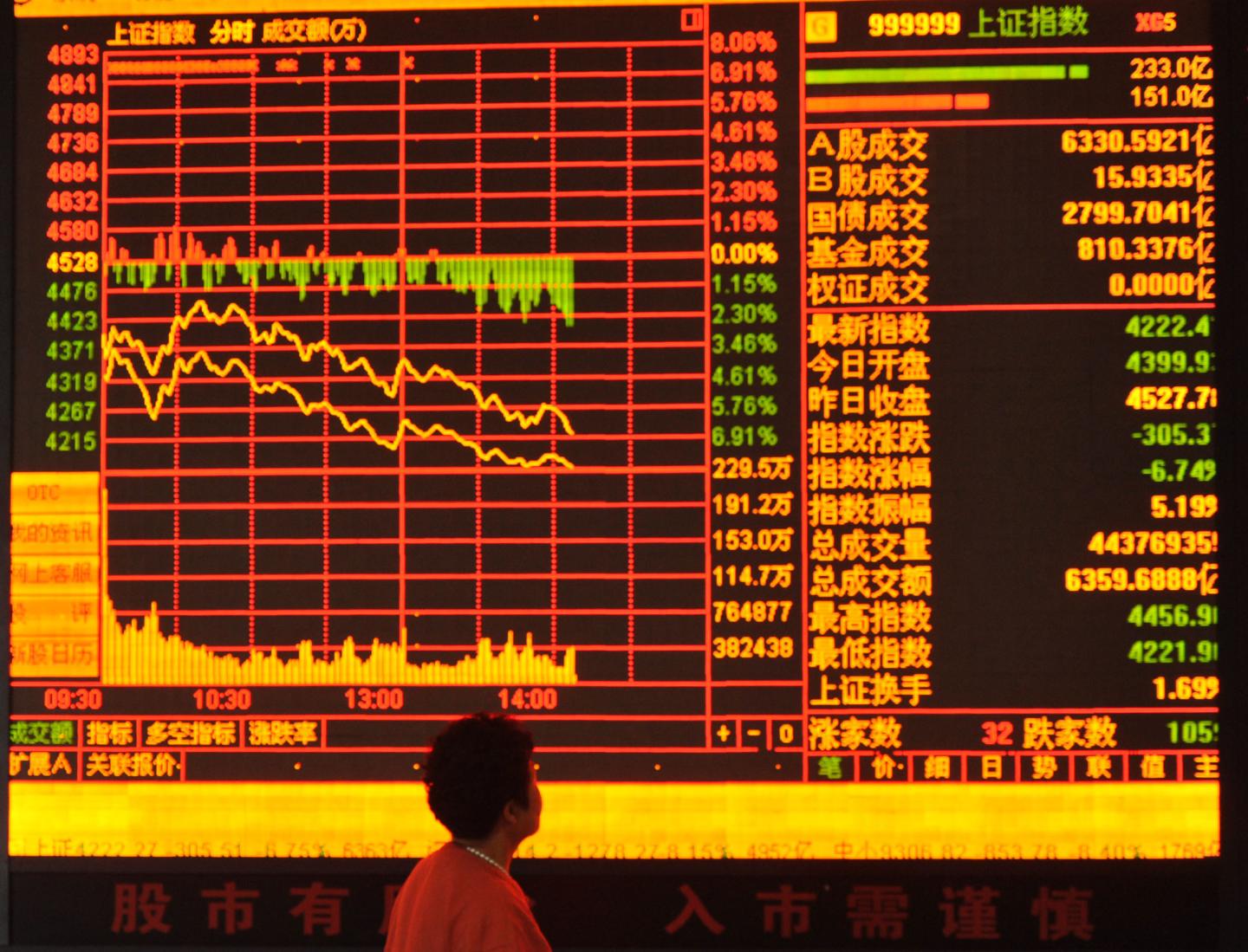
FUYANG, CHINA - JUNE 26:(CHINA OUT) An investor observes stock market at a stock exchange hall on June 26, 2015 in Fuyang, Anhui province of China. Chinese stocks dropped sharply on Friday. The benchmark Shanghai Composite Index lost 334.91 points, or 7.40 percent, to close at 4192.87 points. The Shenzhen Component Index shed 1293.66 points, or 8.24 percent, to 14398.78 points. (Photo by ChinaFotoPress)***_***
FUYANG, CHINA - JUNE 26:(CHINA OUT) An investor observes stock market at a stock exchange hall on June 26, 2015 in Fuyang, Anhui province of China. Chinese stocks dropped sharply on Friday. The benchmark Shanghai Composite Index lost 334.91 points, or 7.40 percent, to close at 4192.87 points. The Shenzhen Component Index shed 1293.66 points, or 8.24 percent, to 14398.78 points. (Photo by ChinaFotoPress)***_***Photograph by ChinaFotoPress/Getty Images
U.S. equities rebounded strongly early Tuesday — only to fall again by the end of the day. Despite the continuing volatility, nothing much really changed since the start of the week except investor sentiment. And therein lies the clue to why another crash could be coming.
Monday’s frantic sell-off was driven ostensibly by concerns over China’s slowing economy, currency devaluation, and distressed commodity prices, but this doesn’t fully explain what happened. China’s challenges aren’t new or even sudden. The economy has been slowing for some time; analysts have expressed concern about inflated prices for a while, and the currency devaluation was within a narrow band that restored the yuan to a more realistic level rather than being the drastic blow to U.S. imports that people think it will be. As for commodity prices, oil has been falling steadily for a more than a year.

The sell-off was at least as much the result of sheer, irrational panic as a careful consideration of macroeconomic factors. Sure, high-frequency trading and the volatility it can precipitate undoubtedly made things worse but seller psychology played a big part.

The perfect example of this is Netflix (NFLX). Even though the streaming video giant has announced a valuable agreement with SoftBank (TYO) for its Japan expansion next month and its prospects remain good, its stock was hammered. Netflix may face challenges when it enters China due to the soft economy, but that market is already fraught with difficulties. So macroeconomic factors can hardly explain why investors were suddenly so bearish on the company.

This is even more mystifying if you consider that the majority of Netflix’s business is conducted in the U.S., where the economy is relatively strong and improving. The only logical explanation is that the run on Netflix’s stock was the result of investors racing blindly for the door after European and Asian markets yelled “fire!” As the day progressed and the panic spread across major news outlets, the more investors rushed to unload their shares and stem their losses, which pushed the needle down even further.

Tuesday was the exact reverse. Buoyed by stronger European markets and a Chinese stimulus in the form of lower interest rates and relaxed reserve requirements for banks, and exhausted from Monday’s carnage, U.S. investors sought relief. That sentiment helped prop up the markets right from the start and, not by coincidence, shaped media coverage. The more confident people felt reading the news and analyst prognostications, the more they rushed back in to buy stocks. Netflix, which had started Monday at about $89 per share, opened the next day at almost $108.

But the fact that the euphoria was so short-lived signals what could happen in the weeks ahead.

The reason that investors quickly lost faith in the so-called recovery was because there was nothing tangible to back it up. Just as the panic a day earlier was irrational, so was the hope that followed. Despite the Chinese government’s short-term stimulus to encourage buying and stabilize the country’s stock market, the long-term impact on its economy is yet to be seen, and it’s that which will determine how much China’s slowdown will impact the rest of the world. As if in confirmation, Chinese equities fell again Tuesday. The price of oil rose a little but is still at a multi-year low.

[fortune-brightcove videoid=4441886976001]

Ideally, things should settle down now that one cycle of panic and hope are over. But the extreme investor behavior of the last few days, the memory of Black Monday, and the fact that the global problems that started it all haven’t gone away, mean that the U.S. stock market is a powder keg that could easily erupt again. All it would take is another catalyst, like perhaps the Federal Reserve surprising U.S. markets by raising interest rates sooner than later; a decline in corporate earnings in the third quarter; or some other unexpected international crisis to spark another panic.

That’s not all bad, of course. If you’re an astute investor with an appetite for some risk, watch for that next big dip. It may be scary, but it will contain some great buying opportunities and some handsome profits when the market comes back to its senses. Again.

S. Kumar is a tech and business commentator. He has worked in technology, media, and telecom investment banking. He is not an investor of Netflix or Softbank.

About the Author
By S. Kumar
See full bioRight Arrow Button Icon

Latest in Commentary

Rakesh Kumar
CommentarySemiconductors
China does not need Nvidia chips in the AI war — export controls only pushed it to build its own AI machine
By Rakesh KumarDecember 3, 2025
21 hours ago
Rochelle Witharana is Chief Financial and Investment Officer for The California Wellness Foundation
Commentarydiversity and inclusion
Fund managers from diverse backgrounds are delivering standout returns and the smart money is slowly starting to pay attention
By Rochelle WitharanaDecember 3, 2025
21 hours ago
Ayesha and Stephen Curry (L) and Arndrea Waters King and Martin Luther King III (R), who are behind Eat.Play.Learn and Realize the Dream, respectively.
Commentaryphilanthropy
Why time is becoming the new currency of giving
By Arndrea Waters King and Ayesha CurryDecember 2, 2025
2 days ago
Trump
CommentaryTariffs and trade
The trade war was never going to fix our deficit
By Daniel BunnDecember 2, 2025
2 days ago
Elizabeth Kelly
CommentaryNon-Profit
At Anthropic, we believe that AI can increase nonprofit capacity. And we’ve worked with over 100 organizations so far on getting it right
By Elizabeth KellyDecember 2, 2025
2 days ago
Decapitation
CommentaryLeadership
Decapitated by activists: the collapse of CEO tenure and how to fight back
By Mark ThompsonDecember 2, 2025
2 days ago

Most Popular

placeholder alt text
North America
Jeff Bezos and Lauren Sánchez Bezos commit $102.5 million to organizations combating homelessness across the U.S.: ‘This is just the beginning’
By Sydney LakeDecember 2, 2025
2 days ago
placeholder alt text
Economy
Ford workers told their CEO 'none of the young people want to work here.' So Jim Farley took a page out of the founder's playbook
By Sasha RogelbergNovember 28, 2025
6 days ago
placeholder alt text
North America
Anonymous $50 million donation helps cover the next 50 years of tuition for medical lab science students at University of Washington
By The Associated PressDecember 2, 2025
2 days ago
placeholder alt text
C-Suite
MacKenzie Scott's $19 billion donations have turned philanthropy on its head—why her style of giving actually works
By Sydney LakeDecember 2, 2025
2 days ago
placeholder alt text
Innovation
Google CEO Sundar Pichai says we’re just a decade away from a new normal of extraterrestrial data centers
By Sasha RogelbergDecember 1, 2025
3 days ago
placeholder alt text
Economy
Scott Bessent calls the Giving Pledge well-intentioned but ‘very amorphous,’ growing from ‘a panic among the billionaire class’
By Nick LichtenbergDecember 3, 2025
16 hours ago
Rankings
  • 100 Best Companies
  • Fortune 500
  • Global 500
  • Fortune 500 Europe
  • Most Powerful Women
  • Future 50
  • World’s Most Admired Companies
  • See All Rankings
Sections
  • Finance
  • Leadership
  • Success
  • Tech
  • Asia
  • Europe
  • Environment
  • Fortune Crypto
  • Health
  • Retail
  • Lifestyle
  • Politics
  • Newsletters
  • Magazine
  • Features
  • Commentary
  • Mpw
  • CEO Initiative
  • Conferences
  • Personal Finance
  • Education
Customer Support
  • Frequently Asked Questions
  • Customer Service Portal
  • Privacy Policy
  • Terms Of Use
  • Single Issues For Purchase
  • International Print
Commercial Services
  • Advertising
  • Fortune Brand Studio
  • Fortune Analytics
  • Fortune Conferences
  • Business Development
About Us
  • About Us
  • Editorial Calendar
  • Press Center
  • Work At Fortune
  • Diversity And Inclusion
  • Terms And Conditions
  • Site Map

© 2025 Fortune Media IP Limited. All Rights Reserved. Use of this site constitutes acceptance of our Terms of Use and Privacy Policy | CA Notice at Collection and Privacy Notice | Do Not Sell/Share My Personal Information
FORTUNE is a trademark of Fortune Media IP Limited, registered in the U.S. and other countries. FORTUNE may receive compensation for some links to products and services on this website. Offers may be subject to change without notice.