Retail CEOs from former J.C. Penney (JCP) boss Ron Johnson to Gap Inc’s (GPS) Art Peck to J.Crew head Mickey Drexler have long lamented shoppers’ addiction to discounts, sometimes going so far as to invoke the image of a needle in a junkie’s arm.
Finally, more and more of these companies are waking up to the fact that by improving their products and changing how they operate so they can quickly capitalize on fashion trends or, conversely, get out of a clothing line that is flopping, they can begin to contain the havoc that clearance markdowns wreak on profit margins.
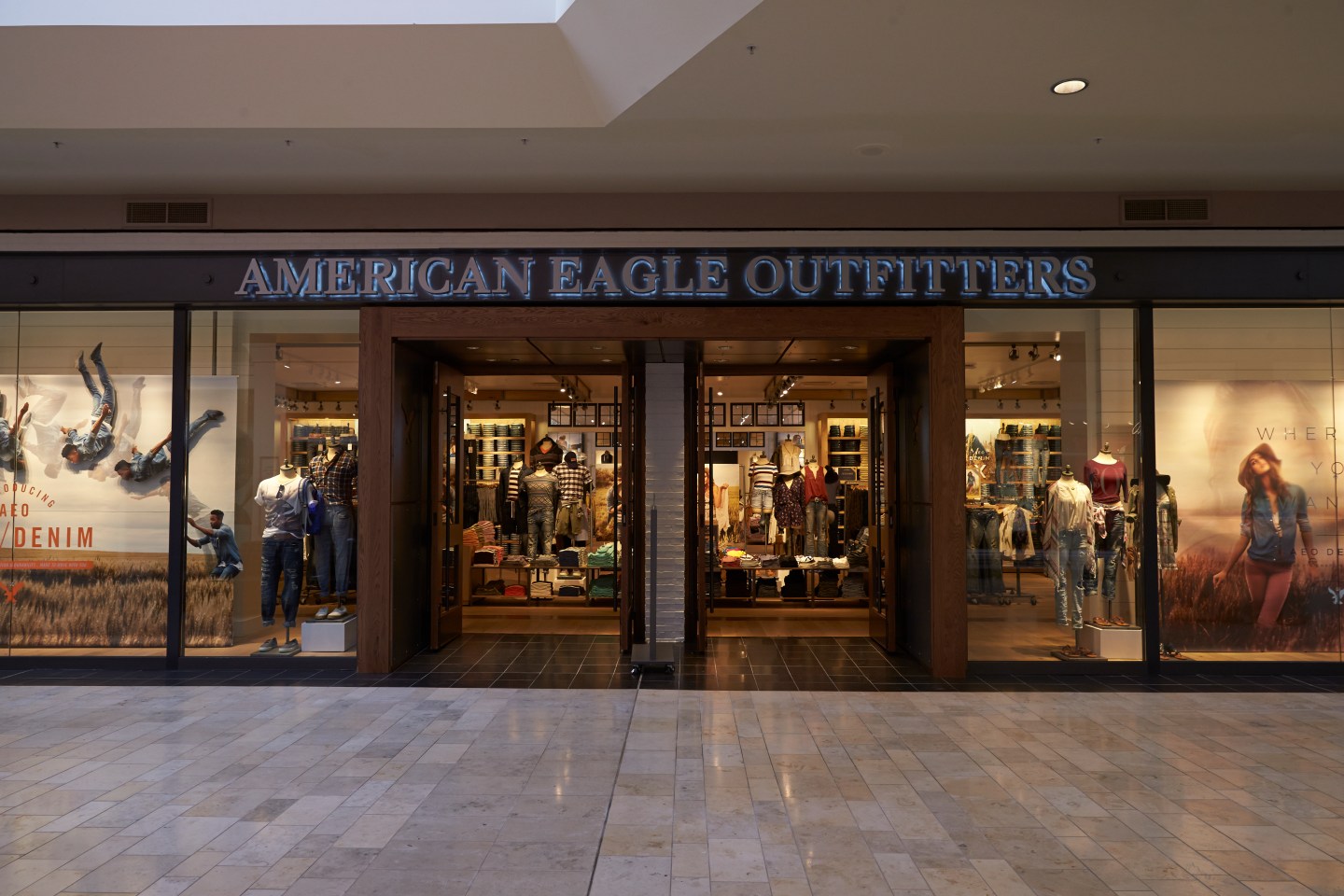
The experience in the past year of one teen apparel retailer, American Eagle Outfitters (AEO), offers a glimmer of hope to an industry whose products are now seen as interchangeable commodities by shoppers.
In 2013 and through most of last year, American Eagle was experiencing a painful sales bleed, suffering from the same loss of market share to fast-fashion upstarts like H&M and Uniqlo that Gap and J.Crew were experiencing. What’s more, it was also dealing with drama in the C-suite: a star executive brought in as CEO to rejuvenate American Eagle was out after less than two years in early 2014.
Fed up with seeing its profitability wane, the Pittsburgh-based clothier, which was established in 1977, decided to dramatically rethink its approach to business.
By improving the quality of its jeans, including introducing a high-performance stretch fabric in its women’s jeans last year, and keeping leaner inventory, American Eagle put an end to its comparable sales slide and vastly improved its profit margins, making it the envy of its peers.
In the first quarter of 2015, comparable sales rose 7% at American Eagle, while its gross profit rose 2.6 percentage points to 37.5% of sales, with similar gains expected for the current quarter. Meanwhile, at Gap and Abercrombie & Fitch (ANF), sales and profits have continued to slide as those companies wait for their turnaround plans to yield results. (See graphic.)
“Everybody makes jeans, and most everybody is competing on pricing down,” Chad Kessler, global brand president for American Eagle Outfitters, told Fortune. “I don’t know that you can get off the merry-go-round without having something the customer is going to respond to.” (The company also operates the Aerie intimates brand, a much smaller business.)
Luckily for Kessler, customers have responded to American Eagle’s new women’s Denim X line, the aforementioned stretch fabric jeans, as well as its recently launched (in time for the crucial back-to-school season) Flex denim for men, which he says is more comfortable because the fabric moves in closer sync with the wearer and is resistant to bagginess.
Those initiatives have helped American Eagle blunt the potential blow from its deliberate move in 2014 to de-emphasize sales and discounts. On a recent trip to the company’s flagship in New York City’s Times Square, there were nearly no sale signs in the store. By contrast, nearby Gap, Abercrombie, and Aeropostale (ARO) locations boasted deep discounts all over.
Kessler, who came to American Eagle in early 2014 after stints at Urban Outfitters, Coach, and Abercrombie, said that buy-in from the vendors and mills the company uses has been key to getting access to newer, innovative fabrics, such as last year’s soft fabric for tops, as well as its ability to use different stitches.
American Eagle is also changing its approach to inventory management. The retailer has spent about two years getting inventory down to levels that are more in line with its sales, something that has been key to reducing its amount of markdowns as it leads to less clearance.
Kessler wants to push that effort further and have inventory grow more slowly than sales. The math would suggest that could lead to sales shortfalls. But the company could make that up by leaving wiggle room in its buying so it can jump more quickly on a hot trend, something key to battling the growing H&M, Uniqlo, and Zara fast-fashion chains.
“If we don’t get clogged up in inventory, then we can really react to what’s working, or what’s not working,” he says.
American Eagle’s efforts have pleased Wall Street. Shares are trading at about 80% above their 52-week low on the heels of the company’s nascent turnaround. “The teen customer can be fickle, and AEO management has done a great job at foretelling fashion trends, and correctly aligning their product and merchandise strategies to take advantage of it,” BlueFin Research Partners analyst Rebecca Duval said in a research note.
But as much as American Eagle appears to be getting back on track, it has its work cut out for itself if it wants to keep that momentum. H&M and Uniqlo are expanding quickly, and both are constantly innovating with its fabrics. And Gap has laid out its plan, modeled on the enormous success of its sister brand Old Navy, to get its mojo back. Abercrombie is plotting its return, too.
Yet American Eagle has a head start because it can more quickly adapt to the new competitive landscape knowing full well that continuing down the road many retailers have walked—one of discounts, discounts, discounts—is a business dead-end.
“The rest of the market continues to be promotional,” says Kessler. “I wonder if customers are a little numb to it.”

(Courtesy of American Eagle Outfitters.)