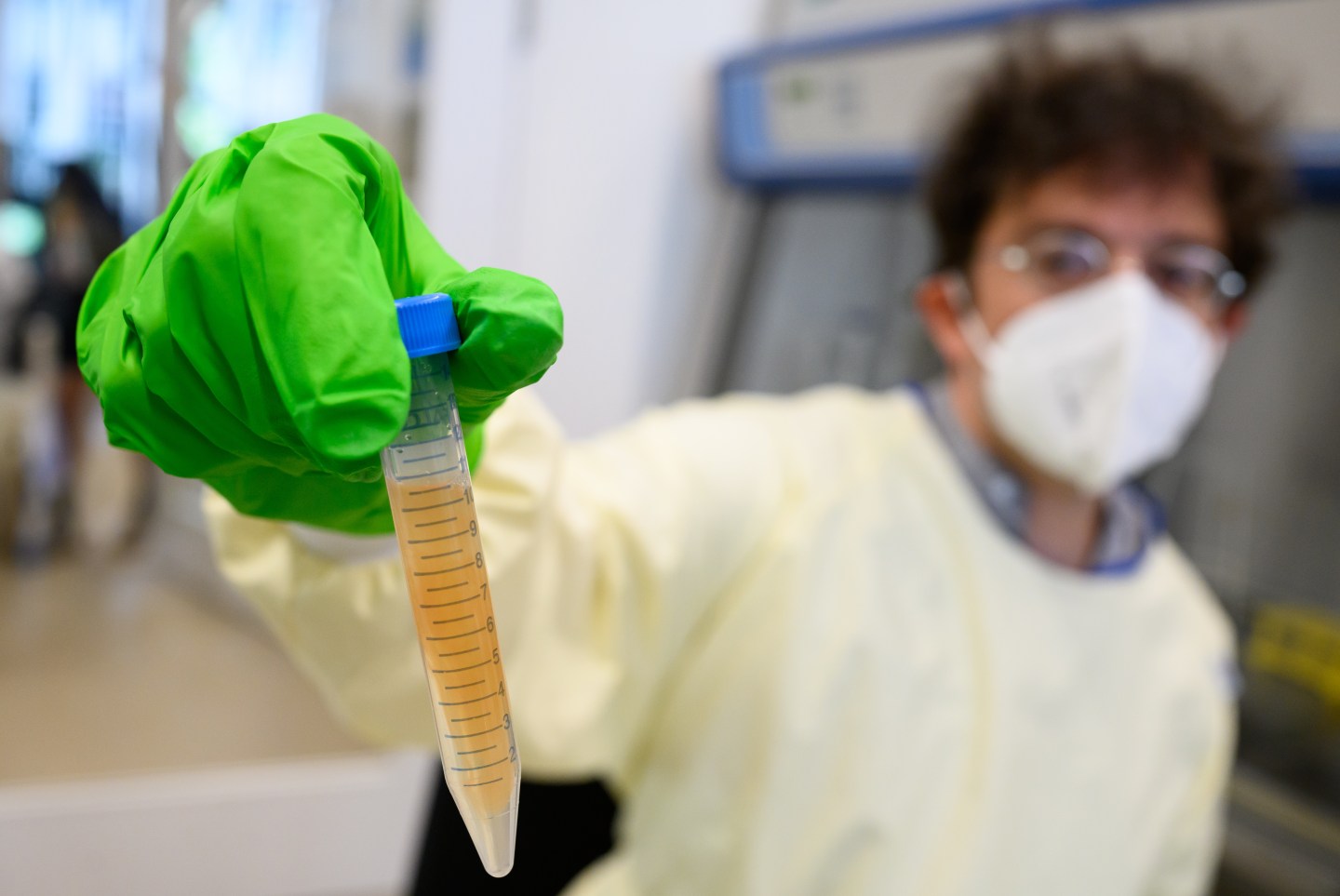
Scientists have spent an inordinate amount of time during the COVID pandemic sifting through sewage—an attempt to consult the “oracle in the toilet” as to what the virus holds next.
Their goal: trace the level of COVID in human waste to gauge its spread in individual cities and states. Scientists are even able to follow the trail further downstream, tracing particular variants to neighborhoods, and even buildings like offices.
But is it ethical?
Wastewater surveillance is a decades-old approach to epidemiology. It rose to prominence during the beginning of the COVID-19 pandemic, when it allowed universities to efficiently track outbreaks in dorms and quarantine accordingly. With COVID testing becoming less and less frequent, it’s become public health officials’ best tell of disease spread in the community.
But a science that has a potential to do so much good—some say it could help thwart the next pandemic—can also be misused. Determined sleuths can track a particularly curious strain of a virus to a region, then a neighborhood, then a location as specific as a home. And all this without your consent or even knowledge.
“On its face, it’s not unethical,” David Larsen, an environmental epidemiologist at Syracuse University in New York who studies wastewater, said of large-scale wastewater surveillance. But “ethical issues are very prominent” when the search becomes more targeted, he said, like tracing a specific viral variant found in a city sewer to a finite location. “I’m nervous about that, personally,” he said.
The signal in the sewer
A recent article in Nature highlighted the search of university scientists in Wisconsin for the source of a concerning, heavily mutated COVID variant. They hypothesized that it came from someone with a long-term COVID infection that likely receded from the lungs to the gut, where immune cells are less aggressive.
They traced the curious variant—initially found in wastewater from more than 100,000 state residents and countless animals—from the main plant to district lines, to subdistrict lines, to city manholes, to village manholes, to facility lines, to toilets, Nature reported.
Thus, they narrowed their search to a small office that employed 30 people. More than half of the business’s employees agreed to COVID nasal swab tests, according to Nature, but none seemed to harbor the variant in question. The researchers are now waiting for approval of a study that would test the stool samples of willing employees and, in the meantime, are looking in nearby sewers, hoping to track the variant to another location.
Though wastewater surveillance rose to prominence early on during the COVID-19 pandemic, the technology is hardly new. Dr. John Snow, the father of epidemiology, was the first person to document a waterborne disease outbreak—a cholera epidemic in London in 1854. Using germ theory, he was able to convince city officials that the scourge was tied to sewage-contaminated water coming from a pump on Broad Street. Once the pump’s handle was removed, ending the community’s access to water from that source, the outbreak was tamed.
So began the interest of scientists in divining water.
Wastewater surveillance, though far less sophisticated than its current state, played a large role in eradicating polio in the 20th century, in the U.S. and third-world countries alike. It was used to monitor the spread of hepatitis A in the U.S. in the 1980s, and has been used by law enforcement to track the flow of drugs in communities for decades.
As COVID testing reaches all-time lows in the U.S. and abroad, public health officials are relying on wastewater all the more as the only accurate measure of the disease’s spread.
Dr. Mark Siedner, an infectious disease doctor at Massachusetts General Hospital and associate professor at Harvard Medical School, went so far as to call wastewater “a public health dream scenario.”
“Everyone poops, and most people poop every day. It provides real-time data on infection rates,” he said. “In that regard, it’s an extremely powerful tool, particularly good at detecting early warning signs.”
A prisoner of public health?
At a community level, the public health benefits of wastewater surveillance are undeniable. The technology lets scientists and public health officials identify outbreaks and intervene accordingly. And it gives those examining its results an accurate, unbiased look at disease spread throughout the community—even in low-income areas, where access to health care and testing is often poor.
The debate over wastewater monitoring gets more heated over what to do after someone with a particularly threatening or interesting disease is identified using the technology. The scenario is a Pandora’s box, said Larsen, the Syracuse University epidemiologist.
He pointed to the case of an Arizona man with an extremely drug-resistant strain of tuberculosis. After visiting a Phoenix convenience store without a mask in 2006, he was held in a hospital jail ward for nearly a year and treated as an inmate.
County health officials claimed the man, Robert Daniels, posed a serious health risk to the community due to his disease and behavior. But Daniels, a Russian native with dual citizenship, told CBS News that he didn’t understand the severity of his condition, and that doctors in Russia didn’t wear masks around him.
In 2008, prosecutors brought felony charges—two counts of unlawful introduction of disease or parasite. By that time Daniels had undergone lung surgery and had been deemed noncontagious. He fled to his native Russia the next month.
A “Typhoid Mary”–type situation
The ethical conundrum wastewater can present also brings to mind the story of “Typhoid Mary”—a cook and an asymptomatic typhoid carrier who infected more than 50 individuals and killed at least three as she drifted from job to job on the East Coast in the late 1800s and early 1900s.
The woman, Mary Mallon, was well aware of the accusations, reportedly chasing with a knife the scientists who came to request stool and urine samples from her. But she never admitted to being a carrier and perhaps never understood how someone without symptoms could be one, according to National Geographic.
Eventually scientists and five policemen escorted her to a New York City hospital, where she tested positive and was quarantined in a small house on hospital grounds. In 1909, she sued the New York City Department of Health. The case landed in the U.S. Supreme Court, with her lawyer arguing that she had been imprisoned and denied due process. Mallon lost, with the court siding with public health officials and their desire to protect the public.
A sympathetic New York City health commissioner freed Mallon in 1910, after she promised to stop cooking for others, according to National Geographic. But she continued, eventually sparking an outbreak at a New York hospital, where she was working under a pseudonym.
Mallon was taken and returned to the grounds of the hospital she was first confined at, where she would live until she died of a stroke in 1938.
Neither Daniels’ case nor Mallon’s involved wastewater. But both serve as examples of the extent to which authorities might go to contain a public health threat—at the expense of personal rights.
Public health officials are “often governed by a utilitarian ethic” that seeks the “greatest good for the greatest number,” Larsen said. But such an approach must be tempered by a concern for personal freedoms, he noted.
“As we saw with COVID, individual rights will often be curtailed to reduce infectious disease transmission,” he said. “That’s where the tension is, where the balance is.”
The data should set you free
How can scientists and public health officials strike such a balance?
It’s a question that must be given thought—especially with wastewater science advancing as rapidly as it is, says Peter Grevatt, CEO of the Water Research Foundation, a nonprofit that seeks to advance water science and improve quality of life.
“Taking biological samples from a group of individuals who haven’t necessarily provided consent for you to do so, gathering information about their health status—it’s not quite at the level of personal infectious disease information, but it’s close,” he said.
He added: “One must ask, ‘What is the right way to handle this information?’ It’s a really important part of the discussion as one is designing a study.”
For now, wastewater-based epidemiology has little oversight, primarily because it doesn’t involve collecting samples directly from individuals and, thus, doesn’t require consent. A pandemic-era guidance published by the U.S. Centers for Disease Control and Prevention on wastewater surveillance addresses only logistics and doesn’t delve into ethical concerns and best practices.
Courts, however, could interpret the small-scale collection of wastewater data as a violation of the Fourth Amendment, which protects U.S. citizens from unreasonable search and seizure, according to a June 2020 article in the Journal of Law and the Biosciences. The U.S. Supreme Court has “recognized that the collection and analysis of biological samples may intrude upon reasonable expectations of privacy,” and, thus, constitute a search under the amendment, according to the article.
Grevatt pointed to a set of ethical guidelines for wastewater surveillance from the European Monitoring Centre for Drugs and Drug Addiction that could inform the actions of U.S researchers.
Some of the recommended best practices included anonymizing data—perhaps by mixing samples from multiple sites, like suburbs, so as not to stigmatize or single out a particular community.
Researchers should also consider how results might be interpreted by the media, deemphasizing the fault of community members, the guide states. It also recommends that scientists using wastewater-based epidemiology seek approval from a research ethics committee, even if such approval isn’t required.
“Wastewater has a story to tell about the health of a community,” Grevatt contended. But those involved in research involving it must keep the preservation of public health—and that goal alone—top of mind.
He cited a project in which his foundation collaborated with law enforcement to track the flow of drugs in wastewater in multiple cities. In one location, a weekend spike in the presence of cocaine was noted, signaling parties at which illicit drugs were being used. But there was a conscious effort by the foundation and police to ensure the information obtained was used to advance public health goals, Grevatt says.
Wastewater surveillance—when used correctly—can actually increase personal rights, Larsen argued. That’s the goal, anyway.
“When done well, wastewater surveillance should increase freedoms as opposed to curtailing them,” he said. “By preventing disease transmission, we actually maximize freedoms that are curtailed by infectious diseases.”