Just below the arctic circle, Northvolt’s flagship battery factory once stood as a beacon of Europe’s ambitions to power its future with clean energy. But following the company’s recent bankruptcy, its last production lines have fallen silent.
There is still hope that a buyer might emerge to revive the fortunes of the small Swedish factory town dependent on Northvolt’s success. Silicon Valley startup Lyten has already taken over Northvolt’s Polish plant, and Swedish truck manufacturer Scania has expressed interest in putting together a consortium to acquire its R&D facility.
Yet one thing is certain: Neither the European Union nor Sweden will rescue Northvolt, even though it was once Europe’s best funded startup, having secured $15 billion in funding commitments from investors and governments.
How a company founded by two former Tesla executives managed to fail despite such a massive amount of capital will be a case study for business schools for years to come. It also raises questions as to whether the government did enough to support its former battery champion, and how Europe should revise its approach to competing with China in high-growth, low-carbon industries.
What went wrong?
While Canada and Germany both provided significant support and grants to the Swedish company, its home country largely abstained, understandably raising criticism from shareholders and former executives. After all, the dominant Chinese industry has long benefited from state aid, which helped it reach the maturity to drive down unit costs to 30% lower than batteries made in Europe.
However, it’s far from clear whether more financial support would have made a decisive difference, given that Northvolt was already so well financed. According to Craig Douglas, a partner at climate tech venture capital firm World Fund, Northvolt’s problems had more to do with the difficulty of playing catch-up with China, and the missteps it made along the way.
“If you want to scale up new production capability in a commoditized market, your executions have to be spectacular; Northvolt’s were not,” says Douglas. “They continued to scale up and expand geographically before they had a good handle on their actual production capability. They did not get their yield numbers up, and their delivery times were delayed, so they could not be competitive.”
As a result, automotive customers started losing confidence. BMW delivered a major blow by canceling a $2.15 billion order amid delays. Scania had to secure alternative supply for its electric fleet as Northvolt struggled to ramp up output.
Even Volkswagen, which held a 21% stake in Northvolt, eventually lost faith and took a major write-down on its investment in 2024, moving forward with its own subsidiary, PowerCo—a move that underscores the ongoing demand for homegrown batteries.
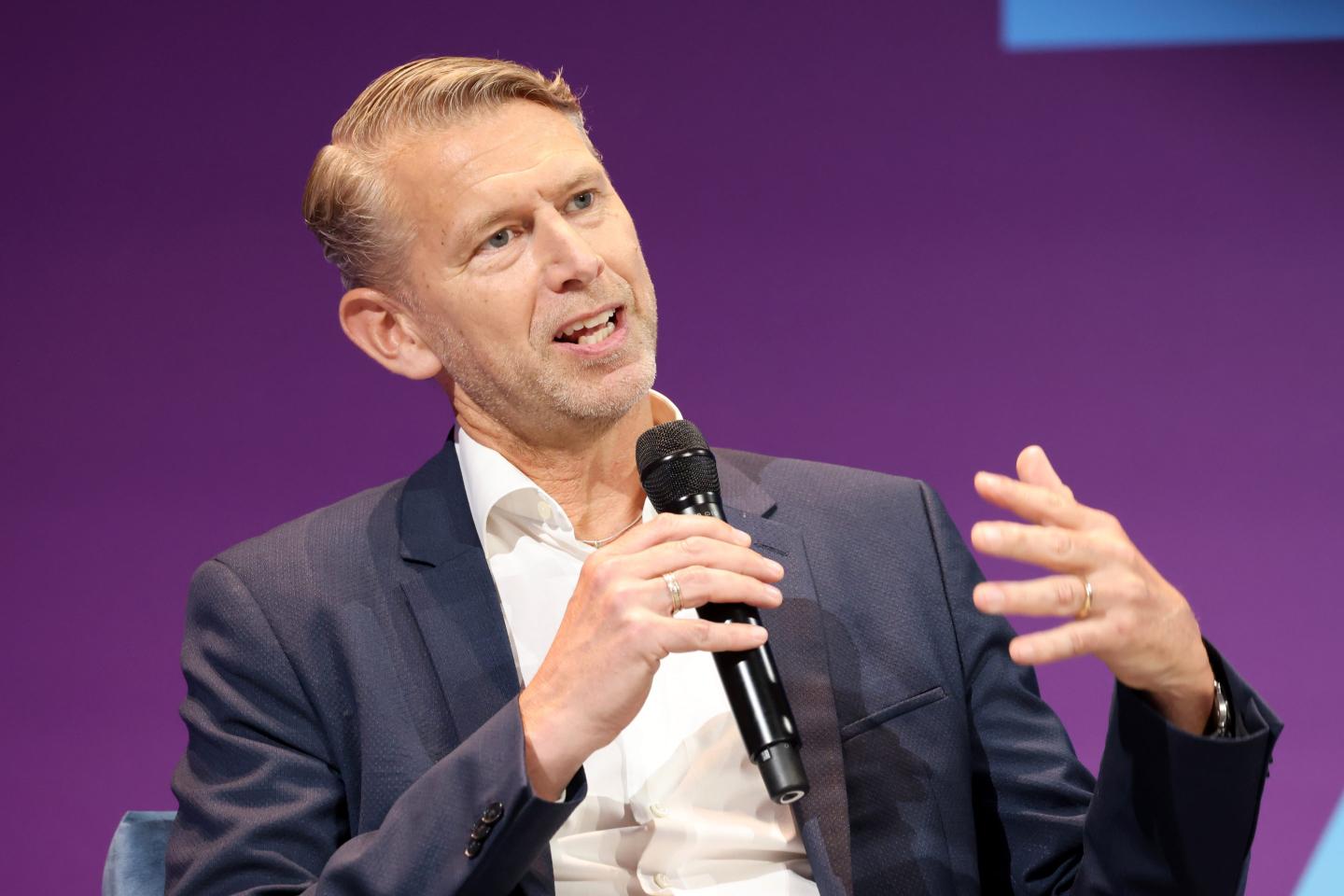
Stepping down as CEO after the company applied for Chapter 11 bankruptcy in the U.S., Northvolt cofounder Peter Carlsson said that while the company’s challenges were multifaceted, he had to take responsibility for the fact it had ended up in this situation.
A make-or-break moment for Europe’s EV sector
Northvolt’s failure is undeniably a blow to the wider ecosystem. For Douglas, it “will make a lot of the larger investors nervous about future scale-ups, and stakeholders will be much more focused on the scale-up manufacturing risks than before.”
“If you want to scale up new production capability in a commoditized market, your executions have to be spectacular; Northvolt’s were not.”
Craig Douglas, a partner at climate tech venture capital firm World Fund
However, it’s important to remember that Northvolt wasn’t the only scale-up in the race. “It’s not because some have struggled, like Northvolt, that it’s the end of the game. Europe needs to keep pushing,” French entrepreneur Benoit Lemaignan recently said. His startup, Verkor, is backed by Renault, and secured $2.15 billion to build an EV battery gigafactory in Dunkirk, France.
Once presented as the French Northvolt, Verkor has moved more slowly than its former peer. Although its pilot line located in Grenoble is manufacturing cells—the basic units that store energy in a battery—full-scale production in Dunkirk hasn’t started yet.
This means that Verkor is still in a critical transition phase, but it can at least now count on a little help from Brussels.
The European Commission recently announced it will distribute approximately $1 billion in grants to six EV battery projects, as it seeks to level the playing field and support Europe’s transition to a clean, competitive, and resilient industrial base. These include Verkor, but also NOVO Energy, a former joint venture between Northvolt and Volvo Cars, the latter of which recently took full ownership; Cellforce, owned by Porsche; and ACC, backed by Stellantis and Mercedes-Benz.
“It’s not because some have struggled, like Northvolt, that it’s the end of the game. Europe needs to keep pushing.”
Benoit Lemaignan, French entrepreneur and cofounder of Verkor
“There are enough examples in history that show that it is seldom too late to catch up, but the question is whether we are willing to do what it takes to compete,” says Andreas Fischer, a founding partner at deep tech VC firm First Momentum Ventures. In his view, this would require investing heavily in the entire European EV industry, not trying to pick a “winning” company.
Protectionism, specialization, and long-termism
It’s a view shared by the International Energy Agency (IEA), which says that we’re in a “make or break” moment for the European battery industry. Although China—which has extensive manufacturing know-how and supply-chain integration—now produces three-quarters of batteries globally, there are pathways for building a more competitive battery industry in Europe, beyond blanket subsidization.
“All start with ensuring strong domestic demand, which gives manufacturers time to hone production processes and develop strong regional industrial ecosystems. On this front, clear policy that signals continued demand growth and reduces investment risks is essential,” the IEA wrote earlier this year.
Fischer adds that policy support for the European battery industry would also need to involve either loosening regulations or turning to protectionist policies, such as the Carbon Border Adjustment Mechanism, an EU system to confirm that a price has been paid for the carbon emitted during the production of certain imported goods, which will fully apply from 2026.
Douglas agrees—“things like the CBAM or local content requirements could help create a level playing field with a clearer value add for being local”—but still thinks it is going to be difficult for Europe to compete in the two main types of lithium-ion batteries currently used in electric vehicles: LFP (lithium iron phosphate), prices for which have dropped, especially in China; and NMC (nickel manganese cobalt oxide), in which Korea and Japan have developed strong expertise.
Instead, Douglas believes that Europe stands a better chance at high-end cells and new cell chemistry. He also points to other related industries where the price gap with China is either less, or just less important: “Decarbonized industrial manufacturing, recycling and circularity, biotech and agritech, and energy business model innovations all have great starts in Europe.”
Nonetheless, Northvolt’s collapse exposed scale-up shortcomings that need to be addressed if Europe wants to build the supply chains that are crucial for its sovereignty, in EV batteries and beyond.
One of these, according to Herbert Mangesius, a general partner at early-stage deep tech VC firm Vsquared, is that Western VC ecosystems should better appreciate how hard it is to build economically viable production systems at the scale and sophistication of China’s. “It is crucial to have appropriate risk management and oversight engraved in governance structures, i.e., the ability to judge progress relative to budgets,” he cautions.
At a system level, cheap energy and a skilled workforce are also a necessary “baseline” for competitiveness, Mangesius adds. Achieving those can take time, but that itself is a lesson in how the Chinese built their own thriving industries. Says Mangesius: “China shows consistency in industry policies, which allows reliable and competitive ecosystems to build up, in particular in clean-tech sectors.”
Europe lags the U.S. and China in key growth sectors due to costly energy and stalled market reforms. This article series explores how technology, regulation, and innovation can revive its competitiveness.