• Home
  • Latest
  • Fortune 500
  • Finance
  • Tech
  • Leadership
  • Lifestyle
  • Rankings
  • Multimedia
Commentaryspace
Europe

A new space race is taking shape as sovereign and newer satellites compete for world domination

By
Jean-François Morizur
Down Arrow Button Icon
By
Jean-François Morizur
Down Arrow Button Icon
March 8, 2024, 11:18 AM ET
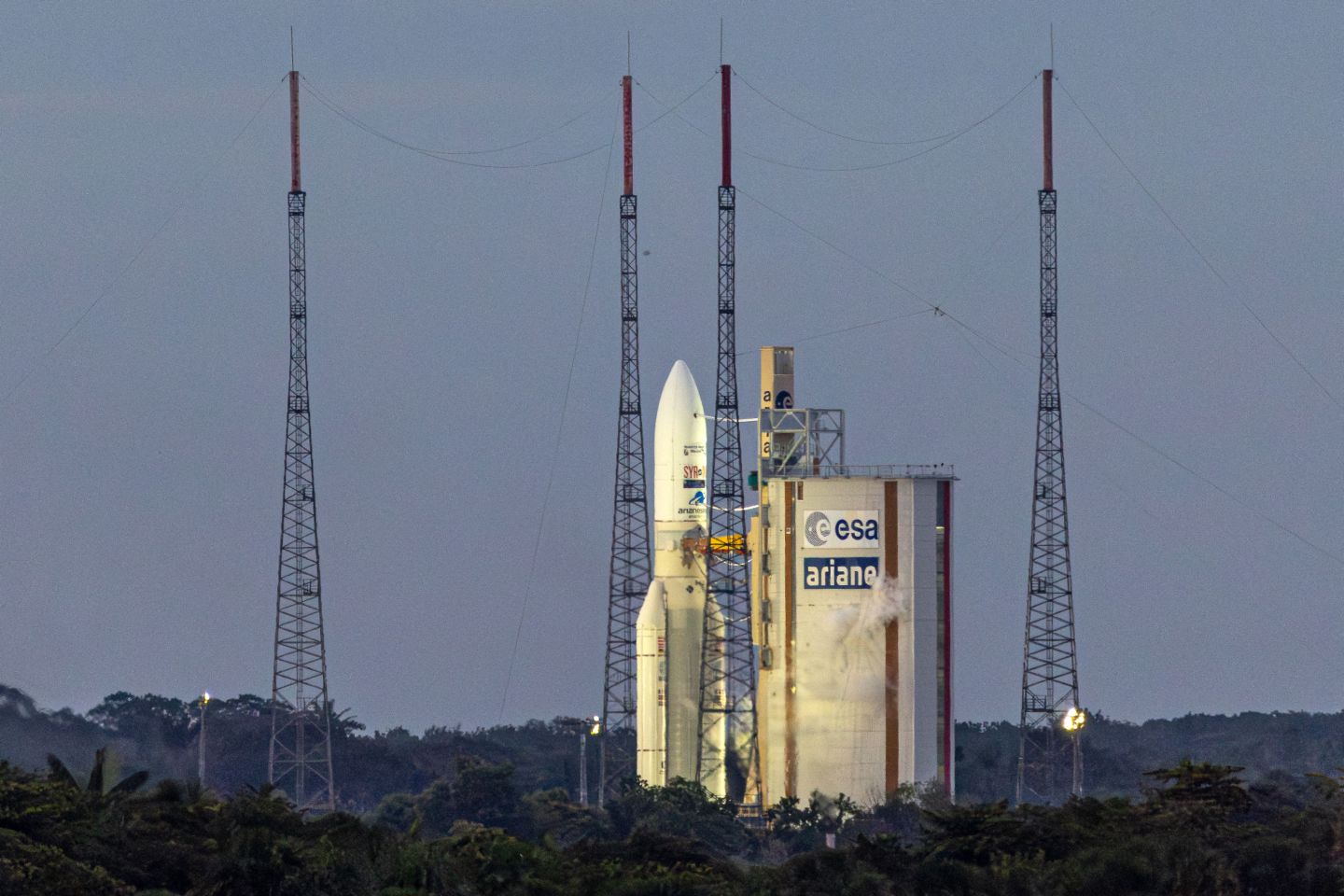
The European Space Agency has launched a competition for the replacement of its flagship Arianne 6 rocket.
The European Space Agency has launched a competition for the replacement of its flagship Arianne 6 rocket.JODY AMIET - AFP - Getty Images

In 2024, tensions in space are poised to reach boiling point as the sector continues to expand. In recent years space has become increasingly dominated by a handful of newer upstart companies notably SpaceX and Project Kuiper. 5,000 Starlink satellites, all operated by Elon Musk’s SpaceX, offer internet coverage to over 70 countries, and it is set to expand further in 2024. Project Kuiper, an Amazon initiative, aims to rival Starlink with a 3,236-strong satellite constellation designed to provide low-latency broadband globally. By 2029, it hopes to double the average broadband speed for U.S. consumers.

Traditional geostationary satellite operators, such as ViaSat and SES, are feeling their historic dominance ebb away, and sovereign operators are getting anxious about maintaining their interests as these (mainly) U.S.-based entities gain ascendency.

Space does not belong to anyone. And many–including sovereign powers–are uncomfortable with the way in which satellites owned by a handful of players are proliferating in Earth’s orbit. With low-Earth orbit satellites set to double in the near future, tensions in space, and here on the ground are bound to increase. The complexity of the situation and the number of countries involved make any future outcome hard to predict.

Competition to launch

To redress the balance, the European Space Agency (ESA) is set to launch several new satellite missions under its Galileo, EarthCARE, Copernicus programs in 2024, which it has described as a “year of launches.” This reflects not only a global space race that has been heating up but also the increasingly essential role satellites play in our lives. From communication to navigation, defense to telecoms, satellites are key. Europe has lagged behind the U.S. and China, but it aims to be a big player.

Morgan Stanley forecast the space industry to be worth $1 trillion by 2040. Yet, the ESA continues to be plagued by delays in launching its own flagship launch system, Ariane 6. In a bid to further stimulate Europe’s space industry, the ESA launched a competition for the next generation of rockets in November last year. Initially, this was for an intermediate launcher, and then for a successor to Ariane 6. ArianeGroup, owned by France’s Airbus and Safran, will no longer be the guaranteed Europe’s company of choice. This could prove promising: Europe has close to 20 start-ups developing micro-launchers and most have plans for larger rockets.

Star wars

Space technology is also key to military primacy. If countries fall behind, they risk losing wars in the future. Satellites are key to finding, and destroying, targets. America is continuing to intensify its efforts in space to maintain its competitive edge with the Department of Defence’s Space Force budget for 2024 set to reach $30 billion.

Pressure on the spectrum

More satellites in space means more pressure on the spectrum in orbit, which enables Wi-Fi in planes, navigation, some mobile communications, broadcasting, and a large number of other services. This segment of the radio spectrum, which is used by satellites in orbit, is finite, and operators must transmit their signals on different bands of it. This prevents their transmissions from interfering with each other. Laser can relieve some of the pressure on the spectrum since laser communications do not compete for spectrum–but only some.

Global regulators and industry have put in place terms and conditions to reduce the likelihood of signals interfering with each other. Service providers are bound by these. But the upstart companies–notably SpaceX and Project Kuiper–want those terms and conditions to evolve to better reflect current requirements and technology. They say the rules, implemented about a quarter of a century ago, are too strict. New technology allows for new radio links without degrading the networks of traditional geostationary satellite systems. By loosening the rules, you increase competition. That’s good news for smaller operators entering the space.

Opposition from regulators

Unsurprisingly, established satellite operators are often against this. Citing security, sustainability, competition, or a combination thereof, they can be resistant to a change in the rules. If regulators loosen the current regulation around the spectrum, they might risk increasing the likelihood of interference and a reduction in the quality of service. Yet if they don’t loosen the rules, then it’s at the expense of any new industry players and efficiency. At the World Radiocommunications Conference in Dubai last November, some evolution had been accepted, but a proposed larger change to the rules in 2027 was defeated. The problem at the heart of that proposal is still far from resolved.

Balancing interests and battling bottlenecks

Trying to balance intensifying commercial and sovereign interests in space is very difficult, and a legal bottleneck does no good for startups and smaller companies that don’t have an army of lawyers to fight their battles.

Yet those interests, sooner rather than later, will have to be balanced. It’s true that the rules in place are dated, and if the future of connectivity lies in low-Earth orbit, then it will be hard to justify stopping Starlink and other companies from providing customers with better connectivity. Moreover, as the U.S. example shows, competition in the space sector has a way of burning off inefficiencies and boosting innovation, generally to the benefit of ordinary people. Tensions between commercial operators and sovereign operators, and sovereign operators and other sovereign operators, will give rise to tensions back down on terra firma in 2024. More than ever, issues in the space sector–increasingly a key part of the global economy–will be influenced by international and geopolitical issues. Rather than advances in space technology or the availability of capital, the question of how to resolve these tensions will drive progress this year and in the years to come.

Jean-François Morizur is the founder and CEO of Cailabs.

More must-read commentary published by Fortune:

  • Here’s how the U.S., Europe, and China are faring in the post-pandemic race for economic growth
  • Global trade is at a critical juncture–and we can’t take it for granted, WTO meeting chair warns
  • The U.S. housing market is headed into a pivotal spring season as home sellers wait for their sweet spot, according to Opendoor
  • The anti-DEI movement has gone from fringe to mainstream. Here’s what that means for corporate America

The opinions expressed in Fortune.com commentary pieces are solely the views of their authors and do not necessarily reflect the opinions and beliefs of Fortune.

Join us at the Fortune Workplace Innovation Summit May 19–20, 2026, in Atlanta. The next era of workplace innovation is here—and the old playbook is being rewritten. At this exclusive, high-energy event, the world’s most innovative leaders will convene to explore how AI, humanity, and strategy converge to redefine, again, the future of work. Register now.
About the Author
By Jean-François Morizur
See full bioRight Arrow Button Icon

Latest in Commentary

Finance
Lorem ipsum dolor sit amet, consectetur adipiscing elit, sed do eiusmod tempor incididunt ut labore et dolore magna aliqua. Ut enim ad minim veniam
By Fortune Editors
October 20, 2025
Finance
Lorem ipsum dolor sit amet, consectetur adipiscing elit, sed do eiusmod tempor incididunt ut labore et dolore magna aliqua. Ut enim ad minim veniam
By Fortune Editors
October 20, 2025
Finance
Lorem ipsum dolor sit amet, consectetur adipiscing elit, sed do eiusmod tempor incididunt ut labore et dolore magna aliqua. Ut enim ad minim veniam
By Fortune Editors
October 20, 2025
Finance
Lorem ipsum dolor sit amet, consectetur adipiscing elit, sed do eiusmod tempor incididunt ut labore et dolore magna aliqua. Ut enim ad minim veniam
By Fortune Editors
October 20, 2025
Finance
Lorem ipsum dolor sit amet, consectetur adipiscing elit, sed do eiusmod tempor incididunt ut labore et dolore magna aliqua. Ut enim ad minim veniam
By Fortune Editors
October 20, 2025
Finance
Lorem ipsum dolor sit amet, consectetur adipiscing elit, sed do eiusmod tempor incididunt ut labore et dolore magna aliqua. Ut enim ad minim veniam
By Fortune Editors
October 20, 2025

Most Popular

Finance
Lorem ipsum dolor sit amet, consectetur adipiscing elit, sed do eiusmod tempor incididunt ut labore et dolore magna aliqua. Ut enim ad minim veniam
By Fortune Editors
October 20, 2025
Finance
Lorem ipsum dolor sit amet, consectetur adipiscing elit, sed do eiusmod tempor incididunt ut labore et dolore magna aliqua. Ut enim ad minim veniam
By Fortune Editors
October 20, 2025
Finance
Lorem ipsum dolor sit amet, consectetur adipiscing elit, sed do eiusmod tempor incididunt ut labore et dolore magna aliqua. Ut enim ad minim veniam
By Fortune Editors
October 20, 2025
Finance
Lorem ipsum dolor sit amet, consectetur adipiscing elit, sed do eiusmod tempor incididunt ut labore et dolore magna aliqua. Ut enim ad minim veniam
By Fortune Editors
October 20, 2025
Finance
Lorem ipsum dolor sit amet, consectetur adipiscing elit, sed do eiusmod tempor incididunt ut labore et dolore magna aliqua. Ut enim ad minim veniam
By Fortune Editors
October 20, 2025
Finance
Lorem ipsum dolor sit amet, consectetur adipiscing elit, sed do eiusmod tempor incididunt ut labore et dolore magna aliqua. Ut enim ad minim veniam
By Fortune Editors
October 20, 2025
Rankings
  • 100 Best Companies
  • Fortune 500
  • Global 500
  • Fortune 500 Europe
  • Most Powerful Women
  • Future 50
  • World’s Most Admired Companies
  • See All Rankings
Sections
  • Finance
  • Leadership
  • Success
  • Tech
  • Asia
  • Europe
  • Environment
  • Fortune Crypto
  • Health
  • Retail
  • Lifestyle
  • Politics
  • Newsletters
  • Magazine
  • Features
  • Commentary
  • Mpw
  • CEO Initiative
  • Conferences
  • Personal Finance
  • Education
Customer Support
  • Frequently Asked Questions
  • Customer Service Portal
  • Privacy Policy
  • Terms Of Use
  • Single Issues For Purchase
  • International Print
Commercial Services
  • Advertising
  • Fortune Brand Studio
  • Fortune Analytics
  • Fortune Conferences
  • Business Development
About Us
  • About Us
  • Editorial Calendar
  • Press Center
  • Work At Fortune
  • Diversity And Inclusion
  • Terms And Conditions
  • Site Map
  • Facebook icon
  • Twitter icon
  • LinkedIn icon
  • Instagram icon
  • Pinterest icon

Latest in Commentary

paramount
CommentaryM&A
A cautionary Hollywood tale: the Ellisons’ lose-lose Paramount positioning
By Jeffrey Sonnenfeld and Stephen HenriquesJanuary 12, 2026
1 day ago
Walken
Commentarybeverages
Molson Coors CEO: We’re doing our part to solve society’s ‘occasion problem’ – and we’re getting some unexpected help
By Rahul GoyalJanuary 12, 2026
1 day ago
AsiaChina
What global executives need to ask about China in 2026
By Joe Ngai and Jeongmin SeongJanuary 11, 2026
2 days ago
Justin Harlan
Commentaryremote work
I run one of America’s most successful remote work programs and the critics are right. Their solutions are all wrong, though
By Justin HarlanJanuary 11, 2026
2 days ago
Gene Ludwig
Commentaryaffordability
Millions of Americans are grappling with years of declining economic wellbeing and affordability needs a rethink
By Gene Ludwig and Shannon MeyerJanuary 11, 2026
2 days ago
doctor
CommentaryMedicaid
Former White House advisor on the real reason your health care costs are going up: Medicare’s doctor pay gap
By Tomas J. PhilipsonJanuary 9, 2026
4 days ago

Most Popular

placeholder alt text
Economy
Treasury spent $276 billion in interest on the national debt in the final three months of 2025, says the CBO—up $30 billion from a year prior
By Eleanor PringleJanuary 12, 2026
1 day ago
placeholder alt text
Economy
‘Sell America’: Investors dump U.S. assets in fear of the end of Fed independence
By Jim EdwardsJanuary 12, 2026
1 day ago
placeholder alt text
Newsletters
The oil CEO who stood up to Trump is a follower of the disciplined 'Exxon way' and has a history of blunt statements
By Jordan BlumJanuary 13, 2026
7 hours ago
placeholder alt text
Success
An exec at $62 billion giant Colgate says Gen Z workers, despite getting flak for being woke and lazy, are actually ‘pushing us to get better’
By Emma BurleighJanuary 10, 2026
3 days ago
placeholder alt text
AI
This CEO laid off nearly 80% of his staff because they refused to adopt AI fast enough. 2 years later, he says he'd do it again
By Nick LichtenbergJanuary 11, 2026
2 days ago
placeholder alt text
Real Estate
'Something big' just happened in the U.S. housing market, real estate CEO says. And it could mean the difference of being able to buy a home or not
By Sydney LakeJanuary 12, 2026
1 day ago

© 2025 Fortune Media IP Limited. All Rights Reserved. Use of this site constitutes acceptance of our Terms of Use and Privacy Policy | CA Notice at Collection and Privacy Notice | Do Not Sell/Share My Personal Information
FORTUNE is a trademark of Fortune Media IP Limited, registered in the U.S. and other countries. FORTUNE may receive compensation for some links to products and services on this website. Offers may be subject to change without notice.










