• Home
  • Latest
  • Fortune 500
  • Finance
  • Tech
  • Leadership
  • Lifestyle
  • Rankings
  • Multimedia

Trendingnow

1

Jensen Huang says ‘a lot’ of six-figure jobs in plumbing and construction will soon be unlocked because someone needs to build new AI centers

2

Millennials say they’ll refuse to care for aging boomer parents—but they’ll be forced to as their inheritance shrinks to 40 cents on the dollar

3

The labor market could become so backward that the economy will have to shed jobs to keep unemployment steady

1

Jensen Huang says ‘a lot’ of six-figure jobs in plumbing and construction will soon be unlocked because someone needs to build new AI centers

2

Millennials say they’ll refuse to care for aging boomer parents—but they’ll be forced to as their inheritance shrinks to 40 cents on the dollar

3

The labor market could become so backward that the economy will have to shed jobs to keep unemployment steady
EnvironmentSustainability
Europe

Chocolate and cosmetic prices could soar on Europe’s new cocoa law that requires firms to prove that every bean they import didn’t contribute to deforestation

By
Mumbi Gitau
Mumbi Gitau
,
Baudelaire Mieu
Baudelaire Mieu
,
Ekow Dontoh
Ekow Dontoh
, and
Bloomberg
Bloomberg
Down Arrow Button Icon
By
Mumbi Gitau
Mumbi Gitau
,
Baudelaire Mieu
Baudelaire Mieu
,
Ekow Dontoh
Ekow Dontoh
, and
Bloomberg
Bloomberg
Down Arrow Button Icon
February 27, 2024, 6:04 AM ET
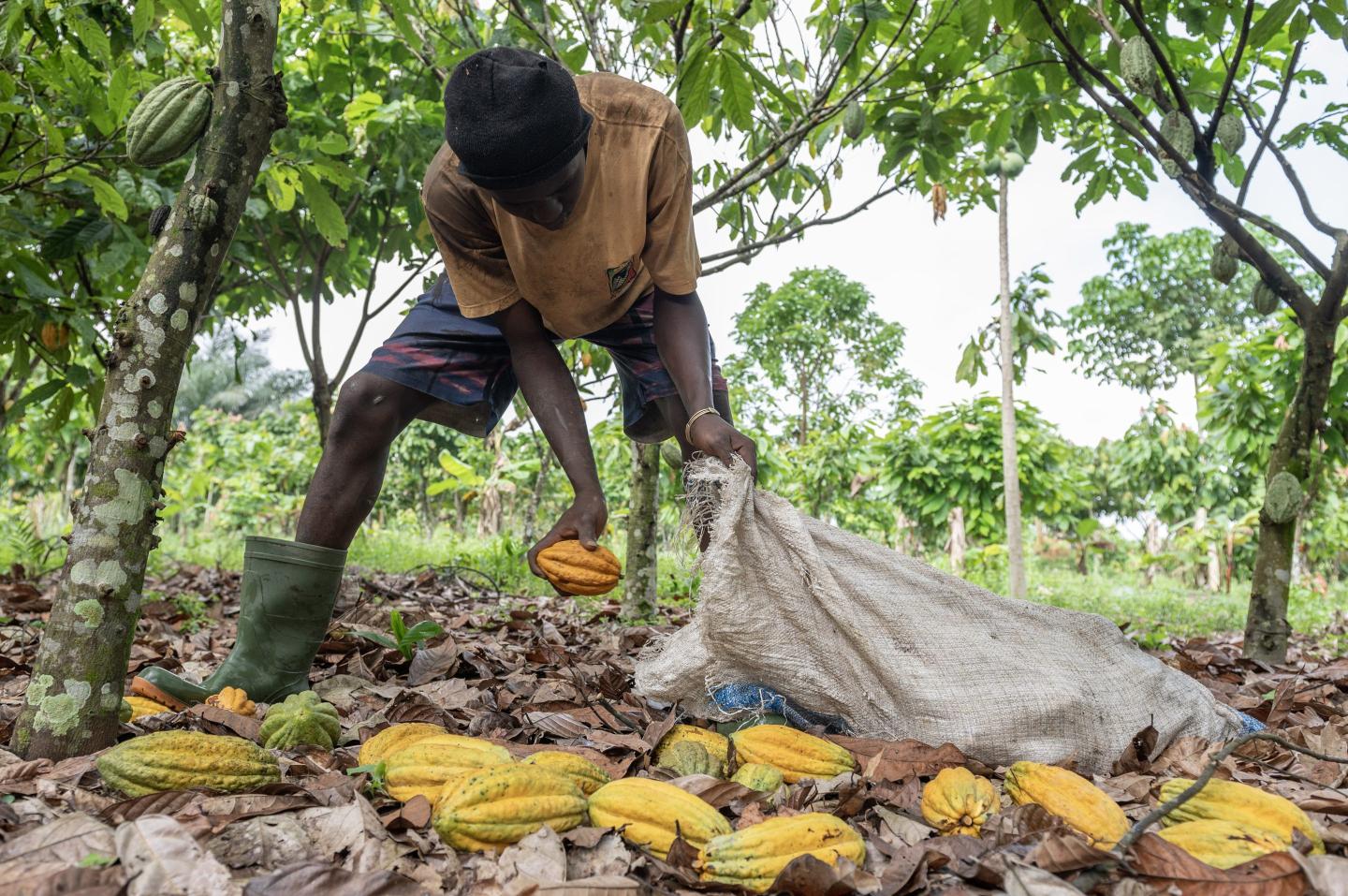
A worker gathers cocoa pods cut from trees into a sack on a farm in Azaguie, Ivory Coast.
Starting Dec. 30, the EU will require companies such as Ferrero Group, Nestle SA, and Mars Inc. to prove that every bean they import didn’t contribute to deforestation.Andrew Caballero-Reynolds—Bloomberg/Getty Images
Add Fortune on Google for similar content.

Cocoa’s journey from bean to bar winds through a rebagging plant like this one in San Pedro, Ivory Coast, where about 20 trailer trucks arrive every day brimming with tons of stock for international markets.

Workers wearing masks against the dust unload sacks weighing as much as 65 kilograms (143 pounds) and tear them open, prepping the contents for drying, sorting and cleaning. Others sweep loose beans on the floor into piles for collection.

Recommended Video

Everywhere you look and walk there are cocoa beans. Millions and millions are delivered to similar facilities in West Africa and then shipped to warehouses in Amsterdam; Hamburg; and Antwerp, Belgium, for the world’s top chocolatiers.

Yet a massive change is afoot that threatens to upend this supply chain and jolt prices for sweets, skin-care products and herbal medicines. Starting Dec. 30, the European Union will require companies such as Cargill Inc., Ferrero Group, Nestle SA and Mars Inc. to prove that every bean they import to the continent didn’t contribute to deforestation somewhere else.

That means tracing cocoa from pod to port, a costly mandate for an industry already staggered by declining production and record prices for futures. But no proof means no sale — a significant penalty given the 27-member EU is the biggest buyer from Ivory Coast and Ghana.

“There is a gun to our head to set up systems and get ready,” said Paul Davis, president of the European Cocoa Association industry group. “We expect disruption for about one to two years, and that could mean higher pricing in Europe.”

Every shipment — in bags or in bulk — will have to list the GPS coordinates of the farms where the cocoa was grown, and that information needs to be uploaded into an EU database. Cargill, Ferrero and Nestle said they’re building up their geolocation networks in Ivory Coast, which supplies 44% of the world’s cocoa.

None of the companies contacted would say how much they’re spending on their efforts, and they wouldn’t discuss whether consumers ultimately will foot those costs in the form of more expensive chocolate. It’s also unclear if the burden will fall on farmers, who already are among the world’s poorest.

During a Feb. 22 earnings call, Nestle Chief Executive Officer Mark Schneider said he is “very confident” the company will have a deforestation-free supply chain by the deadline.

Yet even while working to meet the mandate, some are pushing the bloc to delay implementation, according to Peter Feld, CEO of Barry Callebaut AG.

“The EU regulation came in place and actually didn’t talk to any of the players in the industry,” Feld said during a Nov. 1 earnings call. “The players are all engaging with the EU Commission to lobby for a transition period.”

The EU Deforestation Regulation, or EUDR, also covers palm oil, coffee, soy, timber and cattle — notorious drivers of clear-cutting. The law, reaching from the Amazon to Africa to Asia, applies to raw materials as well as products such as leather and furniture.

Without it, about 248,000 hectares (613,000 acres) of forest would be lost every year by 2030, the bloc estimated.

Beans deemed non-compliant by companies likely will be sold in the US or Asia — decidedly smaller, less-lucrative markets for West African producers. If the EU learns that a shipment broke the law, the penalties include fines, confiscation or a temporary ban on trading in the bloc.

That’s created a pressing problem for the industry. Cocoa beans take about 12-18 months from the time of harvest to arrive in Europe, so the current crop has to comply with the regulation because it will land after Dec. 30.

Anxiety about the law enveloped the World Cocoa Foundation conference this month in Amsterdam, where a session on “The Known Unknowns of the EUDR” overflowed with regulators and industry executives.

Attendees peppered commission policy officer Zoe Druilhe for details on implementation but didn’t get all the answers they wanted.

Druilhe couldn’t specify when the EUDR website will go live or what reference map authorities will use to double-check the companies’ submissions.

“There is a high level of uneasiness among traders because the regulation will make it difficult for beans to enter the EU market,” said Fuad Mohammed Abubakar, head of Ghana Cocoa Marketing Company (UK) Ltd. “That will only push prices higher.”

London futures cost about $800 a ton more than those in New York, according to Bloomberg calculations based on most-active contracts.

Cocoa is responsible for 7.5% of the EU’s contribution to global deforestation, according to BloombergNEF. Some companies already track beans through voluntary sustainability programs, but the new law requires a deeper level of surveillance that starts with mapping the oft-fuzzy boundaries of remote, individual plots.

In Ivory Coast, the biggest cocoa grower, the due-diligence mandate will be a tall order. About 30% of the country’s planted area is within protected forests, despite laws against that, a 2022 research paper found.

The expansion of cocoa farms was linked to the loss of more than 360,000 hectares (890,000 acres) of forest from 2000 to 2020, according to the study. That’s twice the size of London.

Visits by Bloomberg News to way stations across southwest Ivory Coast in late 2023 revealed the kinks that may interrupt EUDR’s implementation. Europe is trying to tame a supply chain that’s fractured, low-tech, disorderly and rife for abuse by thousands of small farmers and surreptitious middlemen.

Cocoa presently changes hands at least six times during its trek to the bloc, and it’s blended with other batches at every step. A bulk carrier could hold beans from more than 80,000 farms — and not all of them are known to the traders.

“The EU has gotten itself into a deep mire of complexities they don’t understand,” said Marc Donaldson, a cocoa sustainability consultant. “Tracking a bag of beans back to a farmer is mind-blowing.”

The first mixing comes immediately after harvest at a community buying center, where about 20-30 farmers drop off their product. These small centers dot Ivory Coast’s cocoa belt.

There, beans are shoveled into jute bags and trucked to a regional cooperative that receives deliveries from other community centers, as well. Product from as many as 2,000 farms may pass through here.

At the Casib Coop-CA in Gabiadji, bags from separate sources are opened and the contents poured onto a massive tarp outside for drying. Workers shuffle through that mottled brown carpet with bare feet — like kicking sand on the beach — to expose the harvest to some sun.

From here, the beans go to a facility such as the one owned by the Societe Ivoirienne de Transformation des Produits Agricoles about 5 miles from San Pedro’s port.

Multiple conveyor belts carry beans from multiple co-ops for cleaning, grading and yet more bagging together. Then, they’re taken to the docks and shipped abroad.

Complicating traceability efforts is the existence of a parallel, clandestine network that the Trase consultancy estimates may supply as much as 60% of Ivory Coast’s beans.

Local intermediaries, called pisteurs, drive pickup trucks to remote fields, pay farmers in cash for their harvest and bring the cargo straight to warehouses, bypassing previous checkpoints altogether.

Major traders need that so-called “indirect” supply to meet customer orders — and knowing which beans in the flatbed came from which farmer isn’t a priority.

“The cocoa that everyone claims being from protected areas is going somewhere, and someone’s buying it,” said Alex Assanvo, executive secretary of the Cote d’Ivoire-Ghana Cocoa Initiative created by the two nations. He believes government-run systems would ensure the data is standardized and all farmers are counted.

“Companies rarely disclose how much of their volumes comes from indirect sources,” said Valentin Guye, a researcher at Belgium’s UCLouvain university who studies cocoa supply chains.

Some avoid it. Ferrero doesn’t buy indirectly sourced cocoa, and it’s requiring suppliers to provide more details on where their beans originate, said Floriane Hédé, a traceability manager.

Cargill, the largest agricultural trader, works with about 400,000 cocoa farmers globally, Marijn Moesbergen, the cocoa sourcing lead, said in Amsterdam. The company is mapping plots in Ivory Coast, giving farmers unique QR codes to scan at community centers and tagging each bag.

“The risk is too high for anyone in the supply chain buying cocoa they can’t trace,” said Jack Steijn, co-founder of sustainable commodities consultancy Equipoise.

Subscribe to Fortune Gulf Brief. Every Tuesday, this new newsletter delivers clear-eyed, authoritative intelligence on the deals, decisions, policies, and power shifts shaping one of the world’s most consequential regions, written for the people who need to act on it. Sign up here.
About the Authors
By Mumbi Gitau
See full bioRight Arrow Button Icon
By Baudelaire Mieu
See full bioRight Arrow Button Icon
By Ekow Dontoh
See full bioRight Arrow Button Icon
By Bloomberg
See full bioRight Arrow Button Icon
Add Fortune on Google for similar content.

Latest in Environment

Finance
Lorem ipsum dolor sit amet, consectetur adipiscing elit, sed do eiusmod tempor incididunt ut labore et dolore magna aliqua. Ut enim ad minim veniam
By Fortune Editors
October 20, 2025
Finance
Lorem ipsum dolor sit amet, consectetur adipiscing elit, sed do eiusmod tempor incididunt ut labore et dolore magna aliqua. Ut enim ad minim veniam
By Fortune Editors
October 20, 2025
Finance
Lorem ipsum dolor sit amet, consectetur adipiscing elit, sed do eiusmod tempor incididunt ut labore et dolore magna aliqua. Ut enim ad minim veniam
By Fortune Editors
October 20, 2025
Finance
Lorem ipsum dolor sit amet, consectetur adipiscing elit, sed do eiusmod tempor incididunt ut labore et dolore magna aliqua. Ut enim ad minim veniam
By Fortune Editors
October 20, 2025
Finance
Lorem ipsum dolor sit amet, consectetur adipiscing elit, sed do eiusmod tempor incididunt ut labore et dolore magna aliqua. Ut enim ad minim veniam
By Fortune Editors
October 20, 2025
Finance
Lorem ipsum dolor sit amet, consectetur adipiscing elit, sed do eiusmod tempor incididunt ut labore et dolore magna aliqua. Ut enim ad minim veniam
By Fortune Editors
October 20, 2025

Most Popular

Finance
Lorem ipsum dolor sit amet, consectetur adipiscing elit, sed do eiusmod tempor incididunt ut labore et dolore magna aliqua. Ut enim ad minim veniam
By Fortune Editors
October 20, 2025
Finance
Lorem ipsum dolor sit amet, consectetur adipiscing elit, sed do eiusmod tempor incididunt ut labore et dolore magna aliqua. Ut enim ad minim veniam
By Fortune Editors
October 20, 2025
Finance
Lorem ipsum dolor sit amet, consectetur adipiscing elit, sed do eiusmod tempor incididunt ut labore et dolore magna aliqua. Ut enim ad minim veniam
By Fortune Editors
October 20, 2025
Finance
Lorem ipsum dolor sit amet, consectetur adipiscing elit, sed do eiusmod tempor incididunt ut labore et dolore magna aliqua. Ut enim ad minim veniam
By Fortune Editors
October 20, 2025
Finance
Lorem ipsum dolor sit amet, consectetur adipiscing elit, sed do eiusmod tempor incididunt ut labore et dolore magna aliqua. Ut enim ad minim veniam
By Fortune Editors
October 20, 2025
Finance
Lorem ipsum dolor sit amet, consectetur adipiscing elit, sed do eiusmod tempor incididunt ut labore et dolore magna aliqua. Ut enim ad minim veniam
By Fortune Editors
October 20, 2025
Fortune Secondary Logo
Rankings
  • 100 Best Companies
  • Fortune 500
  • Global 500
  • Fortune 500 Europe
  • Most Powerful Women
  • World's Most Admired Companies
  • See All Rankings
  • Lists Calendar
Sections
  • Finance
  • Fortune Crypto
  • Features
  • Leadership
  • Health
  • Commentary
  • Success
  • Retail
  • Mpw
  • Tech
  • Lifestyle
  • CEO Initiative
  • Asia
  • Politics
  • Conferences
  • Europe
  • Newsletters
  • Personal Finance
  • Environment
  • Magazine
  • Education
Customer Support
  • Frequently Asked Questions
  • Customer Service Portal
  • Privacy Policy
  • Terms Of Use
  • Single Issues For Purchase
  • International Print
Commercial Services
  • Advertising
  • Fortune Brand Studio
  • Fortune Analytics
  • Fortune Conferences
  • Business Development
  • Group Subscriptions
About Us
  • About Us
  • Press Center
  • Work At Fortune
  • Terms And Conditions
  • Site Map
  • About Us
  • Press Center
  • Work At Fortune
  • Terms And Conditions
  • Site Map
  • Facebook icon
  • Twitter icon
  • LinkedIn icon
  • Instagram icon
  • TikTok icon
  • YouTube icon

Latest in Environment

SpaceAI could be Southeast Asia’s edge against El Niño—if governments actually use it
AsiaSatellites
SpaceAI could be Southeast Asia’s edge against El Niño—if governments actually use it
By Karryl Kim Sagun Trajano and Iuna TsyrulnevaAugust 2, 2026
2 hours ago
f
Environmentclimate change
France’s largest peacetime evacuation ends — with new fires erupting elsewhere
By Thomas Adamson, Nicolas Garriga and The Associated PressAugust 1, 2026
18 hours ago
f
Environmentclimate change
‘People are realizing August is a crapshoot here’: Climate change means the U.S. west is closing rivers for fishing half the time
By Matthew Brown, Dorany Pineda and The Associated PressAugust 1, 2026
18 hours ago
mn
Cybersecuritycyber
Iran-style hackers shut down a Minnesota town’s water plant. Only the water tower saved it
By Jamie Stengle, Eric Tucker and The Associated PressJuly 31, 2026
2 days ago
danube
Environmentclimate change
The Dry Danube: Europe’s legendary river got so low that a cruise ship ran out of food and water
By Justin Spike and The Associated PressJuly 31, 2026
2 days ago
s
Environmentwildfires
Climate change made Spain’s wildfires 20 times more likely, study finds
By Seth Borenstein and The Associated PressJuly 31, 2026
2 days ago

Most Popular

Jensen Huang says ‘a lot’ of six-figure jobs in plumbing and construction will soon be unlocked because someone needs to build new AI centers
Success
Jensen Huang says ‘a lot’ of six-figure jobs in plumbing and construction will soon be unlocked because someone needs to build new AI centers
By Preston ForeAugust 1, 2026
17 hours ago
Millennials say they’ll refuse to care for aging boomer parents—but they’ll be forced to as their inheritance shrinks to 40 cents on the dollar
Personal Finance
Millennials say they’ll refuse to care for aging boomer parents—but they’ll be forced to as their inheritance shrinks to 40 cents on the dollar
By Nick LichtenbergJuly 31, 2026
2 days ago
The labor market could become so backward that the economy will have to shed jobs to keep unemployment steady
Economy
The labor market could become so backward that the economy will have to shed jobs to keep unemployment steady
By Jason MaAugust 1, 2026
7 hours ago
The rise of 'conspicuous waiting': The 19th-century economic theory that explains why Gen Z posts their place in line
Retail
The rise of 'conspicuous waiting': The 19th-century economic theory that explains why Gen Z posts their place in line
By Tatiana SatauaJuly 31, 2026
2 days ago
Jensen Huang says this is the greatest time in history to start a business—and his advice is to stop overthinking it: 'How hard can it be?’
Success
Jensen Huang says this is the greatest time in history to start a business—and his advice is to stop overthinking it: 'How hard can it be?’
By Preston ForeJuly 31, 2026
2 days ago
'Retiring backwards': How cold economic reality forced Gen X into something like the reverse of baby boomers' golden years
Success
'Retiring backwards': How cold economic reality forced Gen X into something like the reverse of baby boomers' golden years
By Nick LichtenbergJuly 31, 2026
2 days ago

© 2026 Fortune Media IP Limited. All Rights Reserved. Use of this site constitutes acceptance of our Terms of Use and Privacy Policy | CA Notice at Collection and Privacy Notice | Do Not Sell/Share My Personal Information
FORTUNE is a trademark of Fortune Media IP Limited, registered in the U.S. and other countries. FORTUNE may receive compensation for some links to products and services on this website. Offers may be subject to change without notice.